
Number Of Employees: 5 Key Thresholds Employers Need To Know
Understand how U.S. employment law obligations change as your workforce grows, from a single hire to 100+ employees.
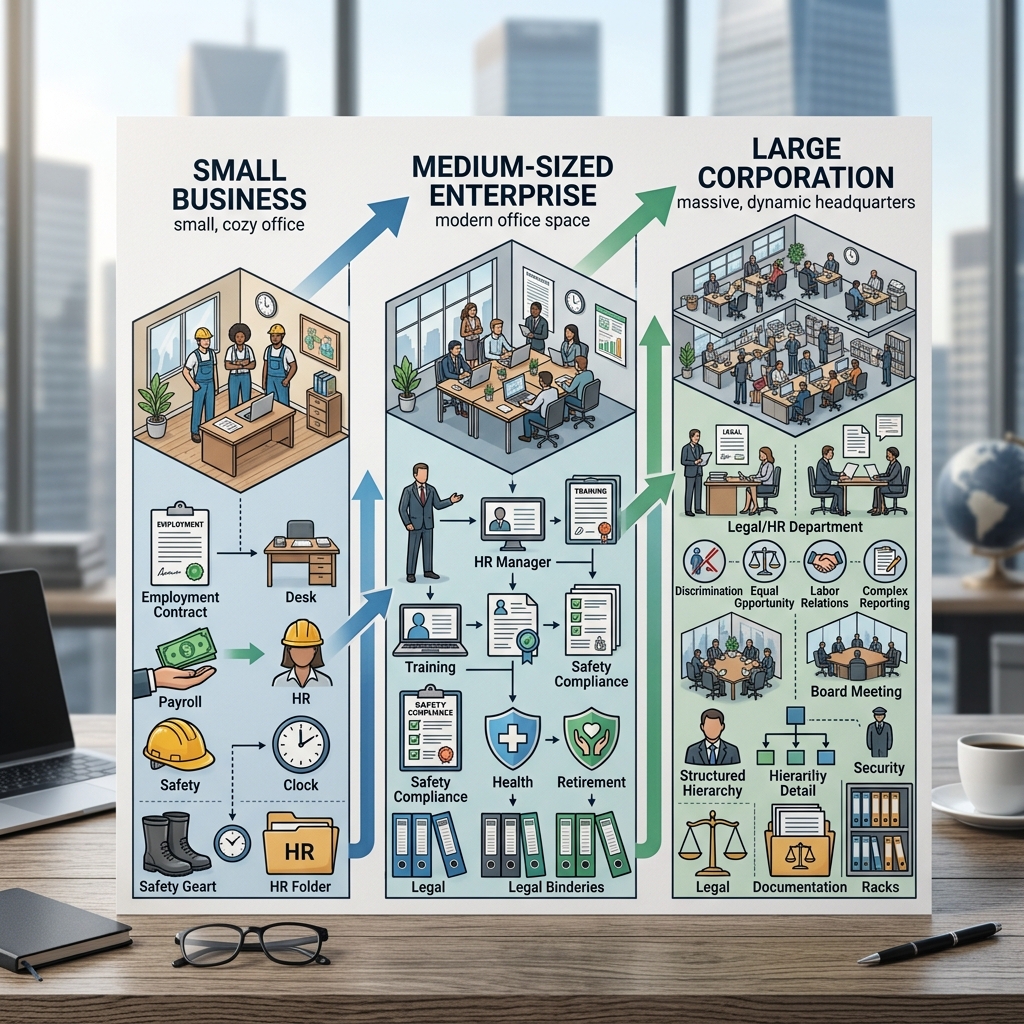
In the United States, the number of employees a business has is one of the most important factors in determining which employment laws apply. Many federal protections are triggered only when an employer reaches specific headcount thresholds, while some rules apply from the moment the first worker is hired. Understanding these thresholds helps owners and HR professionals plan for compliance and avoid costly penalties.
Why Employee Count Matters in Employment Law
Employment laws are designed to protect workers while balancing the administrative burden on employers of different sizes. To achieve that balance, Congress and regulatory agencies often use employee headcount thresholds to decide:
- Whether a law applies at all to a particular employer
- What type of reporting and documentation is required
- Which benefits or leave protections must be made available
- When anti-discrimination and equal opportunity rules become enforceable
As a result, growing from 10 to 15 employees, or from 49 to 50 employees, can significantly change a company’s legal obligations.
Core Concepts: Employees, Coverage and Thresholds
Before looking at specific laws, it is helpful to understand three basic concepts used across U.S. employment regulations:
- Employee definition: Many statutes use common-law tests of control to define who counts as an employee, focusing on whether the business directs how and when work is done.
- Coverage thresholds: Laws specify the minimum number of employees an employer must have for the law to apply (for example, 15, 20 or 50 workers).
- Measurement period: Headcount is often measured over a period of weeks or months; for instance, Title VII applies when an employer has at least 15 workers for each working day in 20 or more weeks in the current or previous year.
These details mean that compliance is not just about a single day’s headcount; it requires tracking workforce size over time.
Federal Laws That Apply From the First Employee
Some federal requirements attach as soon as a business hires one employee. These rules set foundational standards for wages, benefits, and equal pay.
Wage and Hour Standards
The Fair Labor Standards Act (FLSA) governs minimum wage, overtime pay, recordkeeping and child labor protections for most U.S. employers. While specific coverage depends on whether the business engages in interstate commerce, the law is broadly interpreted and reaches most organizations that pay employees. Under the FLSA, employers must:
- Pay at least the federal minimum wage to covered, non-exempt workers
- Provide overtime pay of at least one and a half times the regular rate for hours worked over 40 in a workweek
- Maintain accurate records of hours worked and wages paid
- Comply with child labor restrictions designed to protect minors
Equal Pay Obligations
The Equal Pay Act, enforced by the U.S. Equal Employment Opportunity Commission (EEOC), requires employers with at least one employee to provide equal pay for equal work to male and female workers performing substantially similar jobs. This obligation exists even in very small businesses and is a core part of federal anti-discrimination policy.
Other Foundational Rules
Additional laws, such as requirements related to immigration verification and certain benefit plan standards under the Employee Retirement Income Security Act (ERISA), often apply without a specific minimum headcount. Employers that sponsor retirement or health plans must comply with ERISA’s rules on fiduciary duties, disclosures, and reporting, while most employers must complete employment eligibility verification (Form I-9) for new hires.
Key Threshold: 15 or More Employees
One of the most important thresholds in federal employment law is 15 employees. At this level, major anti-discrimination statutes come into play.
Title VII and Basic Anti-Discrimination Protections
For private employers with 15 or more employees, Title VII of the Civil Rights Act prohibits discrimination based on race, color, religion, sex (including pregnancy, sexual orientation and gender identity) and national origin. These employers must avoid discriminatory practices in:
- Recruitment and hiring
- Promotion and advancement
- Compensation and job assignments
- Training, discipline and termination
Title VII also restricts employment policies that disproportionately harm workers in protected groups unless the policy is job-related and necessary for business operations.
Americans with Disabilities Act (ADA)
Employers with 15 or more employees are also generally subject to the Americans with Disabilities Act (ADA)
- Provide reasonable accommodations unless doing so would create an undue hardship
- Refrain from disability-related harassment
- Limit medical inquiries to what is job-related and consistent with business necessity
Genetic Information Protections
The Genetic Information Nondiscrimination Act (GINA) uses the same 15-employee threshold as Title VII. Covered employers may not request or use genetic information (including family medical history) when making employment decisions. This means medical questionnaires and wellness initiatives must be designed carefully to avoid improper collection or use of genetic data.
Key Threshold: 20 or More Employees
When a business reaches 20 employees, additional protections come into force, particularly around age discrimination and, in many cases, continuation of health coverage.
Age Discrimination in Employment Act (ADEA)
The Age Discrimination in Employment Act (ADEA) generally applies to private employers with 20 or more employees and public-sector entities. It protects workers age 40 and older from discrimination based on age in hiring, promotion, compensation, and termination decisions. Covered employers must avoid age-based stereotypes or policies that disadvantage older workers.
Continuation of Health Coverage (COBRA)
Many employers that sponsor group health plans and have at least 20 employees fall under the federal COBRA provisions, which require the offer of temporary continuation of health coverage after certain qualifying events such as job loss or reduced hours. Some plans, such as those sponsored by churches, may be exempt.
Key Threshold: 50 or More Employees
At 50 employees, businesses cross into a higher level of regulatory responsibility. Two major frameworks become especially important: the Family and Medical Leave Act and the Affordable Care Act’s employer shared responsibility rules.
Family and Medical Leave Act (FMLA)
The Family and Medical Leave Act (FMLA) generally applies to private-sector employers with 50 or more employees, as well as public agencies and certain educational institutions. For covered employers, eligible employees are entitled to:
- Up to 12 weeks of unpaid, job-protected leave for qualifying family and medical reasons
- Continuation of group health benefits under the same terms during FMLA leave
- Reinstatement to the same or an equivalent position at the end of leave, with limited exceptions
To comply, employers must track employee eligibility, maintain required notices, and implement procedures for handling leave requests in a non-discriminatory way.
Affordable Care Act (ACA) Employer Responsibilities
Under the Affordable Care Act (ACA), employers with 50 or more full-time equivalent employees may be subject to employer shared responsibility rules. These provisions require applicable large employers to offer affordable, minimum-value health coverage to full-time employees and their dependent children or face potential penalties. Determining whether an organization is an applicable large employer involves calculating full-time equivalents over a lookback period rather than just counting bodies on a single day.
Key Threshold: 100 or More Employees
At 100 employees, employers cross another important reporting threshold. Larger organizations must submit detailed workforce composition data to federal agencies.
EEO-1 Reporting
Employers with 100 or more employees, and certain federal contractors with at least 50 employees and qualifying contract amounts, are required to file an annual EEO-1 Report with the EEOC and the U.S. Department of Labor. This report categorizes employees by race/ethnicity, gender and job category, allowing regulators to monitor patterns and detect potential systemic discrimination. Some entities, such as state and local governments and educational institutions, are exempt from this particular reporting requirement.
At-a-Glance: Major Federal Laws by Employee Count
| Employee Count | Key Federal Laws | Main Obligations |
|---|---|---|
| 1+ | FLSA, Equal Pay Act, ERISA (for covered plans) | Minimum wage, overtime, child labor rules, equal pay for equal work, benefit plan standards. |
| 15+ | Title VII, ADA, GINA | Anti-discrimination and anti-harassment protections; reasonable accommodations for disabilities; limitations on genetic data use. |
| 20+ | ADEA, COBRA (for many health plans) | Protection of workers age 40+ from age discrimination; continuation of health coverage after qualifying events. |
| 50+ | FMLA, ACA employer shared responsibility rules | Unpaid, job-protected family and medical leave; offer of affordable, minimum-value health coverage to full-time employees and dependents. |
| 100+ | EEO-1 reporting | Annual submission of workforce demographics to EEOC and Department of Labor. |
Practical Compliance Steps for Growing Businesses
Because obligations increase as a business grows, owners and HR leaders should adopt proactive strategies to stay ahead of legal thresholds.
Track Headcount and Structure
- Maintain accurate records of full-time, part-time and seasonal employees.
- Monitor headcount trends so you can anticipate when you will cross key thresholds like 15, 20 or 50 employees.
- Consider how mergers, acquisitions or restructuring might affect your status under federal laws.
Review Which Laws Apply
- Use authoritative resources such as guidance from the EEOC, the U.S. Department of Labor, and state agencies to determine which statutes cover your business.
- Recognize that industry, revenue and public versus private status may influence coverage in addition to headcount.
- Consult legal or HR professionals to interpret borderline situations or complex definitions.
Build Policies and Training
- Develop written policies for equal employment opportunity, anti-harassment, wage and hour compliance, leave and accommodations.
- Train managers on their responsibilities under applicable laws, including how to avoid retaliation and discriminatory practices.
- Implement systems for tracking leave, documenting performance, and responding to complaints.
Plan for Long-Term Compliance
- Understand that once you cross a threshold and are covered by a law, obligations are ongoing, not one-time.
- Regularly audit pay practices, benefits and HR procedures to ensure they remain compliant as the workforce changes.
- Stay informed about regulatory updates that may adjust thresholds or add new requirements.
Frequently Asked Questions
Do owners and family members count as employees for these thresholds?
Whether owners and family members count as employees depends on the specific law and their role in the business. Some statutes treat owner-operators differently from traditional employees, while others look primarily at whether the individual is on payroll and subject to the company’s direction. For borderline cases, employers should review the statutory definition of “employee” or seek legal advice.
What happens if my headcount fluctuates above and below a threshold?
Many federal laws assess coverage using a period of weeks or months rather than a single day’s headcount. For example, Title VII typically applies if an employer has 15 or more employees for each working day in at least 20 weeks in the current or preceding year. As a result, temporary dips below the threshold may not remove coverage if the longer-term criteria are still met.
Are small businesses exempt from all discrimination laws?
No. Although major statutes like Title VII and the ADA apply starting at 15 employees, smaller businesses are still subject to laws such as the Equal Pay Act and, in many cases, state or local anti-discrimination rules. Many states have lower thresholds than federal law, so small employers should examine both federal and state obligations.
Does the Affordable Care Act require all employers to offer health insurance?
The ACA’s employer shared responsibility provisions apply only to employers that qualify as applicable large employers, generally those with 50 or more full-time equivalent employees. Smaller employers may choose to offer health benefits but are not subject to the same penalty structure for failing to do so.
How can I quickly find which federal laws apply to my company size?
Charts and summaries provided by organizations such as the Society for Human Resource Management and state workforce agencies can give an overview of federal laws by number of employees. However, these tools are starting points; businesses should confirm the details using official guidance from the EEOC, the U.S. Department of Labor, and other government sources.
References
- Small Business Requirements — U.S. Equal Employment Opportunity Commission. 2023-05-01. https://www.eeoc.gov/employers/small-business/small-business-requirements
- Thresholds for Coverage Under Employment-Related Laws — Texas Workforce Commission. 2022-06-15. https://efte.twc.texas.gov/thresholds_for_coverage.html
- Which Federal Employment Laws Apply to My Company — TIG Advisors. 2021-09-10. https://tigadvisors.com/which-federal-employment-laws-apply-to-my-company/
- Federal Law Breakdown by 1+, 15+, 20+ Employee Threshold — Stratus HR. 2022-04-05. https://stratus.hr/resources/federal-law-breakdown-how-many-employees
- Numbers Matter in Employment Law — Legacy Law Firm PC. 2020-11-12. https://www.legacylawfirmpc.com/blog/numbers-matter-in-employment-law
- Federal Labor Laws by Number of Employees — Society for Human Resource Management (SHRM). 2019-01-01. https://www.shrm.org/content/dam/en/shrm/topics-tools/legal-compliance/Federal-Labor-Laws-by-Number-of-Employees.pdf
Similar Articles








Read full bio of Sneha Tete




