
Employer’s Guide to Sponsoring an H-1B Worker
A practical, step-by-step overview for U.S. employers that want to sponsor skilled foreign professionals for H-1B status.
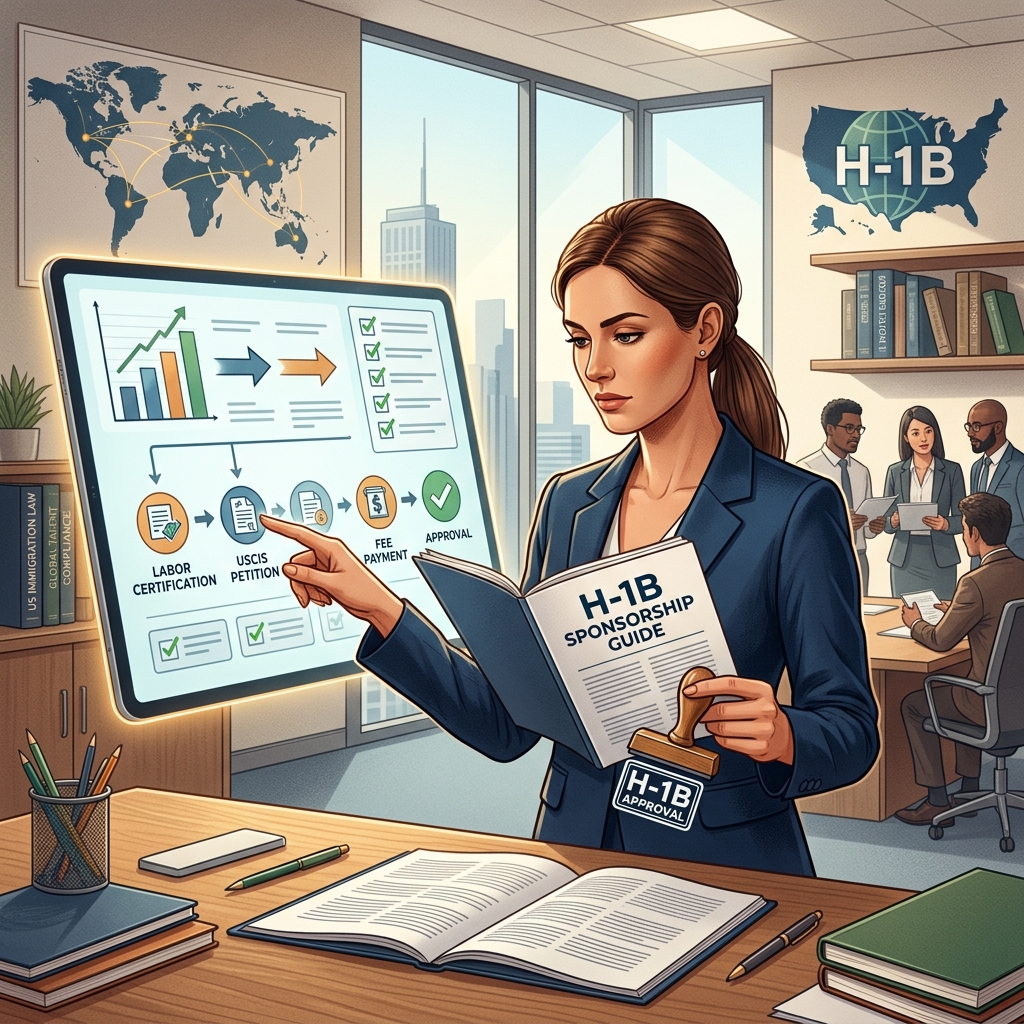
Hiring highly skilled professionals from abroad can be a powerful way to fill talent gaps and grow your business. One of the most common pathways is the H-1B visa, a temporary classification for workers in specialty occupations that require at least a bachelor’s degree or equivalent in a specific field. This guide walks U.S. employers through the major steps, decisions, and compliance obligations involved in sponsoring an employee for H-1B status.
Understanding the H-1B Category
The H-1B classification allows U.S. employers to temporarily employ foreign workers in roles that demand specialized knowledge and at least a bachelor’s degree (or equivalent experience) in a particular discipline. Typical examples include engineers, software developers, financial analysts, and university faculty, but many fields can qualify if the role meets legal standards.
- Specialty occupation: The position must require specialized, theoretical or technical expertise and normally at least a bachelor’s degree in a specific field.
- Employer sponsorship: A U.S. employer or agent serves as the petitioner and offers a valid job to the foreign worker.
- Temporary status: Initial approval is typically up to three years, with possible extensions up to six years in many cases.
Because H-1B is an employer-driven process, businesses must understand both the eligibility requirements and the procedural steps before committing to sponsorship.
Key Pre-Sponsorship Questions for Employers
Before beginning any formal filings, employers should evaluate whether H-1B is appropriate for the role and the candidate. Consider the following questions:
- Does the position qualify as a specialty occupation? The job’s minimum requirements should normally include a specific bachelor’s degree or its equivalent in a specialized field.
- Can the company pay the required wage? H-1B employers must pay at least the prevailing wage or the actual wage paid to similarly situated workers, as certified in the Labor Condition Application (LCA).
- Is the employer cap-subject or cap-exempt? Most private employers are subject to the annual H-1B cap and lottery; certain institutions (for example, higher education or nonprofit research organizations) may be exempt.
- What is the hiring timeline? Because several steps can take months, employers should begin planning at least six months before the desired start date.
Clarifying these points early helps avoid wasted effort, missed deadlines, or non-compliance later in the process.
Overview of the Sponsorship Process
Most H-1B cases follow three major stages as outlined by U.S. agencies:
- Electronic registration with USCIS (for cap-subject petitions).
- Labor Condition Application (LCA) filing and certification with the U.S. Department of Labor (DOL).
- H-1B petition filing (Form I-129) with U.S. Citizenship and Immigration Services (USCIS), followed by consular processing or change of status.
Cap-exempt employers generally skip the lottery registration step and can file the LCA and petition on a more flexible schedule. Cap-subject employers, however, must work within strict government windows.
Cap-Subject vs. Cap-Exempt Employers
Understanding whether your organization is subject to the annual H-1B cap is critical for planning. The cap limits the number of new H-1B approvals each fiscal year and triggers a lottery if demand exceeds the quota.
| Employer Type | Cap Status | Key Implications |
|---|---|---|
| Typical private company | Cap-subject | Must register in the H-1B lottery and can file petitions only if selected. |
| U.S. institution of higher education | Often cap-exempt | Can file H-1B petitions year-round without going through the lottery. |
| Nonprofit research or governmental research organization | Often cap-exempt | Greater flexibility on timing; still must meet all H-1B substantive requirements. |
Employers unsure of their cap status should consult immigration counsel or carefully review federal regulations before planning a new H-1B hire.
Step 1: Electronic Registration for the H-1B Cap
Cap-subject employers must first complete an electronic registration for each prospective H-1B worker. USCIS opens the registration period for a minimum of 14 calendar days each year, typically in March. During this time, employers or their representatives submit basic details about the company and the beneficiary.
- Create a USCIS online account for the company.
- Enter information about each beneficiary, including passport or travel document data.
- Pay the non-refundable registration fee, which is per beneficiary and must be paid before submitting each registration.
Once the registration window closes, USCIS runs the selection process. If the number of registrations exceeds the statutory cap, a lottery is conducted and selected employers are notified via their online accounts.
Step 2: Preparing and Filing the Labor Condition Application (LCA)
Whether cap-subject or cap-exempt, employers sponsoring a worker in a specialty occupation must obtain a certified Labor Condition Application from the U.S. Department of Labor before filing the H-1B petition. The LCA ensures that hiring an H-1B worker will not adversely affect U.S. workers.
Core LCA Obligations
- Pay prevailing wages: Employers must agree to pay at least the prevailing wage for the occupation in the geographic area or the actual wage paid to similarly employed workers, whichever is higher.
- Maintain working conditions: The employer must attest that employing the H-1B worker will not negatively impact the working conditions of similarly employed U.S. workers.
- No strikes or lockouts: The employer must confirm there is no ongoing strike or lockout in the occupational classification at the H-1B worksite.
- Notice to employees: The employer must notify existing employees (for example, by posting notices at the worksite) that an LCA has been filed.
The LCA is filed electronically through DOL’s system and, once certified, must be kept with other required documents in a public access file. This documentation can be inspected by government agencies, so accuracy and recordkeeping matter.
Step 3: Filing the H-1B Petition with USCIS
After the LCA is certified, the employer can prepare and file Form I-129, Petition for a Nonimmigrant Worker, together with the H Classification Supplement and the DOL-certified LCA. For cap-subject cases, this filing is only allowed during the petition window for selected registrations.
Typical Petition Components
- Form I-129 and supplements: Completed forms signed by an authorized company representative.
- DOL-certified LCA: Evidence that wage and working condition attestations have been approved.
- Company documentation: Information about the employer’s operations, such as brochures, annual reports, or business plans, to demonstrate that the position is genuine and the company can pay the offered wage.
- Position details: A detailed job description, minimum requirements (degree and field), worksite location, and offered salary.
- Beneficiary qualifications: Evidence that the worker meets the minimum requirements, such as diplomas, transcripts, and professional licenses.
USCIS reviews the petition and may issue a Request for Evidence (RFE) if additional information is needed. Standard processing can take several months, though employers may choose to pay an additional fee for premium processing, which offers a significantly faster decision.
Timing and Planning Considerations
Successful H-1B sponsorship requires careful scheduling. Universities and institutional offices often recommend starting the process at least six to seven months before the intended employment start date.
- Allow time to evaluate whether the job qualifies as a specialty occupation and gather evidence.
- Build in the DOL’s LCA processing time, which is typically several days but can vary.
- Account for USCIS processing times, which may range from a few months under premium processing to longer periods under standard processing.
For cap-subject cases, employers should also be aware of the broader H-1B calendar: registration in March, petition filing shortly after selection, and typical work authorization beginning on October 1 for newly approved petitions.
Worker Admission and Consular Processing
If the H-1B petition is approved and the prospective worker is outside the United States, they must generally apply for an H-1B visa through a U.S. embassy or consulate before traveling. Once the visa is issued, the worker seeks admission at a U.S. port of entry.
- Consular application: The worker completes the visa application, pays required fees, and attends an interview at a U.S. consular post.
- Entry in H-1B status: With an approved petition and visa, the worker applies for admission through U.S. Customs and Border Protection and, if admitted, can begin employment in H-1B classification.
Workers already in the U.S. in another status may instead seek a change of status as part of the H-1B petition. Employers should clarify the worker’s current immigration situation when planning sponsorship.
Employer Compliance Duties After Approval
Sponsoring an H-1B worker carries ongoing obligations beyond initial approval. The U.S. Department of Labor and USCIS can audit or investigate employers to ensure compliance with wage, working condition, and recordkeeping requirements.
- Maintain wages and hours: Pay the H-1B worker at least the wage listed on the LCA, and ensure working conditions are consistent with those promised.
- Keep public access files: Maintain documents such as the certified LCA, wage rate, and summary of benefits for public inspection.
- Report material changes: Significant changes in job duties, worksite, or salary may require an amended petition and updated LCA.
- Handle terminations correctly: If employment ends early, the employer usually must offer to pay reasonable return transportation costs for the worker’s travel abroad and notify USCIS of the termination.
Good compliance practices protect both the company and the sponsored employee, and reduce the risk of penalties or petition revocations.
Common Issues and Practical Tips
Although every case is unique, certain challenges arise frequently in H-1B sponsorship. Employers can reduce problems with careful preparation.
- Job description too generic: Overly broad or vague duties may lead USCIS to question whether the role is truly a specialty occupation. Provide specific tasks and show how they relate to specialized knowledge.
- Degree and field alignment: USCIS may scrutinize whether the worker’s degree field logically relates to the position. Employers should explain the connection when it is not obvious.
- Wage documentation: Failure to support the offered wage with reliable prevailing wage data or inconsistent company records can generate DOL or USCIS concerns.
- Missed deadlines: Late registrations or petitions are generally rejected. Build internal procedures that track all relevant government windows.
For complex roles, unusual corporate structures, or borderline specialty occupations, consulting with an experienced immigration attorney can be especially valuable.
Employer-Focused FAQs on H-1B Sponsorship
How long can an H-1B employee work for my company?
H-1B status is usually granted for an initial period of up to three years and can often be extended, in most cases, for a total of six years. Certain workers involved in the permanent residence process may qualify for additional extensions under specific rules.
Do I have to participate in the lottery every year for the same worker?
No. Once a worker has been counted against the H-1B cap and holds H-1B status, future extensions or changes of employer generally do not require the lottery, as long as the worker has already been subject to the cap.
Can I sponsor multiple employees at once?
Yes. During the electronic registration period, employers can register several prospective workers, with each registration linked to a specific beneficiary and subject to a separate fee.
Is premium processing available?
USCIS offers premium processing for certain H-1B petitions, which provides a faster decision for an additional fee. Premium processing does not affect the underlying eligibility requirements or the selection process for cap-subject cases.
What happens if my employee is outside the United States?
If USCIS approves the H-1B petition for a worker abroad, the employee usually must apply for an H-1B visa at a U.S. consulate, then seek admission at a port of entry before starting work in the United States.
Can small or startup employers sponsor H-1B workers?
Yes, small businesses can sponsor H-1B employees if they can demonstrate a real need for the position, ability to pay the required wage, and compliance with all regulatory requirements. However, they may face closer scrutiny, so thorough documentation is important.
References
- H-1B Specialty Occupations — U.S. Citizenship and Immigration Services (USCIS). 2024-03-01. https://www.uscis.gov/working-in-the-united-states/h-1b-specialty-occupations
- H-1B Electronic Registration Process — U.S. Citizenship and Immigration Services (USCIS). 2024-03-01. https://www.uscis.gov/working-in-the-united-states/temporary-workers/h-1b-specialty-occupations/h-1b-electronic-registration-process
- H-1B Program — U.S. Department of Labor, Wage and Hour Division. 2023-06-30. https://www.dol.gov/agencies/whd/immigration/h1b
- Think Immigration: The H-1B Nonimmigrant Visa Process — American Immigration Lawyers Association (AILA). 2023-04-10. https://www.aila.org/library/think-immigration-the-h-1b-nonimmigrant-visa-process-key-concepts-and-considerations
- Navigating the H-1B Visa: A Guide for Employers — U.S. Chamber of Commerce. 2022-08-16. https://www.uschamber.com/co/run/human-resources/sponsor-h1b-visas
- Employment-Based Visa Sponsorship Processing Timeline and Planning Guidance (H-1B, O-1, E-3, TN) — Yale University OISS. 2023-05-01. https://oiss.yale.edu/for-departments/inviting-a-scholar/next-steps-for-h-1b/employment-based-visa-sponsorship-processing-timeline-and-planning-guidance-h-1b-o-1-e-3-tn
- H-1B Petition Process — Dartmouth College OVIS. 2022-09-01. https://ovis-intl.dartmouth.edu/immigration/h-1b-employees/h-1b-petition-process
Similar Articles








Read full bio of medha deb




