
Employer Liability for Employee Misconduct
How workplace misconduct can create legal exposure and what employers can do to reduce it.
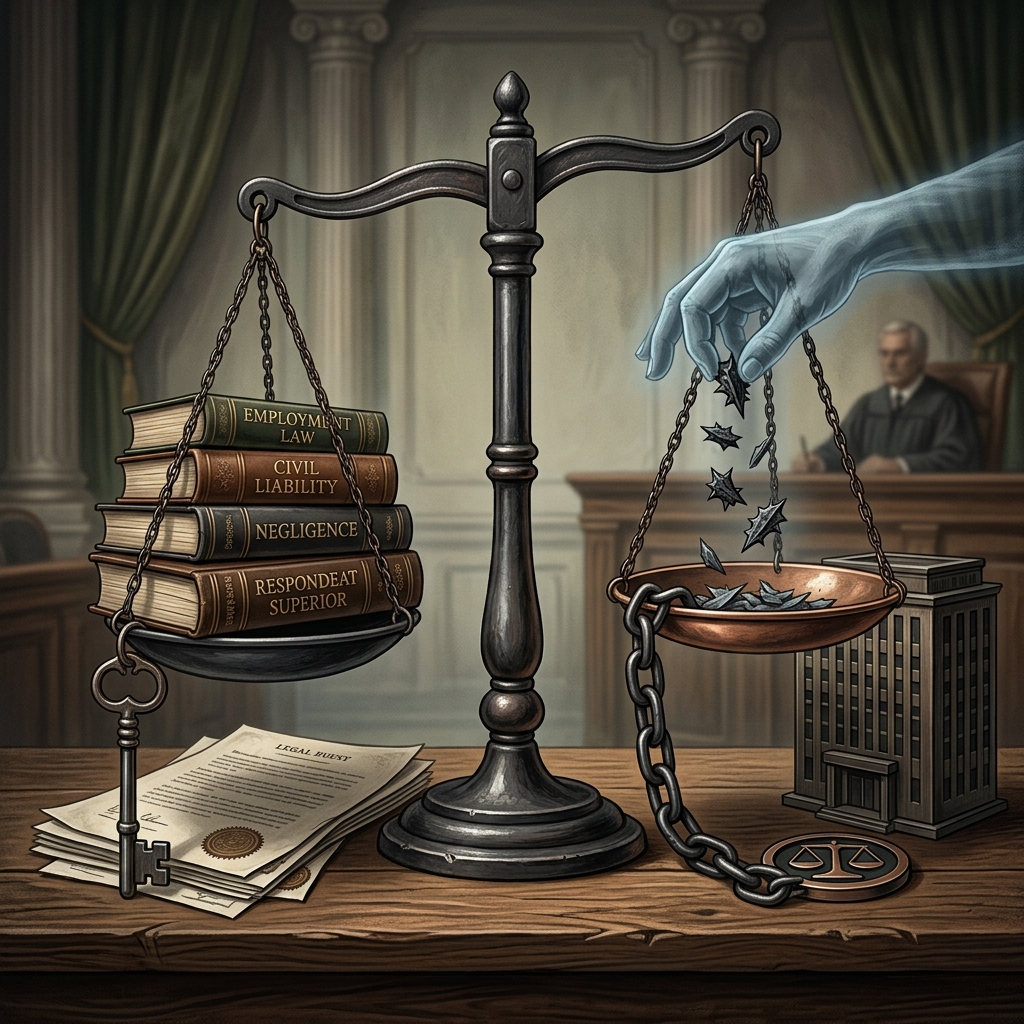
Employee misconduct can create legal trouble for a business even when the employer did not directly commit the bad act. In workplace law, the central question is often not only what happened, but who knew about it, who had authority over the people involved, and how the employer responded once concerns surfaced.
That issue matters because harassment, retaliation, threats, discrimination, and other improper conduct can affect the business itself, not just the person who behaved badly. In many situations, the law looks at whether the employer took reasonable steps to prevent harm and to correct it quickly after learning of a problem.
Why employee misconduct can become the employer’s problem
Businesses often assume that liability follows the individual who caused the harm. In employment law, however, the employer may also be responsible if the wrongdoer acted with supervisory power, if the conduct changed the terms of employment, or if management failed to respond appropriately.
Federal guidance treats workplace harassment as a serious compliance issue because it can undermine equal employment rights and create a hostile work environment. The legal standard depends heavily on the relationship between the harasser and the targeted worker, as well as whether the conduct was connected to a job decision such as termination, demotion, or loss of pay.
When a supervisor’s conduct can trigger liability
Harassment by a supervisor is treated more seriously than the same conduct by a co-worker. According to EEOC guidance, an employer may be vicariously liable when a supervisor’s harassment results in a tangible employment action, such as firing, demotion, or another concrete change in the employee’s status.
If there is no tangible employment action, the employer may still be liable, but it can sometimes raise the Faragher-Ellerth defense. That defense requires the employer to show two things: first, that it acted reasonably to prevent and correct harassment; and second, that the employee unreasonably failed to use available complaint procedures or other protective steps.
What counts as a tangible employment action
A tangible employment action is more than rude behavior or an offensive comment. It is a significant job-related decision that affects the worker’s employment conditions. Examples include termination, demotion, a reduction in pay, or a denial of promotion tied to the harassment.
Importantly, the harmful act does not have to happen at the very start of the harassment. EEOC guidance notes that a tangible employment action may occur at any point during the harassment period, and threats that are never carried out can still be evidence of harassing behavior even if they do not themselves count as a tangible action.
Co-worker misconduct follows a different liability rule
When the harasser is a co-worker rather than a supervisor, the legal standard is usually negligence. Under that approach, the employer is liable only if it knew or should have known about the harassment and failed to take reasonable steps to stop it.
This means that employers are expected to act on actual notice, but they can also be responsible when the facts were obvious enough that management should have understood a problem was developing. In practice, repeated complaints, visible workplace tension, or a pattern of inappropriate conduct can create constructive notice.
Why notice matters so much
Notice is the turning point for many harassment claims. Once management receives a complaint, hears rumors from reliable sources, or observes conduct that suggests a hostile environment, the employer’s duty to respond is triggered. A delayed, vague, or incomplete response can increase liability because the law expects corrective action that is prompt and reasonable.
That duty is not limited to isolated incidents. EEOC guidance explains that an employer’s corrective efforts must be adequate for the size, scope, and seriousness of the reported problem. If harassment is systemic, the response has to be broad enough to address the larger pattern, not just a single complaint.
How non-workers can also create risk
Workplace misconduct does not always come from a company employee. Customers, vendors, contractors, temporary workers, and other non-employees can also create harassment risk. In those situations, the employer’s liability usually turns on whether it knew or should have known about the conduct and failed to take appropriate corrective action.
This is especially important in environments where employees interact with the public or with outside labor providers. A company may not have complete control over every visitor or contractor, but it still has a responsibility to respond when outside conduct creates a hostile atmosphere for employees.
| Harasser | Typical liability approach | Key question |
|---|---|---|
| Supervisor | Vicarious liability, with limited defenses in some cases | Did the conduct lead to a tangible employment action? |
| Co-worker | Negligence standard | Did the employer know or should it have known, and did it respond reasonably? |
| Customer, vendor, contractor, or other non-worker | Usually negligence-based | Did management take prompt steps after learning of the problem? |
What a reasonable employer response should look like
A company reduces its risk when it can show a real system for prevention and correction. That means more than having a handbook in a drawer. It includes a policy that is communicated to employees, a complaint process that people can actually use, and a response process that works when allegations arise.
Preventive steps matter because they can support a defense if harassment occurs. Corrective steps matter because they show the employer did not ignore the problem. Together, these measures help demonstrate that management acted reasonably under the circumstances.
- A clear anti-harassment policy that covers supervisors, co-workers, and outside actors.
- Multiple reporting channels so employees are not forced to complain only to one manager.
- Prompt, neutral investigation procedures for complaints and witness statements.
- Follow-up measures to monitor whether misconduct stops after the complaint.
- Training for supervisors so they understand how to recognize and escalate issues.
Why policies alone are not enough
A written policy helps, but it does not automatically shield a business from liability. Courts and enforcement agencies focus on how the policy works in practice. If employees do not understand the complaint process, if managers ignore reports, or if complaints are routinely handled by people with conflicts of interest, the policy may have little value.
Training also matters. Workers need to know what conduct is prohibited and how to report it, while supervisors need to know that they have an obligation to escalate concerns rather than quietly resolve them on their own. A policy without enforcement can leave the employer exposed even if the document itself looks complete.
The role of HR and management in preventing liability
Human resources teams and front-line managers are often the first people who can stop a problem from becoming a lawsuit. Their actions shape whether the employer is seen as responsive or indifferent. Once a complaint is raised, management should document what it learned, what steps it took, and why those steps were reasonable.
That record can be critical if a claim later arises. In many disputes, the employer’s best defense is proof that it investigated promptly, took the complaint seriously, and used a response proportional to the allegations. Without that record, the company may struggle to show it acted in good faith.
Special issues in joint employment and outsourced workplaces
Some workplaces involve more than one employer. Staffing agencies, franchisors, subcontractors, and host companies can all share responsibility in the right circumstances. Liability often depends on who controlled the worker’s daily tasks, who had authority to investigate complaints, and who could take corrective action.
When multiple entities are involved, each one should not assume the other will handle a complaint. If one employer knows about the misconduct and fails to act, or if both employers contribute to the problem through inconsistent policies, both may face exposure.
Common mistakes that increase exposure
Many employers create unnecessary risk by reacting slowly or inconsistently. A delayed investigation can allow the hostile environment to continue. A response that treats a serious complaint as a minor personality conflict can also backfire. So can retaliation against the complaining worker, even if the original complaint is later found to be unsubstantiated.
Another common error is failing to separate the investigation from the chain of command. When the alleged harasser or someone closely tied to that person controls the process, employees may be less willing to cooperate and the employer may be unable to show fairness.
- Ignoring repeated complaints because the conduct seems “personal” rather than legal.
- Allowing the accused supervisor to investigate the complaint alone.
- Waiting for more evidence instead of taking immediate interim steps.
- Assuming a hostile environment claim is harmless because no one was fired.
- Failing to address misconduct by customers or contractors.
Practical steps for reducing legal risk
Employers lower their exposure when they create a culture in which complaints are expected, received, and addressed. That starts with a policy, but it must continue with training, credible reporting channels, and consistent enforcement. The goal is not just legal compliance; it is preventing repeat harm and demonstrating responsible management.
Businesses should also review whether their complaint process works for different kinds of workers, including remote staff, temporary workers, and employees on customer sites. A process that is easy to use for office staff may fail in a warehouse, restaurant, construction, or staffing-agency setting if it is not adapted to the reality of the workplace.
Frequently asked questions
Can an employer be liable even if it did not know about the misconduct?
Yes, in some situations. If the harasser is a supervisor and the conduct results in a tangible employment action, liability may follow even without prior notice. In other cases, if the employer should have known about the conduct and failed to act, negligence-based liability can still apply.
Does a complaint have to be formal for the employer to be on notice?
No. Notice can come from many sources, including informal complaints, observations by management, and patterns of conduct that make misconduct reasonably apparent. Once the employer has actual or constructive notice, it must respond reasonably.
Can a customer’s conduct create liability?
Yes. If customer or non-employee conduct is severe enough to create a hostile environment, employers may face liability when they know or should know about it and do not take appropriate corrective action.
What is the best defense to a harassment claim?
The strongest defense usually combines strong prevention efforts with a prompt and documented response. Employers should show that they had a real policy, trained personnel, offered a workable complaint process, and acted quickly when concerns arose.
Does every hostile workplace create liability?
No. The conduct must be serious enough to implicate legal standards under employment law. But when harassment affects working conditions, job status, or the overall environment, employer liability can arise if the business failed to meet its legal obligations.
References
- EEOC Enforcement Guidance on Workplace Harassment: Liability — Jackson Lewis. 2024. https://www.jacksonlewis.com/insights/eeoc-enforcement-guidance-workplace-harassment-liability
- Employer Liability for Employee Harassment Explained — Mitchell Kline. 2024. https://www.mitchellkline.com/can-an-employer-be-liable-for-a-workers-harassing-behavior/
- When is an Employer Liable for Harassment? — Moon Law Group. 2024. https://www.moonlawgroup.com/faqs/when-is-an-employer-liable-for-harassment/
- Legalities of Sexual Harassment in the Workplace — Tulane Law Online. 2024. https://online.law.tulane.edu/blog/legal-truths-sexual-harassment
- Guard Against Legal Pitfalls: HR’s Personal Liability Explained — SHRM. 2024. https://www.shrm.org/topics-tools/employment-law-compliance/guard-against-legal-pitfalls-hr-personal-liability
- Harassment — U.S. Department of Labor. 2024. https://beta.dol.gov/policy-regulations/pay-benefits/employment-rights/nondiscrimination/harassment
- Joint Employees and Harassment: Who Is Responsible? — Freed Law Firm. 2024. https://www.freedlawfirm.com/blog/joint-employees-and-harassment-who-is-responsible
Similar Articles








Read full bio of Sneha Tete




