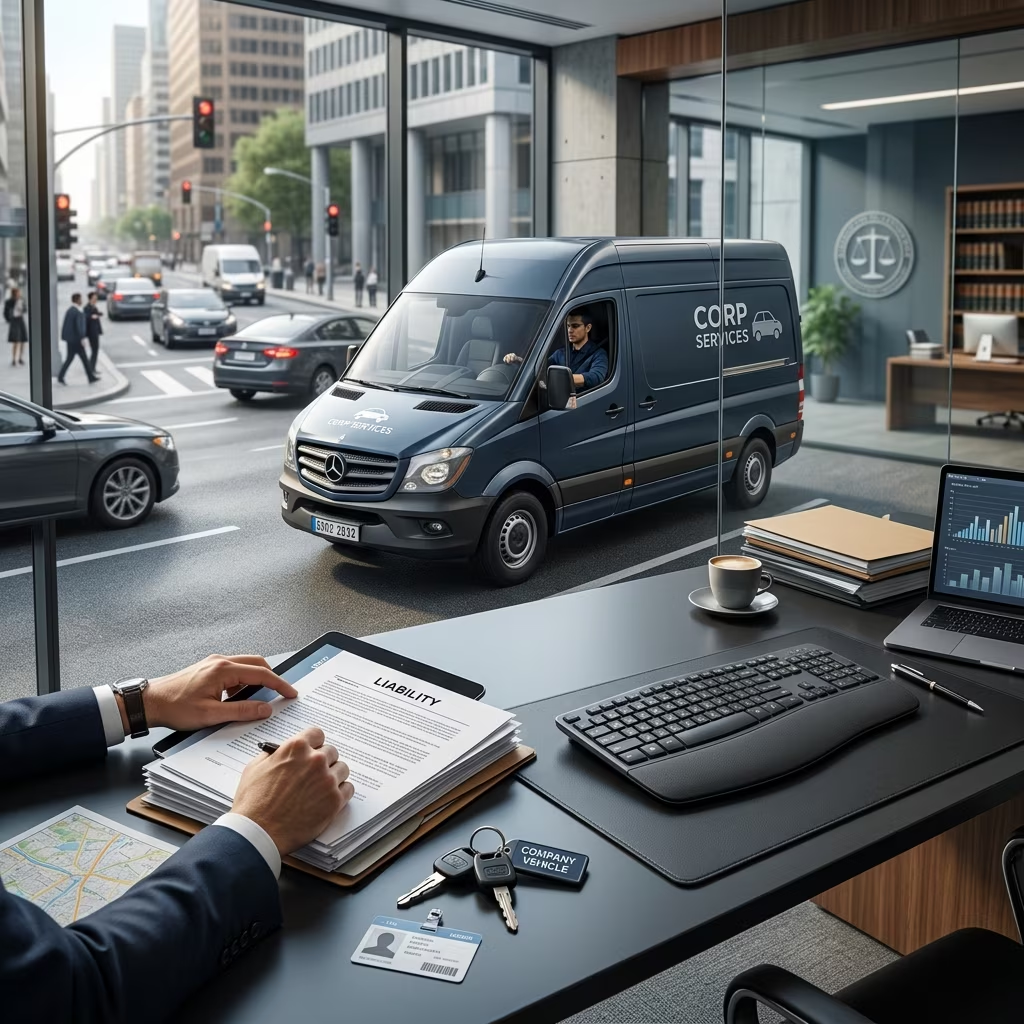
Any time an employee gets behind the wheel to perform a job-related task, your business may be pulled into the legal and financial consequences of a crash. Understanding when a company is responsible for an employee’s driving, and how insurance and policies should be structured, is essential risk management for every employer.
This article explains the core legal concepts, breaks down common driving scenarios, and offers practical steps you can take to reduce exposure and protect both your business and your workers.
1. Why Employer Liability Matters When Employees Drive
Employers in the United States can be held responsible for harm caused by employees who are acting in the course of their work duties, including while operating vehicles for business purposes. This is not limited to company-owned cars. Liability can also attach when workers drive their own vehicles but are running errands or trips that benefit the employer.
For small businesses, a single serious auto accident can:
- Trigger lawsuits seeking compensation for injuries, property damage, and lost wages.
- Increase liability and auto insurance premiums for years.
- Disrupt operations if key employees are injured or a vehicle is totaled.
- Damage your reputation with customers and the community.
Because vehicle accidents are a major source of liability claims, regulators and insurers consistently emphasize that small businesses must consider auto risks in their overall insurance and safety planning.
2. Key Legal Concept: Vicarious Liability and Scope of Employment
The foundation for employer responsibility in driving cases is the doctrine commonly referred to as vicarious liability (often expressed in Latin as respondeat superior). Under this doctrine, an employer can be held legally responsible for an employee’s negligent act if it occurs within the employee’s job duties.
2.1 What “Scope of Employment” Typically Means
Courts look at whether the employee was acting to further the employer’s business, or performing a task the employer reasonably expected or directed. Typical factors include:
- Was the task part of the employee’s job role or assigned by a supervisor?
- Did the employer benefit from the trip (for example, sales, deliveries, banking)?
- Did the trip occur during work hours or while the employee was on call?
- Was the employee using a route and method reasonably connected to the assignment?
If the answer to these questions is “yes,” there is a strong chance the trip will be considered within the scope of employment, and the employer may share liability if an accident occurs.
2.2 When Employers Are Usually Not Responsible
There are limits to vicarious liability. Employers generally are not responsible when workers are engaged in purely personal activities, even if they are employees. Common examples include:
- Driving to a private social event on the weekend.
- Running personal errands unrelated to work during off-hours.
- Taking a vacation road trip in the employee’s own car.
However, if a personal errand mixes with a work task (for example, stopping at the bank for business on the way home), the analysis becomes more complex and fact-specific.
3. Company Vehicles vs. Personal Vehicles Used for Work
Liability questions often turn on whose vehicle is involved. The core legal theory may be the same, but the insurance and financial consequences can differ significantly depending on whether the vehicle is owned by the business or the employee.
| Scenario | Who Owns Vehicle? | Primary Liability Risk | Typical Primary Insurance |
|---|---|---|---|
| Driving on assigned business trip | Company | Employer faces direct and vicarious liability | Business auto policy |
| Employee uses personal car for client visit | Employee | Employer may be vicariously liable for third-party injuries | Employee’s auto policy first; non-owned auto coverage may apply |
| Employee commuting to regular workplace | Employee | Normally no employer liability (coming-and-going rule) | Employee’s auto policy |
| Employee running personal errand only | Employee | Generally no employer liability | Employee’s auto policy |
3.1 Use of Company-Owned or Leased Vehicles
When the vehicle belongs to the business, there is usually a direct connection between the company and the accident. In addition to vicarious liability for the driver’s negligence, the employer can face claims for:
- Negligent maintenance (for example, failing to repair brakes or lights).
- Negligent entrustment (allowing an unsafe or unlicensed driver to operate the vehicle).
- Failure to train or supervise drivers adequately.
A properly structured business auto insurance policy is the primary layer of protection for these risks. Many small-business insurance guides emphasize that auto coverage is a core component of a comprehensive risk-management program.
3.2 Employee-Owned Vehicles Used for Business Tasks
Employees frequently use their own vehicles for activities that benefit the employer, such as visiting customers, transporting equipment, or going to the bank. Legally, these trips can still fall within the scope of employment, so the employer may be sued along with the driver if an accident occurs.
In these situations:
- The employee’s personal auto insurance is usually the first source of coverage for injured third parties.
- If damages exceed the employee’s policy limits, the injured party may pursue the employer, and the employer’s non-owned auto or umbrella coverage may be triggered.
- The employer still faces workers’ compensation exposure if the employee is injured during a work-related trip, regardless of who owns the vehicle.
4. The Coming-and-Going Rule and Other Common Scenarios
Not every trip an employee makes in a vehicle is considered work-related for liability purposes. Courts and insurers commonly apply several practical rules and exceptions.
4.1 Commuting: The Coming-and-Going Rule
Most states recognize a general principle that employers are not liable for accidents that occur while an employee is commuting to or from their regular place of work, known as the “coming-and-going rule.” The reasoning is that the commute is typically viewed as a personal responsibility, even if the employee must travel to be at work.
However, there are notable exceptions, such as:
- The employee is paid for travel time or provided with a company vehicle specifically for commuting.
- The employee is required to transport tools, equipment, or products as part of their job.
- The employee makes a special trip at the employer’s request (for example, traveling directly to a client site instead of the office).
4.2 Mixed-Purpose Trips: Business and Personal
Employees often combine business tasks with personal errands, which can complicate liability. For instance, an employee may stop at the post office for company mail on the way to a personal appointment. Courts may analyze exactly when the business purpose began and ended, and who primarily benefited from each portion of the trip.
Employers cannot fully eliminate this gray area, but clear policies and training can help reduce confusion about when employees are officially “on the job” while driving.
4.3 Remote and Mobile Workers
As remote work and mobile roles expand, more employees are using vehicles outside a traditional office commute. Employees who regularly drive between home, coworking spaces, job sites, and clients may blur the line between personal and business driving. The same basic tests apply—whether the travel is primarily for the employer’s benefit and within assigned duties—but the fact patterns can be more complex, making documentation and insurance even more important.
5. Insurance Coverages That Address Driving Risks
Understanding which policies respond after a crash is crucial. While coverage varies by insurer and jurisdiction, the following types of insurance are commonly involved in work-related auto accidents.
5.1 Business Auto Insurance
A business auto policy provides liability coverage for vehicles owned, leased, or sometimes hired by the company. It typically covers:
- Injuries and property damage to third parties caused by covered vehicles.
- Legal defense costs for claims and lawsuits.
- Physical damage to company-owned vehicles (if collision/comprehensive coverage is included).
Small-business insurance guides from state regulators emphasize that auto coverage is an essential component of property and casualty insurance for many enterprises.
5.2 Hired and Non-Owned Auto Coverage
When employees drive their personal vehicles or rented cars for business, the company may still face vicarious liability, even though it does not own the vehicles. To address this, many insurers offer:
- Hired auto coverage for vehicles the business rents or borrows.
- Non-owned auto coverage for vehicles owned by employees but used for company business.
These coverages usually act as excess liability, kicking in after the driver’s personal policy if damages exceed their limits. For businesses with employees who frequently use their own vehicles, these policies are a critical backstop.
5.3 Workers’ Compensation
Workers’ compensation coverage applies when an employee is injured in the course of employment, which can include work-related driving. If the injury arises out of a business task, the employee may be eligible for:
- Medical expense coverage.
- Partial wage replacement.
- Disability benefits depending on the severity of the injury.
5.4 Umbrella and Excess Liability Policies
An umbrella or excess liability policy provides additional limits beyond primary general liability and auto policies. For businesses concerned about large verdicts or severe accidents, especially involving multiple injured parties, an umbrella policy can offer an extra layer of protection if a catastrophic claim exhausts primary coverage.
6. Practical Steps to Reduce Liability and Protect Your Business
Legal doctrines and insurance policies are only part of the picture. Proactive risk management dramatically reduces the likelihood and severity of claims involving employees who drive for work. Guidance from business organizations and insurers highlights several best practices employers should consider.
6.1 Screen and Monitor Drivers
Before assigning any employee to drive for business purposes, employers should conduct reasonable due diligence.
- Verify a valid driver’s license appropriate for the vehicle type.
- Review motor vehicle records (MVRs) at hiring and at regular intervals.
- Set clear eligibility criteria (for example, maximum number of moving violations or at-fault accidents).
- Document reviews and any corrective actions taken.
6.2 Establish a Written Vehicle Use Policy
A written policy, included in the employee handbook and acknowledged by drivers, should address at least the following:
- When employees are permitted to use personal vehicles for work.
- Safety rules (seat belts, speed, impaired driving, and mobile phone use).
- Accident reporting requirements, including immediate notification to the employer.
- Insurance requirements and minimum liability limits for employee-owned vehicles.
- Maintenance expectations for personal vehicles used for business.
- Consequences for violating the policy.
6.3 Set Insurance Requirements for Employee-Owned Vehicles
Because the employee’s policy is often the first line of defense when they use their own car for work, employers should require evidence of adequate insurance.
- Require proof of current personal auto insurance before approving business use.
- Set a minimum liability limit that exceeds state minimums where feasible.
- Request updated proof of insurance at least annually.
- Keep copies of insurance documents and inspection certificates in personnel files.
6.4 Training and Safety Culture
Policies are more effective when coupled with training and a culture that emphasizes safe driving. Consider:
- Periodic reminders about distracted driving, speed, and fatigue.
- Clear bans on texting, handheld phone use, and driving under the influence while on company time.
- Encouraging employees to report vehicle issues or near-misses without fear of retaliation.
- Reviewing serious incidents to identify root causes and preventive measures.
6.5 Clarify Reimbursement and Expense Policies
When employees use personal vehicles for work, employers frequently reimburse mileage or specific expenses. Guidance for small businesses notes that clearly stated reimbursement practices help avoid disputes and demonstrate that the employer has considered the costs of business driving.
- State the mileage reimbursement rate and what it is intended to cover (fuel, wear and tear, insurance costs, etc.).
- Explain how to submit mileage logs or receipts.
- Clarify whether the company will assist with deductibles or repairs after a work-related accident, if at all.
7. Frequently Asked Questions
Does employer liability apply if the employee was using their own car?
Yes, it can. If the employee was performing a job-related task that benefits the employer, the company may face vicarious liability even when the employee drives their own vehicle. The employee’s personal auto policy is typically primary, but the employer can still be sued and may rely on non-owned auto or umbrella coverage.
Is a business responsible if an employee causes an accident during their commute?
Generally, no. Under the coming-and-going rule, commuting to and from the regular workplace is normally treated as a personal activity, so employers are not liable for accidents during the commute. Exceptions can arise if the employee is on a special mission for the employer or is required to transport work equipment.
What should an employer do immediately after learning about an employee’s accident?
Employers should ensure any injuries are addressed, require the employee to report the accident to their auto insurer, notify the company’s insurance carrier, document the circumstances, and follow internal reporting protocols. In serious cases, consulting legal counsel early helps manage liability and evidence preservation.
Can a company shift all responsibility to the employee through a contract?
An employer cannot completely contract away vicarious liability to third parties injured by an employee’s negligence. Internal agreements may allocate some costs between employer and employee, but they do not usually prevent injured third parties from pursuing the business if the accident occurred within the scope of employment.
Do small businesses always need non-owned auto coverage?
Not every business has the same risk profile, but if any employees drive their personal vehicles for work—such as visiting clients, making deliveries, or going to the bank—many insurers and risk advisors recommend at least considering non-owned auto coverage as part of a broader insurance program. A qualified insurance professional can help assess whether it is appropriate for your operations.
References
- Driving on Company Time — FindLaw. 2024-01-05. https://www.findlaw.com/smallbusiness/liability-and-insurance/driving-on-company-time.html
- Are Employers Liable for Employees Driving Personal Cars? — Embark Safety. 2022-08-15. https://www.embarksafety.com/blog/are-employers-liable-for-employees-driving-personal-cars/
- Using Personal Vehicles for Work: What’s the Employer’s Liability? — BlueLion, LLC. 2023-06-01. https://bluelionllc.com/using-personal-vehicles-for-work-whats-the-employers-liability/
- Employer Liability for Personal Vehicle Use for Work — Axcet HR Solutions. 2023-04-10. https://blog.axcethr.com/employer-liability-when-employees-use-personal-cars-for-work-purposes
- Using Personal Vehicles for Work: What You Need to Know — U.S. Chamber of Commerce CO. 2024-02-20. https://www.uschamber.com/co/run/human-resources/can-employees-use-their-own-vehicles-for-work
- How Employee-Owned Vehicles Can Impact Your Business Insurance — Gannon Associates Insurance. 2026-01-31. https://gannonassociates.com/2026/01/31/how-employee-owned-vehicles-can-impact-your-business-insurance/
- Information for Small Businesses — New York State Department of Financial Services. 2023-09-01. https://www.dfs.ny.gov/consumers/small_businesses
- When Is a Driver’s Employer Responsible for Their Accident? — GGW&M Law Office. 2022-11-18. https://www.ggwmlawoffice.com/blog/when-is-a-drivers-employer-responsible-for-their-accident/