
Employer Identification Numbers: A Practical Guide for Small Businesses
Understand when your business needs an EIN, why it matters for taxes and banking, and how to apply quickly and correctly.
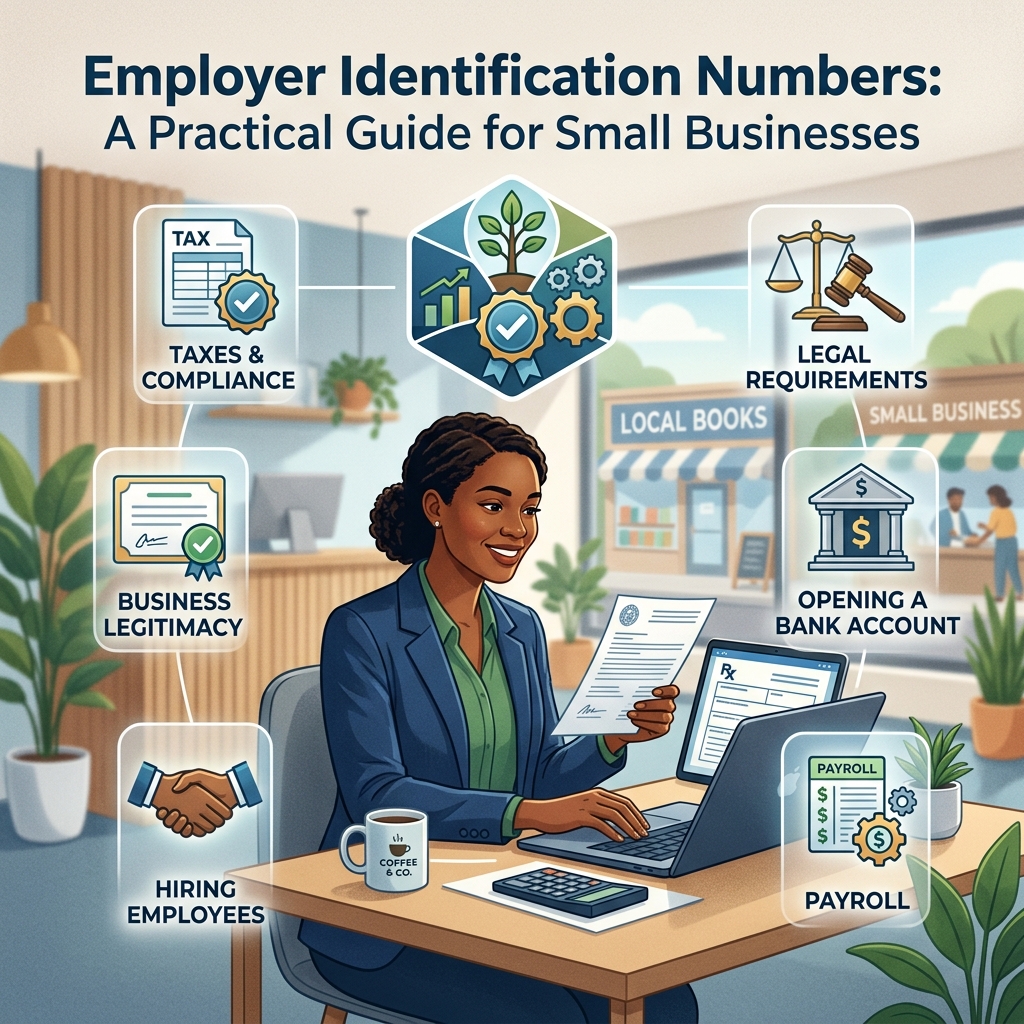
An Employer Identification Number (EIN) is more than just a nine-digit code; it is the federal tax identity of your business in the United States. Many small business owners encounter the term when opening a bank account, hiring their first employee, or filing initial tax forms and discover they cannot move forward without one. This guide explains in clear, practical terms what an EIN is, when you need it, how to get it, and how to avoid common mistakes that can create headaches with the Internal Revenue Service (IRS) and financial institutions.
What Exactly Is an Employer Identification Number?
An Employer Identification Number is a unique nine-digit number assigned by the IRS to identify the tax accounts of employers and certain other entities. It is formatted as XX-XXXXXXX and acts as the federal tax ID for your business. In many ways, an EIN functions like a Social Security number does for an individual, but it is used for business tax and reporting purposes.
The IRS and other agencies use your EIN to:
- Track federal tax filings and payments for your business.
- Connect payroll, employment, excise, and other business tax returns to the correct entity.
- Identify your business for certain compliance and information reporting requirements, such as forms issued to independent contractors or financial institutions.
Businesses use their EIN when they:
- Open business bank or brokerage accounts.
- Apply for licenses, permits, and some business registrations.
- Register for state tax accounts and employer accounts.
- Work with vendors and customers who require a tax ID for reporting.
When Does a Business Need an EIN?
Not every business is legally required to obtain an EIN, but many are, and some find it beneficial even when it is optional. The IRS identifies several situations where an EIN is necessary.
Clear Triggers That Require an EIN
| Situation | Does Your Business Need an EIN? | Why |
|---|---|---|
| You have one or more employees. | Yes | Employment taxes and payroll reporting must be connected to a federal tax ID. |
| Your business is a partnership or corporation. | Yes | These entities file separate business tax returns and cannot use an owner’s SSN alone. |
| You operate an LLC with more than one member. | Yes, in most cases | Multi-member LLCs are generally treated as partnerships or corporations for tax purposes. |
| You file employment, excise, or alcohol, tobacco and firearms tax returns. | Yes | Those returns require a business EIN for tracking. |
| You withhold taxes on income (other than wages) paid to non-resident aliens. | Yes | Withholding and information reporting must be tied to a tax ID. |
| You maintain certain retirement plans for yourself or employees. | Yes | Some qualified plans require an EIN for reporting. |
Entities That Commonly Need an EIN
According to IRS guidance, an EIN is used by a wide range of entities beyond conventional businesses.
- Employers paying wages to staff.
- Sole proprietors with employees or who file certain business tax returns.
- Partnerships of any kind.
- Corporations, including S corporations.
- Limited liability companies (LLCs), particularly multi-member LLCs.
- Nonprofit organizations recognized for tax-exempt status.
- Trusts and estates that file separate tax returns.
- Certain specialized entities such as cooperatives, real estate mortgage investment conduits, and retirement plans.
Do Sole Proprietors and Single-Member LLCs Always Need an EIN?
Sole proprietors and single-member LLCs often wonder whether they must obtain an EIN, particularly when they are just starting and have no employees. The answer depends on how the business is structured and what activities it undertakes.
Situations Where an EIN May Not Be Mandatory
If you operate as a sole proprietor or a single-member LLC taxed as a disregarded entity and you:
- Have no employees, and
- Do not file excise, employment, or specialized business tax returns,
then you may be able to use your individual Social Security number (SSN) instead of an EIN for federal tax filings. However, banks, vendors, or state agencies may still require an EIN for their own purposes, even if the IRS does not.
Reasons Sole Proprietors Choose to Get an EIN Anyway
Many one-person businesses decide to obtain an EIN voluntarily because:
- They prefer not to disclose their SSN on business forms, invoices, or to vendors for privacy and security reasons.
- Financial institutions often ask for an EIN to open a business account or lines of credit.
- Using an EIN can help separate personal and business finances, reinforcing limited liability and good accounting practices.
- They anticipate hiring employees or converting to a partnership or corporation in the near future.
Why an EIN Matters Beyond Tax Filing
While taxes are the central purpose of an EIN, the number plays a broader role in the life of a small business.
Banking and Financial Relationships
Banks and credit unions commonly require an EIN before opening a dedicated business account or issuing a business credit card. Lenders and investors may also ask for the EIN during underwriting or due diligence. This allows them to:
- Verify the legal existence and structure of the business.
- Check tax compliance status when appropriate.
- Ensure they are dealing with an entity separate from the owner’s personal finances.
Licenses, Permits, and Registrations
State and local agencies often require an EIN when issuing:
- Sales tax permits or seller’s certificates.
- Professional and occupational licenses for regulated fields.
- Local business operation permits and employer accounts.
The EIN becomes a central identifier when interacting with state tax authorities and compliance systems.
Working With Contractors, Vendors, and Platforms
Businesses that pay independent contractors or receive reports from payment processors may use their EIN on information returns instead of a personal SSN. This can reduce exposure of personal data and help keep tax documentation consistent.
How to Apply for an EIN: Step-by-Step
The IRS provides several methods to obtain an EIN, and there is no fee when applying directly with the government. The simplest option for most U.S.-based small businesses is the online EIN application.
Application Methods for U.S.-Based Businesses
- Online application: Use the IRS online tool to answer structured questions and receive an EIN immediately upon approval.
- Fax application: Complete Form SS-4 and fax it to the appropriate IRS number; the IRS will reply with your EIN, typically within a few business days if you include a fax number.
- Mail application: Mail Form SS-4 to the address matching your location; processing takes longer and is best suited to non-urgent situations.
Special Rules for Businesses with a Principal Place of Business Outside the U.S.
Entities whose main business location is outside the United States can apply by phone or by submitting Form SS-4 via fax or mail to dedicated IRS contacts. This allows international organizations with U.S. tax obligations to obtain an EIN even if they cannot use the domestic online system.
Information You Will Need Before Applying
The IRS application process requires specific details about the business and its responsible party. To avoid delays and session timeouts in the online system, gather the following before you begin:
- Legal name of the business or entity.
- Trade name or “doing business as” name, if different.
- Mailing address and, where applicable, physical business address.
- Type of entity (sole proprietorship, partnership, corporation, LLC, nonprofit, trust, estate, etc.).
- Reason for applying (starting a new business, hiring employees, banking, compliance requirements, etc.).
- Responsible party’s name and taxpayer ID (often the owner or primary officer who manages funds and assets).
- Date the business started or acquired, and the closing month of its accounting year.
Common Application Pitfalls to Avoid
Small business owners can run into avoidable problems when applying for an EIN. To minimize issues:
- Apply directly on the official IRS site or using IRS forms, not through third-party services that charge unnecessary fees.
- Use consistent business names and addresses across formation documents, license applications, and the EIN request.
- Make sure the person listed as the responsible party has the authority to act for the business and can provide their taxpayer ID.
- Avoid duplicate applications; creating more than one EIN for the same entity can complicate tax records.
Using and Maintaining Your EIN Correctly
Once you receive an EIN, it stays with the business for its lifetime in most circumstances. Proper use and maintenance are vital for clean tax and compliance records.
Where to Use Your EIN
After obtaining your EIN, you should use it consistently on:
- Federal business tax returns and related schedules.
- Employment tax forms, including those for payroll and withholding.
- Information returns, such as forms issued to contractors or financial institutions when your business is the filer.
- Applications for state and local tax accounts and employer registrations.
- Business bank, credit, and merchant accounts.
What Happens If Your Business Changes
Certain changes in the form or ownership of your business may require notifying the IRS or, in some cases, obtaining a new EIN. Examples include:
- Transforming a sole proprietorship into a corporation or partnership.
- Adding partners to a previously sole-owned business, changing its tax classification.
- Creating a new corporation from an existing entity.
The IRS publishes detailed rules on when a new EIN is required, and it is wise to consult those rules or a qualified advisor when contemplating major structural changes.
Frequently Asked Questions About EINs
Is an EIN the same as a Taxpayer Identification Number (TIN)?
No. A Taxpayer Identification Number is a broad term that includes several identifiers, such as Social Security numbers and Employer Identification Numbers. An EIN is one specific type of TIN used for businesses and certain entities.
Can a business have more than one EIN?
Generally, a single entity should have only one EIN. Multiple EINs for the same business can cause confusion in IRS records and may trigger correspondence or compliance issues. Separate entities—such as distinct corporations or trusts—each need their own EIN.
Is there a fee to obtain an EIN?
No. The IRS issues EINs free of charge when you apply through official channels. If a service provider offers to obtain an EIN for a fee, you are paying for their assistance, not for the number itself.
How quickly can I get my EIN?
For online applications on the official IRS site, the EIN is typically issued immediately after the application is successfully submitted and approved. Fax and mail applications take longer because they require manual processing and response.
Can I use my EIN for state tax accounts?
Yes. Many states ask for your federal EIN when you register for employer accounts, sales tax, or other business tax programs. The state will also assign its own numbers, but the EIN helps link state and federal records.
What if I lose or misplace my EIN?
If you misplace your EIN, it can often be found on prior tax returns, notices, or bank documents. The IRS also provides a Business and Specialty Tax Line that businesses can call to retrieve their EIN after verifying identity.
Key Takeaways for Small Business Owners
- An EIN is the federal tax identity for your business and is required in many common situations, especially when you hire employees or form entities other than a sole proprietorship.
- Even when the IRS does not strictly require an EIN, banks, vendors, and state agencies may, and obtaining one can enhance privacy and financial separation.
- The IRS offers multiple ways to apply, including a fast online tool. Applying directly through official channels avoids unnecessary fees and delays.
- Once issued, your EIN should be used consistently on tax forms and official documents, and you should understand when major changes require communication with the IRS.
References
- Understanding Your EIN — Internal Revenue Service. 2024-01-01. https://www.irs.gov/pub/irs-pdf/p1635.pdf
- Employer Identification Number (EIN) — Internal Revenue Service. 2024-02-15. https://www.irs.gov/businesses/employer-identification-number
- Get Federal and State Tax ID Numbers — U.S. Small Business Administration. 2023-09-10. https://www.sba.gov/business-guide/launch-your-business/get-federal-state-tax-id-numbers
- Employer Identification Number (EIN): Everything You Need to Know — Square, Inc. 2023-06-20. https://squareup.com/us/en/the-bottom-line/starting-your-business/what-is-an-employer-identification-number
- What’s an EIN Number and Do I Need One? — The Hartford. 2022-11-01. https://www.thehartford.com/business-insurance/strategy/business-taxes/employer-identification-number
Similar Articles








Read full bio of Sneha Tete




