
Employer Guide to Michigan Workers’ Compensation Duties
A practical, plain‑language roadmap to Michigan workers’ compensation obligations, coverage rules, and claims handling for employers.
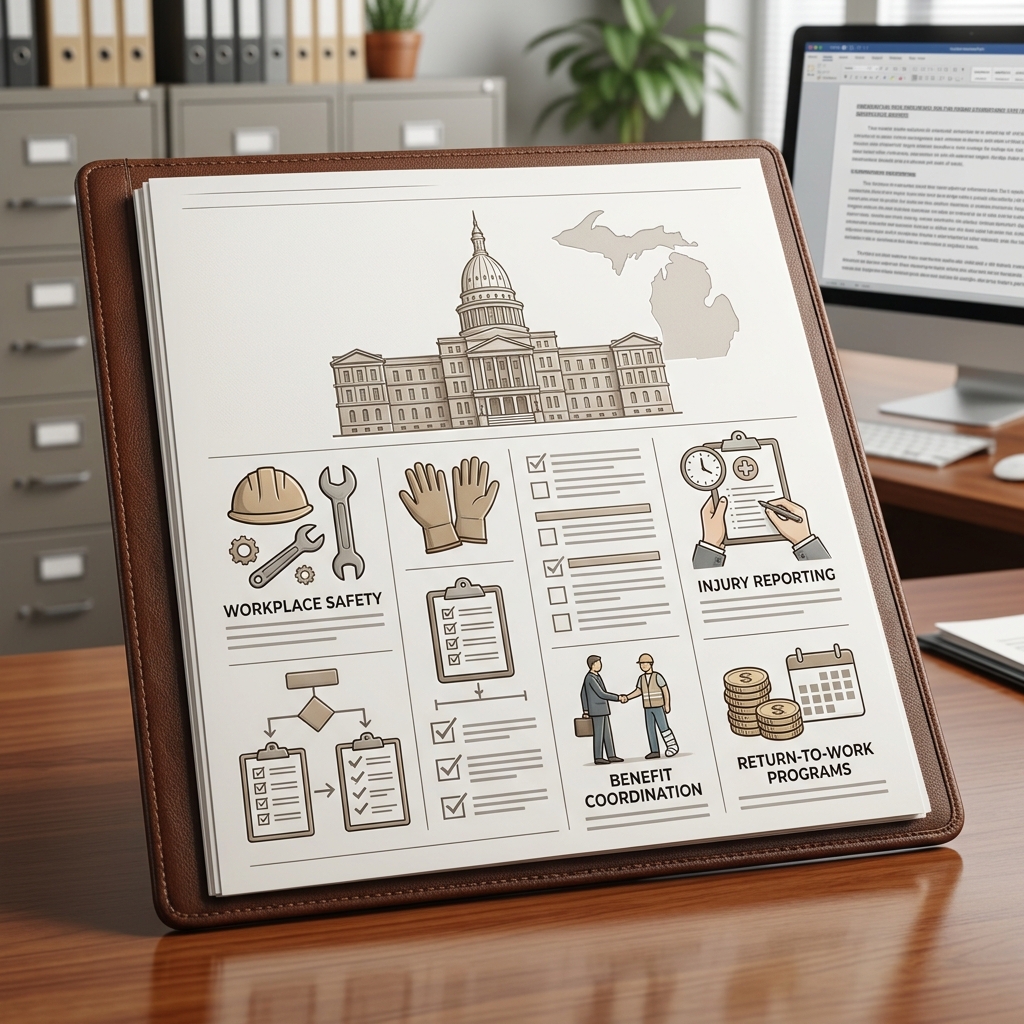
Michigan’s workers’ compensation system is designed to protect both employees and employers when a worker is injured or becomes ill due to their job. Workers receive medical care and wage replacement benefits, while employers gain protection from most civil lawsuits related to workplace injuries. Understanding how this system works is essential for every Michigan employer, regardless of size.
This guide explains who must carry workers’ compensation insurance, what happens when an employee is injured, and how to manage claims, benefits, and disputes under Michigan law, using practical steps and employer-focused strategies.
1. Core Principles of Michigan Workers’ Compensation
Michigan workers’ compensation is a no‑fault system, meaning employees generally receive benefits for work‑related injuries or occupational diseases regardless of who caused the incident. In exchange, workers’ compensation is usually the employee’s exclusive remedy against the employer for covered injuries.
Under the Michigan Workers’ Disability Compensation Act (often abbreviated as WDCA), compensation is provided for disability or death arising from work‑related injuries or diseases. Michigan is a wage‑loss compensation state, so weekly benefits are tied to the worker’s lost earning capacity rather than a fixed schedule for every injury.
| Key Feature | What It Means for Employers |
|---|---|
| No‑fault system | Benefits may be payable even if the employer or co‑workers did nothing wrong; fault is typically not litigated. |
| Exclusive remedy | Employees generally cannot sue the employer in tort for work‑related injuries covered by the Act, reducing litigation exposure. |
| Wage‑loss focus | Weekly benefits are based on a percentage of the worker’s after‑tax average weekly wage, subject to limits. |
| Work‑related requirement | Compensation applies only where the injury or disease arises out of and in the course of employment. |
2. Which Michigan Employers Must Carry Coverage?
Most private employers in Michigan are required to purchase workers’ compensation insurance. State law sets clear thresholds for when coverage is mandatory.
2.1 Coverage Thresholds
An employer must typically carry workers’ compensation insurance in Michigan if it meets either of the following conditions:
- Three or more employees at any time, whether full‑time or part‑time; or
- One or more employees working 35 hours or more per week for 13 weeks or longer during the year.
Once an employer meets these criteria, coverage must be in place for all eligible employees, not just those working full‑time.
2.2 Employees vs. Non‑Employees
Almost anyone hired to perform services for pay is considered an employee for workers’ compensation purposes, but there are notable exceptions.
- Some farm workers may be exempt from coverage requirements.
- Independent contractors are generally not covered, provided the relationship is legitimately structured and documented.
Misclassifying employees as independent contractors can expose an employer to penalties and liability if an injury occurs, so it is important to correctly determine worker status.
2.3 Why Compliance Matters
Maintaining required workers’ compensation coverage is not optional. If an employer fails to carry insurance when required, it may face civil penalties, criminal consequences, and direct liability for workplace injuries that would otherwise be covered by insurance. In addition, uninsured employers lose much of the protective value of the exclusive‑remedy rule.
3. Understanding Covered Injuries, Illnesses, and Misconduct
Workers’ compensation does not apply to every health issue that arises while someone is employed. Employers need a basic understanding of what qualifies as a work‑related condition and when benefits may be denied.
3.1 Work‑Related Requirement
To qualify for workers’ compensation benefits, an injury or occupational disease must arise out of and in the course of employment. This generally means:
- The condition was caused, contributed to, or aggravated by the work performed.
- The injury occurred while the employee was engaged in job duties or activities reasonably related to the job.
- Travel, off‑site work, or remote locations may be covered if the job requires the employee to be there.
Illnesses or injuries entirely unrelated to the job, or arising during activities purely personal in nature, typically fall outside the system.
3.2 Intentional and Willful Misconduct
While Michigan’s system is no‑fault, benefits may be denied when the injury results from the worker’s intentional and willful misconduct. Examples can include deliberate violations of safety rules, intentionally self‑inflicted harm, or extreme behavior undertaken with disregard for known risks.
Employers should document policy violations carefully and communicate safety rules in writing, as the burden of proving intentional misconduct can be significant.
4. Employer Duties When a Workplace Injury Occurs
The first hours and days after an injury are crucial. Prompt action helps the injured worker receive care and protects the employer’s legal position.
4.1 Immediate Steps at the Time of Injury
When an employee is hurt or becomes suddenly ill on the job, employers should ensure that the following steps occur, consistent with state guidance:
- Ensure safety and medical care – Assist the worker in obtaining emergency or urgent medical treatment as needed.
- Promptly receive notice – Encourage employees to immediately notify a supervisor when an injury or illness occurs.
- Document the event – Record the date, time, place, witnesses, and circumstances of the incident.
- Preserve evidence – Secure relevant equipment, photographs, or video footage, if available, especially for serious incidents.
Even minor injuries should be reported and documented, as symptoms can worsen over time and late reporting may create disputes.
4.2 Designating Medical Providers
In Michigan, the employer or its workers’ compensation insurer may designate a medical provider for the first 28 days of treatment following a work‑related injury. After this 28‑day period, the employee generally has more freedom to choose their own doctor.
Employers should make policies clear about:
- Which clinics or physicians are authorized for initial treatment.
- How employees should schedule appointments after reporting an injury.
- Who receives medical reports and work‑status notes.
4.3 Reporting to the State and Insurer
Michigan law requires employers to report certain injuries and begin the claims process within established time frames.
- If it appears the worker will miss more than one week of work, the employer must file an Employer’s Basic Report of Injury with the Workers’ Disability Compensation system and decide whether to begin payments or deny the claim.
- The law requires prompt payment of benefits when a claim is accepted; the first payment is due on the 14th day after the employer has notice or knowledge of disability or death.
- All compensation accrued should then be paid weekly, and a benefit check is considered late only after 30 days past the due date.
Failing to file timely reports or begin payment when required can lead to enforcement actions and additional liability.
5. Time Limits and Benefit Basics
Michigan workers’ compensation law includes clear time frames for notice, claim filing, and the start of wage‑loss payments. Employers should be familiar with these rules to avoid disputes and penalties.
5.1 Notice and Claims Deadlines
- Employees should notify their employer of a work‑related injury or illness within 90 days.
- Claims for compensation generally must be made within two years of the injury.
Although the worker has up to two years to file, employers benefit from encouraging immediate reporting so that facts are fresh and medical treatment begins promptly.
5.2 Waiting Period and Weekly Benefits
Michigan law includes a seven‑day waiting period before wage‑loss benefits begin. Key points for employers and employees include:
- No weekly wage‑loss compensation is paid if disability lasts fewer than seven days.
- If disability continues beyond one week, benefits are payable from the eighth day after the injury.
- If disability lasts for at least 14 days, the worker may receive benefits retroactively for the first week as well.
Weekly wage‑loss benefits are typically calculated as about 80% of the worker’s after‑tax average weekly wage, subject to a maximum rate. Employers should coordinate closely with their insurer or third‑party administrator to ensure accurate calculations.
6. Managing Claims, Disputes, and Hearings
Not every claim proceeds smoothly. Some injuries may raise questions about causation, coverage, or the extent of disability. Employers must balance skepticism about questionable claims with their duty to treat injured workers fairly.
6.1 When a Claim Is Accepted
If the employer or insurer accepts the claim, the focus shifts to monitoring medical treatment and the worker’s capacity to return to work.
- Track medical restrictions and explore light duty or modified work that fits the employee’s capabilities.
- Maintain open communication with the employee about anticipated recovery timelines.
- Ensure wage‑loss payments and medical bills are processed promptly and accurately.
6.2 When a Claim Is Disputed
If an employer or insurer disputes compensability, degree of disability, or other elements, Michigan’s system provides formal processes for resolution.
- An employee whose claim is disputed may file an Application for Mediation or Hearing with the Agency (for example, using form WC‑104A).
- Depending on case facts, the Agency may schedule a mediation or a hearing before a workers’ compensation magistrate.
- Employers should be prepared to present documentation, witness testimony, and medical evidence to support their position.
Reasonable disagreements can be resolved through mediation, but contested claims may proceed to trial‑like hearings, where decisions are made based on the evidence presented.
7. Employer Best Practices for Compliance and Risk Management
Beyond legal minimums, employers can adopt practical strategies to reduce workplace injuries and control workers’ compensation costs.
7.1 Build a Strong Reporting Culture
- Train supervisors to recognize and respond to injury reports consistently.
- Encourage employees to report all incidents, near misses, and symptoms promptly.
- Use simple reporting forms and ensure workers understand how to access them.
Prompt reporting aligns with Michigan’s notice requirements and helps employers fulfill their duty to report serious injuries to the Agency.
7.2 Coordinate with Your Insurer
- Review your policy’s requirements for claim reporting and medical provider networks.
- Maintain updated contact information for claims adjusters and nurse case managers.
- Ask for periodic claim reviews to identify trends and opportunities to improve safety.
Insurers are often a key resource for understanding evolving legal standards and best practices related to workers’ compensation.
7.3 Focus on Safety and Return‑to‑Work
- Implement written safety programs and conduct regular training tailored to job tasks.
- Investigate every injury and use findings to prevent similar incidents.
- Develop a formal return‑to‑work program that offers modified duties when medically appropriate, which can reduce wage‑loss exposure.
Michigan law expects injured workers receiving benefits to seek jobs reasonably available that fit their post‑injury abilities, especially if the original employer cannot accommodate restrictions. Employers who proactively offer suitable work can often decrease the duration and cost of claims.
8. Frequently Asked Questions for Michigan Employers
FAQ 1: Do I need workers’ compensation insurance if I only have part‑time employees?
Yes, you may. Michigan’s coverage rules look at how many employees you have and whether at least one works long‑term full‑time hours, not just whether workers are part‑time. If you have three or more employees at any time, even if they are part‑time, or if you have one employee working 35+ hours per week for 13 weeks or more, you are generally required to carry workers’ compensation coverage.
FAQ 2: What if an employee waits months to report an injury?
Employees should provide notice of a work‑related injury or illness within 90 days. Late reporting can make it harder to investigate the claim and may contribute to disputes. Employers should still document the report, gather facts, and coordinate with their insurer to determine whether the claim is compensable under the Act.
FAQ 3: Are injuries during business travel covered?
They can be. If travel is a required part of the employee’s job and the injury occurs while the worker is engaged in work‑related activities, the condition is often considered to arise out of and in the course of employment. Each case is fact‑specific, so employers should carefully document circumstances and consult with their carrier when a travel‑related incident occurs.
FAQ 4: How much will my employee receive in weekly benefits?
Michigan is a wage‑loss compensation state. Weekly benefits for most injuries are generally about 80% of the employee’s after‑tax average weekly wage, subject to a statutory maximum. Your insurer or claims administrator will calculate the precise benefit based on payroll data, tax status, and applicable limits.
FAQ 5: What happens if we do not have required coverage?
An employer that fails to carry workers’ compensation insurance when required risks civil fines, potential criminal penalties, and direct liability for workplace injuries. Without coverage, you may have to pay benefits out of pocket, and you may lose some of the protections that normally shield insured employers from lawsuits.
9. When to Seek Legal or Professional Advice
Although many routine claims can be handled through your insurer’s processes, certain situations warrant consultation with experienced professionals:
- Complex questions about whether a condition is work‑related.
- Claims involving alleged intentional and willful misconduct.
- Disputes proceeding to hearings before a workers’ compensation magistrate.
- Issues related to classification of workers as employees or independent contractors.
Working with legal counsel or specialized advisors can help employers navigate contested claims, avoid missteps, and maintain compliance with the Michigan Workers’ Disability Compensation Act.
References
- Michigan Workers’ Compensation Laws — FindLaw. 2023-05-01. https://www.findlaw.com/state/michigan-law/michigan-workers-compensation-laws.html
- Michigan Workers’ Comp Insurance Laws — WorkersCompensationShop.com. 2022-08-10. https://www.workerscompensationshop.com/insurance-states/michigan/information
- An Overview of Workers’ Compensation Benefits — Michigan Legal Help. 2023-04-15. https://michiganlegalhelp.org/resources/employment/overview-of-workers-compensation-benefits
- Rights and Responsibilities — State of Michigan, Department of Labor and Economic Opportunity. 2021-01-01. https://www.michigan.gov/leo/-/media/Project/Websites/leo/Documents/WDCA-RESOURCES-AND-REPORTS/Publications/wca_WCPUB001.pdf
- Workers’ Compensation — State of Michigan Civil Service Commission. 2022-03-01. https://www.michigan.gov/mdcs/disability-gateway/dmo-home/wc
- Michigan Workers Compensation Rules — Lee Steinberg Law Firm. 2022-09-01. https://www.1800leefree.com/workers-compensation/rules
Similar Articles








Read full bio of medha deb




