
Employer vs. Employee: Who Owns Workplace Inventions?
Understand how law, contracts, and workplace realities decide whether an employer or an employee owns new ideas and inventions.
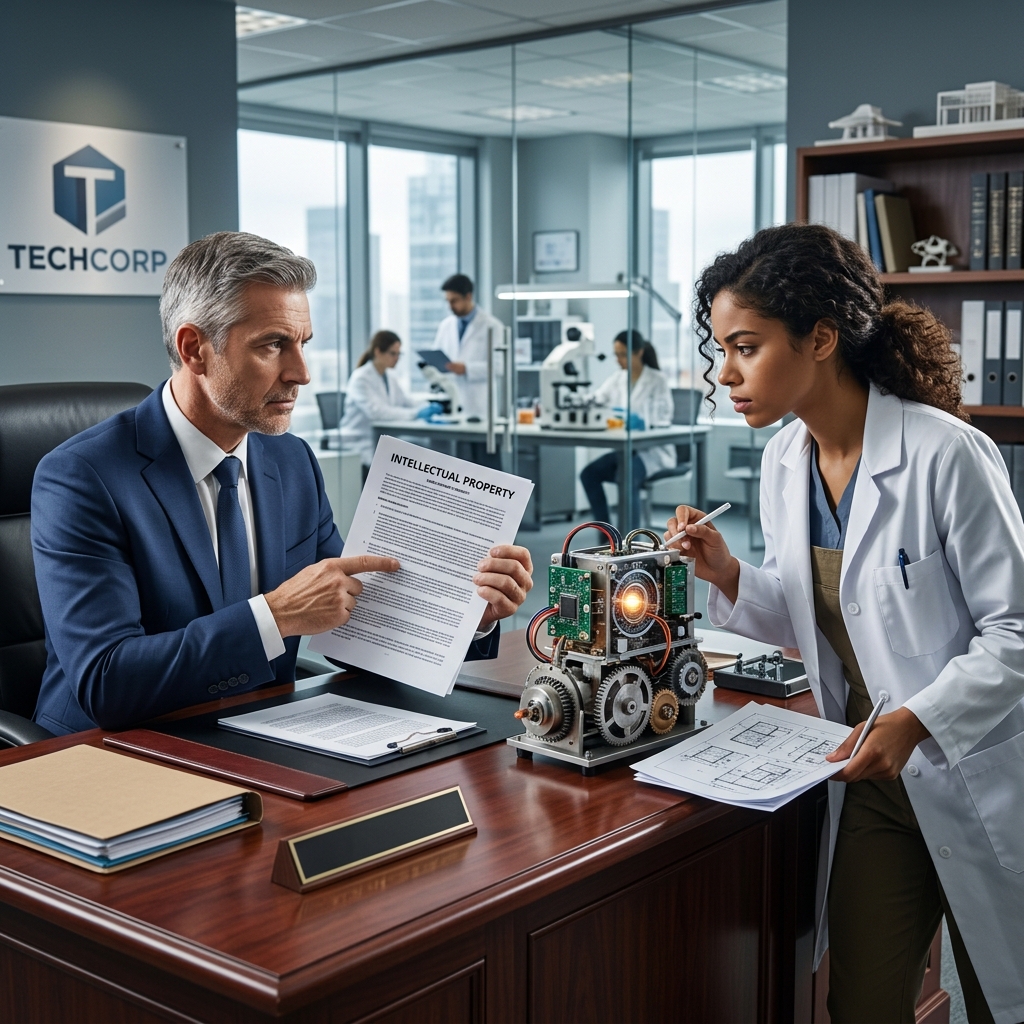
When a new product, software tool, or process is developed in the workplace, the immediate question is often: who owns it — the employer or the employee who came up with the idea? The answer depends on a mix of patent law, employment contracts, and in some states, specific employee invention statutes. Understanding these rules is crucial for both sides of the employment relationship.
This guide explains the core legal concepts that govern ownership of workplace inventions, how written agreements change the default rules, what happens when inventions are created on personal time, and practical steps employers and employees can take to protect their interests.
Key Concepts in Employer–Employee Invention Ownership
Before examining specific situations, it helps to understand a few foundational principles that structure most disputes over employee inventions.
- Inventor ownership as a default – Under U.S. patent law, the inventor is the initial owner of patent rights, unless those rights are transferred by contract or by operation of specific legal doctrines.
- Assignment agreements – Employers often require employees to sign written contracts assigning all workplace inventions (and sometimes even off-duty inventions) to the company.
- Hired-to-invent rule – If an employee is employed specifically to invent or solve a defined technical problem, ownership may shift to the employer even in the absence of a detailed written assignment, though a written assignment is still strongly recommended.
- Shop rights doctrine – In certain situations, even if the employee keeps patent ownership, the employer can obtain a nonexclusive, royalty-free license to use the invention in its business.
- State statutes limiting agreements – Many states restrict how far employers can go in claiming ownership of inventions created entirely on the employee’s own time and without company resources.
Default Rules: Who Owns an Invention Without a Contract?
If there is no written agreement assigning inventions, courts apply default rules rooted in patent law and common law doctrines.
| Scenario (No Written Assignment) | Typical Default Outcome |
|---|---|
| Employee creates an invention unrelated to job duties, without employer resources | Employee usually owns the invention outright. |
| Employee is clearly hired to invent or solve a specific technical problem | Employer may be deemed the owner or have a strong claim, especially if paid to invent. |
| Employee uses significant employer facilities or funds to develop invention | Employee may own the patent, but employer often gains a shop right to use it. |
| Invention is created fully off-duty, without employer tools or trade secrets | Employee usually owns it, subject to any valid contractual claims and state law limits. |
In general, simply being an employee does not automatically give the employer ownership of the employee’s patentable inventions. Something more — such as a contract, a hired‑to‑invent role, or use of employer resources — is usually required.
Assignment Agreements: The Most Important Ownership Tool
Most technology-focused employers do not rely on default rules. Instead, they use written invention assignment agreements to clarify and shift ownership of employee inventions.
Common Features of Invention Assignment Clauses
While wording differs by employer and jurisdiction, many agreements include:
- Present assignment language – Wording that the employee “hereby assigns” rather than merely promising to assign future inventions, which helps ensure immediate transfer of rights when an invention is created.
- Scope of covered inventions – Provisions that cover inventions made during employment that relate to the employer’s business, research, or development activities.
- Disclosure obligations – Requirements that employees promptly disclose new inventions to the company to evaluate ownership and protection strategies.
- Cooperation duties – Obligations to sign additional documents (such as patent assignments and declarations) to perfect the employer’s ownership and support patent filings.
- Confidentiality and trade secret clauses – Restrictions on sharing or using company confidential information, which can indirectly affect ownership disputes.
Well-drafted assignment clauses dramatically reduce the likelihood of uncertainty, but they must also comply with state laws that protect off-duty inventions.
Hired to Invent: When Job Duties Drive Ownership
Even without a detailed assignment, some employees are effectively paid to invent. Courts recognize that when a person is employed specifically to design, develop, or invent certain types of technology, the resulting invention may belong to the employer under an implied or express obligation.
Indicators that an employee was hired to invent include:
- Job title and description clearly centered on research, design, or invention.
- Explicit expectations that the employee will solve a particular technical problem or develop a specific product.
- Performance metrics tied to creating new technology or filing patents.
- Compensation or bonuses linked to invention or innovation milestones.
Even in these cases, legal advisors strongly recommend capturing ownership through written assignments, because courts can differ on what counts as being hired to invent and on whether an implied assignment exists.
Shop Rights: When the Employer Can Use an Employee-Owned Invention
Sometimes an employee retains patent ownership, but the employer has invested resources or allowed the invention to be developed on company time. In these situations, courts may grant the employer a shop right — a nonexclusive, royalty-free license to use the invention in the employer’s business.
Characteristics of Shop Rights
- They usually arise when the employee uses employer equipment, facilities, or funds to create the invention.
- The employer may use the invention internally without paying royalties, but typically cannot assign or sell the right separate from the business itself.
- The employee still owns the patent and can enforce it against others, subject to the employer’s shop right.
Shop rights are equitable — they are grounded in fairness to the employer that supported development — and they can exist even without a written agreement. However, because they are limited and can be fact-intensive to prove, many employers prefer explicit assignments.
Off-the-Clock Inventions: How Far Can Employers Reach?
A particularly sensitive area involves inventions created on the employee’s own time, away from the workplace and without company tools. Many states have laws that restrict an employer’s ability to claim ownership of such inventions.
Typical State Law Approach
Statutes in several states, such as North Carolina and others, generally provide that provisions requiring assignment of inventions do not apply when the employee:
- Develops the invention entirely on personal time,
- Does not use employer equipment, supplies, facilities, or trade secrets, and
- Creates technology that does not relate to the employer’s business or its actual or demonstrably anticipated research or development, and does not result from work performed for the employer.
Where the invention does relate closely to the employer’s business or results from the employee’s job tasks, the employer may still have a legitimate ownership claim — and recent laws can shift the burden of proof to the employer to establish that connection.
Restrictions on Overbroad Assignment Clauses
Some states prohibit overly broad clauses that purport to assign every invention an employee creates during employment, regardless of when and how it was developed. Under these laws, provisions that reach beyond business-related inventions developed with employer input or resources can be unenforceable as a matter of public policy.
Employers therefore must tailor assignment clauses to comply with local statutes, and employees should understand that not all sweeping contract language is legally valid.
Intellectual Property Types: Patents vs. Copyrights at Work
Ownership analysis differs depending on whether the creation is a patentable invention (e.g., a device, process, or composition) or a copyrightable work such as code, documentation, or marketing content.
| IP Type | Typical Workplace Ownership Rule |
|---|---|
| Patentable inventions | Inventor initially owns the rights, subject to assignment agreements, hired‑to‑invent doctrine, and shop rights in favor of the employer. |
| Copyrightable works (e.g., code, manuals, designs) | Works created by an employee within the scope of employment are often treated as “works made for hire,” so the employer is the default owner. |
Because many technical employees create both patentable inventions and copyrightable materials (for example, novel algorithms and the code that implements them), employment agreements often address both regimes explicitly.
Best Practices for Employers
Employers that invest in innovation should adopt clear policies and agreements that align with federal patent law and applicable state statutes. Legal guidance is particularly important for multi-state employers whose workforce may be governed by different state laws.
Practical Steps to Protect Employer Rights
- Use clear, present-tense assignment language in employment and contractor agreements to ensure inventions are automatically assigned when created.
- Define the scope of covered inventions as those related to the business or anticipated research, rather than attempting to claim everything an employee creates.
- Incorporate disclosure procedures so employees report all potentially relevant inventions, enabling timely evaluation and patent filings.
- Address IP in exit processes by reiterating ongoing obligations and confirming that assignments and disclosures are up to date.
- Ensure compliance with state statutes that protect off-duty inventions, revising generic or template agreements that may be overbroad.
Regular training for managers and technical staff on confidentiality, use of company resources, and invention reporting also helps avoid later disputes over ownership.
Best Practices for Employees and Independent Contractors
Employees, especially those in engineering, research, and software development roles, should be proactive about understanding how their work may be treated under IP law and their contracts.
Steps Employees Can Take
- Read IP and assignment clauses carefully before signing employment agreements. Ask questions if language appears to claim rights in off-duty inventions or side projects.
- Document personal projects (time, location, equipment used) if you intend them to be separate from your job, especially when they are in similar fields.
- Avoid using employer resources (hardware, software licenses, confidential information) for personal inventions, as this can create shop rights or ownership claims.
- Consider independent legal advice when starting a side business or commercializing a personal invention that overlaps with your employer’s industry.
- Be aware of non-compete and confidentiality obligations, which may limit how and where you can use certain knowledge or technology, even if you own the invention.
Independent contractors have slightly different default rules from employees, but their contracts often expressly allocate ownership of both patentable inventions and copyrights, so careful review is equally important.
Frequently Asked Questions
1. If I invent something at home while employed, do I automatically own it?
Not automatically. If you created it entirely on your own time, without using your employer’s equipment or trade secrets, and it does not relate to your employer’s business or research, many state laws favor your ownership. However, if it closely relates to your employer’s products or results from your job duties, the employer may have a claim, especially if you signed an assignment agreement.
2. Can my employer claim ownership of every invention I make during employment?
Many states restrict broad clauses that attempt to assign all inventions, including those developed on personal time and without employer resources. Employers can generally claim inventions related to their business or anticipated research that are developed with company resources or as part of your job, but unlawfully broad language may be unenforceable in part.
3. What is the difference between a work made for hire and a shop right?
A work made for hire usually refers to copyrightable works created within the scope of employment, where the employer is the initial owner of the copyright. A shop right is a limited, nonexclusive license that allows an employer to use an employee’s patented invention when the invention was developed using employer resources; the employee still owns the patent.
4. Does my job title matter in deciding who owns my invention?
Yes, job title and description can be important. If you are clearly employed to invent, design, or solve particular technical problems, courts are more likely to find that inventions created in that role belong to the employer, especially when combined with written assignment language.
5. How can an employer prove that an invention relates to its business or research?
Employers typically rely on documentation of business plans, research roadmaps, technical specifications, and the employee’s job responsibilities to show that the invention falls within the company’s actual or demonstrably anticipated research or development. Good recordkeeping and clear job descriptions are therefore critical.
References
- Ownership of Employee Inventions — Fennemore. 2021-05-01. https://www.fennemorelaw.com/ownership-of-employee-inventions/
- New Law in New York Threatens Employer Ownership of Employee Inventions — Fox Rothschild LLP. 2023-11-15. https://www.foxrothschild.com/publications/new-law-in-new-york-threatens-employer-ownership-of-employee-inventions
- Who Owns Employee Inventions? The Employer Or The Employee? — FindLaw. 2019-07-10. https://corporate.findlaw.com/human-resources/who-owns-employee-inventions-the-employer-or-the-employee.html
- If I Invent Something While Working for a Company, Does the Company Own It? — MoloLamken LLP. 2018-02-01. https://www.mololamken.com/knowledge-if-i-invent-something-while-working-for
- Employer’s Ownership of Intellectual Property Depends on Type of IP — Gordon Feinblatt LLC. 2017-06-01. https://www.gfrlaw.com/what-we-do/insights/employers-ownership-intellectual-property-depends-type-ip
- North Carolina General Statutes, Chapter 66, Article 10A – Employee Inventions — North Carolina General Assembly. 1981-07-01. https://www.ncleg.gov/EnactedLegislation/Statutes/PDF/ByArticle/Chapter_66/Article_10A.pdf
Similar Articles








Read full bio of medha deb


