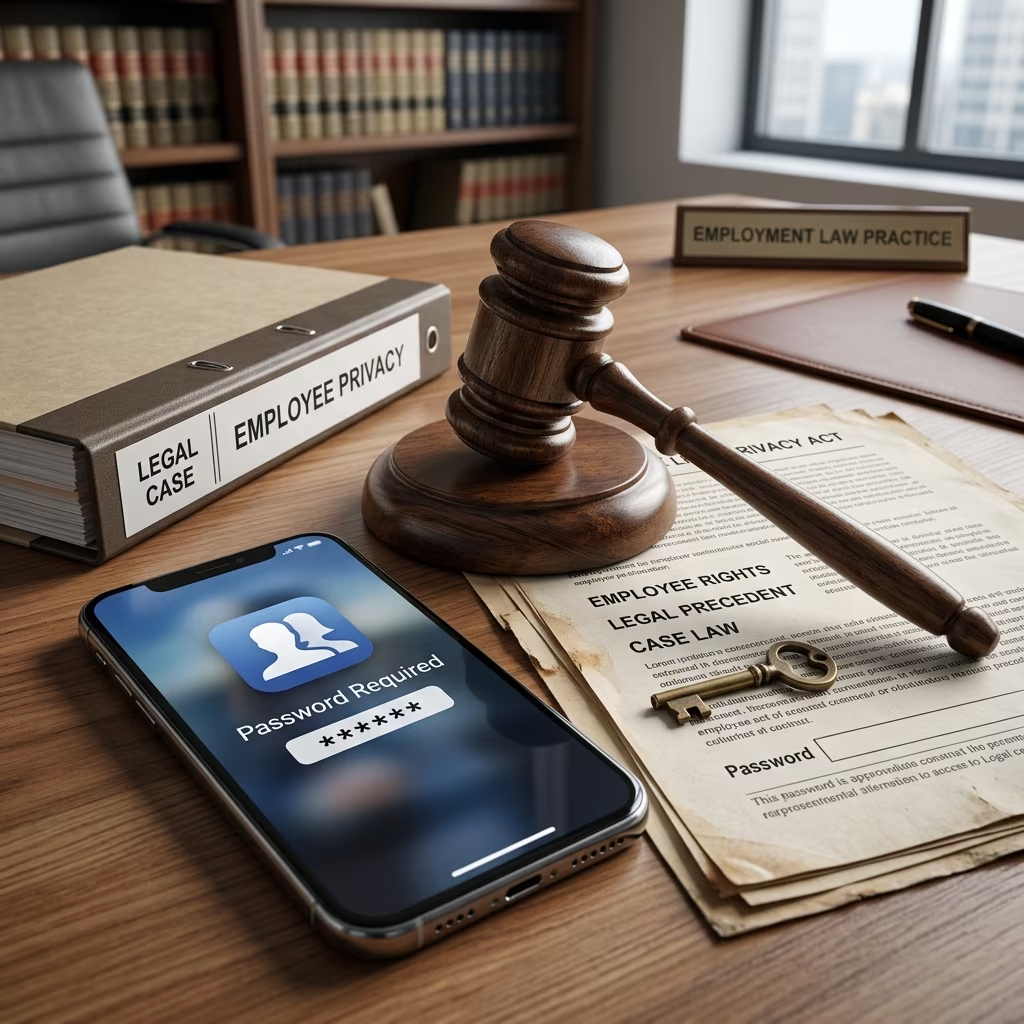
Social media is woven into everyday life, but the line between your personal online activity and your job is not always clear. As more employers look to social networks to evaluate applicants and monitor employees, questions arise: Can your employer demand your social media password? Do you have the right to refuse? Does the law protect you?
This article explains the current legal landscape in the United States, focusing on how federal law, state statutes, and workplace policies interact when employers seek access to employees’ or job applicants’ social media accounts. It also offers practical guidance to help you protect your privacy while staying compliant at work.
1. The Big Picture: No Single National Rule
At the federal level, there is no comprehensive law that outright forbids employers from asking for your social media username or password. Instead, protections have largely emerged through a patchwork of state laws, general privacy principles, and anti-discrimination rules.
- About half of U.S. states have enacted statutes limiting employer access to personal social media accounts.
- These laws typically focus on accounts used for personal, not business, purposes.
- Federal laws like anti-discrimination statutes and the Stored Communications Act may indirectly restrict how employers use social media information, even when access is voluntary or obtained lawfully.
Because protections vary widely by location, understanding your rights requires looking both at your state law and at your employer’s policies.
2. Key Concepts: Personal vs. Work Accounts
Most laws and policies distinguish between personal accounts and employer-related accounts. That distinction is crucial when assessing what your employer can require.
| Type of Account | Typical Use | Employer Access Rights |
|---|---|---|
| Personal social media accounts | Private communication, social networking, non-work activities | Often protected by state law; employers usually cannot require passwords or coercive access methods. |
| Employer-provided accounts or services | Company email, internal collaboration tools, accounts created for business use | Employers generally may require access to ensure security, compliance, or business continuity. |
| Hybrid accounts used for both work and personal activity | Professional networks or shared corporate pages managed through personal logins | Legal treatment depends on state law and contract terms; employers may have limited business-related access rights. |
State social media privacy statutes usually focus on protecting personal online accounts, not those directly tied to employer systems or business operations.
3. How State Social Media Privacy Laws Work
States that have adopted workplace social media privacy laws tend to share several common themes. While details differ, the following restrictions are typical:
3.1 Prohibitions on Password Requests
In many states, employers are barred from requesting or requiring employees or applicants to provide their social media passwords, usernames, or other access credentials to personal accounts.
- Employers may not demand login information to view non-public content on personal social media.
- Some laws also prohibit employers from suggesting or strongly encouraging that employees provide such information, closing loopholes around “voluntary” disclosure.
3.2 Bans on Coercive Access Methods
Several states go beyond password requests and explicitly ban tactics that effectively force employees to open up their accounts.
- Shoulder surfing: Demanding that employees log in to personal accounts while a manager watches to review private content.
- Forced connections: Requiring employees to “friend,” “follow,” or otherwise add the employer, supervisor, or school as a contact on personal accounts.
- Privacy setting changes: Compelling employees to alter privacy controls to make their content more visible to the employer.
These laws reflect a broader policy choice: your employer should not use its leverage to gain privileged access to spaces intended to be personal and private.
3.3 Protection Against Retaliation
Many state statutes prohibit employers from retaliating against employees or applicants who refuse unlawful requests for social media access.
- No firing or discipline solely for refusing to share a password protected by law.
- No rejection of an applicant because they decline access that state law forbids the employer from demanding.
In some jurisdictions, employers can face statutory fines for violations, particularly for repeated or willful conduct.
4. Important Exceptions and Employer Rights
Even in states with strong protections, social media privacy laws often include exceptions recognizing legitimate employer interests.
4.1 Access to Employer Systems and Non-Personal Accounts
Most laws clearly preserve an employer’s ability to secure its own systems and business-related accounts.
- Employers may require employees to share credentials for non-personal accounts that provide access to internal networks, proprietary platforms, or company-managed social media pages.
- Security audits, data protection efforts, and continuity of business operations are typical justifications for this access.
In other words, while your employer may not have a legal right to read private messages in your personal social media account, it can insist on access to accounts that exist solely to perform your job.
4.2 Investigations of Misconduct or Legal Violations
Some states allow limited access to personal accounts when an employer has specific, credible information suggesting serious wrongdoing tied to social media use.
- Suspected disclosure of trade secrets or confidential business information through a personal account.
- Allegations of criminal defamation, harassment, or other unlawful conduct via social media.
- Violations of clearly articulated written workplace policies involving online behavior.
Even in these scenarios, the employer’s request must usually be tailored to the investigation and cannot be a blanket demand to view everything in your accounts. Employees retain rights under other laws, including privacy and communications statutes.
4.3 Compliance with Other Legal Obligations
Some statutes recognize that employers may face regulatory or legal duties that require review of online content in certain industries—for example, financial services or healthcare.
In practice, this means that employers may:
- Monitor business-related communications to meet recordkeeping or reporting obligations.
- Implement social media policies designed to prevent unlawful advertising, disclosures, or professional misconduct.
These obligations rarely justify unrestricted access to purely personal accounts, but they can shape the boundaries of acceptable online behavior related to work.
5. Federal Anti-Discrimination Limits on Social Media Use
Even where no state social media privacy law applies, employers must comply with federal anti-discrimination statutes such as Title VII of the Civil Rights Act, the Americans with Disabilities Act, and the Age Discrimination in Employment Act.
These laws restrict how employers can use information gleaned from social media accounts, whether access is direct or indirect:
- Employers may not base employment decisions on protected characteristics such as race, religion, gender, age, disability, or national origin, regardless of where they learned that information.
- Using social media to screen applicants can expose employers to claims if it leads to discriminatory practices.
- Requests for social media passwords, even if technically lawful, may be scrutinized under anti-discrimination frameworks if they disproportionately affect certain groups.
Thus, legal risk for employers arises not only from how they access social media, but also from what they do with the information once they have it.
6. Practical Tips to Protect Your Online Privacy at Work
Whether or not your state has a specific social media privacy statute, you can take steps to safeguard your personal accounts while maintaining professionalism.
6.1 Use Clear Boundaries Between Work and Personal Life
- Maintain separate accounts for business and personal use whenever possible.
- Avoid accessing personal social media on employer-owned devices when you have reasonable alternatives.
- Do not share personal account passwords with colleagues, even informally.
6.2 Review and Adjust Privacy Settings
- Regularly audit who can view your posts, photos, and profile details.
- Limit public visibility of content that could be misunderstood or taken out of context by potential employers.
- Use features such as restricted lists or separate audience settings to keep professional contacts from viewing purely personal content.
6.3 Understand Your State Law and Company Policy
- Look for any state-specific social media privacy statutes that apply to employees and job applicants.
- Read your employer’s social media policy and employee handbook to identify what is allowed and what is prohibited.
- If you work in a regulated industry, familiarize yourself with relevant professional guidelines on online conduct.
6.4 Responding to Requests for Access
If a prospective or current employer asks for access to your personal social media account:
- Politely ask whether the request is consistent with applicable state law.
- Clarify whether they seek access to a personal account or a business-related account tied to your role.
- If you believe the request is unlawful, consider consulting an employment attorney or contacting your state labor or human rights agency.
Document any requests and your responses, especially if you fear retaliation or discriminatory treatment.
7. Employer Perspective: Balancing Risk and Privacy
Employers face their own challenges in navigating social media in the workplace. Excessive monitoring can erode trust and create legal exposure, while too little oversight may allow reputational or compliance problems to fester.
Best practices for employers typically include:
- Developing a clear, written social media policy explaining acceptable use, privacy expectations, and investigation procedures.
- Training managers not to request personal social media passwords where prohibited by law.
- Focusing oversight on publicly available content and business-related accounts rather than private personal accounts.
- Consulting legal counsel before undertaking any investigation that might require access to personal social media.
By aligning policies with state statutes and federal anti-discrimination obligations, employers can use social media responsibly without infringing on employee privacy.
8. Frequently Asked Questions (FAQs)
8.1 Can my employer legally demand my Facebook or Instagram password?
In many states, employers are prohibited from requesting or requiring passwords to personal social media accounts. In states without such laws, there is no broad federal ban, but other legal constraints—such as privacy expectations and anti-discrimination statutes—still apply.
8.2 What if I voluntarily give my employer my password?
If you voluntarily provide access, your employer may view non-public content, but they must still comply with general employment laws, including those prohibiting discrimination and unlawful retaliation. Voluntary disclosure may also affect your privacy expectations, so consider the decision carefully.
8.3 Can I be fired for refusing to share my social media login?
In states with social media privacy statutes that bar password requests, employers are generally prohibited from retaliating against employees who refuse to provide access. In other states, refusal might not be explicitly protected, but termination based on refusal could still raise broader legal issues, depending on the circumstances.
8.4 Does my employer have the right to monitor social media on company devices?
Employers usually have more authority to monitor activity on their own devices and networks, especially when employees have been notified of monitoring policies. However, state social media privacy laws may still limit direct access to personal account credentials, and monitoring must comply with general privacy and communications laws.
8.5 How can I find out what my state law says?
You can consult official resources such as state legislative websites or reliable legal surveys summarizing social media privacy laws in employment. If uncertain, consider seeking advice from an employment attorney familiar with local regulations.
References
- State Laws on Social Media Password Requests By Employers — Nolo. 2023-05-01. https://www.nolo.com/legal-encyclopedia/state-laws-on-social-media-password-requests-by-employers.html
- Social Media in the Workplace – State Laws — Workplace Fairness. 2022-08-15. https://www.workplacefairness.org/social-media-state-laws/
- Employer Access, Use and Regulation of Social Media — Brown & Brown Insurance (BIG). 2013-06-10. https://www.bigreport.com/resource-center/compliance-services/employer-access-use–regulation-of-social-media/
- Social Media Privacy Laws in Employment: 50-State Survey — Justia. 2023-04-01. https://www.justia.com/employment/employment-laws-50-state-surveys/social-media-privacy-laws-in-the-workplace-50-state-survey/
- Employment and Social Media (Part 1): Can my employer request my personal social media user name and password? — Burruezo & Burruezo, PLLC. 2019-02-05. https://burruezolaw.com/employment-and-social-media-part-1-can-my-employer-request-my-personal-social-media-user-name-and-password/
- Privacy of Employee and Student Social Media Accounts — National Conference of State Legislatures (NCSL). 2022-02-24. https://www.ncsl.org/technology-and-communication/privacy-of-employee-and-student-social-media-accounts