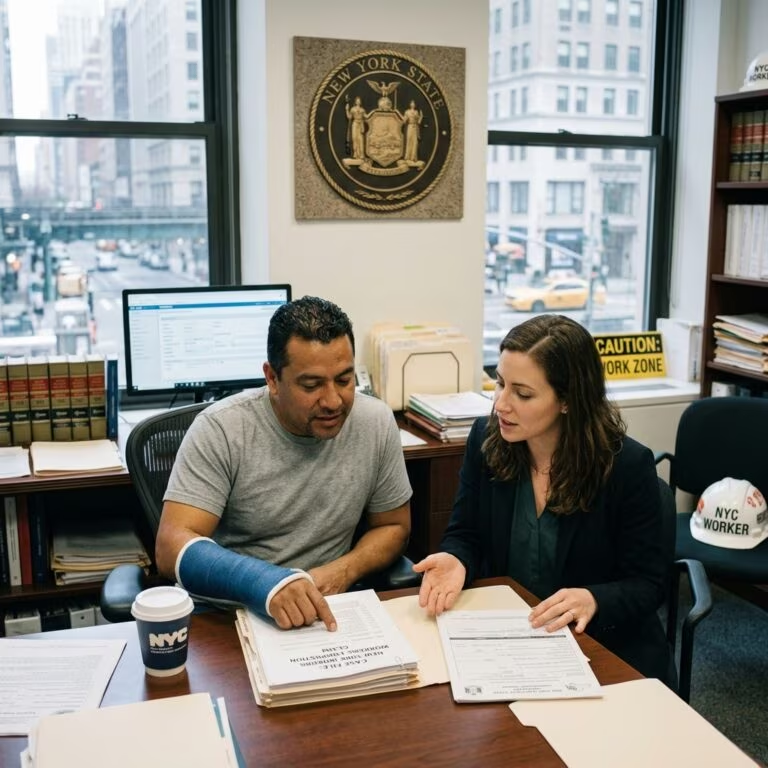
In the United States, federal workplace safety laws give employees a clear and enforceable right to work in an environment that is free from serious, preventable hazards. At the same time, these laws make it illegal for employers to punish workers who raise safety concerns, report injuries, or cooperate with government investigations. Understanding these rights is essential if you are worried about unsafe conditions or retaliation for speaking up.
Core Legal Foundations of Workplace Safety Rights
The primary federal law governing workplace safety is the Occupational Safety and Health Act (OSHA Act), enforced by the Occupational Safety and Health Administration (OSHA). Under this law, most private-sector employers must provide a workplace that is as safe and healthy as reasonably possible, comply with OSHA standards, and correct recognized hazards that could cause serious injury or death.
In addition to federal OSHA, many states operate their own OSHA-approved state plans that cover public-sector workers and sometimes expand protections. These state programs must be at least as effective as federal OSHA, and often mirror the same rights and obligations.
- Federal OSHA covers most private employers nationwide.
- State OSHA programs cover state and local government workers and may offer additional protections.
- General duty clause requires employers to keep the workplace free from recognized serious hazards.
Key Employee Safety Rights Under OSHA
Federal law gives workers a number of specific rights designed to ensure they can identify and address safety risks before someone is hurt.
- Right to a safe and healthy workplace free from known safety and health hazards.
- Right to safety training in a language and format you can understand.
- Right to safe equipment, including machines that meet safety standards and required protective gear, such as gloves, fall protection, or respirators.
- Right to protection from toxic chemicals, including proper labeling, safety data sheets, and controls that limit exposure.
- Right to access information about work-related injuries, illnesses, hazard test results, and your own medical records.
- Right to request an OSHA inspection if you believe workplace conditions are unsafe or unhealthy.
- Right to report injuries and illnesses without interference and obtain copies of related records.
These rights apply regardless of your immigration status, job title, or length of employment. Worker.gov, a federal resource, explicitly notes that the right to a safe and healthy workplace exists regardless of immigration status.
Employer Safety Obligations and Compliance Duties
Employer responsibilities mirror employee rights. If you are experiencing unsafe conditions, it is useful to understand what the law requires your employer to do.
| Employer Obligation | What It Means in Practice |
|---|---|
| Provide a safe workplace | Identify hazards, implement controls, and remove or reduce risks that could cause serious harm. |
| Comply with OSHA standards | Follow specific safety rules for your industry, such as fall protection, machine guards, respiratory protection, and emergency exits. |
| Inform and train employees | Give clear training on hazards, safety procedures, and emergency response, in a language workers understand. |
| Maintain records and report serious incidents | Keep logs of work-related injuries and illnesses and report certain severe incidents to OSHA within strict time limits. |
| Display OSHA poster | Post the official OSHA workers’ rights notice in a visible location at the worksite. |
Many state safety programs, such as Maine’s SafetyWorks, reinforce these obligations by listing employer duties like providing safe tools and equipment, establishing operating procedures, and reporting fatalities and serious injuries promptly to authorities.
Your Right to Report Hazards and Request Corrections
One of the most powerful safety protections is the right to report hazards and ask that they be corrected. Workers may raise concerns internally or directly with OSHA or a state agency.
Reporting Safety Issues Internally
In many workplaces, problems can be resolved quickly by notifying a supervisor, safety officer, or human resources department and documenting your concerns. Internal reporting is often the first step and can demonstrate that the employer was aware of the hazard.
- Describe the hazard clearly: what it is, where it is, and why it is dangerous.
- Record dates, times, locations, and individuals involved in your report.
- Keep copies of emails, written complaints, or meeting notes.
Requesting an OSHA Inspection
If your employer does not address the problem, you have the right to file a confidential safety and health complaint with OSHA and request an inspection. Complaints may be submitted online, by mail, or by phone, and OSHA may conduct an on-site inspection or other follow-up based on your information.
OSHA encourages workers to notify their employer first when possible, because some hazards can be fixed quickly without formal enforcement. However, that is not a legal requirement, and you may go directly to OSHA if you fear retaliation or believe the danger is urgent.
Refusing Dangerous Work: When and How
Under federal law and many state policies, workers may refuse work that poses an imminent danger of serious injury or death in certain circumstances. The right is not unlimited, but it is an important protection when safety risks are extreme and unaddressed.
- The hazard must present a serious risk of injury or death.
- There is no reasonable way to perform the work safely.
- The employer has been asked to correct the condition and has not done so, or there is not enough time to seek correction through normal channels.
Guidance from worker advocacy groups and state programs generally advises that workers who refuse unsafe work should stay at the worksite if possible and request alternative safe tasks rather than leaving entirely, unless danger is immediate. This approach reduces the risk that the employer will claim you abandoned your job.
Understanding Retaliation: What Employers Cannot Do
Retaliation occurs when an employer takes adverse action against a worker because the worker exercised a protected safety right—such as filing an OSHA complaint, reporting a hazard, or participating in an investigation. OSHA’s whistleblower provisions make it illegal to fire, demote, transfer, or otherwise discriminate against workers for using these rights.
Common Examples of Retaliation
- Terminating or laying off an employee soon after they report a safety issue to OSHA.
- Reducing hours, pay, or benefits because a worker raised concerns about dangerous equipment.
- Disciplining a worker for reporting an injury or illness to the employer or authorities.
- Transferring a worker to a less desirable position or shift as punishment for cooperating with an OSHA inspection.
- Threatening immigration-related consequences for speaking up about unsafe conditions.
Retaliation can be overt, such as firing, or subtle, such as exclusion from training or promotion opportunities. Both can violate whistleblower protections if they are motivated by your use of safety rights.
Filing a Retaliation (Whistleblower) Complaint
Workers who believe they have been retaliated against for reporting safety concerns or using OSHA rights can file a whistleblower complaint with OSHA. This is separate from a safety hazard complaint and is handled by OSHA’s whistleblower program.
Steps to Take If You Experience Retaliation
- Document the events: Keep detailed records of your original safety complaint and the employer’s actions afterward, including dates, witnesses, and communications.
- File a whistleblower complaint promptly: OSHA requires workers to file within a short time frame (often 30 days) after the retaliatory action, such as a firing or demotion.
- Consider contacting state agencies: Some states have additional protections and complaint procedures through labor or safety departments.
- Seek legal advice: An employment attorney can help assess your case and explain potential remedies, including reinstatement, back pay, or damages.
For example, state programs like Maryland’s MOSH emphasize that workers have the right to report both safety issues and actions taken against them—such as being fired or disciplined—for speaking up. This reinforces the federal protections and may provide additional avenues for relief.
Balancing Safety Rights With Worker Responsibilities
While workers have strong safety rights, they also bear responsibilities under OSHA and state laws. Fulfilling these duties supports a safe environment and protects your legal position if you later need to assert your rights.
- Read and follow posted safety and health information at your worksite.
- Comply with employer safety rules and procedures, including use of required protective equipment.
- Report hazardous conditions promptly to your employer or safety representative.
- Report work-related injuries and illnesses and seek medical treatment when needed.
- Participate honestly in safety trainings, drills, and investigations.
Workers who consistently follow safety rules and document hazards in good faith are better positioned to show that any adverse action taken against them was retaliatory rather than legitimate discipline.
Practical Strategies for Protecting Yourself
Beyond knowing the law, practical steps can help you stay safe and safeguard your rights.
Build a Record of Your Safety Concerns
- Keep a written log of unsafe conditions you observe, including photos where appropriate.
- Note when you report hazards and how management responds.
- Save copies of incident reports, emails, and training materials.
Use Multiple Reporting Channels
- Notify your supervisor or manager.
- Reach out to your company’s safety officer, HR, or safety committee if one exists.
- Contact OSHA or the appropriate state program if conditions remain unsafe or you fear retaliation.
Know When to Seek Outside Help
- Consult a lawyer experienced in employment or occupational safety law if retaliation occurs or hazards persist.
- Consider contacting worker advocacy organizations or unions that can support your complaint or help monitor conditions.
Frequently Asked Questions About Safety and Retaliation
Do I need proof before I report a safety hazard?
You do not need to prove a violation before reporting; you only need a reasonable, good-faith belief that conditions are unsafe or unhealthy. OSHA and state agencies investigate and determine whether a violation exists.
Can my employer see my OSHA complaint?
OSHA keeps complaints confidential, but may share enough information about the hazard for the employer to understand the issue. OSHA will typically not reveal your name without your permission.
What if I am undocumented? Do I still have safety rights?
Yes. Worker.gov makes clear that the right to a safe and healthy workplace applies regardless of immigration status. Retaliation protections also apply when you use OSHA rights, though immigration-related threats may raise additional legal issues.
Can I be fired for refusing dangerous work?
Employers may not lawfully fire workers for refusing imminently dangerous work in line with OSHA guidance and applicable state rules. However, because this right is limited and fact-specific, it is important to follow proper steps—such as reporting the hazard and staying at the worksite—and to seek legal advice if you are disciplined.
Is reporting an injury the same as filing a safety complaint?
Reporting a work-related injury or illness to your employer is itself a protected right. Filing a safety complaint with OSHA is a separate process, but both actions are protected from retaliation.
References
- Worker Rights and Protections — Occupational Safety and Health Administration (OSHA). 2024-01-10. https://www.osha.gov/workers
- Employee Rights Under OSHA (the Occupational Safety and Health Act) — Anthem Legal Resources. 2023-06-01. https://www.anthemeap.com/learn/find-legal-support/resources/consumer-rights/legal-assist/employee-rights-under-osha-the-occupational-safety-and-health-act
- Employee Rights and Responsibilities — SafetyWorks! Maine Department of Labor. 2023-03-15. https://safetyworksmaine.gov/workplace-safety/rights-responsibilities
- Safety Rights — Worker.gov, U.S. Department of Labor. 2022-11-30. https://www.worker.gov/safety-rights/
- Worker’s Rights — Maryland Occupational Safety and Health (MOSH), Maryland Department of Labor. 2023-05-10. https://labor.maryland.gov/labor/mosh/moshworkersrights.shtml
- Your Right to Be Safe and Secure at Work — Rights at Work Washington. 2022-09-01. https://rightsatworkwa.org/know-your-rights/your-right-to-be-safe-at-work/
- Workplace Safety Regulations: Your Rights as a NYC Employee — Lipsky Lowe LLP. 2023-04-20. https://lipskylowe.com/workplace-safety-regulations-your-rights-as-a-nyc-employee/