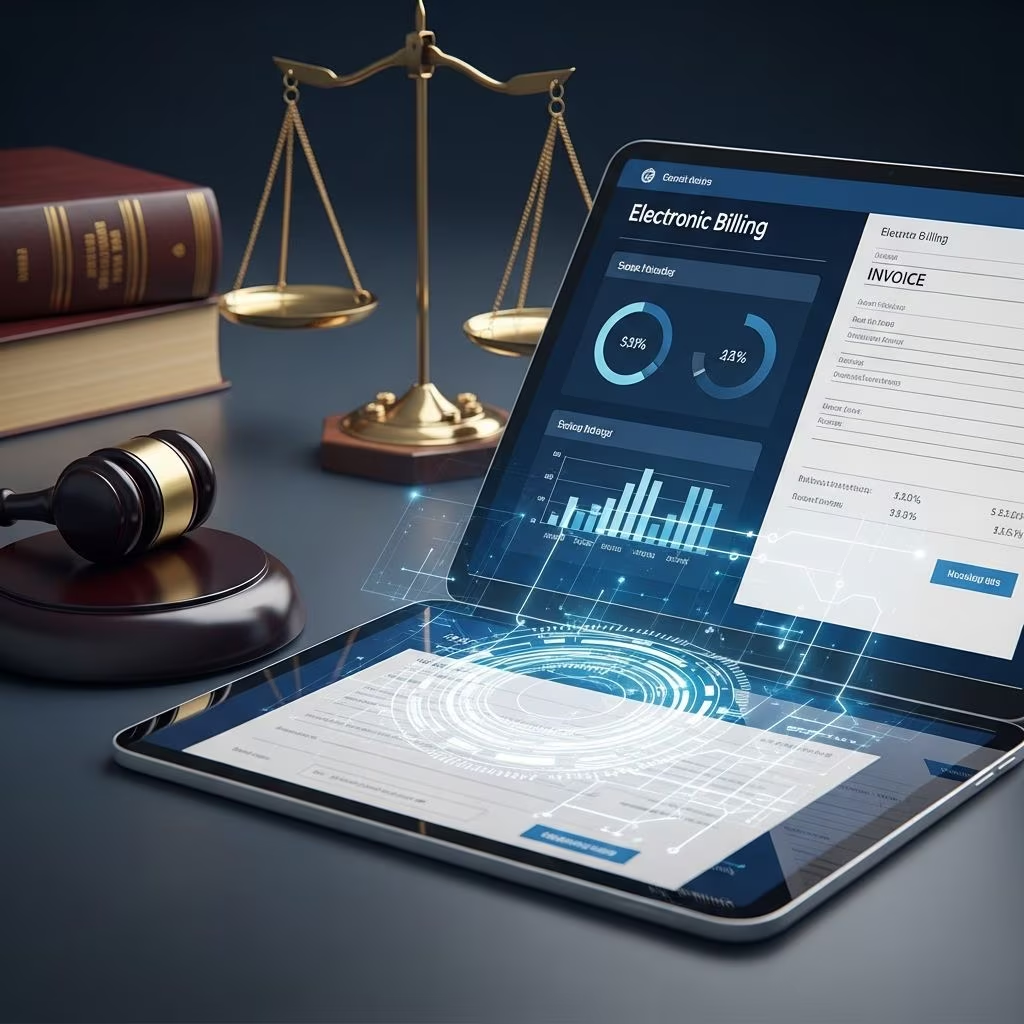
Electronic billing, or e-billing, has become a cornerstone of modern legal practice, replacing outdated paper-based systems with streamlined digital processes. Law firms adopting e-billing report significant improvements in operational efficiency, cost savings, and client satisfaction. This article delves into the transformative impact of e-billing, offering practical insights for firms ready to modernize their billing workflows.
Understanding the Shift to Digital Invoicing in Legal Services
In the legal sector, billing is not just about collecting fees; it’s a critical function that reflects a firm’s professionalism and financial health. Traditional paper invoicing involves printing, mailing, and manual tracking, which are prone to delays and errors. E-billing digitizes this entire process, allowing invoices to be generated, submitted, reviewed, and paid electronically.
For law firms, e-billing means integrating with practice management software to automate invoice creation based on time entries and matter budgets. Clients receive invoices via secure portals, email, or EDI formats, enabling quick approvals and payments. This shift is particularly vital in a post-pandemic world where remote collaboration is standard, minimizing physical interactions while maximizing speed.
Core Advantages Driving E-Billing Adoption
The benefits of e-billing extend beyond mere convenience, delivering measurable returns on investment for law firms of all sizes.
- Cost Savings: Eliminate expenses on paper, printing, postage, and storage. Firms can redirect these savings—often thousands annually—to strategic growth initiatives.
- Time Efficiency: Automate repetitive tasks like data entry and invoice distribution, freeing billing staff for high-value work such as matter budgeting and client advisory.
- Error Reduction: Built-in validation rules catch discrepancies in rates, hours, or task codes before submission, minimizing disputes and revisions.
- Enhanced Security: Encrypted transmission and storage protect sensitive financial data, reducing fraud risks and ensuring audit-ready trails.
Moreover, e-billing provides real-time visibility into invoice status, from submission to payment, empowering firms to forecast cash flow accurately and manage budgets proactively.
How E-Billing Streamlines Accounts Receivable
Accounts receivable (AR) departments in law firms often struggle with aging receivables and payment delays. E-billing addresses these pain points head-on by accelerating the payment cycle. Invoices delivered digitally reach clients instantly, and one-click payment options integrated with ERP systems post transactions automatically.
Consider a typical workflow: An attorney logs billable hours, the system auto-generates an invoice compliant with client guidelines, and it’s routed for review. Once approved, it’s sent via a client portal where payments can be made using stored methods. This reduces days sales outstanding (DSO) significantly, with some firms reporting 20-30% faster collections.
| Traditional Billing | E-Billing |
|---|---|
| Paper invoices: 7-10 days delivery | Instant digital delivery |
| Manual data entry: High error rate | Automated validation: 99% accuracy |
| Check mailing/depositing: 5-7 days | ACH/credit card: Same-day posting |
| Physical storage: Costly archiving | Cloud storage: Unlimited, searchable |
This comparison highlights why e-billing is a game-changer for AR efficiency.
Compliance and Risk Management in Legal E-Billing
Legal billing demands strict adherence to regulations like LEDES standards, client-specific guidelines, and data privacy laws such as GDPR or HIPAA where applicable. E-billing platforms enforce these through configurable rules, ensuring every invoice meets requirements before submission.
Auditable trails are automatically generated, logging every change and approval. This not only satisfies regulatory audits but also protects firms from disputes over billing practices. Features like fraud detection—flagging unusual patterns in time entries or rates—further safeguard operations.
Leveraging Data Insights from E-Billing Systems
One of the most underappreciated benefits is the wealth of data e-billing generates. Advanced platforms analyze billing patterns, revealing insights like matter profitability, attorney utilization rates, and budget variances.
Firms can set alerts for matters approaching budget limits, preventing overruns and facilitating proactive client discussions. Historical data informs pricing strategies and resource allocation, driving long-term profitability. For instance, integrating with analytics tools allows visualization of trends via dashboards, turning raw billing data into actionable intelligence.
Key Features to Seek in an E-Billing Platform
Selecting the right e-billing software requires evaluating features tailored to legal needs:
- Client guideline enforcement (e.g., rate caps, task codes)
- Seamless integration with PMS/ERP like Clio or QuickBooks
- Mobile accessibility for approvers on-the-go
- Custom reporting and analytics
- Multi-format support (PDF, XML, LEDES)
- Robust API for custom workflows
Scalability is crucial; the system should grow with your firm, handling increased volume without performance dips.
Overcoming Common Implementation Challenges
Transitioning to e-billing isn’t without hurdles. Staff resistance to change can be mitigated through targeted training and demonstrating quick wins. Data migration from legacy systems requires careful planning to avoid disruptions.
Client adoption is another factor—some prefer paper. Offer hybrid options initially, like PDF attachments, while encouraging portal use for faster payments. Vendor support during onboarding is essential for smooth rollout.
Real-World Impact: Case Studies and Statistics
Law firms implementing e-billing have seen transformative results. One mid-sized firm reduced billing cycle time from 45 to 15 days, boosting cash flow by 25%. Another reported a 40% drop in billing disputes due to automated compliance checks.
Industry-wide, e-billing adoption correlates with higher client retention, as transparent, timely invoicing builds trust. With AR automation, firms reallocate 30-50 hours monthly to strategic tasks.
Frequently Asked Questions (FAQs)
What is legal e-billing exactly?
E-billing refers to the electronic creation, submission, review, and payment of legal invoices, often using standardized formats like LEDES for compliance.
Is e-billing suitable for small law firms?
Yes, scalable platforms make e-billing accessible and cost-effective even for solo practitioners or small teams, with cloud-based options requiring no IT overhead.
How does e-billing improve cash flow?
By speeding up invoice delivery, approvals, and payments through digital portals and auto-posting, significantly reducing DSO.
What about data security in e-billing?
Reputable systems use encryption, multi-factor authentication, and compliance certifications to protect sensitive legal billing data.
Can e-billing integrate with existing software?
Most modern solutions offer APIs and pre-built integrations with popular legal PMS, accounting, and ERP systems.
Steps to Implement E-Billing Successfully
Begin with a needs assessment: Map current workflows and pain points. Select a vendor with strong legal focus, pilot the system on select matters, train users, and monitor KPIs like processing time and error rates. Iterate based on feedback for optimal results.
In conclusion, e-billing is no longer optional—it’s a strategic imperative for law firms aiming to thrive in a competitive landscape. By embracing this technology, firms position themselves for efficiency, compliance, and growth.
References
- eBilling Basics and Benefits for Procurement Processes — Order.co. 2023-05-15. https://www.order.co/blog/accounts-payable/ebilling/
- Everything You Need to Know About Legal eBilling — Centerbase. 2023-08-22. https://centerbase.com/blog/everything-you-need-to-know-about-legal-ebilling-and-why-your-firm-needs-it/
- E-billing: The Key to Improving Law Firm Efficiency — Accurate Legal Billing. 2024-01-10. https://www.accuratelegalbilling.com/blog/ebilling-the-key-to-improving-law-firm-efficiency-and-productivity
- How eBilling Saves Time and Gets You Paid Faster — Versapay. 2024-03-05. https://www.versapay.com/resources/benefits-of-ebilling
- How Electronic Billing Can Benefit You — Corcentric. 2023-11-12. https://www.corcentric.com/blog/how-electronic-billing-can-benefit-you/
- What is e-Billing? Guide to Electronic Billing — Tipalti. 2024-02-18. https://tipalti.com/resources/learn/what-is-ebilling/
- Critical factors to consider when choosing a legal ebilling system — Milliman. 2023-07-30. https://www.milliman.com/en/insight/critical-factors-to-consider-when-choosing-a-legal-ebilling-system