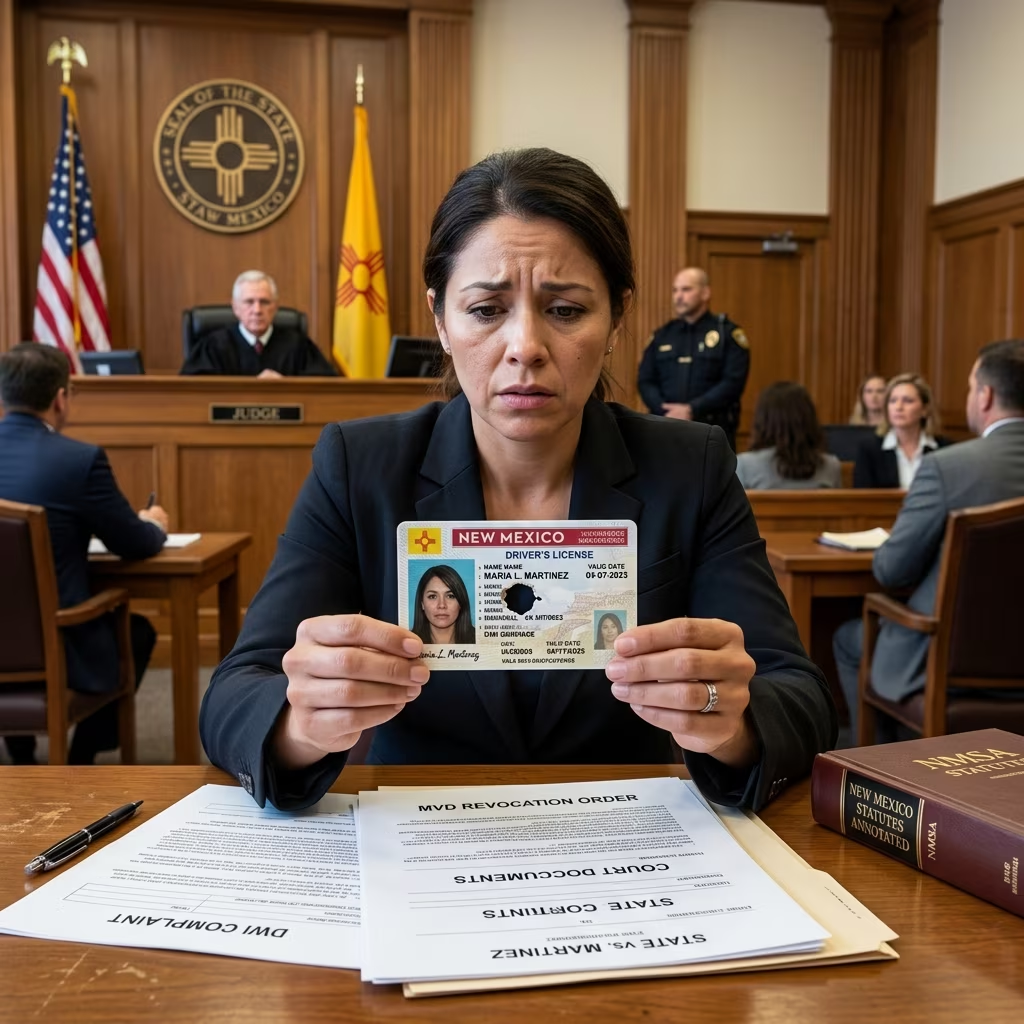
Being arrested for driving while intoxicated (DWI) in New Mexico does not only raise criminal court issues; it also puts your right to drive at immediate risk. New Mexico’s laws allow the Motor Vehicle Division (MVD) to revoke your driver’s license after a DWI arrest or conviction, and the consequences grow more severe with repeated offenses.
This guide explains how a New Mexico DWI affects your driver’s license, the difference between criminal penalties and administrative actions, typical revocation periods, and what you can do to work toward reinstatement once your case is resolved.
Criminal Case vs. MVD License Action: Two Tracks to Understand
New Mexico uses a dual system for DWI enforcement. A single incident can lead to:
- Criminal charges in court, which can result in jail, fines, probation, and license consequences.
- Administrative action by the MVD against your license, often triggered even before your court case is completed.
These two tracks are legally distinct. You can “win” one and still lose the other. For example, you might be acquitted in criminal court but still face an implied consent revocation if you refused a chemical test.
Key Differences Between Criminal and Administrative Processes
| Aspect | Criminal Court Case | MVD Administrative Action |
|---|---|---|
| Purpose | To determine guilt and impose criminal penalties | To decide if your driving privileges should be revoked or restricted |
| Decision-maker | Judge (and sometimes a jury) | MVD hearing officer or automatic statutory process |
| Standard of proof | Beyond a reasonable doubt | Lower civil standard (typically “preponderance of the evidence”) |
| Outcome | Conviction or acquittal; possible jail, fines, probation | Revocation, suspension, interlock requirement, or reinstatement |
| Timing | Can take months from arrest to resolution | Revocation can start quickly, sometimes within days of the incident |
How New Mexico Defines DWI and Implied Consent
New Mexico law recognizes DWI in two primary ways:
- Impairment-based DWI: Driving under the influence of alcohol or drugs to a degree that makes you incapable of safely operating a vehicle.
- Per se DWI: Having a blood or breath alcohol concentration of 0.08 or more within three hours of driving (or 0.04 or more for commercial drivers).
New Mexico also has an Implied Consent Act. By driving on public roads, you are deemed to have agreed to alcohol or drug testing when lawfully arrested for DWI. Refusing a breath or blood test can trigger an administrative license revocation independent of your criminal case.
License Revocation After a DWI Conviction
If you are convicted of DWI in criminal court, your driver’s license can be revoked for a fixed period based on the number of prior offenses.
Standard Revocation Periods for Non-Commercial Drivers
Under New Mexico MVD guidance, typical revocation lengths following a DWI conviction are:
- First offense: 1-year revocation.
- Second offense: 2-year revocation.
- Third offense: 3-year revocation.
- Fourth or subsequent offense: Lifetime revocation of driving privileges.
In addition to revocation, courts may order an ignition interlock device for a similar or longer period. For example, first-time offenders generally face a 1-year ignition interlock requirement, while repeat offenders can be ordered to use interlocks for several years.
Commercial Driver’s Licenses (CDLs)
Drivers holding a commercial driver’s license face stricter consequences, even if they were not driving a commercial vehicle at the time of the DWI:
- First DWI offense: 1-year CDL disqualification.
- Second offense: Lifetime CDL disqualification.
This CDL disqualification is in addition to any revocation of your standard driving privileges.
Administrative License Revocation and Implied Consent
Separate from the court process, the MVD can revoke your license if you either:
- Test at or above the per se alcohol limit; or
- Refuse a lawful breath or blood test under the Implied Consent Act.
Administrative revocations often start rapidly, sometimes after a short temporary license period. You generally have a limited timeframe to request an MVD license revocation hearing to challenge the action.
Factors Considered at an MVD Hearing
During an administrative hearing, the MVD may consider:
- Whether the officer had reasonable grounds to believe you were driving under the influence.
- Whether you were properly advised of your implied consent rights and consequences of refusal.
- Whether your chemical test result met or exceeded the legal limit.
- Whether you refused the test after being advised of the penalties.
A finding against you can result in revocation, even if your criminal case later ends in dismissal or acquittal.
Penalties for Driving on a Suspended or Revoked License
Once your license has been suspended or revoked, driving is no longer a minor infraction—it is a separate criminal offense under New Mexico law.
Driving on a Suspended License
Driving while your license is suspended typically carries misdemeanor penalties such as:
- Up to 90 days in jail or equivalent time in an approved alternative sentencing program.
- Fines up to approximately $300.
- Possible vehicle immobilization for 30 days.
Driving on a Revoked License
Driving after your license is revoked is more serious, especially when the revocation arose from DWI. Statutory penalties can include:
- 4 to 364 days in jail (with higher minimums when the revocation is for DWI).
- Fines up to $1,000.
- Additional 1-year license revocation tacked onto your existing revocation period.
- 30 days of vehicle immobilization, at your expense.
Courts and the MVD treat driving on a revoked license, especially after a DWI-related revocation, as an indicator that you pose a continuing risk on the road, which is why penalties escalate.
Other License Suspension Issues in New Mexico
While DWI and implied consent are major sources of revocation, New Mexico has also been reforming some license suspension practices. For example, the state ended automatic suspensions for failing to appear in court or failing to pay fines in many traffic and criminal cases in 2023.
However, DWI-related revocations remain firmly in place, and the state continues to prioritize public safety through strict license consequences and DWI prevention initiatives.
Ignition Interlock Devices and Interlock Licenses
New Mexico uses ignition interlock devices (IIDs) and special interlock licenses as tools to allow limited driving while still reducing impaired driving risks. An IID requires a driver to provide a breath sample before starting the vehicle; if alcohol concentration exceeds a preset limit, the vehicle will not start.
When Interlocks Are Required
Court-ordered and MVD-required interlocks are common after DWI convictions. Examples include:
- First conviction: Typically 1 year of ignition interlock and 1-year license revocation.
- Second conviction: 2 years of ignition interlock and 2-year revocation.
- Third conviction: 3 years of ignition interlock and 3-year revocation.
- Eighth or subsequent conviction: Lifetime revocation and interlock requirement.
Basic Steps to Obtain an Interlock License
While details can vary, obtaining an interlock license generally involves:
- Identifying an approved IID installer and scheduling installation.
- Signing a contract that clearly states the duration and terms of the IID service.
- Using the contract and proof of installation to apply for your interlock driver’s license with the MVD.
- Complying with any education or treatment programs, such as state-approved DWI courses.
An interlock license allows you to drive legally but only in a vehicle equipped with the device, and violating interlock rules can lead to additional sanctions.
Working Toward License Reinstatement After DWI
Once your revocation period ends, you are not automatically allowed to drive again. You must complete reinstatement requirements set by law and the MVD.
Typical Reinstatement Requirements
Although exact steps depend on your individual situation, common requirements include:
- Paying a reinstatement fee (often around $25, and higher for DWI-related suspensions).
- Providing proof of identity and Social Security number.
- Showing proof of New Mexico residency (usually two documents) if you are applying for a NM license.
- Maintaining liability insurance and, in some cases, providing proof of coverage.
- Completing required DWI education, screening, treatment, or community service imposed in your criminal case.
For those with long-term or lifetime revocations, especially after multiple DWI convictions, reinstatement can require a formal petition to the court showing “good cause” for restoring driving privileges and evidence that you have addressed any alcohol or drug problems.
Out-of-State Drivers and Prior New Mexico DWI
If you now live in another state but your driving record still shows a New Mexico DWI revocation, you may need to obtain an order restoring your NM driving privileges before your current state will issue or renew a license.
This can involve filing a petition in a New Mexico court, attaching treatment records and letters of support, and then using the court order and proof of your current residency to seek reinstatement through the New Mexico MVD.
Long-Term Consequences of Multiple New Mexico DWI Convictions
Repeated DWI offenses in New Mexico lead to sharply escalating penalties that go far beyond simple license revocation. Statutory provisions impose higher jail ranges, larger fines, longer probation, and extended interlock orders for each additional conviction.
By the time a driver reaches their eighth or subsequent DWI, the offense can be treated as a second-degree felony with a mandatory minimum of ten years in prison and up to twelve years, plus a lifetime revocation and interlock requirement.
These long-term sanctions reflect the state’s view that chronic impaired driving presents an extreme danger to public safety and requires strong deterrence.
DWI Prevention and Public Safety in New Mexico
New Mexico’s Department of Public Safety and related agencies highlight the “high cost” of DWI, noting that a single conviction can result in driver’s license suspension ranging from 90 days to more than a year, financial costs, and lasting record impacts.
The combination of criminal penalties, license revocations, ignition interlock requirements, and enforcement campaigns is designed to reduce impaired driving and encourage safer choices on the road.
Frequently Asked Questions (FAQ)
1. Will I automatically lose my license after a DWI arrest in New Mexico?
Your license is at immediate risk. New Mexico law allows administrative revocation based on chemical test results or a refusal under the Implied Consent Act, even before your criminal case is resolved.
2. Can my license be revoked if I refused the breath or blood test?
Yes. Refusal of a lawfully requested test under the Implied Consent Act can lead to administrative license revocation, regardless of whether you are later convicted in criminal court.
3. How long will my license be revoked after a first DWI conviction?
For a first offense, New Mexico typically imposes a 1-year license revocation, along with a 1-year ignition interlock requirement and other conditions such as DWI education and community service.
4. What happens if I drive while my license is revoked for DWI?
Driving on a DWI-related revocation is a separate misdemeanor offense that can result in 7 to 364 days in jail, fines up to $1,000, an additional 1-year revocation, and 30 days of vehicle immobilization.
5. Are commercial drivers treated differently?
Yes. Commercial driver’s license holders face one-year disqualification for a first DWI and lifetime disqualification for a second, even if the offense did not occur in a commercial vehicle.
6. What do I need to do to reinstate my license after a DWI revocation?
Generally, you must complete your revocation period, pay reinstatement and license fees, provide identity and residency documents, show proof of insurance, and complete any court-mandated programs or interlock requirements. Some drivers with long-term revocations must also petition a court for restoration of privileges.
7. Has New Mexico changed any license suspension rules recently?
Yes. In 2023 New Mexico ended license suspensions for failure to appear or failure to pay in many cases. However, DWI-related suspensions and revocations remain in full force and continue to be strictly enforced.
References
- Driving on a Suspended or Revoked License in New Mexico — CriminalDefenseLawyer.com. 2026-01-01. https://www.criminaldefenselawyer.com/resources/criminal-defense/crime-penalties/driving-suspended-license-new-mexico
- General DWI Information — New Mexico Motor Vehicle Division. 2024-03-01. https://www.mvd.newmexico.gov/nm-drivers-licenses-ids/dwi-information/
- New Mexico DUI Laws — National College for DUI Defense. 2023-06-01. https://www.ncdd.com/new-mexico-dui-laws
- New Mexico Statutes Section 66-5-39: Driving while license suspended or revoked — Justia. 2018-01-01. https://law.justia.com/codes/new-mexico/2018/chapter-66/article-5/section-66-5-39/
- DWI Prevention — New Mexico Department of Public Safety. 2023-08-15. https://www.dps.nm.gov/nmsp/dwi-prevention/
- New Mexico’s Driver’s License Suspension Reform Is Now In Effect — Fines and Fees Justice Center. 2023-06-15. https://finesandfeesjusticecenter.org/news/2023/06/15/new-mexicos-drivers-license-suspension-reform-is-now-in-effect-heres-what-you-need-to-know/
- New Mexico MVD: DUI or DWI License Reinstatement — MVD Express. 2022-05-01. https://www.mvdexpress.com/blog/new-mexico-mvd/differentiating-dwi-and-dui-in-new-mexico/
- Driver’s License Restoration Packet — Sixth Judicial District Court of New Mexico. 2023-11-01. https://sixthdistrict.nmcourts.gov/wp-content/uploads/sites/24/2023/11/Packet-MVD-License-Restoration.pdf