
Drug-Sniffing Dogs in Schools: Rights, Risks, and Legal Limits
Understand how drug-sniffing dogs are used in schools, what the law allows, and how student privacy rights are protected or limited.
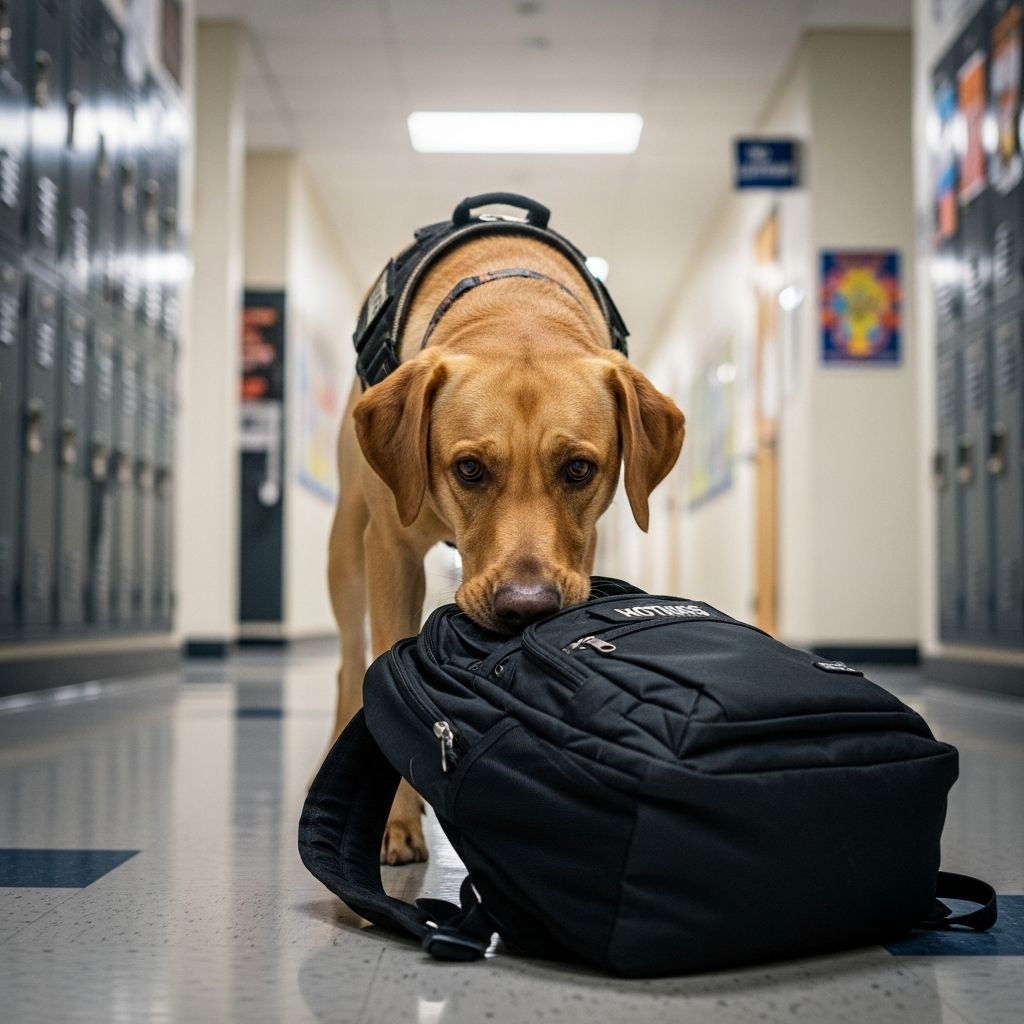
Many school districts turn to drug-sniffing dogs to deter drug use and keep campuses safe. At the same time, these canine searches raise difficult questions about student privacy, the Fourth Amendment, and how far school officials can go when working with law enforcement. This guide explains the main legal rules, practical issues, and key court decisions that shape how canine units may be used in and around schools.
Why Schools Use Drug-Detection Dogs
School leaders often justify canine searches as one element of a broader safety strategy aimed at reducing drugs, weapons, and other contraband on campus.
Common reasons schools adopt drug-dog programs include:
- Deterrence: The visible presence of dogs can discourage students from bringing drugs or other banned items to school.
- Early detection: Administrators hope to identify problems before they escalate into overdoses, violence, or criminal charges.
- Community pressure: Parents, community members, or school boards may demand a strong response to perceived increases in student drug use.
- Policy compliance: Some state laws explicitly allow or encourage searches of lockers, parking lots, and other school property using canines.
However, these goals must be balanced against legal protections that limit how public schools may search students and their belongings under the U.S. Constitution and, in some cases, stricter state constitutions.
Legal Foundation: The Fourth Amendment in Schools
The Fourth Amendment to the U.S. Constitution protects people from unreasonable searches and seizures by the government. In public schools, this applies to searches carried out by principals, teachers, school resource officers, and police officers working with the school.
In the landmark case New Jersey v. T.L.O., the U.S. Supreme Court held that school officials generally do not need a warrant or full probable cause to search a student, but their actions must be reasonable under all the circumstances. That decision created a special school standard that balances:
- Students’ legitimate expectations of privacy; and
- The school’s interest in maintaining safety and order.
Most courts apply a two-part test drawn from this standard when reviewing school searches:
- Was the search justified at its inception (for example, based on reasonable suspicion)?
- Was the search reasonable in scope, meaning not excessively intrusive given the student’s age, sex, and the nature of the suspected violation?
The use of drug-sniffing dogs in school settings sits at the intersection of this student-search framework and the Court’s broader decisions about canine sniffs in public places, vehicles, and homes.
Key Distinctions: What Is Being Searched?
Courts often distinguish canine searches in schools based on what or who is being sniffed. This distinction is crucial in deciding whether the search is constitutional.
| Target of Dog Sniff | Typical Legal Treatment | Student Privacy Expectation |
|---|---|---|
| Unattended school property (lockers, empty classrooms, parking lots) | Often upheld as reasonable; some courts find no individualized suspicion is needed if students have been warned they lack privacy in these areas. | Generally reduced expectation of privacy, especially where policy states lockers or lots are subject to search. |
| Backpacks, bags, or vehicles in place (e.g., dogs walking past lockers or parked cars) | Many courts treat a dog sniff of the exterior as minimally intrusive and sometimes not a “search” at all under the Fourth Amendment, depending on the circumstances. | Moderate privacy expectation; greater than school-owned property but less than a person’s body. |
| Students’ persons (bodies or clothing) | Often viewed as a higher-level intrusion; suspicionless sweeps of students’ bodies are more likely to violate the Fourth Amendment or state constitutional protections. | Highest expectation of privacy, similar to other personal searches. |
Suspicionless vs. Suspicion-Based Canine Searches
A central question is whether schools can conduct random dog sweeps without any evidence that a particular student has done something wrong.
Suspicionless sweeps of school property
Some courts have upheld random canine sweeps of unattended school property, such as hallways, lockers, and parking lots, when:
- Students have prior notice that these areas can be searched and that they have limited expectations of privacy.
- Dogs are used to sniff objects or areas, not individual students’ bodies.
- The sweep is part of a broader safety plan, sometimes tied to evidence of increased drug problems.
In one federal appellate decision, a dog sniff of a classroom and subsequent searches of certain students following an alert were upheld, in part because the school could document a recent rise in drug use on campus.
Suspicionless sweeps of students themselves
By contrast, suspicionless canine sniffs directed at a student’s person are far more controversial. Legal commentators and some courts argue that treating every student as a suspect without any individualized reason undermines the core protection of the Fourth Amendment.
Civil rights advocates, including the ACLU, maintain that public schools should not use drug dogs on students at all, and that if they do, they must at least have reasonable suspicion tied to a particular student rather than relying on blanket sweeps.
How Supreme Court Precedent on Dogs and Searches Matters
The U.S. Supreme Court has not yet squarely decided the constitutionality of drug-dog programs in public schools. However, its broader rulings on canine sniffs provide important guidance.
- Homes: In Florida v. Jardines, the Court held that bringing a drug dog to a suspect’s front door was a search that generally requires a warrant because it intrudes on the privacy of the home.
- Vehicles and public places: In other cases, the Court has characterized a dog sniff of a car’s exterior during a valid traffic stop as less intrusive, sometimes treating it as not a search at all when it only reveals the presence or absence of contraband.
- Special school standard: In cases about student drug testing (for example, testing athletes or students in extracurricular activities), the Court has allowed certain suspicionless programs where the government could show a strong safety interest and relatively limited privacy impact.
Legal scholars argue that these strands of doctrine together suggest that suspicionless canine sniffs of students’ bodies in public schools are likely unconstitutional, while sniffs aimed at school-owned property are more likely to be upheld, especially with clear written policies and advance notice.
State Laws and Local School Policies
Even when federal constitutional standards allow certain searches, state law or local policy may impose stricter rules.
Examples of state-level approaches include:
- Statutory authority: Some states explicitly authorize schools to use trained dogs to search lockers, desks, and parking lots, and to hand over any evidence of illegal activity to law enforcement.
- No expectation of privacy notices: School codes in several states inform students that they have no reasonable expectation of privacy in school property such as lockers or parking spaces controlled by the school.
- State constitutions: Certain states, such as Washington, interpret their own constitutions to give broader privacy protection than the federal Fourth Amendment, potentially limiting blanket dog sweeps that treat all students as suspects.
Because these rules vary, it is critical to review both your state’s education and criminal codes and your local district’s written policies on searches and canine units.
Typical Procedures in School Canine Programs
While practices differ, many school districts that use drug-sniffing dogs follow similar operational patterns designed to reduce classroom disruption and legal risk.
Common elements include:
- Advance planning with legal counsel: Administrators and school boards consult attorneys to craft policies and plan how and when searches will occur.
- Notice to students and families: Handbooks and codes of conduct may state that lockers, desks, parking areas, and sometimes other locations are subject to periodic searches, including by canines.
- Limiting dog contact with students: Many districts restrict dogs to sniffing objects and areas (lockers, cars, hallways) rather than students’ bodies, in part to reduce the risk of constitutional challenges.
- Lockdowns during sweeps: Some schools temporarily confine students to classrooms while dogs search hallways or parking lots, to avoid direct interaction between students and dogs.
- Post-alert follow-up: When a dog alerts, school officials decide whether to search a locker, vehicle, or personal item, and whether to involve law enforcement if contraband is found.
What Happens When a Dog Alerts?
A central legal issue is how much weight a dog’s alert carries and what it allows school officials (and police) to do next.
Typical steps after an alert include:
- Confirming location: Handlers and administrators verify which locker, bag, or car the dog has indicated.
- Deciding on further search: School staff may open and inspect the locker or vehicle if policy and state law permit. Whether they can demand access to a student’s closed backpack or pockets may depend on individualized suspicion and the student-search standard.
- Documenting the incident: More careful districts keep records of when the search occurred, why it was conducted, what the dog alerted on, and what was found, to support later discipline or to defend against civil claims.
- Discipline and referral: Schools may impose discipline under their code of conduct and, in some cases, turn over evidence to law enforcement, especially when the contraband is illegal drugs or weapons.
Court decisions differ on whether a dog’s alert alone provides enough justification to search a student’s body or personal possessions. Many commentators caution that schools should not treat an alert as automatic permission for the most intrusive searches, particularly if no other signs of wrongdoing exist.
Student and Parent Rights: Practical Takeaways
Understanding your rights does not mean that you can refuse every school search, but it does help you recognize when a search may have crossed legal boundaries.
Key points for students and parents:
- Public vs. private schools: The Fourth Amendment restricts government actors, so public schools are generally bound by these rules, while private schools often are not, unless state law says otherwise.
- School property vs. personal property: Privacy expectations are typically lowest in lockers, desks, and other school-owned spaces, higher in backpacks and vehicles, and highest with respect to students’ bodies.
- Right to be informed: You are usually entitled to review the district’s written policies on searches, drug detection, and cooperation with law enforcement. These should be available in student handbooks or board policies.
- Challenging improper searches: If you believe a search violated your rights, you may be able to challenge school discipline through internal appeals and, in some circumstances, bring legal claims in court or through civil rights organizations.
- Special protections in some states: State constitutions or statutes may provide higher privacy protections than the federal minimum, particularly regarding suspicionless, blanket searches.
Policy Considerations for Schools
For administrators and school boards, the question is not only what is technically legal, but what is appropriate and educationally sound.
Factors schools are urged to weigh include:
- Evidence of a problem: Courts have sometimes been more receptive to canine programs when there is documented evidence of increased drug activity among students.
- Intrusiveness: Programs that focus on unattended property and avoid direct dog contact with students are often viewed as less invasive.
- Educational climate: Critics argue that heavy reliance on police tools can make schools feel more like correctional facilities, undermining trust between students and educators.
- Alternatives: Prevention programs, counseling, and restorative approaches may be more effective long term in addressing substance abuse than purely enforcement-oriented tactics.
- Legal risk: Vague or overly broad policies can lead to litigation, negative publicity, and potential liability if a court later finds the searches unconstitutional.
Frequently Asked Questions (FAQs)
Q1: Can a school use drug-sniffing dogs without telling students in advance?
In many jurisdictions, schools may conduct unscheduled canine sweeps of school property if board-approved policies authorize such searches, particularly when students have been told that lockers and similar areas are subject to random inspection. However, some state constitutions and local rules may require more specific notice or limit blanket searches, so the answer depends on your state and district.
Q2: Are dogs allowed to sniff individual students during class or in hallways?
Direct dog sniffs of a student’s body are the most constitutionally sensitive use of canine units in schools. Legal scholarship and civil liberties groups contend that suspicionless sniffs of students themselves are generally impermissible, and at least some courts have been skeptical of such practices. Programs that restrict dogs to sniffing lockers, cars, and other inanimate objects face fewer legal obstacles.
Q3: What happens if a dog alerts on my locker or car but no drugs are found?
If a dog alerts, school officials typically inspect the identified area or item. If nothing is found, they may document the incident and end the search. False alerts can raise questions about the reliability of the dog and the reasonableness of any further search, but courts often defer to trained handlers unless there is evidence of systemic problems. Whether the school can impose discipline when no contraband is discovered will depend on your district’s policies.
Q4: Can evidence found by a drug dog at school be used in a criminal case?
Yes. If a canine search and any subsequent search are deemed lawful, evidence of illegal drugs, weapons, or contraband can be turned over to law enforcement and used in juvenile or criminal proceedings. If a court later finds that the search violated the Fourth Amendment or state constitutional protections, that evidence may be suppressed and excluded from trial.
Q5: What should I do if I think a canine search at school violated my rights?
You can start by documenting what happened (date, time, location, who was involved, and what was searched) and requesting copies of relevant school policies. Families often consult with an attorney experienced in education or civil rights law, or contact civil liberties organizations for guidance. In some cases, they may challenge school discipline through internal appeals, file administrative complaints, or pursue litigation in state or federal court.
References
- Drug-Sniffing Dogs in Schools Not Violating Privacy Rights? — Education Week (Mark Walsh). 2013-03-27. https://www.edweek.org/leadership/drug-sniffing-dogs-in-schools-not-violating-privacy-rights/2013/03
- To What Extent Are Canine Searches Allowed In Schools? — Maya Murphy, P.C. (School law commentary). 2012-08-23. https://mayalaw.com/sniff-away-fido-assessing-the-extent-of-allowing-canine-searches-of-students-in-our-schools-2/
- Suspicionless Canine Sniffs: Does The Fourth Amendment Prohibit Public Schools from Using Drug Dogs to Detect Students’ Illegal Drug Possession? — UC Davis School of Law, Journal of Juvenile Law & Policy (Feinberg). 2007-01-01. https://sjlr.law.ucdavis.edu/sites/g/files/dgvnsk15361/files/media/documents/SJLR-11-2-Feinberg-11-2.pdf
- Do I Smell a Problem? Considerations When Implementing Randomized Drug Dog Searches in Schools — Franczek P.C. (School law blog). 2018-03-20. https://www.franczek.com/blog/do-i-smell-a-problem-considerations-when-implementing-randomized-drug-dog-searches-in-schools/
- Use of Drug Detecting Dogs in Public High Schools — U.S. Department of Justice, National Criminal Justice Reference Service. 1987-01-01. https://www.ojp.gov/ncjrs/virtual-library/abstracts/use-drug-detecting-dogs-public-high-schools
- Drug-Sniffing Dogs in Schools: Make Every Student a Suspect? — American Civil Liberties Union of Washington. 2010-02-05. https://www.aclu-wa.org/news/drug-sniffing-dogs-schools-make-every-student-suspect/
- ACLU of New Mexico Sues School District Over Use of Drug-Sniffing Dogs to Search Students — American Civil Liberties Union. 2011-10-18. https://www.aclu.org/press-releases/aclu-new-mexico-sues-school-district-over-use-drug-sniffing-dogs-search-students
- Drug Sniffing Dogs and Students’ Rights — Shipman & Goodwin LLP, School Law Practice Group. 2009-10-15. https://www.ctschoollaw.com/2009/10/drug-sniffing-dogs-and-students-rights
- Drug Dog Searches: What Are My Rights? — Malcolm Anthony, P.A. (Criminal defense guidance). 2019-04-01. https://malcolmanthony.com/drug-dog-searches-what-are-my-rights/
Similar Articles








Read full bio of Sneha Tete




