
Drug-Induced Homicide in Florida: Liability, Penalties, and Defense
Understanding how Florida treats overdose deaths as homicide, who can be charged, and what legal defenses may protect the accused.
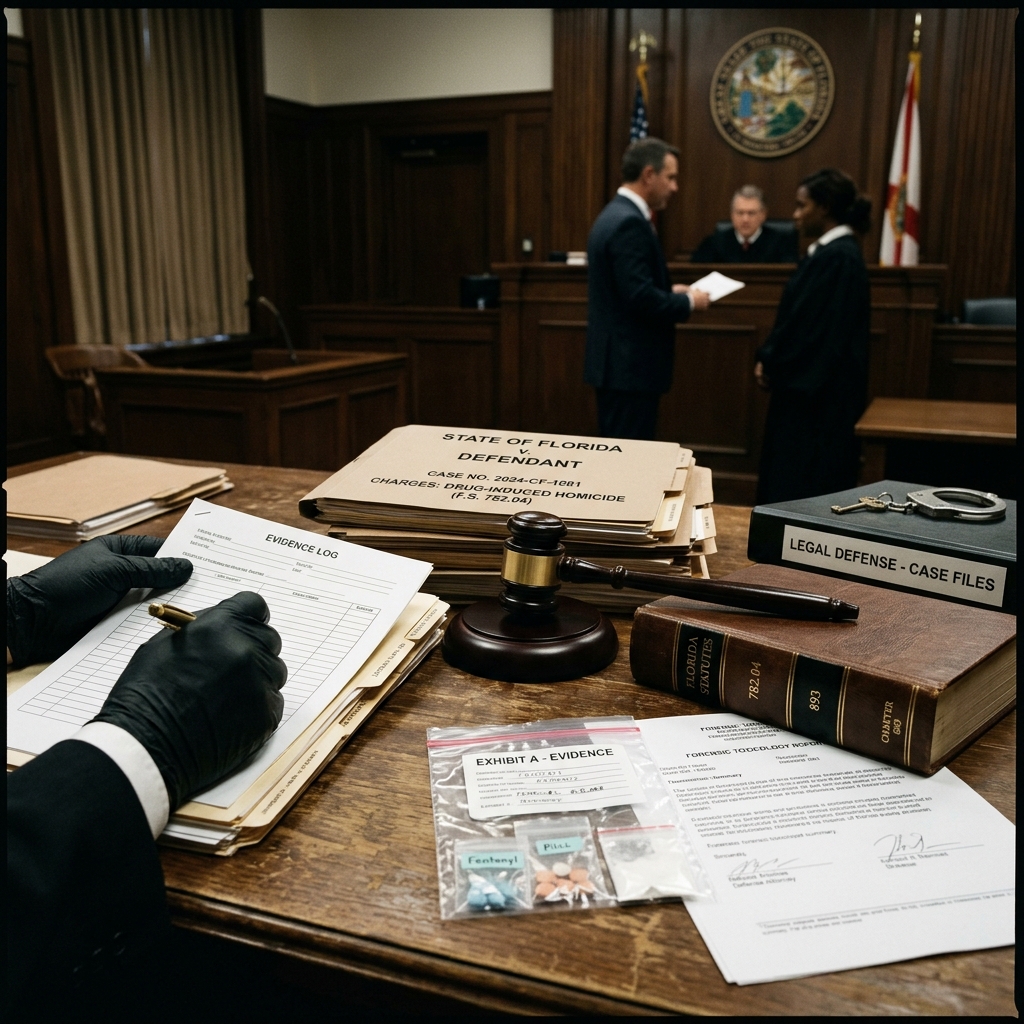
Florida has adopted some of the toughest drug-induced homicide laws in the United States, allowing prosecutors to treat certain overdose deaths as first-degree murder and even pursue capital punishment in severe cases. Understanding how these laws operate, who can be charged, and what defenses might be available is critical for anyone who provides, shares, or sells controlled substances within the state.
This article explains the foundation of Florida’s drug-induced homicide framework, highlights the role of fentanyl and other high-risk substances, outlines possible penalties, and discusses key defense strategies that experienced criminal defense attorneys use to challenge these serious charges.
What Is Drug-Induced Homicide Under Florida Law?
In simple terms, drug-induced homicide refers to criminal charges brought when a person provides a controlled substance and the recipient dies from using that drug. In Florida, these cases are generally prosecuted under the state’s murder statute, which explicitly includes overdose deaths caused by the unlawful distribution of certain substances.
Florida Statute 782.04 defines murder to include killings that result from the unlawful distribution of specific controlled substances by a person aged 18 or older, when that substance is proven to have caused or been a substantial factor in causing the victim’s death. In practice, this means a drug dealer—or even someone informally sharing drugs—can face homicide charges if their actions are linked to a fatal overdose.
Key Legal Elements
To pursue a drug-induced homicide case, prosecutors must typically prove:
- Unlawful distribution of a controlled substance, as defined in Florida’s drug laws.
- The accused was 18 years or older at the time of distribution.
- The substance provided is one of the listed drugs in the statute or a mixture containing those substances.
- The drug ingested by the victim caused or substantially contributed to the victim’s death.
Importantly, Florida does not require proof that the accused intended to kill the victim. The focus is on the unlawful distribution and the causal connection between the drug and the death.
Florida’s Statutory Framework: Murder and Drug Distribution
Florida combines its homicide law with its controlled substances statutes to create a powerful tool for prosecuting overdose deaths. Two key statutes work together:
| Statute | Primary Focus | Role in Drug-Induced Homicide Cases |
|---|---|---|
| F.S. 782.04 | Murder and degrees of homicide | Defines when overdose deaths from unlawful distribution qualify as first- or third-degree murder. |
| F.S. 893.131 | Distribution of controlled substances leading to overdose or serious injury | Covers overdose and serious bodily injury from certain drugs, creating additional felony liability for distributors. |
First-Degree Murder: Capital Felony
Under Florida law, a death “which resulted from the unlawful distribution” of specified substances by someone 18 or older is classified as murder in the first degree and is a capital felony. As a capital felony, it is punishable by life imprisonment or the death penalty, making Florida one of only a handful of states that authorize capital punishment for drug-induced homicide.
The statute covers a range of substances, including:
- Drugs controlled under Schedule I, such as certain opioids and synthetic substances.
- Cocaine and specific opium derivatives.
- Methadone and other powerful pain relievers.
- Methamphetamine, a widely abused stimulant.
- Fentanyl and various analogs, which have been explicitly added due to their role in fatal overdoses.
Third-Degree Murder and Other Felony Offenses
Not every overdose death in Florida leads to a first-degree murder charge. Depending on the circumstances and statutory provisions applied, some cases may be prosecuted as third-degree murder, which is a second-degree felony carrying a significant prison term.
In addition, Florida Statute 893.131 creates a separate offense when an overdose or serious bodily injury results from the unlawful distribution of certain drugs, even if the outcome is not fatal. In such cases, the distributor faces a second-degree felony if the substance is proven to have caused or substantially contributed to the overdose or injury.
The Special Role of Fentanyl and Other High-Risk Substances
The explosion of overdose deaths involving fentanyl has significantly shaped Florida’s approach to drug-induced homicide. Fentanyl and its analogs are extremely potent synthetic opioids, and even small amounts can be lethal. Florida amended its murder statute to specifically include fentanyl in the list of substances where unlawful distribution leading to death constitutes first-degree murder.
This heightened focus means that:
- Individuals dealing fentanyl face a particularly high risk of murder charges if a buyer overdoses.
- Mixtures containing fentanyl or related analogs can be treated the same as pure fentanyl for purposes of liability.
- Overdose cases involving fentanyl often attract aggressive law enforcement and prosecutorial attention, given the drug’s contribution to the opioid crisis.
Who Can Be Charged in a Drug-Induced Homicide Case?
Florida’s laws allow a broad range of individuals to face liability, not just traditional “drug kingpins.” Anyone who unlawfully distributes the covered substances to a user may be exposed to homicide or related felony charges.
Potentially affected groups include:
- Street-level dealers selling heroin, fentanyl, methamphetamine, cocaine, or other listed drugs.
- Friends or acquaintances who share or pass along controlled substances without payment, if their actions qualify as “distribution” under the law.
- Intermediate suppliers who provide drugs that are ultimately consumed by the victim, depending on the evidence of supply chain and causation.
Florida law defines “distribute” broadly to include direct or indirect delivery of a controlled substance to a user, which can encompass informal sharing, not just commercial transactions. This expansive definition increases the range of people who could face serious charges after an overdose.
Penalties and Sentencing Exposure
Penalties for drug-induced homicide and related offenses in Florida are severe, reflecting the legislature’s intention to confront overdose deaths with strong criminal sanctions.
First-Degree Murder: Capital Felony
For overdose deaths that meet the criteria of first-degree murder—where the unlawful distribution of a listed substance causes or substantially contributes to the victim’s death—the offense is a capital felony. Potential sentences include:
- Life imprisonment without the possibility of parole.
- Death penalty, when prosecutors seek capital punishment and the required aggravating factors are established.
Florida is among a small group of states that permit the death penalty for drug-induced homicide, illustrating the extraordinary seriousness with which the state views these cases.
Third-Degree Murder and Related Felonies
In situations where the statutory elements for first-degree murder are not met, prosecutors may pursue third-degree murder, a second-degree felony under Florida law. Sentences for second-degree felonies can reach substantial terms of incarceration, often ranging up to 15 years or more depending on the specific statute and any enhancements.
Separate from murder charges, violations of Florida Statute 893.131—overdose or serious bodily injury resulting from unlawful distribution—are also second-degree felonies, creating additional exposure even when the victim survives.
How Causation and Evidence Shape These Cases
Drug-induced homicide prosecutions depend heavily on the concept of causation. It is not enough that the accused distributed a drug; the state must prove that the substance was the cause, or a substantial factor in producing the death or overdose.
Challenges in Proving Causation
Establishing causation can be complex, especially when victims use multiple substances or have underlying health issues. Evidence typically involves:
- Toxicology reports showing the presence and concentration of drugs in the victim’s system.
- Medical examiner findings on the official cause and manner of death.
- Witness statements describing what drugs the victim used, when, and from whom they obtained them.
- Digital evidence, such as text messages or social media communications related to drug transactions.
Defense teams often focus heavily on challenging the state’s causation theory, especially in cases involving polysubstance use or other potential causes of death.
Defense Strategies in Drug-Induced Homicide Cases
Given the severe penalties attached to drug-induced homicide charges, strategic legal defense is essential. Experienced Florida criminal defense attorneys use a range of approaches to challenge these cases.
1. Contesting Causation
One of the most common defense strategies is to dispute the claim that the defendant’s drug caused or substantially contributed to the death. This may involve:
- Presenting evidence of multiple substances in the victim’s system.
- Highlighting pre-existing health conditions that could explain the death.
- Using expert testimony to argue that the drug concentration was not lethal or that another substance was more likely the cause.
2. Challenging Distribution
The prosecution must show the accused unlawfully distributed the drug to the victim. Defense teams may argue:
- The defendant never provided drugs to the victim.
- The drugs consumed by the victim came from a different source.
- Evidence linking the defendant to the drug transaction is unreliable or insufficient.
3. Attacking the Quality of Evidence
Many cases rely on circumstantial evidence, informant testimony, or digital communications. Defenses may target:
- Chain-of-custody issues with physical evidence.
- Inconsistencies in witness statements.
- Improper police procedures or potential constitutional violations (e.g., unlawful search or seizure).
4. Negotiating Reduced Charges
When evidence is strong but not airtight, attorneys may work to negotiate plea agreements that reduce exposure from capital or first-degree charges to lesser offenses, such as third-degree murder or non-homicide drug felonies. This can significantly lower sentencing risk, especially in cases where the defendant has limited prior criminal history.
Florida in the National Landscape of Drug-Induced Homicide Laws
Florida’s approach does not exist in isolation. Across the United States, drug-induced homicide laws have proliferated in response to the overdose crisis. Research shows that as of May 2024, 31 states and the District of Columbia have such laws in place, a notable increase from 2018.
Florida stands out in several ways:
- It is one of only four states—along with Arizona, Colorado, and Oklahoma—that authorize the death penalty for violations of drug-induced homicide laws.
- It explicitly incorporates overdose deaths into its murder statute, rather than relying solely on separate drug-specific homicide provisions.
- Its laws intersect with broader national debates about whether drug-induced homicide statutes effectively address the overdose crisis or instead produce unintended consequences, such as discouraging people from seeking help for overdosing friends.
Practical Implications: What People in Florida Should Know
For anyone who uses drugs, sells drugs, or is simply present in social settings where controlled substances are exchanged, Florida’s legal environment has serious practical implications:
- Overdose deaths are treated as potential homicide scenes, and law enforcement may quickly focus on identifying the source of the drugs.
- Informal sharing of substances—such as giving pills or drugs to a friend—can carry the same liability as commercial dealing if an overdose occurs.
- Those involved in the drug supply chain may face multiple layers of prosecution, including murder, distribution, and overdose-related felonies.
- Early involvement of a qualified criminal defense attorney is critical for anyone under investigation following an overdose death.
FAQs: Drug-Induced Homicide in Florida
Is intent to kill required for a drug-induced homicide charge in Florida?
No. Florida law focuses on unlawful distribution and causation. The state does not need to prove that the accused intended to kill the victim, only that the person unlawfully distributed a listed substance and that the substance caused or substantially contributed to the death.
Can sharing drugs with a friend lead to a murder charge?
Yes. If the sharing qualifies as “distribution” under Florida law and the recipient dies as a result of using the drug, the sharer could face drug-induced homicide charges. The statute’s broad definition of distribution includes direct or indirect delivery of a controlled substance to a user.
What drugs most commonly trigger drug-induced homicide charges in Florida?
Charges frequently involve opioids such as heroin and fentanyl, as well as cocaine and methamphetamine. Fentanyl, in particular, has been specifically named in the murder statute because of its high lethality and role in a large share of overdose deaths.
Are all overdose deaths in Florida prosecuted as homicide?
No. Not every overdose leads to homicide charges. Prosecutors consider the available evidence, the type of substance involved, the circumstances of distribution, and whether they can prove the statutory elements, especially causation. However, the legal framework enables aggressive prosecution when those elements are present.
What should someone do if they might be under investigation after an overdose?
Anyone who suspects they are under investigation in connection with an overdose death should seek legal counsel immediately. Speaking with law enforcement without an attorney can seriously impact their rights and defense options in a potential drug-induced homicide case.
References
- Florida Statute 782.04 (Murder) — Florida Legislature (Online Sunshine). 2023-01-01. https://www.leg.state.fl.us/statutes/index.cfm?App_mode=Display_Statute&URL=0700-0799/0782/Sections/0782.04.html
- Florida Statute 893.131 (Unlawful distribution resulting in overdose or serious bodily injury) — Florida Senate. 2023-01-01. https://www.flsenate.gov/laws/statutes/2023/893.131
- Attorneys for Drug Induced Homicide Charges in Florida — Sammis Law Firm. 2025-07-01. https://criminaldefenseattorneytampa.com/drug-crimes/drug-induced-homicide/
- Florida Drug-Induced Homicide Laws — The Umansky Law Firm. 2023-06-01. https://thelawman.net/orlando-drug-lawyer/drug-induced-homicide/
- Two-Thirds of US States Now Have Laws Governing the Prosecution of Drug-Related Deaths as Criminal Killings — Center for Public Health Law Research, Temple University Beasley School of Law. 2025-01-25. https://phlr.temple.edu/news/2025/01/two-thirds-us-states-now-have-laws-governing-prosecution-drug-related-deaths-criminal-killings
- Drug-Induced Homicide Laws Dataset — Policy Surveillance Program (PDAPS). 2024-05-01. https://pdaps.org/datasets/drug-induced-homicide-1529945480-1549313265-1559075032
- Resources for Families on Drug-Induced Homicide Laws — Partnership to End Addiction. 2023-09-15. https://drugfree.org/article/drug-induced-homicide/
Similar Articles








Read full bio of medha deb




