Small unmanned aircraft have become a familiar sight over parks, neighborhoods, and scenic viewpoints. But when it comes to sports stadiums and large outdoor events, United States federal law draws a firm line: there are times and places where flying a drone is simply not permitted. Understanding these restrictions is essential for anyone who owns or operates a drone, whether as a hobbyist, a content creator, or a professional pilot.
This article explains the legal framework behind stadium and event-related drone bans, outlines how Temporary Flight Restrictions (TFRs) work, and provides practical guidance for staying compliant while still enjoying drone flying.
Why Stadiums Are Special in Drone Law
A packed sporting event combines several risk factors: dense crowds, high-profile athletes and officials, live media coverage, and heightened security concerns. To reduce the risk of collisions, interference with aircraft, and security threats, Congress and the Federal Aviation Administration (FAA) have created specific rules for stadium airspace.
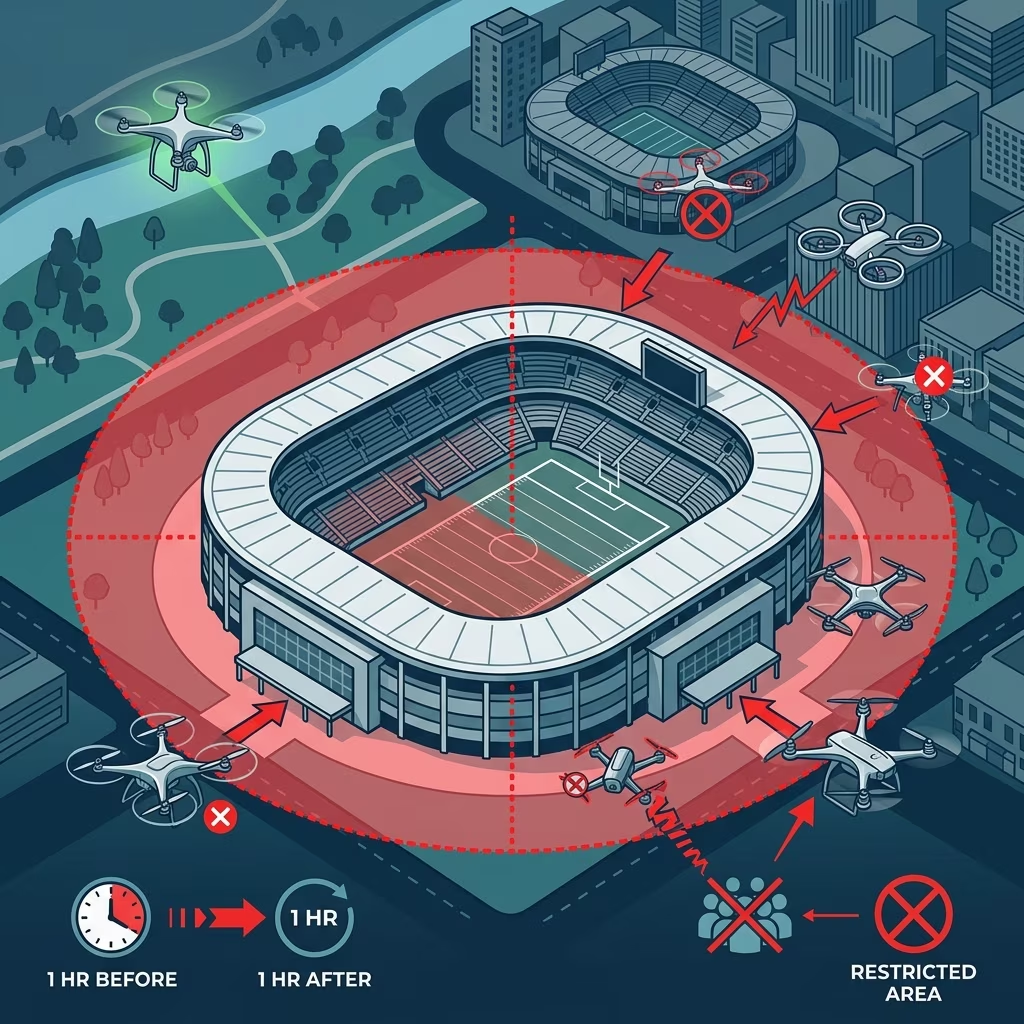
According to the FAA, federal law restricts unmanned aircraft from flying at or below 3,000 feet above ground level within a three nautical mile radius of certain large stadiums during defined time windows around specific events. This restriction is part of a broader effort to protect the National Airspace System and large crowds at major sporting contests.
Key Federal Stadium Rules in Plain Language
For most drone pilots, the most important rule to remember is the recurring stadium restriction that applies to major professional and college sports and large motor races. The FAA summarizes this as a “no drone zone” in and around qualifying stadiums.
- Coverage radius: Unmanned aircraft operations are prohibited within a 3 nautical mile radius of the stadium or venue.
- Vertical limit: The restriction applies up to and including 3,000 feet above ground level (AGL).
- Time window: The ban starts one hour before the scheduled start of the event and ends one hour after the event concludes.
- Capacity threshold: The rule applies to stadiums that can seat 30,000 or more spectators.
- Covered events: Major League Baseball (MLB) games, National Football League (NFL) games, NCAA Division I football games, and major motor speedway events such as NASCAR Sprint Cup, IndyCar, and Champ Series races.
These restrictions are nationwide and apply regardless of whether the drone is flown recreationally or commercially.
Temporary Flight Restrictions (TFRs) and Large Events
Beyond recurring stadium rules for specific leagues, the FAA can impose Temporary Flight Restrictions for other major events and security-sensitive situations. A TFR temporarily limits or prohibits aircraft operations in a defined area for a specific timeframe. TFRs can apply to all aircraft or specifically to unmanned aircraft systems (UAS), depending on the authority used.
At large outdoor gatherings, such as international tournaments, political events, or major concerts, a TFR may create a broader or more tailored no-fly zone than the standard stadium rule. Recent guidance allows drone-only TFRs requested by law enforcement for stadium-type venues and very large outdoor gatherings.
- Stadium/venue category: Used for venues that have previously required special security instructions, are not fully enclosed, are publicly advertised, and expect at least 30,000 attendees.
- Other large gathering category: Applies to primarily outdoor events with defined boundaries, publicly advertised, and expecting at least 100,000 attendees.
- Requested by law enforcement: Only designated law enforcement agencies can request these UAS-specific TFRs, and they must do so in advance.
During major global events, such as the FIFA World Cup hosted in U.S. cities, the FAA, in coordination with other security agencies, has established strict no-drone zones covering stadiums, fan festivals, and related venues. Unauthorized flights in those TFRs can be treated not merely as regulatory violations, but as federal crimes.
How Stadium Restrictions Interact with General Drone Rules
Stadium restrictions do not replace general drone safety standards; they add extra layers of protection. Drone operators must comply with the broader FAA regulations that apply nationwide, in addition to respecting stadium and event-specific bans.
| Regulation Area | General Drone Rule | Stadium / Event-Specific Rule |
|---|---|---|
| Altitude | Fly at or below 400 ft AGL in uncontrolled (Class G) airspace, unless specifically authorized. | During covered stadium events, drones are banned at or below 3,000 ft AGL within 3 NM of the venue. |
| Airspace Authorization | Obtain FAA authorization (e.g., via LAANC or DroneZone) when flying in controlled airspace. | Authorization for stadium or event TFR areas is only possible in narrow circumstances and typically requires coordination with the FAA and law enforcement. |
| Remote ID & Registration | Drones over 0.55 lb must be registered, and most must broadcast Remote ID. | Even a registered, Remote ID compliant drone cannot lawfully fly in a stadium no-fly zone during a restricted period. |
| Operations Over People | Only permitted under specific categories and conditions defined by the FAA (usually Part 107). | Stadium bans generally prohibit operations altogether over the crowd and surrounding area during applicable events. |
Penalties for Violating Stadium and Event No-Fly Zones
Flying a drone in violation of a stadium restriction or event-related TFR can trigger multiple layers of consequences. Depending on the circumstances, enforcement may involve the FAA, federal law enforcement, and local police.
- Administrative penalties: The FAA can issue civil penalties, including substantial fines for violating airspace restrictions or operating rules.
- Criminal exposure: For certain security-sensitive events, unauthorized flights inside TFRs may constitute federal crimes, potentially exposing the operator to imprisonment and significant fines.
- Seizure or loss of equipment: Drone equipment used in a prohibited flight may be confiscated, especially if connected with criminal charges or ongoing investigations.
- Licensing and certification impacts: Commercial remote pilots holding Part 107 certificates may face suspension or revocation of their certification for serious violations.
In video guidance related to major tournament venues, the FAA has emphasized that flying a drone in these restricted areas is not a minor infraction: operators risk losing their drone, being fined, and potentially serving up to a year in federal prison for knowing violations.
Checking for Stadium and Event Restrictions Before You Fly
The safest habit any drone pilot can develop is to check airspace restrictions before each flight. Stadium rules and event TFRs are predictable, but they may change or expand depending on security assessments and new legislation.
Practical steps include:
- Consult official FAA resources on airspace restrictions near sporting events and stadiums.
- Use FAA-approved apps or services that display active TFRs and no-fly zones for unmanned aircraft.
- Review major event schedules in your area, especially for professional sports, NCAA Division I football, and large motor races.
- Monitor announcements from law enforcement or emergency management agencies about airspace restrictions around major outdoor events.
For very large gatherings or high-profile events, local emergency management agencies and law enforcement often share public advisories emphasizing that venues and fan festivals are no-drone zones and that TFRs are in effect.
Authorized Operations Within Restricted Airspace
Although most recreational pilots and independent operators must avoid these no-fly zones, not every drone operation is automatically barred. Under certain conditions, the FAA and requesting law enforcement agencies may authorize limited UAS operations within event TFRs when they are necessary for safety, security, or compliance.
Authorized operators may include:
- Law enforcement or public safety agencies conducting situational awareness, crowd monitoring, or emergency response.
- Event security teams using drones under coordinated authorization for perimeter surveillance.
- Media organizations with special waivers in tightly controlled circumstances.
These operations typically require formal approval, detailed risk assessments, and strict coordination with event organizers, law enforcement, and the FAA. Casual drone flights or unapproved commercial projects are not eligible for these exceptions.
Best Practices for Drone Pilots Near Stadiums
To fly responsibly and avoid conflicts with stadium restrictions and TFRs, drone pilots can adopt a few practical best practices.
- Plan flights away from major venues: Before choosing a flying location, check for nearby stadiums and large outdoor arenas.
- Respect time buffers: Avoid flying in the vicinity of stadiums on game days or event days, even outside the formal one-hour windows.
- Stay informed on local sports calendars: Know when local teams have home games and when major events are scheduled.
- Develop a habit of checking TFRs: Use official channels to confirm whether any event-related restrictions are active near your planned flight area.
- Consider alternative locations: Parks, rural landscapes, and designated flight areas typically pose fewer regulatory complications.
By integrating these habits into flight planning, drone pilots reduce legal risk, support event security, and contribute to the safe use of airspace.
Frequently Asked Questions (FAQs)
1. Can I fly a drone over a stadium during a game if I stay below 400 feet?
No. The stadium restriction applies within a three nautical mile radius and up to 3,000 feet AGL, regardless of whether you fly below the usual 400-foot limit. During MLB, NFL, NCAA Division I football, and certain motor racing events at large stadiums, drones are prohibited during the defined time window.
2. Do these rules apply when the stadium is empty?
The specific federal stadium restriction is tied to qualifying events and applies from one hour before the scheduled start to one hour after the end of the event. Outside those times, general airspace rules apply. However, other local or temporary restrictions may still be in effect, so pilots should always verify current airspace status.
3. Are smaller college games or local sports events automatically covered?
Not necessarily. The standard stadium rule focuses on MLB, NFL, NCAA Division I football games, and major motor speedway events at venues with seating capacity of 30,000 or more. Other events may require separate TFRs or local restrictions. Large gatherings could fall under newer drone-only TFR categories if law enforcement requests them.
4. How do I know if a Temporary Flight Restriction is active near me?
Active TFRs are published through FAA channels and can be viewed using approved applications or official web resources that display current airspace limitations. Checking these resources before flying is essential, especially in areas near major stadiums or high-profile events.
5. What should I do if I accidentally fly into a stadium no-fly zone?
If a pilot realizes they are in restricted airspace, they should safely exit the area immediately, land as soon as practical, and avoid repeating the behavior. Reporting the incident may be appropriate in some circumstances. However, because penalties can be serious, the best strategy is thorough pre-flight planning to avoid such situations altogether.
Stadium Restrictions in the Broader Drone Law Landscape
Stadium and large event restrictions are just one part of the evolving drone regulatory environment in the United States. Drone pilots must navigate an interplay of FAA rules, state laws, local ordinances, and situational measures like event TFRs.
Key context points include:
- Federal baseline: The FAA sets core safety rules, including registration requirements, Remote ID, altitude limits, and operational categories for recreational and commercial pilots.
- State and local layers: States and municipalities may implement additional rules addressing privacy, critical infrastructure, and use of public lands.
- Event-driven restrictions: Stadium bans and TFRs are activated based on scheduled games, races, or major gatherings, and may expand in response to changes in security policy.
For pilots, this means that compliance is not a one-time checklist but an ongoing practice of staying informed, using reliable tools, and treating stadium and event areas with extra caution.
References
- Can I fly a model aircraft or UAS over a stadium or sporting events for hobby or recreation? — Federal Aviation Administration. 2023-06-01. https://www.faa.gov/faq/can-i-fly-model-aircraft-or-uas-over-stadium-or-sporting-events-hobby-or-recreation
- Drones Are Prohibited In and Around Stadiums — Federal Aviation Administration. 2023-09-15. https://www.faa.gov/uas/resources/community_engagement/no_drone_zone/stadiums
- Stadiums and Sporting Events — Federal Aviation Administration. 2023-09-15. https://www.faa.gov/uas/getting_started/where_can_i_fly/airspace_restrictions/sports_stadiums
- Drone TFR for Large Events and Stadiums: FAA Issues New 2025 Rules — Aero Defense Tech. 2025-08-07. https://blog.aerodefense.tech/drone-tfr
- World Cup Venue Drone Rules — NewsNation. 2026-06-05. https://www.newsnationnow.com/us-news/sports/world-cup/world-cup-venue-drone-rules-faa/
- Drones Are Prohibited In and Around Stadiums (Video: World Cup No Drone Zones) — Federal Aviation Administration via YouTube. 2026-05-30. https://www.youtube.com/watch?v=TyYTI-dzkmg
- Drone Laws in the USA — Drone U. 2026-01-10. https://www.thedroneu.com/blog/usa-drone-laws-regulations-by-state/