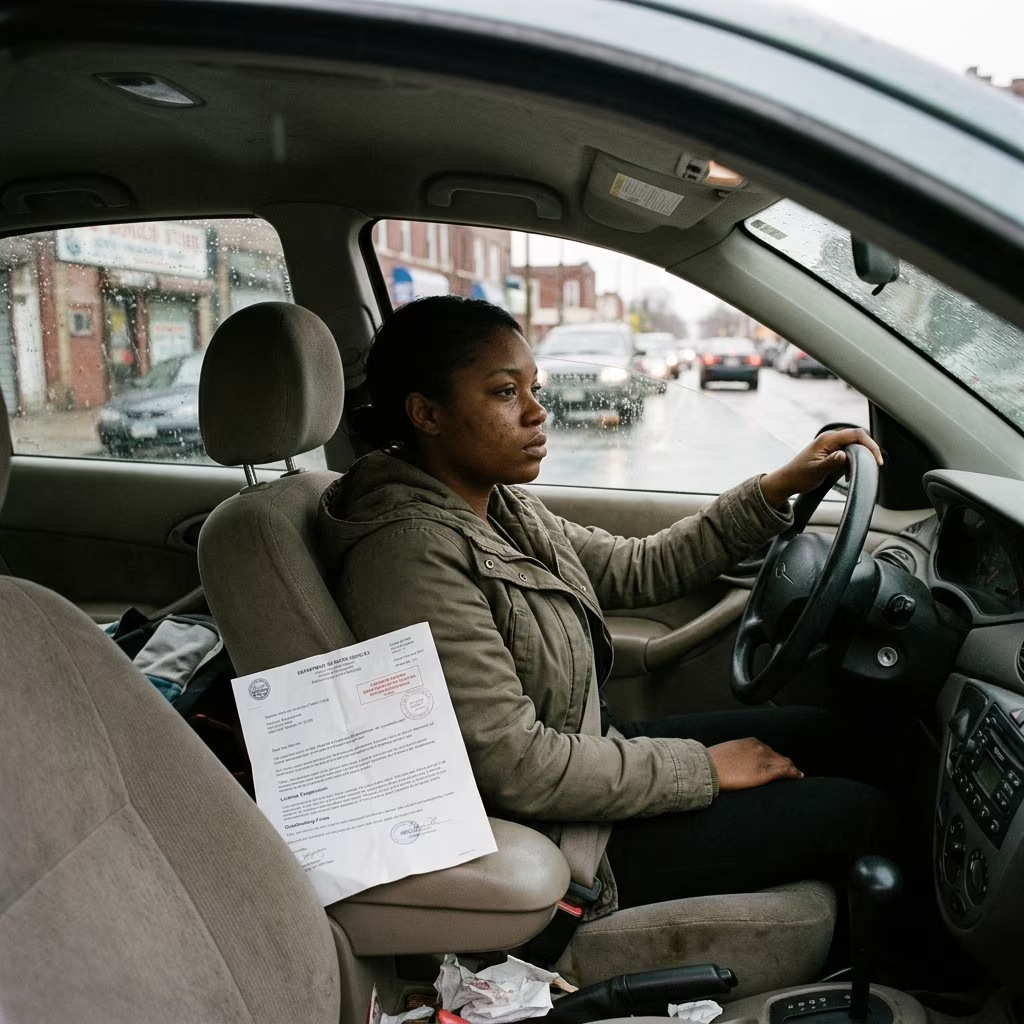
Across the United States, millions of people have lost their driver’s licenses not because they are dangerous on the road, but because they are too poor to pay traffic fines and fees. Civil rights organizations have increasingly challenged these practices, arguing that suspending licenses for unpaid debt effectively criminalizes poverty and violates basic principles of due process and equal protection.
This article explores how driver’s license suspension systems work, why they disproportionately harm low‑income communities and communities of color, and how litigation and legislative reforms are reshaping the landscape in places like California and Washington State.
From Traffic Tickets to Life‑Altering Consequences
What begins as a minor traffic infraction can quickly escalate into a serious economic and legal crisis. In many states, courts and motor vehicle departments historically suspended licenses when a person failed to pay fines or missed a court date, often without any assessment of whether the driver had the ability to pay.
- A routine traffic stop leads to a ticket and monetary fine.
- If the fine isn’t paid on time, late fees and collection costs may be added.
- In some jurisdictions, the court reports the unpaid debt or a missed appearance to the motor vehicle agency.
- The agency then suspends the driver’s license, sometimes automatically and without a hearing.
These systems are frequently described as license‑for‑payment schemes, because the ability to legally drive can hinge less on safety and more on the driver’s financial resources.
| Issue | Traditional Safety‑Based Suspension | Debt‑Based Suspension |
|---|---|---|
| Primary Trigger | Serious moving violations (e.g., DUI, reckless driving) | Unpaid fines, fees, or failure to appear in court |
| Goal | Protect public safety | Coerce payment and enforce court compliance |
| Assessment of Ability to Pay | Not typically relevant | Often not considered, even for indigent drivers |
| Main Consequence | Removing dangerous drivers from the road | Economic hardship, job loss, and increased criminal justice contact |
The Legal Challenge: Driving While Poor
Advocacy organizations, including the American Civil Liberties Union (ACLU), legal aid groups, and community law centers, have filed lawsuits arguing that automatic license suspensions for unpaid tickets violate constitutional guarantees of due process and equal protection, particularly when there is no meaningful inquiry into a person’s ability to pay.
One core legal argument is that a court’s power to suspend a license should be limited to situations where a driver willfully fails to pay—a deliberate refusal rather than an inability caused by poverty. In California litigation, civil rights lawyers contended that state law allows suspension only for failure to appear, and even then the failure must be willful, not the product of financial hardship or unstable circumstances.
- Due process concerns: Some courts have found that suspending licenses without a meaningful ability‑to‑pay evaluation denies drivers fair procedures before a significant property interest—their license—is taken away.
- Equal protection concerns: When license suspensions fall almost exclusively on people who are poor, they can function as de facto discrimination based on wealth, deepening inequality.
- Statutory interpretation: Litigants have argued that state statutes cannot be read to authorize blanket suspensions for debt where the text limits sanctions to deliberate non‑compliance, such as willful failure to appear.
Case Studies: Washington and California
Washington State: A Moratorium on Debt‑Based Suspensions
In Washington State, a Thurston County Superior Court judge ruled that the state’s law allowing automatic and mandatory license suspensions for unpaid non‑criminal moving violations, without meaningful evaluation of ability to pay, violated the state constitution’s due process protections.
Following that decision, the court ordered the Department of Licensing to:
- Stop suspending licenses for failure to pay traffic tickets.
- Rescind existing suspensions based on failure to pay, failure to appear, or failure to comply with ticket terms.
- Maintain a moratorium until new legislative reforms took effect, including a law (ESSB 5226) designed to reduce or eliminate debt‑based suspensions.
Advocates estimated that roughly 100,000 residents would see their licenses reinstated, marking a major step away from penalizing people for “driving while poor.”
California: Narrowing the Grounds for Suspension
In California, lawsuits and advocacy focused on how courts and the Department of Motor Vehicles (DMV) handled license suspensions for unpaid fines and failures to appear. A key issue was whether existing law truly permitted suspensions for non‑payment, or whether it was limited to failures to appear in court.
In 2020, a California Court of Appeal agreed with plaintiffs that state law did not authorize license suspension simply for unpaid traffic debt. Instead, it held that the statute allowed suspension only for failure to appear, and even then under specific conditions.
Following litigation and pressure from a coalition of civil rights groups, the California DMV reported lifting more than half a million improperly imposed license suspensions, signaling a major policy shift away from debt‑based penalties.
- Over 550,000 suspensions were rescinded after the court clarified the limits of state law.
- Courts were pushed to examine whether drivers had the resources to pay before imposing harsh consequences.
- Advocates emphasized that enforcement should target dangerous driving, not unpaid bills.
Economic and Social Impacts on Low‑Income Communities
Research and policy analysis show that license suspension schemes have far‑reaching consequences for individuals and families, particularly those already living on the economic margins.
Job Loss and Reduced Earning Potential
For many workers, driving is essential to maintaining employment. Losing a license can lead directly to job loss or force workers into unstable, time‑consuming, and sometimes costly alternative transportation arrangements.
- Workers who rely on cars to reach jobs, childcare, or medical appointments may have no practical alternatives, especially in regions with limited public transit.
- Without a license, workers may be unable to accept shifts, travel to new job sites, or pursue employment opportunities in neighboring areas.
- Reduced income makes it even harder to pay off the underlying fines, creating a feedback loop of debt and non‑compliance.
Increased Exposure to the Criminal Justice System
When people continue to drive out of necessity on suspended licenses, they risk additional citations, arrests, and criminal charges, even though the underlying issue is often economic rather than behavioral.
- Driving with a suspended license can be a criminal offense or carry enhanced penalties in many jurisdictions.
- Each new stop may generate more fines and fees, compounding the debt.
- Police, prosecutors, and courts must devote time and resources to enforcing and processing these cases instead of focusing exclusively on public safety threats.
Disproportionate Impact on Communities of Color
Studies and advocacy reports indicate that debt‑based license suspensions disproportionately affect communities of color, reflecting broader patterns of racial and economic inequality in traffic enforcement and the criminal justice system.
- Communities of color are often subject to higher rates of traffic stops and citations.
- Income disparities mean that fines and fees fall more heavily on these communities, increasing the risk of unpaid debt.
- Suspensions then translate into lost economic opportunities and further criminal justice involvement, reinforcing cycles of disadvantage.
Why Courts and Legislatures Are Rethinking License Suspensions
As evidence mounts that debt‑based suspension schemes harm public welfare, state courts and legislatures are reconsidering how traffic debt should be handled.
Policy Reasons to Move Away from Debt‑Based Suspensions
- Public safety focus: Resources are better directed toward genuinely dangerous driving behaviors, such as impaired or reckless driving, rather than penalizing people for unpaid bills.
- Economic stability: Allowing people to keep their licenses helps them work, support families, and ultimately pay off obligations, rather than pushing them into deeper poverty.
- Administrative efficiency: Courts and motor vehicle agencies can reduce caseloads and administrative burdens by avoiding suspension processes that generate little net revenue.
- Fairness and legitimacy: Systems perceived as punishing poverty can undermine public trust in courts and law enforcement.
Emerging Reform Strategies
Reform efforts typically combine legal challenges, legislative changes, and administrative policy shifts. Strategies used in different states include:
- Eliminating automatic suspensions for unpaid non‑criminal traffic tickets.
- Requiring courts to conduct ability‑to‑pay hearings before imposing sanctions.
- Offering payment plans, community service options, or fine reductions for low‑income defendants.
- Clarifying statutory language to limit suspension authority to specific, willful non‑compliance (such as intentional failure to appear).
- Directing motor vehicle departments to rescind past suspensions based solely on unpaid debt.
Frequently Asked Questions
1. Why do some states suspend driver’s licenses for unpaid tickets?
Many states adopted license suspension policies as a way to enforce court orders and encourage payment of fines and fees. The idea was that the threat of losing a license would compel compliance. Over time, however, evidence showed that these systems mainly punished people who could not afford to pay, without significantly improving collections.
2. Is it constitutional to suspend a license for unpaid fines?
Courts differ, but some have held that automatic, mandatory suspensions without a meaningful ability‑to‑pay evaluation violate due process protections under state constitutions. In Washington State, for example, a judge found that suspending licenses for unpaid non‑criminal moving violations without such an inquiry denied drivers fair procedures.
3. How are civil rights groups challenging these policies?
Organizations such as the ACLU have filed lawsuits arguing that debt‑based suspensions criminalize poverty, lack adequate procedural safeguards, and exceed statutory authority. They seek court orders halting suspensions, requiring agencies to reinstate licenses, and clarifying that laws cannot be used to punish people simply because they are poor.
4. Do reforms mean dangerous drivers keep their licenses?
No. Most reforms distinguish between safety‑related suspensions and debt‑based suspensions. States can still suspend licenses for serious moving violations, such as driving under the influence or reckless driving. The changes mainly affect people whose licenses were suspended for unpaid tickets or administrative failures linked to poverty.
5. What should drivers do if their license was suspended for unpaid debt?
Available options vary by state. In jurisdictions that have enacted reforms or court orders, drivers may be able to request reinstatement, enter payment plans, or ask courts for ability‑to‑pay hearings. Consulting local court clerks, legal aid organizations, or civil rights groups can help affected individuals understand current rules and potential remedies.
Practical Steps for Policy Makers and Advocates
For those working to address the harms of debt‑based suspension systems, several practical steps can help drive change.
- Data collection: Gather local data on how many licenses are suspended for non‑payment, the demographics of affected drivers, and the economic impact.
- Legal analysis: Examine state statutes and case law to determine whether current suspension practices align with legislative intent and constitutional protections.
- Coalition building: Partner with legal aid organizations, community groups, and civil rights advocates to coordinate litigation and policy campaigns.
- Legislative reform: Draft bills that eliminate or sharply limit debt‑based suspensions, require ability‑to‑pay hearings, and expand alternatives like payment plans.
- Public education: Inform affected communities about their rights, the risks of driving with suspended licenses, and available pathways to reinstatement.
By refocusing license suspension on genuine public safety concerns and removing poverty as a basis for losing the legal right to drive, jurisdictions can strengthen both justice and economic stability.
References
- Discriminatory Driver’s License Suspension Schemes — American Constitution Society. 2018-06-01. https://www.acslaw.org/issue_brief/briefs-landing/discriminatory-drivers-license-suspension-schemes/
- Judge Orders Halt to Driver’s License Suspensions for Unpaid Tickets — American Civil Liberties Union. 2021-06-14. https://www.aclu.org/press-releases/judge-orders-halt-drivers-license-suspensions-unpaid-tickets-washington-state
- Court Agrees Not to Suspend Licenses of Drivers Too Poor to Pay Traffic Fines — FindLaw Legal Blogs. 2020-06-15. https://www.findlaw.com/legalblogs/california-case-law/court-agrees-not-to-suspend-licenses-of-drivers-too-poor-to-pay-traffic-fines/
- ACLU Sues Northern California Court Over License Suspensions — Lawyers’ Committee for Civil Rights of the San Francisco Bay Area. 2017-09-06. https://lccrsf.org/news/aclu-sues-northern-california-court-over-license-suspensions/
- PRESS RELEASE: CA DMV Reports Lifting 554,997 Improperly Imposed Driver’s License Suspensions — Western Center on Law & Poverty. 2020-07-28. https://wclp.org/press-release-ca-dmv-reports-lifting-554997-improperly-imposed-drivers-license-suspensions/
- Judge Orders Halt to Driver’s License Suspensions for Unpaid Tickets — ACLU of Washington. 2021-06-14. https://www.aclu-wa.org/press-releases/judge-orders-halt-drivers-license-suspensions-unpaid-tickets/