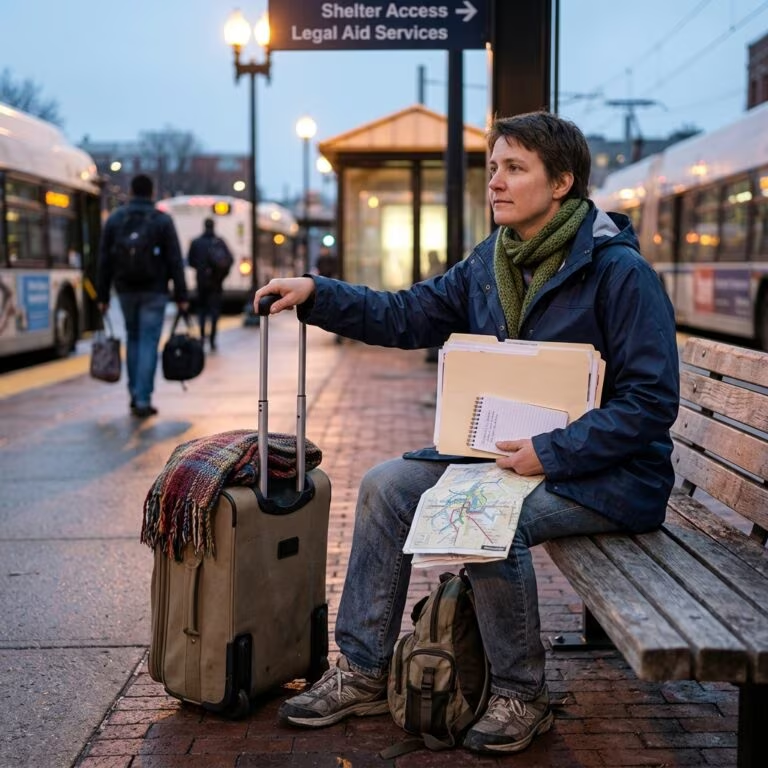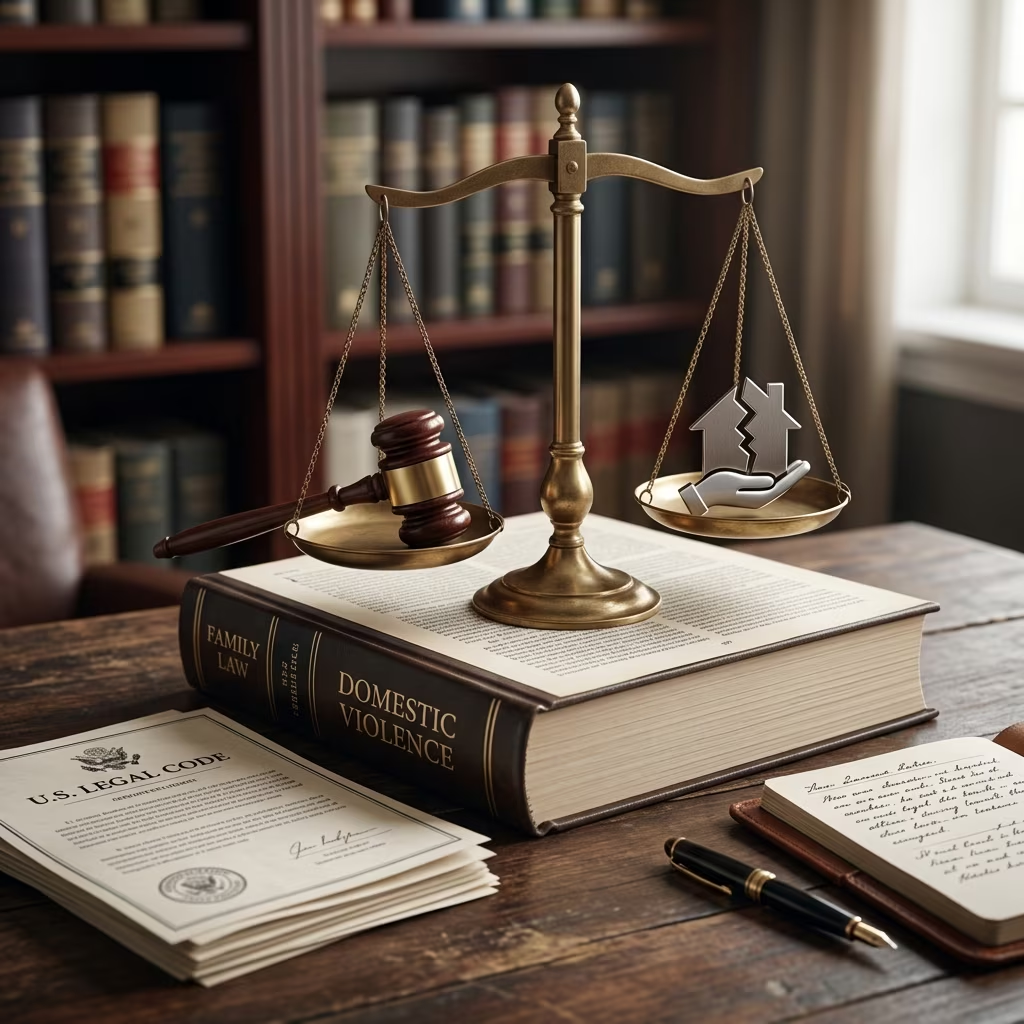
Domestic violence law in the United States is built around one central goal: reducing harm while giving survivors practical tools to stay safe. The legal framework includes federal criminal laws, firearm restrictions, housing protections, and victim services that work alongside state and local rules. Together, these measures recognize that abuse can involve physical violence, threats, stalking, coercion, and patterns of control, not only visible injuries.
Because domestic violence cases often overlap with family law, criminal law, housing law, and public safety policy, the legal response is broader than a single statute. Federal law is especially important when abuse crosses state lines, occurs on federal or tribal land, involves interstate stalking, or includes unlawful firearm possession by a prohibited person.
What the legal system tries to prevent
Modern domestic violence laws are designed to interrupt patterns of control and prevent escalation. Survivors may need protection from physical assault, stalking, threats, harassment, financial abuse, or abuse involving technology and communications. Federal law and related victim-service guidance recognize that abuse can include conduct used to gain or maintain power over another person.
- Stopping imminent harm through protection orders and emergency intervention
- Punishing conduct that crosses state lines or federal jurisdictional boundaries
- Restricting firearm access for people legally barred from possession
- Protecting housing access and confidentiality for survivors
- Connecting victims with shelters, hotlines, legal help, and crisis support
Federal crimes linked to domestic violence
Some domestic violence conduct becomes a federal crime when it involves interstate activity, Indian country, maritime or territorial jurisdiction, or other federal interests. Under the Violence Against Women Act framework, federal law criminalizes certain acts such as crossing state lines to injure an intimate partner, crossing state lines to stalk or harass, or crossing state lines to violate a qualifying protection order.
These offenses matter because abusers sometimes use travel, relocation, or jurisdictional gaps to avoid consequences. Federal law helps close those gaps by making the movement itself part of the offense when it is tied to abusive conduct.
| Federal issue | Typical legal focus |
|---|---|
| Interstate violence | Crossing state lines to commit injury against an intimate partner |
| Interstate stalking or harassment | Travel or communications used to stalk, threaten, or harass |
| Protection-order violations | Crossing state lines or entering Indian country to violate an order |
| Firearm possession | Possession while prohibited by domestic violence law or court order |
These federal crimes are commonly treated as serious offenses, and guidance from the Department of Justice describes them as felonies.
How firearm restrictions work
One of the most significant federal tools is the domestic violence firearm prohibition. Under federal law, people convicted of a qualifying misdemeanor crime of domestic violence generally may not possess firearms or ammunition. In addition, people subject to a qualifying protection order may also be barred from possession.
The firearm ban reflects the well-documented connection between domestic abuse and lethal escalation. Federal law does not treat every conflict the same way; instead, it focuses on legal disqualifiers such as certain convictions and court orders. The result is a targeted safety measure rather than a broad criminal rule.
- A qualifying misdemeanor domestic violence conviction can trigger federal firearm disability
- A qualifying protection order can also restrict firearm possession
- Violating the firearm ban can create a separate federal offense
- The law applies nationwide, not just in the state where the order or conviction arose
Protection orders and survivor safety
Protection orders, sometimes called restraining orders, are among the most common legal tools available to survivors. These orders are designed to reduce contact, set boundaries, and provide a clearer basis for police and courts to act if the abuser ignores the order. Federal law can make it a crime to cross state lines to violate a qualifying order, which gives these civil orders real enforcement force.
A protection order may require the abuser to stay away from the survivor, stop contacting them, leave shared premises, or surrender firearms where required by law. While details vary by state, the broader legal purpose is consistent: create enforceable distance and reduce the chance of repeated abuse.
Housing rights for survivors
Domestic violence often creates housing instability, and federal housing protections are meant to reduce that risk. Under the Violence Against Women Act housing provisions, survivors of domestic violence, dating violence, sexual assault, and stalking may receive protections in certain HUD-subsidized or HUD-assisted housing programs.
These protections are important because survivors should not lose housing simply because they experienced abuse. HUD guidance states that survivors cannot be denied admission, evicted, or have assistance terminated based on violence committed against them, and they may also request an emergency transfer for safety reasons.
- Protection from denial of admission based on abuse-related circumstances
- Limits on eviction or termination of assistance because of victimization
- Right to confidentiality regarding survivor status
- Ability to request emergency transfer in appropriate cases
- Potential lease bifurcation to remove the abuser from the lease or unit
These rules reflect a practical understanding of abuse dynamics. A survivor may have a poor credit record, an eviction history, or criminal allegations tied to the abuse, but those facts should not automatically erase access to housing protections when the underlying problem is victimization.
What counts as domestic violence in legal terms
Legal definitions are not identical across all statutes, but federal victim-services guidance describes domestic violence as involving physical abuse, sexual abuse, or a pattern of coercive behavior used to control a victim. That can include psychological, economic, verbal, and technological abuse, even when every act is not itself separately prosecuted as a crime.
This broader framing matters because abusive conduct often appears in layers. Threats may be paired with isolation, economic dependency, digital surveillance, or manipulation of children and housing. Laws that recognize coercive control are better suited to real-world abuse than laws focused only on isolated assaults.
Why federal and state systems both matter
Domestic violence enforcement in the United States is shared by state, tribal, and federal authorities. State law usually handles day-to-day criminal charges, family court matters, custody disputes, and local protective orders. Federal law becomes especially important when the conduct fits a national statute, uses interstate travel, occurs in federal or tribal territory, or involves firearm prohibitions and certain enforcement priorities.
This layered structure can be confusing, but it gives survivors more than one path to protection. A person may seek a protective order in state court, report criminal conduct to local police, and still benefit from federal housing or firearm restrictions where applicable.
Support services and practical assistance
Law alone does not solve domestic violence. Effective response depends on access to hotlines, advocacy, shelters, emergency housing, legal services, and trauma-informed support. Federal and national resources exist to help survivors connect with local providers and emergency assistance.
Common forms of support include:
- Crisis counseling and safety planning
- Emergency shelter and confidential housing referrals
- Help filing protection orders
- Legal assistance for custody, divorce, and related matters
- Interpretation and culturally responsive services
- Support navigating police, courts, and benefit systems
The Department of Justice and related federal agencies also direct survivors to state-specific resource networks, recognizing that local service providers often play the most immediate role in safety planning and case coordination.
How survivors can use the law strategically
In practice, survivors often benefit from combining tools rather than relying on a single remedy. A protection order may reduce direct contact, a housing transfer may improve physical safety, and a firearm prohibition may reduce the risk of lethal escalation. When a case also involves interstate travel, stalking, or violation of an existing order, federal law may add another enforcement path.
Legal planning is usually strongest when it is tailored to the survivor’s immediate risks. For some people, the priority is preventing contact. For others, it is securing housing, addressing child safety, or making sure an abusive partner cannot legally possess a gun. Domestic violence law is most effective when it is used as a coordinated safety strategy rather than as a single isolated filing.
Common questions about domestic violence laws
Are all domestic violence offenses federal crimes?
No. Most domestic violence cases are handled under state law, but federal law applies in specific situations such as interstate conduct, qualifying protection-order violations, and unlawful firearm possession.
Can a survivor stay in federally assisted housing?
Yes, survivors generally have important protections under VAWA-related housing rules, including limits on denial, eviction, and termination based on abuse committed against them.
Does domestic violence law cover more than physical assault?
Yes. Legal and victim-services definitions can include coercive control, threats, sexual abuse, psychological abuse, economic abuse, and technological abuse.
Can a protection order affect firearm possession?
Yes. Federal law may prohibit firearm and ammunition possession by a person subject to a qualifying protection order.
Why is federal law important if state law already exists?
Federal law fills jurisdictional gaps, strengthens enforcement in interstate cases, and provides national rules for firearms, housing protections, and victim support.
Key takeaways for readers
Domestic violence law in the United States is not limited to criminal punishment. It is a system of prevention, protection, and survivor support that reaches across criminal courts, civil orders, housing programs, and firearm restrictions. The federal role is especially important when abuse crosses borders, involves prohibited weapons possession, or requires protections that state systems alone may not fully provide.
For survivors, the most useful legal response is often the one that matches the immediate risk: a protection order, a safe housing plan, enforcement of firearm restrictions, or access to a local advocate who can help coordinate next steps. The law works best when it is treated as part of a broader safety plan, not as a stand-alone solution.
References
- Domestic violence | Wex — Cornell Law School Legal Information Institute. 2025-01-01. https://www.law.cornell.edu/wex/domestic_violence
- Federal Domestic Violence Laws — U.S. Department of Justice, U.S. Attorney’s Office for the Western District of Tennessee. 2024-01-01. https://www.justice.gov/usao-wdtn/victim-witness-program/federal-domestic-violence-laws
- Violence Against Women Act (VAWA) — U.S. Department of Housing and Urban Development. 2025-01-01. https://www.hud.gov/vawa
- Violence Against Women Act — National Network to End Domestic Violence. 2025-01-01. https://nnedv.org/content/violence-against-women-act/
- Domestic Violence in the United States — U.S. Department of State. 2024-01-01. https://travel.state.gov/content/dam/NEWadoptionassets/pdfs/Domestic%20Violence%20Brochure%20(English).pdf
- Domestic Violence in the United States — Wikipedia. 2025-01-01. https://en.wikipedia.org/wiki/Domestic_violence_in_the_United_States
- Domestic Violence Laws — U.S. Department of Justice, U.S. Attorney’s Office for the Central District of California. 2024-01-01. https://www.justice.gov/usao-cdca/domestic-violence-laws