
Domestic Partnerships in Michigan: Local Options, Limits, and Legal Planning
Understand how Michigan’s limited domestic partnership recognition works, which cities offer registries, and how unmarried couples can protect their rights.
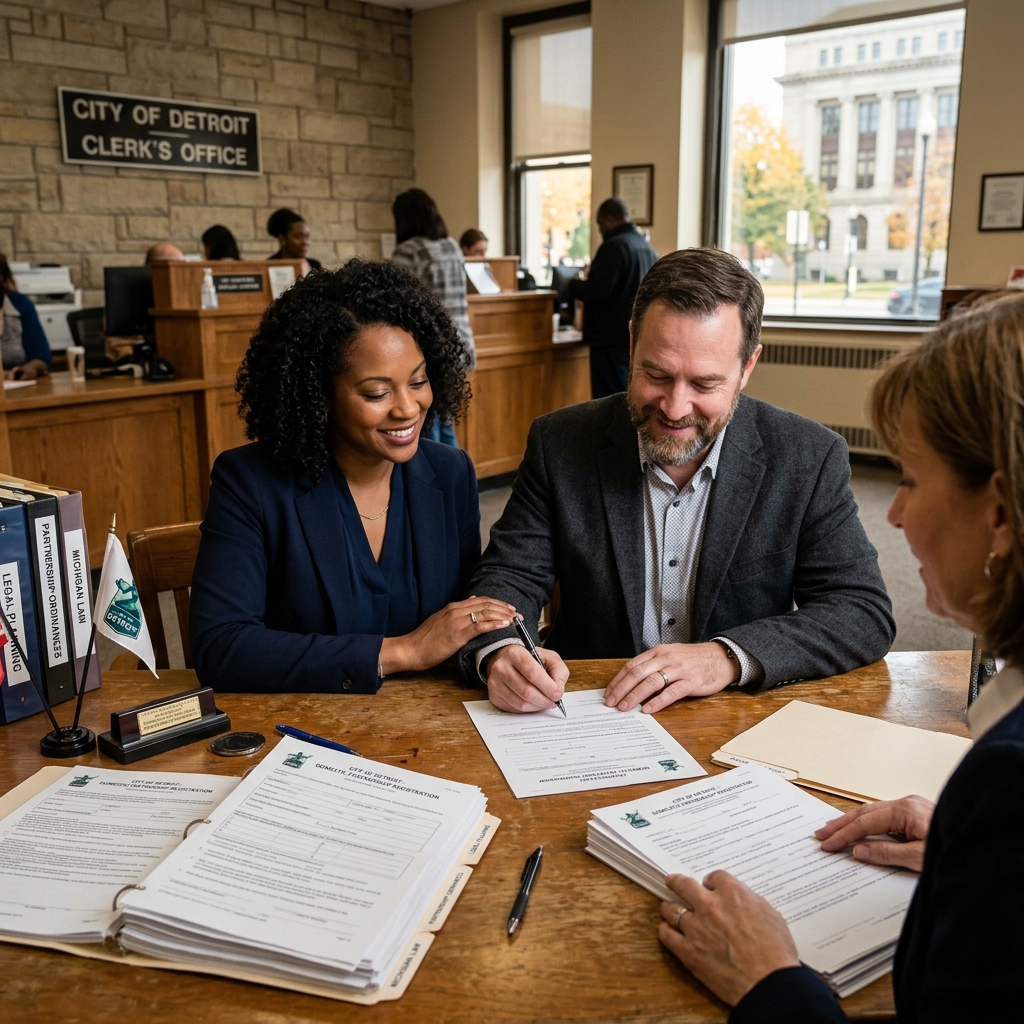
Unmarried couples in Michigan often want legal recognition for their relationships without getting married. Domestic partnerships can be one way to do this, but Michigan’s approach is more limited and localized than many people expect. This guide explains where domestic partnerships are recognized in Michigan, what local registries do, and how cohabiting couples can protect their rights using other legal tools.
Statewide Rules: What Michigan Does and Does Not Recognize
At the state level, Michigan does not create a formal domestic partnership status comparable to marriage. There is no statewide statute that defines domestic partnership rights or provides a uniform registration and dissolution process.
Instead, Michigan law focuses on marriage as the primary form of legally recognized intimate partnership. Common-law marriage has been abolished, and living together—even for many years—does not create marital rights by itself. Couples who do not marry remain separate legal individuals unless they take additional steps to contract for specific rights.
- No statewide domestic partnership status: There is no Michigan law that automatically grants property, inheritance, or support rights based on domestic partnership alone.
- No common-law marriage: Time spent cohabiting does not convert a relationship into a legal marriage in Michigan.
- Marriage remains central: Most default rights for couples—such as spousal inheritance, tax filing, and divorce procedures—apply only to legal spouses under state law.
There are, however, specific statutory contexts in which the term domestic partner appears—for example, in labor or employment regulations—but these do not create a general, statewide domestic partnership system with broad family-law rights.
Local Domestic Partnership Registries in Michigan
Although the state does not authorize domestic partnerships across Michigan, several cities and counties have adopted local ordinances to recognize domestic partnerships within their jurisdictions. These local registries allow couples to formally declare their relationship and obtain a certificate or registration number that can be used for limited purposes, such as employer benefits or city policies.
Examples of Michigan Local Governments Recognizing Domestic Partnerships
Local recognition is available only in certain communities. According to legal resources, the following types of jurisdictions have established domestic partnership registries:
- Major cities such as those in southeastern and mid-Michigan that have adopted inclusive relationship policies.
- University-oriented municipalities that often seek to recognize a broad range of family structures.
- Counties that have implemented registries to coordinate benefits for employees or residents.
Each local government sets its own rules about how partnerships are registered, what documentation is required, and whether non-residents may use the registry. For example, some municipalities allow any Michigan resident to register, while others limit registration to people living within the city or county.
| Feature | Typical Local Approach |
|---|---|
| Who can register | Adults who meet age, residency, and relationship requirements; details vary by city or county. |
| Recognition level | Applies mainly within the local jurisdiction and for employers or institutions that choose to honor the registry. |
| Proof of partnership | Signed declaration, notarization, and sometimes witness signatures; may need supporting evidence of cohabitation or mutual support. |
| End of partnership | Usually requires a signed and notarized termination form filed with the same office that accepted the declaration. |
Typical Qualifications for Local Domestic Partnerships
While each registry has its own ordinance, domestic partnership requirements across Michigan’s local governments are broadly similar. Couples are generally expected to meet all of the following conditions:
- Both partners are at least 18 years old and legally competent.
- Neither partner is married to someone else nor registered in another domestic partnership.
- They are not closely related by blood in a way that would legally bar them from marrying.
- They are in a relationship of mutual support, caring, commitment, and shared life responsibilities.
- They may share a primary residence and the common necessities of life, such as housing and day-to-day expenses.
These requirements aim to ensure that local registries are used to recognize genuine, committed relationships rather than casual arrangements.
How Local Registries Work: Registration and Termination
Local domestic partnership registries function largely through public declarations recorded with the city or county clerk. Although procedures differ, the core steps typically include registration, proof of partnership, issuance of a certificate, and a formal process to end the partnership.
Registering a Domestic Partnership
Using one Michigan city as an example, the registration process usually looks like this:
- Partners obtain a Declaration of Domestic Partnership form from the clerk’s office.
- Both partners complete and sign the form, confirming that they meet the eligibility requirements.
- Two witnesses sign the declaration to attest that the partners are making the statement voluntarily.
- The document is notarized; in some places, clerk staff can act as both witnesses and the notary.
- Any applicable registration fee is paid, and the declaration is filed with the clerk.
Once filed, the clerk issues a proof of registration—often in the form of a certificate or official record—that couples can present to employers, landlords, or other entities willing to recognize domestic partnerships.
Ending a Domestic Partnership
Local ordinances also spell out how partnerships are terminated. A common approach is for one or both partners to sign and notarize a Termination of Domestic Partnership form and file it with the clerk.
- If both partners agree, they may sign a joint termination declaration.
- If only one partner signs, the clerk typically sends notice of the termination to the other partner’s last known address.
- Once the termination is recorded, the local registry no longer treats the pair as domestic partners.
Unlike divorce, termination of a local domestic partnership does not automatically divide property or assign support obligations. These issues must be resolved by contract, negotiation, or court action under other areas of law.
Limits of Domestic Partnerships Compared to Marriage
Domestic partnerships in Michigan—especially those recognized only at the local level—provide far fewer rights than marriage. Many key benefits remain tied to legal marriage under state and federal law.
Property and Support Rights
Domestic partners are treated as separate individuals when it comes to property ownership and financial obligations, unless they enter into specific written agreements.
- Property ownership: Assets are generally owned by the person whose name appears on the title or account, unless there is a clear written agreement or joint title.
- Support obligations: There is no automatic right to spousal support or alimony when a domestic partnership ends.
- Debt responsibility: Partners are not automatically responsible for each other’s debts, but may be jointly liable for shared loans or contracts.
Tax, Inheritance, and Federal Benefits
Domestic partnerships do not confer the same tax or inheritance advantages that married couples receive under federal and Michigan law.
- Income taxes: Domestic partners generally cannot file joint federal or state tax returns as spouses.
- Inheritance: A domestic partner is not automatically entitled to inherit if the other partner dies without a will. Any inheritance may be subject to taxes that spouses can often avoid.
- Social Security: Domestic partners cannot claim spousal Social Security benefits based solely on their partnership.
- Immigration: Federal law does not treat domestic partners as spouses for immigration purposes. Marriage remains the primary route for spousal immigration benefits.
Children and Parenting
Domestic partnership status does not automatically create parental rights. Parentage and custody are determined under Michigan’s family and parentage laws, which focus on biological connection, adoption, or legal acknowledgment of parentage.
- Being a domestic partner does not make someone a legal parent of the partner’s child.
- Second-parent adoption, guardianship arrangements, or formal acknowledgment processes may be required for non-biological parents.
- Custody and parenting time disputes are decided by courts using the “best interests of the child” standard, not simply domestic partnership status.
Practical Strategies for Unmarried Couples in Michigan
Because domestic partnerships and cohabitation do not automatically grant marital rights, Michigan couples who choose not to marry often need to rely on contracts and estate planning to protect themselves.
Cohabitation Agreements
Michigan courts generally enforce well-drafted cohabitation agreements as contracts, as long as they are based on legitimate consideration and entered into voluntarily. A cohabitation agreement can address many issues that marriage would otherwise cover by default, such as:
- How property acquired during the relationship will be owned or divided.
- Responsibility for rent, mortgage payments, and household expenses.
- How to handle major purchases like vehicles or real estate.
- Procedures for resolving disputes or ending the relationship.
These agreements work best when both partners fully disclose their assets and debts, and each has a chance to seek independent legal advice before signing.
Estate Planning and Beneficiary Designations
Estate planning is critical for domestic partners who want to make sure their significant other is protected if something happens to them.
- Wills: A will can name a domestic partner as a beneficiary and specify who will manage the estate.
- Trusts: Trusts may be used to provide long-term financial security for a partner and avoid probate.
- Beneficiary designations: Life insurance policies, retirement accounts, and payable-on-death bank accounts can list a partner as beneficiary.
- Powers of attorney and health directives: These documents can give a partner authority to make financial and medical decisions if the other becomes unable to do so.
Using Local Registries Strategically
For couples living in or near Michigan communities with domestic partnership registries, registering can provide practical benefits, even if it doesn’t replace marriage.
- Some employers or institutions accept local domestic partnership certificates as proof of relationship for benefit eligibility.
- Registry documents can be useful when dealing with landlords, schools, or hospitals that ask for evidence of a committed partnership.
- Registration may support the couple’s intentions in future legal disputes by documenting the existence of a long-term relationship.
Couples should consult the ordinance of the specific city or county to confirm what recognition the registry provides and whether there are any fees, residency requirements, or renewal rules.
Frequently Asked Questions About Michigan Domestic Partnerships
1. Does Michigan recognize domestic partnerships statewide?
No. Michigan does not have a statewide domestic partnership statute that creates broad rights similar to marriage. Recognition comes only from local ordinances and specific limited legal contexts.
2. Are domestic partners treated like spouses under Michigan law?
Generally, no. Domestic partners do not receive automatic spousal rights to property division, support, intestate inheritance, or federal benefits. Most protections must be arranged through contracts, registries, and estate planning.
3. Can any couple register as domestic partners in Michigan?
Only couples who meet the eligibility criteria of a particular city or county and follow its registration procedures can be listed as domestic partners in that jurisdiction. Requirements commonly include being adults, unmarried, not closely related, and in a relationship of mutual support.
4. Does living together for many years create legal rights like marriage?
No. Michigan abolished common-law marriage decades ago, and cohabitation—even for long periods—does not automatically create marital or domestic partnership rights.
5. How can domestic partners protect themselves if they do not want to marry?
Unmarried couples can use cohabitation agreements, wills, trusts, beneficiary designations, and powers of attorney to define property rights, support arrangements, and decision-making authority. Registering with a local domestic partnership registry, where available, can supplement these tools but does not replace them.
References
- Michigan Domestic Partnership Laws — FindLaw. 2022-06-01. https://www.findlaw.com/state/michigan-law/michigan-domestic-partnership-laws.html
- Domestic Partnership Registry (East Lansing) — City of East Lansing, Michigan. 2023-03-15. https://www.cityofeastlansing.com/229/Domestic-Partnership-Registry
- Domestic Partnerships in Central Michigan: Your Rights, Protections, and What Happens When It Ends — Bailey & Terranova. 2023-05-10. https://bbalawmi.com/domestic-partnerships-in-central-michigan-your-rights-protections-and-what-happens-when-it-ends/
- Domestic Partnerships in Michigan — Goulding Family Law. 2022-09-20. https://www.northoaklandmichigandivorcelawyer.com/domestic-partnerships-in-michigan
- Domestic Partnership vs. Marriage: What Is the Difference? — MetLife Legal Resource Center. 2023-02-01. https://www.metlife.com/stories/legal/domestic-partnership-vs-marriage/
- Michigan Legislature – Section 408.962 — State of Michigan. 2019-12-31. https://www.legislature.mi.gov/Laws/MCL?objectName=mcl-408-962
Similar Articles








Read full bio of Sneha Tete


