
Domestic Partnerships and Civil Unions in Washington
Understanding how Washington treats domestic partnerships, civil unions, and marriage-equivalent statuses for couples.
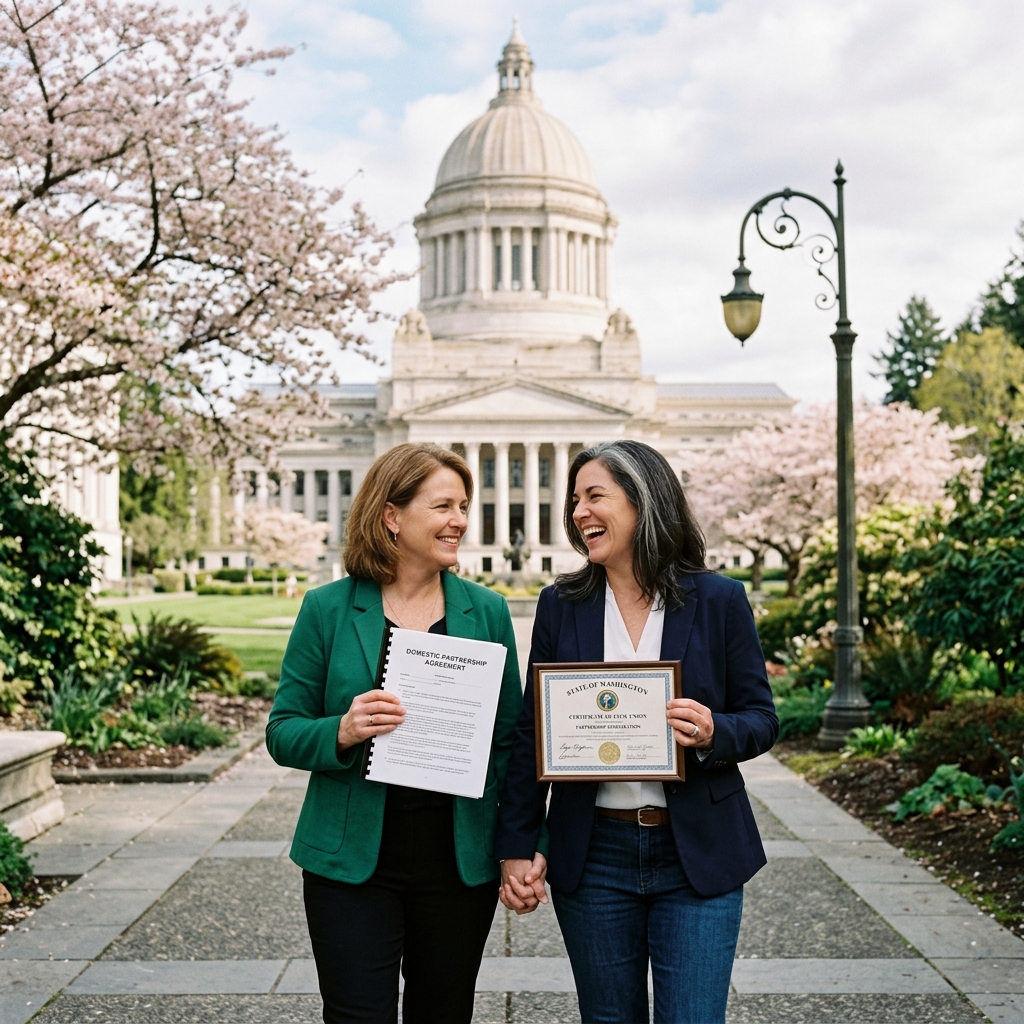
Couples who want legal recognition of their relationship in Washington State have several pathways, including marriage and state registered domestic partnerships. Understanding how these frameworks work, who can qualify, and how they interact with civil unions or domestic partnerships formed in other states is crucial for making informed decisions about your legal and financial future.
This article explains the role of domestic partnerships and civil unions in Washington today, with a particular focus on how state law evolved in the context of marriage equality and how seniors and out-of-state couples are treated.
From Alternative Status to Marriage Equality
Before marriage equality, domestic partnerships and civil unions emerged as ways to provide legal protections to couples, especially same-sex partners, who were excluded from marriage. These statuses offered some or nearly all rights associated with marriage, but under different names and sometimes with different limitations.
Over time, courts and legislatures expanded access to marriage, and many states adjusted or phased out domestic partnership and civil union frameworks. Washington followed this broader trend by allowing same-sex couples to marry and then restricting new state domestic partnerships to a narrow group—mainly older couples.
What Is a Domestic Partnership?
A domestic partnership is a legally recognized relationship between two adults who are not married but who live together and share a domestic life. Depending on the jurisdiction, domestic partners may receive benefits similar to those of spouses, such as inheritance rights, health insurance coverage, and authority to make medical decisions.
- Domestic partnerships are usually created by registration with a state or local government authority.
- They may offer a limited set of rights (such as hospital visitation), or a broad range of rights comparable to marriage.
- Eligibility criteria typically address age, residence, and whether the parties are already married or in another legal union.
In Washington, the principal form of statewide recognition is the state registered domestic partnership, defined by statute and administered through the Office of the Secretary of State.
Domestic Partnerships vs. Civil Unions
Although the terms “domestic partnership” and “civil union” are often used interchangeably, they have distinct histories and legal uses. Some states adopted civil unions as a separate status that provided the full rights and responsibilities of marriage without using the term “marriage.”
Domestic partnerships, by contrast, can range from municipal registrations with limited benefits to robust state-level systems similar to civil unions. In practice, Washington law treats certain out-of-state civil unions and comprehensive domestic partnerships as equivalent either to marriage or to a state domestic partnership, depending on the situation.
| Feature | Domestic Partnership (WA) | Civil Union (Other States) |
|---|---|---|
| Primary purpose | Alternative recognition, especially for older couples and legacy relationships. | Marriage-like status, often created before marriage equality. |
| Legal rights | In Washington, state registered domestic partners receive nearly all rights and duties of spouses under state law. | Many civil unions provide most or all rights of marriage, but details vary by state. |
| Recognition in WA | Governed by RCW 26.60; subject to age and residency limits for new registrations. | Treated as domestic partnerships or as marriage-equivalent for certain non-resident couples under reciprocity rules. |
Key Features of Washington State Registered Domestic Partnerships
Washington law defines “state registered domestic partners” and sets eligibility requirements in its statutes, particularly RCW 26.60 and related provisions. These partnerships are available only to couples who meet specific criteria and complete formal registration.
Eligibility Requirements
Under Washington law, adults who wish to become state registered domestic partners must satisfy several conditions. While the details are set out in statute, major elements include:
- Age and capacity – Both partners must be adults with legal capacity to enter into the partnership.
- Not closely related – The partners cannot be closely related in a way that would bar them from marrying under Washington law.
- Single status – Neither partner may be currently married nor in another domestic partnership with a different person.
- Shared residence – The couple must share a common residence.
Since Washington enacted marriage equality, new state registered domestic partnerships are largely limited to couples where at least one partner is age 62 or older, particularly to address certain pension and social security considerations. This age-based restriction reflects the legislature’s decision to preserve an alternative structure for seniors who might face financial disadvantages if they marry.
Rights and Responsibilities
State registered domestic partners receive nearly all spousal rights and duties provided under Washington law. That means, in many contexts, domestic partners are treated similarly to married spouses.
- Ability to make medical decisions for a partner, including hospital visitation rights.
- Rights in probate and inheritance when one partner dies without a will, subject to state law.
- Protections related to guardianships, conservatorships, and protection from abuse.
- Duties and obligations similar to those of spouses in areas such as community property and support, as defined by state statutes.
However, domestic partnerships are still not identical to marriage. They may be treated differently for federal law purposes, tax rules, and recognition across state lines, especially because states differ in how they view domestic partnerships.
Washington’s Transition to Marriage Equality
Same-sex couples in Washington gained access to marriage after a state ban was struck down and subsequent legislation codified that change. Once marriage became available, domestic partnerships shifted from being a primary route for same-sex couples to something much more limited.
Washington law provided a transition period during which existing domestic partnerships could be converted into marriages. Many comprehensive domestic partnerships were automatically converted to marriages after a specified date, except in situations where one or both partners were over 62 and chose to remain domestic partners.
- Domestic partnerships formed before marriage equality could be maintained, converted by marrying, or in some cases automatically transformed into marriages.
- New state registrations are now focused on older couples who may have particular financial or benefit-related reasons to prefer domestic partnerships over marriage.
This evolution illustrates how domestic partnerships and civil unions often serve as transitional structures. Once marriage is open to all couples, legislatures frequently narrow or repeal these alternative statuses, sometimes leaving them available only for specialized circumstances.
Recognition of Out-of-State Civil Unions and Domestic Partnerships
Washington has rules on how to treat legal unions formed in other jurisdictions. These rules address both comprehensive domestic partnerships and civil unions from other states.
Short-Term Recognition (Non-Residents and Visitors)
For couples traveling through Washington or residing in the state temporarily, Washington may treat certain out-of-state civil unions and comprehensive domestic partnerships as having the rights and responsibilities of marriage, as long as the couple is not a permanent resident of Washington.
- When a couple is in a legal union from another state that provides substantially similar rights to marriage, Washington generally extends comparable rights while they are within Washington.
- These rights may include hospital visitation, decision-making authority, and protections under family and property law.
Permanent Residents and the One-Year Rule
For couples who move to Washington and become permanent residents, state law imposes a timeline. If they are in a civil union or comprehensive domestic partnership from another state, they may need to marry within a set period to preserve continuous recognition.
- Washington treats out-of-state civil unions or comprehensive domestic partnerships as equivalent to marriage for up to one year after the couple becomes permanent residents.
- After that period, couples typically must marry in order to retain relationship recognition under Washington law; otherwise, the prior status may no longer be treated as marriage-equivalent.
In some circumstances, an out-of-state legal union that is substantially equivalent to a Washington domestic partnership may be recognized as a state registered domestic partnership, subject to Washington’s eligibility rules.
Local Domestic Partnership Registries
In addition to state-level domestic partnerships, some municipalities offer local domestic partnership registration programs. For example, the City of Seattle operates its own registry that can be used by couples seeking recognition for purposes such as employer benefits or symbolic affirmation.
Local registries typically:
- Require both partners to be adults and not married to someone else.
- Involve a registration form, notarized signatures, and a modest fee.
- Provide a certificate that may be accepted by employers or organizations, but does not create the same rights as a state registered domestic partnership under state law.
Couples should distinguish between local registries, which may be useful for private benefit eligibility, and the state’s domestic partnership framework, which carries broad legal consequences under Washington statutes.
Practical Considerations for Couples
Choosing between marriage, a state registered domestic partnership, or relying on an out-of-state civil union involves legal, financial, and personal considerations. While this article cannot offer legal advice, it highlights some factors that couples commonly analyze.
Potential Advantages of State Registered Domestic Partnerships
- Preserving certain benefits – Older couples may prefer domestic partnerships to avoid potential changes in pension or social security benefits that could occur upon marriage.
- State-level protection – Domestic partners receive extensive rights under Washington law, including protections in property, medical decision-making, and inheritance.
- Clear statutory framework – Domestic partnership statutes provide defined eligibility, registration procedures, and standards for dissolution.
Limitations and Risks
- Different treatment under federal law – Domestic partnerships may not be recognized in the same way as marriage for federal tax, immigration, or social security purposes.
- Variation among states – Other states may not treat Washington domestic partnerships as equivalent to marriage, affecting rights when couples move or travel.
- Complex transitions – Converting from a domestic partnership or civil union to marriage can involve procedural steps and may impact existing legal arrangements.
Because these questions can be complex and heavily dependent on individual circumstances, many couples consult family law attorneys or financial advisors before deciding which status to pursue.
Frequently Asked Questions
1. Are domestic partnerships still available in Washington?
Yes, but new state registered domestic partnerships are largely limited to couples where at least one partner is age 62 or older, and they must meet other statutory requirements such as sharing a residence and not being closely related or already married.
2. Do domestic partners have the same rights as married spouses under Washington law?
Registered domestic partners receive nearly all spousal rights and duties under Washington state law, including property, inheritance, and medical decision-making rights. However, domestic partnerships are not treated identically to marriage for all purposes, especially under federal law.
3. What happens if we move to Washington with a civil union from another state?
For a limited period after becoming permanent residents, Washington may treat your civil union or comprehensive domestic partnership as equivalent to marriage. After that period, you generally must marry in order to maintain full recognition under Washington law.
4. Can we use Seattle’s domestic partnership registry instead of a state registered domestic partnership?
Seattle’s registry is a local program that can help couples demonstrate their relationship for purposes such as employer benefits, but it does not create the same statewide legal rights and obligations as a state registered domestic partnership provided under Washington law.
5. Should we choose marriage or a domestic partnership?
The choice depends on your age, benefit situation, and long-term plans. Marriage generally offers the broadest and clearest recognition at both the state and federal levels, while domestic partnerships in Washington are now tailored primarily to older couples with specific financial considerations. Consulting a legal professional can help you evaluate your options.
References
- Domestic Partnerships – Washington Secretary of State — Washington Office of the Secretary of State. 2024-01-01. https://www.sos.wa.gov/corporations-charities/additional-services/domestic-partnerships
- Laws and Regulations: Domestic Partnerships — Washington Office of the Secretary of State. 2024-01-01. https://www.sos.wa.gov/corporations-charities/additional-services/domestic-partnerships/laws-and-regulations
- Marriage, Domestic Partnerships, and Civil Unions: Relationship Recognition for Same-Sex Couples — National Center for Lesbian Rights. 2014-07-01. https://www.nclrights.org/wp-content/uploads/2013/07/Relationship_Recognition.pdf
- Domestic Partners: Legal Rights of Domestic Partners in Washington — ACLU of Washington. 2011-09-01. https://www.aclu-wa.org/app/uploads/2011/09/Legal_Rights_of_Domestic_Partners_0.pdf
- Domestic partnership — Summary of Jurisdictional Approaches. 2023-01-01. https://en.wikipedia.org/wiki/Domestic_partnership
- City of Seattle Domestic Partnership Registration Program — City of Seattle. 2023-01-01. https://www.seattle.gov/city-clerk/city-clerk-services/domestic-partnership-registration
- Same-Sex Marriage & Domestic Partnership — Anderson Hunter Law Firm. 2022-01-01. https://andersonhunterlaw.com/personal-law/family-law/sex-marriages-domestic-partnerships
Similar Articles








Read full bio of medha deb


