Domestic partnerships provide a way for unmarried couples to obtain some legal recognition and benefits without entering into a marriage. Although the concept is similar nationwide, the exact rights, requirements, and procedures are largely determined by state and local law, as well as by individual employers. This article explains what domestic partnerships are, how state laws differ, what benefits may be available, and how these partnerships compare to marriage.
What Is a Domestic Partnership?
A domestic partnership is generally a legally recognized relationship between two adults who live together in a committed, intimate partnership but are not married. Depending on the jurisdiction or employer, it may be open to same-sex couples, opposite-sex couples, or both.
Common elements of a domestic partnership definition include:
- Two adults who are each other’s sole partner and intend the relationship to be long-term.
- Sharing a common residence as their primary home.
- Mutual responsibility for financial support and basic living expenses.
- Not being married, in a civil union, or in another registered partnership.
- Not closely related by blood in a way that would bar marriage in that jurisdiction.
Because there is no single nationwide statute governing domestic partnerships, the precise legal definition can vary significantly by state and even by city.
Types of Domestic Partnership Recognition
Within the United States, domestic partnerships can be recognized at several levels, each with different legal consequences.
- Statewide domestic partnership or civil union status – Some states historically created domestic partnerships or civil unions that offered a package of state-level benefits. After the nationwide recognition of same-sex marriage, many of these regimes were modified, converted to marriage, or limited to specific groups.
- Local (city or county) domestic partnership registries – Municipalities may adopt their own registration systems that grant local benefits, such as access to city employee health benefits or hospital visitation rights in city facilities.
- Employer-based domestic partner benefits – Employers, including government agencies and large private companies, may extend certain benefits—such as health insurance, family leave, or bereavement leave—to an employee’s registered domestic partner even if state law does not provide a broad status.
- Private contractual arrangements – Couples who do not have access to a public registry may use contracts, cohabitation agreements, powers of attorney, and estate planning documents to approximate some of the protections of marriage or formal partnerships.
State-Level Variation in Domestic Partnership Laws
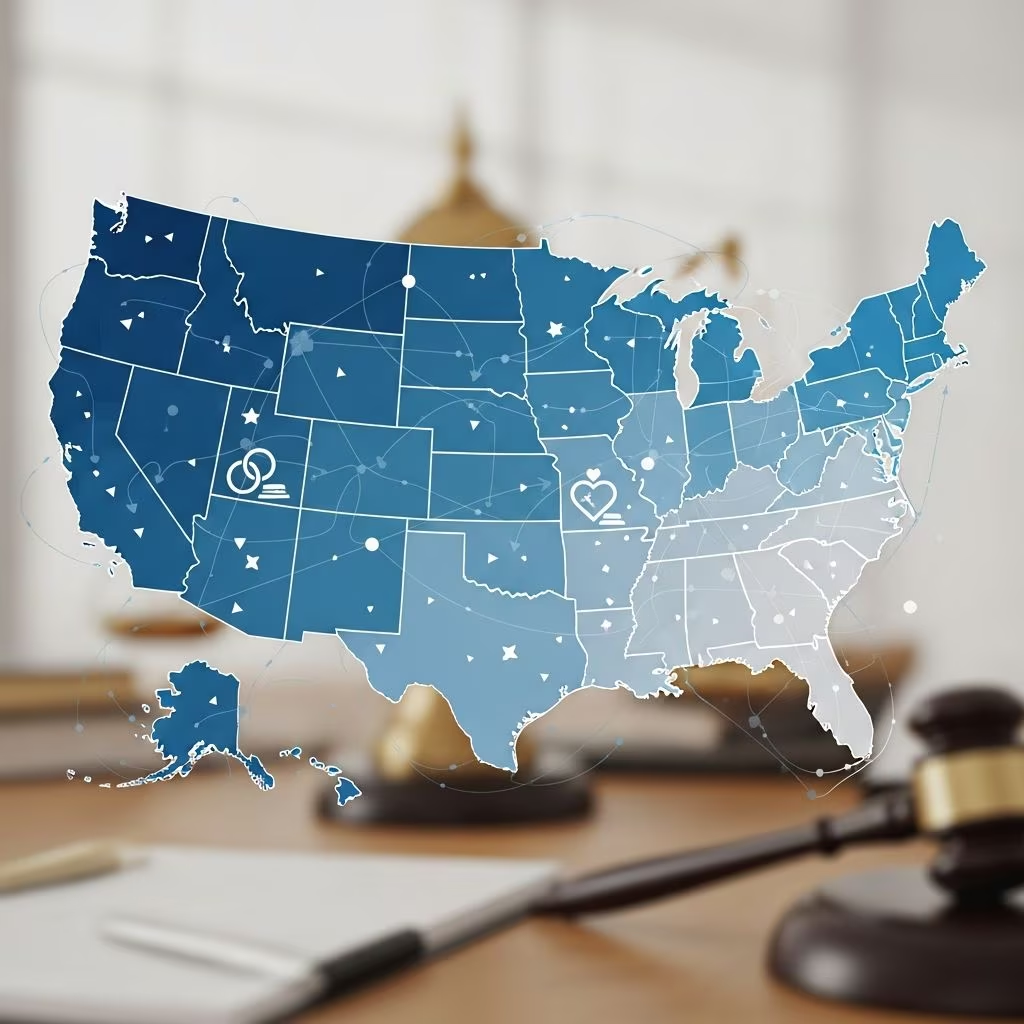
State approaches to domestic partnership and similar statuses have evolved significantly, especially after same-sex marriage became recognized nationwide. Many states that once relied on domestic partnerships or civil unions have since enacted full marriage equality while keeping limited partnership frameworks in place, modifying them, or phasing them out.
The following table summarizes common patterns seen across states. It is a general guide, not a substitute for local legal advice:
| State Policy Pattern | Typical Features | Practical Impact on Couples |
|---|---|---|
| Full marriage equality with legacy domestic partnerships or civil unions |
|
|
| States or cities with limited domestic partnership benefits |
|
|
| Minimal or no statutory recognition |
|
|
Common Eligibility Requirements
Although the wording differs from place to place, many jurisdictions and employers impose similar eligibility criteria for registering a domestic partnership.
- Both partners are at least 18 years old and mentally competent to consent.
- Partners are not married to anyone else, not in another registered partnership, and not closely related by blood.
- They share a primary residence or intend to continue living together.
- They agree to be jointly responsible for each other’s basic living expenses or financial obligations.
- They intend the relationship to be long-term rather than temporary.
Some registries require proof that the couple lives together, such as a joint lease, mortgage, deed, or consistent documentation showing a shared address.
How Couples Register a Domestic Partnership
The process of registering a domestic partnership depends on whether the recognition is provided by a state, city, or employer.
Government or Local Registry Procedures
When a state or municipality offers registration, the steps often include:
- Completing a domestic partnership application or declaration form.
- Providing identification and supporting documents, such as proof of residence or prior marital status.
- Signing in front of a clerk, notary, or designated witnesses.
- Paying a filing or registration fee.
- Receiving a certificate or registration record as proof of the partnership.
Some jurisdictions also allow eligible family members (such as parents or adult children) to request certified copies of partnership records for legal or administrative purposes.
Employer-Based Registration for Benefits
For employer-sponsored domestic partner benefits, the employer, not the state, usually sets the documentation requirements. Common features include:
- Signing an affidavit affirming that the relationship meets the employer’s definition of a domestic partnership.
- Providing evidence of joint residence and/or financial interdependence.
- Agreeing to notify the employer if the relationship ends, often within a specified time.
These registrations are typically valid only for employer benefits and do not automatically create broader rights under state law.
Key Benefits Domestic Partnerships May Provide
Domestic partnerships were originally designed to provide some legal security to couples who could not marry or chose not to marry. Today, depending on the jurisdiction and employer, partners may receive a limited package of benefits.
Possible State or Local Benefits
- Hospital and nursing home visitation – Some laws specifically grant visitation rights for partners comparable to those of a spouse.
- Health insurance access – State or municipal employees may extend health benefits to a registered domestic partner and, in some instances, their dependents.
- Family and bereavement leave – Partners may qualify for leave to care for one another during illness or attend funerals, depending on local rules and employer policies.
- Certain state-level tax or housing benefits – Some state regimes have historically allowed state income tax advantages, housing preferences, or other benefits, although these are usually narrower than those linked to marriage.
Employer and Private Benefits
Independent of state law, employers may voluntarily grant benefits to domestic partners, including:
- Enrollment of a partner in the employee’s health insurance plan.
- Access to wellness programs, employee assistance programs, or family-oriented benefits.
- Eligibility for certain survivor or death benefits under employer-sponsored plans.
- Use of family sick leave or paid time off to care for an ill partner.
Because federal law does not treat domestic partnerships like marriage for tax and Social Security purposes, some employer-provided benefits may be taxed differently for partners than for spouses.
Limits of Domestic Partnership Protections
Although domestic partnerships can be valuable, they generally offer fewer protections than marriage, especially at the federal level.
- No uniform federal recognition – Marriage is recognized throughout the United States and under federal law. Domestic partnerships, by contrast, are created and defined by state or local law and are not themselves a federal status.
- Uncertain recognition across state lines – A partnership registered in one state or city may not be recognized if the couple moves to another jurisdiction.
- Limited automatic rights to property or inheritance – Unless state law provides otherwise, partners might not have the same inheritance, community property, or elective-share rights that married spouses receive. Careful estate planning is often critical.
- Federal benefits usually unavailable – Social Security spousal and survivor benefits, most federal tax advantages, and many immigration-related benefits require a valid marriage rather than a domestic partnership.
Domestic Partnership vs. Marriage: Legal Comparison
The following table highlights some broad legal differences between domestic partnerships and marriage in the United States. Specific outcomes depend on the laws of the state and the details of any employer or local program.
| Legal Area | Marriage | Domestic Partnership (Typical) |
|---|---|---|
| Federal recognition | Recognized nationwide; provides access to federal tax, immigration, and Social Security spousal benefits. | Generally not recognized as a federal status; federal benefits rarely apply. |
| Recognition across states | Marriages are ordinarily recognized in all states under traditional principles of interstate recognition. | Recognition varies; some states may disregard another state’s partnership or treat it differently. |
| Property and inheritance | Spouses usually receive default inheritance rights and may share marital or community property depending on the state. | Partners often need wills, contracts, and other planning tools to secure similar protections unless specific state laws apply. |
| Creation and dissolution | Created by marriage license and ceremony; dissolution usually requires a divorce proceeding in court. | Created by registration or employer affidavit; termination rules vary and may range from simple notices to court proceedings. |
Ending a Domestic Partnership
Like relationships themselves, domestic partnerships do not always last. Terminating a partnership can range from straightforward to complex, depending on where the partnership was registered and what rights it confers.
Administrative Termination
Where a domestic partnership is primarily an administrative status with limited rights, and no children or major property issues are involved, a jurisdiction may allow termination through relatively simple steps, such as:
- Filing a notice or declaration of termination with the same office that recorded the partnership.
- Paying a small fee and providing identification.
- Notifying the other partner if they did not jointly sign the termination form.
Court-Based Dissolution
If the domestic partnership carries rights similar to marriage—such as property division rules, support obligations, or parental rights—ending the partnership may resemble a divorce process.
- Partners may need to file a dissolution petition in family or superior court.
- The court can address division of jointly owned property, debts, and support obligations.
- When children are involved, the court may issue custody, visitation, and child support orders.
Regardless of the procedure, couples often benefit from obtaining independent legal advice to understand what rights they may be waiving or preserving by terminating a partnership.
Practical Planning Tips for Domestic Partners
Because of the limits and variability of domestic partnership laws, many couples take additional steps to protect themselves and their families.
- Draft a cohabitation or domestic partnership agreement to clarify expectations about property ownership, financial support, and responsibility for debts.
- Use estate planning tools, such as wills, trusts, and beneficiary designations, to ensure that property passes consistently with the partners’ wishes.
- Sign medical powers of attorney and advance directives so each partner can make health care decisions if the other becomes incapacitated.
- Review employer policies to understand which benefits require registration and what documentation must be kept up to date.
- Consult a local family law attorney when entering, modifying, or dissolving a partnership, especially where significant property or children are involved.
Frequently Asked Questions (FAQs)
Do all U.S. states still offer domestic partnership registration?
No. Some states have eliminated or restricted new domestic partnership registrations after adopting marriage equality, while others maintain limited systems or rely mostly on local or employer policies. The availability of registration depends on where you live and work.
Can a domestic partnership be converted into a marriage?
In some jurisdictions, couples who previously registered as domestic partners were given the option to convert their status to marriage or were automatically converted unless they opted out. In other areas, partners must independently marry if they want the legal status and benefits of marriage.
Are domestic partners entitled to federal Social Security benefits?
Generally, no. Federal Social Security spousal and survivor benefits are based on a valid marriage under federal law, not on domestic partnership status. A domestic partner may qualify only if they are also a legal spouse.
If I move to another state, will my domestic partnership still be valid?
Not necessarily. Because domestic partnerships are creatures of state or local law, another jurisdiction may treat the relationship differently or may not recognize it at all. Couples planning a move should review the laws of the destination state or seek legal advice.
Is a lawyer required to register or end a domestic partnership?
A lawyer is not always required, especially where registration and termination are handled through simple forms. However, legal counsel is strongly recommended when the partnership involves substantial assets, shared debts, business interests, or children, or when the partnership carries legal consequences similar to marriage.
References
- Domestic Partnership — DC Health, Government of the District of Columbia. 2023-06-01. https://dchealth.dc.gov/service/domestic-partnership
- What is the definition of a domestic partner? — U.S. Office of Personnel Management. 2013-07-01. https://www.opm.gov/frequently-asked-questions/domestic-partner-benefits-faq/same-sex-domestic-partner-benefits/what-is-the-definition-of-a-domestic-partner/
- Civil Unions and Domestic Partnership Statutes — National Conference of State Legislatures (NCSL). 2021-07-08. https://www.ncsl.org/human-services/civil-unions-and-domestic-partnership-statutes
- Domestic partnership in the United States — Summary of U.S. legal developments. 2022-05-01. https://en.wikipedia.org/wiki/Domestic_partnership_in_the_United_States
- How Domestic Partnerships Legally Compare to Marriage — Super Lawyers, Thomson Reuters. 2020-09-15. https://www.superlawyers.com/resources/family-law/how-domestic-partnerships-legally-compare-to-marriage/
- Understanding Domestic Partnerships: Your Guide to Rights and Benefits — S|H Attorneys at Law. 2023-03-10. https://sihattorneys.com/blog/domestic-partnerships/
- What Is a Domestic Partnership? — LawDepot Legal Resources. 2022-11-01. https://www.lawdepot.com/us/resources/family-articles/what-is-a-domestic-partnership/