
Dog Sniffs and Traffic Stops After Rodriguez
How the Supreme Court’s Rodriguez ruling reshaped the rules for police dog sniffs during routine traffic stops in the United States.
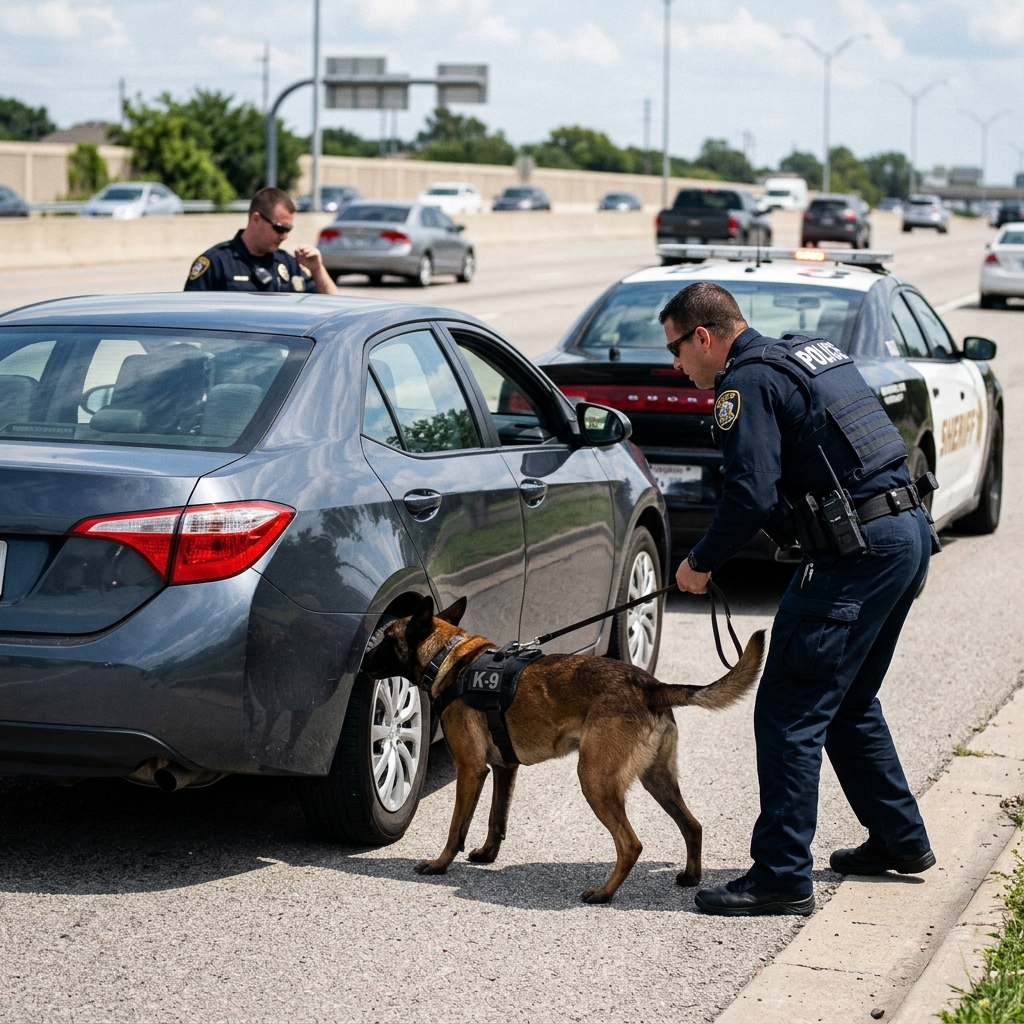
The U.S. Supreme Court’s decision in Rodriguez v. United States dramatically narrowed police authority to prolong a routine traffic stop for the sole purpose of conducting a drug-detection dog sniff. The ruling clarified that a stop justified only by a traffic violation may last no longer than necessary to handle the traffic matter, and any extra delay to facilitate a canine search is generally unconstitutional.
This article explains how Rodriguez fits into the broader line of Supreme Court cases on dog sniffs, what it means for drivers and law enforcement, and how courts continue to apply the decision in everyday traffic-stop encounters.
Background: Dog Sniffs and the Fourth Amendment
The Fourth Amendment protects people against unreasonable searches and seizures. For decades, the Supreme Court has treated dog sniffs as a special investigative technique, neither exactly like a traditional search nor entirely outside constitutional scrutiny.
Earlier cases, including Illinois v. Caballes, held that a dog sniff conducted during a lawful traffic stop does not itself violate the Fourth Amendment when it only reveals the presence or absence of contraband, an item in which individuals have no legitimate privacy interest. At the same time, the Court recognized that a traffic stop can become unlawful if it is extended beyond the time reasonably required to complete the “mission” of the stop.
- Search: An intrusion by the government into an area where a person has a reasonable expectation of privacy.
- Seizure: Restraining a person’s freedom of movement through physical force or authority.
- Reasonable suspicion: A specific, articulable basis to suspect criminal activity, less than probable cause but more than a mere hunch.
- Probable cause: A fair probability that evidence of a crime will be found, often required before a search.
Dog sniffs at traffic stops sit at the intersection of these doctrines: officers may stop a vehicle for a traffic violation, but how long they may detain a person and what they can do during that time are constrained by Fourth Amendment principles.
Rodriguez v. United States: Facts and Holding
In Rodriguez v. United States, a driver in Nebraska was stopped by police for briefly drifting out of his lane. After completing the traffic-related tasks—checking documents and issuing a written warning—an officer detained the driver for about seven to eight extra minutes while awaiting a drug-detection dog. The dog alerted and officers found methamphetamine in the vehicle.
The key question was whether this short additional delay, occurring after the traffic mission had concluded, was permissible under the Fourth Amendment. The government argued that a few extra minutes was a de minimis intrusion. The Supreme Court disagreed.
In a 6–3 decision, the Court held:
- A traffic stop’s permissible duration is limited to the time reasonably needed to address the traffic violation and related safety concerns.
- Tasks unrelated to the mission of the stop—such as investigating for drugs by calling a canine unit—may not prolong the stop, absent independent reasonable suspicion of criminal activity.
- There is no de minimis exception; even a small extension of a completed traffic stop for a dog sniff violates the Fourth Amendment if unsupported by reasonable suspicion.
As a result, Mr. Rodriguez’s detention for the extra seven to eight minutes, solely for the purpose of conducting a dog sniff, was deemed an unconstitutional seizure. The evidence obtained was suppressed.
Defining the “Mission” of a Traffic Stop
A core concept introduced and emphasized in Rodriguez is the “mission” of the traffic stop. The Court explained that a stop justified by a traffic violation has a limited purpose: to address the violation and to handle ordinary safety-related checks.
Typical tasks within the mission include:
- Checking the driver’s license and registration.
- Running warrant and insurance checks.
- Inspecting plates and vehicle identification numbers.
- Deciding whether to issue a ticket, warning, or take no further action.
- Addressing immediate safety issues, such as impaired driving or dangerous vehicle defects.
Activities that fall outside this mission—like questioning unrelated to traffic, seeking consent to search for drugs, or arranging a dog sniff—are permissible only if they do not add time to the stop or if the officer has separate reasonable suspicion of criminal conduct.
When does a stop become unlawfully prolonged?
Rodriguez instructs courts to focus on whether police conduct adds time to the stop compared to what is reasonably required to complete the traffic mission. It does not matter whether the dog sniff occurs before or after a ticket is issued; the critical question is whether the stop is lengthened to accommodate the sniff.
| Police Action | Within Mission? | Effect on Legality |
|---|---|---|
| Checking license, registration, insurance | Yes | Permitted during traffic stop |
| Running warrant checks | Yes | Permitted as part of safety-related tasks |
| Calling for a drug-detection dog with no suspicion | No | Unlawful if it adds time to the stop |
| Using a dog that arrives while traffic tasks are ongoing | Depends | Permissible if it does not extend the overall duration |
| Extending detention to ask unrelated criminal questions | No, if it prolongs the stop | Requires reasonable suspicion of crime |
Rodriguez in the Broader Dog-Sniff Case Law
Rodriguez did not occur in a vacuum. It built upon and refined prior decisions concerning dog sniffs and traffic stops.
Illinois v. Caballes: Dog sniff during an ongoing stop
In Illinois v. Caballes, the Supreme Court held that using a drug-sniffing dog around a lawfully stopped car did not violate the Fourth Amendment when the sniff took place while the officer was still legitimately handling the traffic violation and did not prolong the stop.
Caballes established two important principles:
- A canine sniff of the exterior of a vehicle, revealing only the presence of contraband, is generally not a “search” requiring probable cause.
- Nevertheless, traffic stops cannot be extended beyond the time needed for the traffic mission simply to conduct a dog sniff.
Rodriguez reinforced the second principle and rejected the notion that officers may add a few minutes of detention as a minor or trivial intrusion.
Other developments: curtilage and probable cause
Subsequent and related decisions have addressed other aspects of dog sniffs:
- The Court has ruled that bringing a drug-sniffing dog onto the curtilage of a home (the area immediately surrounding and associated with the residence) for a warrantless sniff constitutes a search requiring a warrant or another valid exception.
- Dog alerts can generate probable cause, allowing officers to search a vehicle without a warrant under the automobile exception, assuming the dog is properly trained and reliable.
As a result, the main constitutional question at traffic stops is not whether a dog sniff itself is permissible, but when and how long officers may detain drivers to conduct it.
How Rodriguez Changed Police Practice
Rodriguez has forced law enforcement agencies to adjust their traffic-stop procedures. Police can still use drug-detection dogs, but they must be careful not to extend a stop beyond its traffic-related mission unless they develop reasonable suspicion of other criminal activity.
Practical implications for officers
- Timing is critical: Officers may arrange for a dog to arrive while they are still completing traffic tasks. If the dog arrives and conducts a sniff without causing any additional delay, the use of the dog is generally permissible under Caballes and Rodriguez.
- No automatic extension: Officers cannot simply decide to hold a driver for “a few extra minutes” after issuing a ticket or warning in order to complete a dog sniff, unless they have a separate basis for reasonable suspicion.
- Reasonable suspicion matters: If specific facts arise during the stop—such as nervous behavior, inconsistent stories, or visible contraband—officers may have reasonable suspicion to extend the stop for investigative steps, including a dog sniff.
Consequences for evidence and prosecutions
Evidence obtained from an unconstitutionally prolonged stop may be suppressed under the exclusionary rule. Courts evaluating suppression motions now carefully examine:
- The timeline of the stop: when traffic tasks began and ended.
- Whether the officer’s actions added measurable time beyond what was necessary.
- Whether any independent reasonable suspicion justified the added detention.
Appellate decisions after Rodriguez, including state supreme court rulings, frequently center on whether the dog sniff meaningfully prolonged the seizure. Some courts have found violations when officers paused traffic-related tasks or held drivers back solely to await a canine unit, while others have upheld stops where the sniff was essentially contemporaneous with ongoing traffic duties.
Rights and Responsibilities of Drivers
Rodriguez offers important protections to motorists, but exercising those rights requires understanding the boundaries of lawful police conduct.
What drivers should know
- Scope of the stop: You may be detained for the time reasonably needed to address the traffic violation and related safety checks, such as license and warrant checks.
- Completion of the mission: Once the officer has finished the traffic tasks and either issued a ticket or decided not to, continued detention must be supported by reasonable suspicion of another crime.
- Dog sniffs: Police may walk a dog around your car during the stop. The key question is whether this prolongs the detention beyond the traffic mission.
- Consent: You may be asked to consent to a search of your vehicle. You generally have the right to decline, though refusal may contribute to reasonable suspicion depending on circumstances.
Drivers cannot unilaterally end a stop, but they can politely ask whether they are free to leave once the traffic business seems complete. If the officer insists on continued detention without clear justification, that decision may later be challenged in court.
Ongoing Legal Questions and Future Cases
Rodriguez settled that any prolongation of a traffic stop for a dog sniff, absent reasonable suspicion, is unconstitutional, but questions remain.
Emerging issues
- Interior vs. exterior sniffs: A pending case has asked whether a dog sniff of the interior of a lawfully stopped vehicle without consent or probable cause violates the Fourth Amendment, raising questions about how far police may go once the dog is deployed.
- Reliability of dogs: Courts continue to assess how training and certification affect the reliability of canine alerts and the existence of probable cause.
- Use of pretext: Police sometimes use minor traffic violations as a pretext to investigate suspected drug activity. Rodriguez does not forbid pretextual stops, but it limits how long officers may hold a driver once the traffic mission is complete.
Legal scholarship has noted that Rodriguez nudges law enforcement toward either developing real reasonable suspicion during the stop or limiting reliance on canine units unless they can be deployed without adding time.
Frequently Asked Questions
Can police always use a drug dog during a traffic stop?
Police may use a drug-detection dog around a vehicle during a lawful traffic stop, but they cannot extend the stop solely to accommodate the dog unless they have independent reasonable suspicion of criminal activity. If the dog is already present and the sniff occurs while traffic tasks are ongoing and does not add time, it is generally permissible.
Does a dog sniff count as a search?
When a trained dog sniffs the exterior of a vehicle during a lawful stop and only reveals the presence of contraband, the Supreme Court has held that this action is not a traditional “search” under the Fourth Amendment because people have no legitimate privacy interest in contraband. However, bringing a dog onto the curtilage of a home or into the interior of a vehicle may be treated differently and can implicate search protections.
How much extra time can police add for a dog sniff?
Under Rodriguez, there is no de minimis allowance to extend a completed traffic stop for a dog sniff. Any prolongation beyond the time reasonably needed to handle the traffic violation is unconstitutional unless supported by reasonable suspicion.
What if the dog arrives while the officer is still writing the ticket?
If the dog sniff occurs while the officer is legitimately engaged in traffic-related tasks and does not lengthen the overall stop, courts have generally found no Fourth Amendment violation, consistent with Caballes and Rodriguez.
Does a dog’s alert create probable cause to search the car?
Courts have held that a reliable dog alert can establish probable cause to search a vehicle without a warrant under the automobile exception, provided the dog is properly trained and certified. Challenges often focus on the dog’s reliability and the circumstances of the sniff.
References
- U.S. Supreme Court Rules that Dog Sniff Searches Cannot Extend Traffic Stops — RH Law Florida. 2015-04-24. https://rhlawfl.com/supreme-court/u-s-supreme-court-rules-dog-sniff-searches-cannot-extend-traffic-stops/
- Chief’s Counsel: Supreme Court Confirms Dog Sniff of Car during a Traffic Stop Is Not a Fourth Amendment Search — Police Chief Magazine (IACP). 2016-01-01. https://www.policechiefmagazine.org/chiefs-counsel-supreme-court-confirms-dog-sniff/
- In the Supreme Court of the State of Kansas (Wilson decision) — Kansas Supreme Court. 2022-02-25. https://searchdro.kscourts.gov/documents/pdf/caseDecisions/79c0d507-aa1a-4ebc-8ca3-f313796db286_125283.pdf
- Supreme Court Decision Expands Use of Drug Sniffing Dogs — Larry P. McDougal, Attorney at Law. 2013-03-01. https://www.larrymcdougal.com/blog/supreme-court-decision-expands-use-of-drug-sniffing-dogs/
- Terry Stops, Traffic Stops, and Dog Sniffs After Rodriguez — Federal Bar Association. 2015-10-01. https://www.fedbar.org/wp-content/uploads/2015/10/Dog-Days-pdf-1.pdf
- Mumford v. Iowa Will Complicate or Clarify the Rules for Dog Sniff Cases — KaiserDillon PLLC. 2025-05-01. https://kaiserlaw.com/mumford-v-iowa-will-complicate-or-clarify-the-rules-for-dog-sniff-cases/
- Deconstructing Dog Sniffs at Traffic Stops — Marquette Law Review. 2022-01-01. https://scholarship.law.marquette.edu/cgi/viewcontent.cgi?article=5537&context=mulr
Similar Articles








Read full bio of Sneha Tete




