
The Impact of Documentary Proof of Citizenship on Voting Access
How new documentation laws are reshaping voter registration and access across the United States.
Introduction
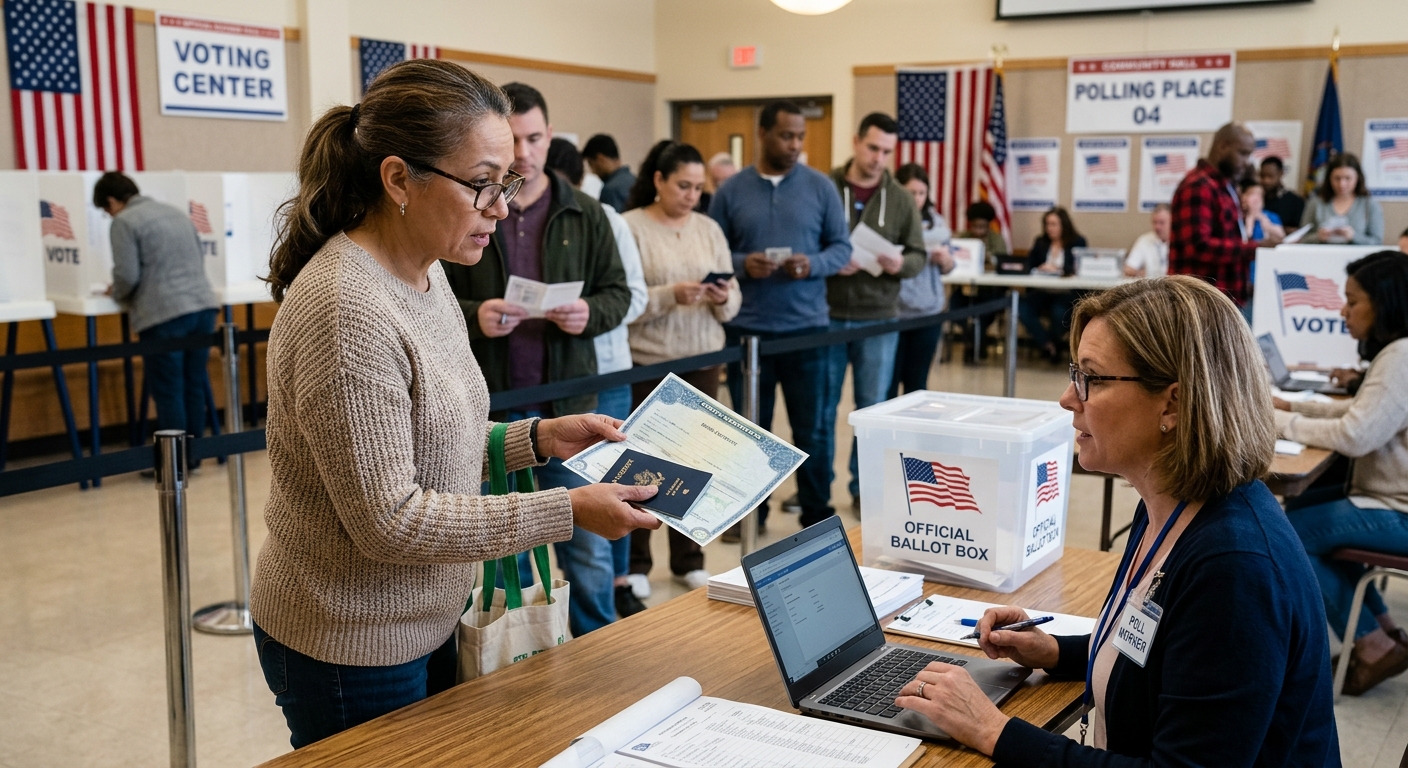
Elections in the United States operate under a delicate balance between securing the ballot box and ensuring that every eligible citizen can seamlessly exercise their fundamental right to vote. In recent years, a fierce legal and political debate has erupted around a specific legislative mechanism: Documentary Proof of Citizenship (DPOC) mandates. Proponents of these laws argue that requiring tangible evidence of citizenship—such as a passport or a certified birth certificate—prior to voter registration is a common-sense safeguard necessary to protect election integrity. Conversely, voting rights advocates warn that these stringent requirements effectively disenfranchise millions of eligible, law-abiding American citizens who do not have immediate or affordable access to such documentation.
As federal proposals like the Safeguard American Voter Eligibility (SAVE) Act gain traction in Congress, and state legislatures across the country introduce their own iterations of DPOC laws, the American voter registration landscape stands on the precipice of a massive transformation. Currently, registering to vote in most jurisdictions is a relatively frictionless process designed to encourage civic participation. The introduction of DPOC mandates threatens to upend this established system, severely restricting community-based voter registration drives, hindering online registration portals, and complicating mail-in registration systems.
To fully understand the gravity of these proposed laws, it is essential to examine the historical context of voter registration in the United States, the practical realities of acquiring government documentation, and the potential fallout for both local election administrators and ordinary citizens.
The Traditional Framework: Self-Attestation and the Motor Voter Law
To grasp how radically DPOC laws would change the voting process, one must first look at the current legal framework governing federal elections. For decades, the standard procedure for voter registration has been deeply rooted in the National Voter Registration Act (NVRA) of 1993, commonly known as the “Motor Voter Law.” The primary objective of the NVRA was to enhance voter participation by making it easier for Americans to register at motor vehicle departments and public assistance offices, while simultaneously maintaining accurate and current voter rolls.
Under this established system, federal law dictates that individuals registering to vote must formally affirm their United States citizenship under penalty of perjury. When citizens sign a standard voter registration form, they are legally swearing that they meet all eligibility requirements. The deterrents against false claims are severe; noncitizen voting has been explicitly codified as a federal crime since the passage of the Illegal Immigration Reform and Immigrant Responsibility Act of 1996. Noncitizens caught illegally registering or casting a ballot face devastating consequences, including hefty fines, lengthy prison sentences, and immediate deportation.
This long-standing system relies on the principle that the severe criminal penalties associated with perjury and federal immigration offenses serve as sufficient deterrents against widespread election fraud. Furthermore, state election officials verify the identities of registrants by cross-referencing applications with existing state and federal databases, such as the Department of Motor Vehicles or the Social Security Administration. This model places the responsibility of background verification on the state apparatus, ensuring the initial act of registering to vote remains accessible to the general public.
Unpacking Documentary Proof of Citizenship (DPOC)
Documentary Proof of Citizenship laws represent a fundamental paradigm shift in election administration. Instead of relying on a sworn affidavit and backend verification by state agencies, DPOC policies transfer the burden of proof entirely onto the individual applicant. Under these regimes, a citizen cannot be placed on the voter rolls simply by submitting a standardized registration form. They must simultaneously present physical, government-issued evidence proving their citizenship status.
What actually qualifies as “satisfactory evidence” under these proposed laws? In most legislative drafts, the acceptable documents are strictly limited. A valid United States passport, a certified birth certificate, or official naturalization papers are the standard requirements. Notably, a standard driver’s license—even a REAL ID-compliant license—does not typically suffice, as noncitizens who are legally residing in the United States are permitted to obtain these forms of identification in many jurisdictions. Similarly, many tribal identification cards and military IDs are often excluded because they do not explicitly list a person’s place of birth.
By demanding documents that many people keep locked away in safe deposit boxes or simply do not possess, DPOC laws strip away the convenience of modern voter registration. In-person registration becomes a logistical hurdle, and highly successful methods like mail-in and online registration are rendered incredibly difficult, as applicants would need to figure out how to securely transmit sensitive documents to election authorities.
Disproportionate Impact: Who Bears the Brunt?
The core criticism of DPOC mandates is that they attempt to solve a statistically negligible problem by erecting massive barriers for millions of eligible Americans. Studies and demographic surveys consistently indicate that nearly one in ten voting-eligible Americans (roughly 21 million citizens) do not have readily available documentary proof of citizenship. This lack of access is not distributed evenly across the population; it disproportionately affects specific demographic groups.
- Low-Income and Hourly Wage Earners: Obtaining a replacement birth certificate or a first-time passport is an expensive and time-consuming endeavor. Processing fees can range from tens to hundreds of dollars. Additionally, there are hidden costs, such as taking time off work, securing transportation to government offices, and navigating bureaucratic red tape. For individuals living paycheck to paycheck, these expenses essentially function as a modern-day poll tax.
- Married Women and Name Changes: Individuals who have changed their legal names face immense difficulties under DPOC laws. Even if a married woman has a certified birth certificate, the name on that document likely will not match the name on her current voter registration application or driver’s license. To prove her eligibility, she would need to present a legally valid chain of documentation—such as a certified marriage license or court order—to bridge the gap between her birth name and her current legal name.
- Rural Populations and Elderly Voters: Older Americans born in rural areas or delivered via midwifery may never have been issued a formal, certified hospital birth certificate. Tracking down vital records from decades past can be nearly impossible for these citizens.
- Military Families: Military personnel and their families who relocate frequently may find it exceptionally difficult to provide original, physical citizenship documents every time they update their voter registration in a new state.
State-Level Experiments and Federal Legislation
The push for documentary proof of citizenship is occurring aggressively on both the state and federal fronts. At the federal level, the Safeguard American Voter Eligibility (SAVE) Act has been a focal point of recent congressional sessions. If enacted, the SAVE Act would amend the National Voter Registration Act to require DPOC for all federal elections nationwide. This sweeping legislation would invalidate current registration methods that do not include document verification and mandate that states audit their existing voter rolls using complex federal databases, a process prone to data matching errors.
While federal legislation faces significant procedural hurdles, states have been much more proactive in implementing these policies. The state of Arizona has been the epicenter of DPOC laws for over two decades, requiring documentary proof for state and local elections. Because the federal NVRA prohibits such requirements for federal forms, Arizona was forced to implement a controversial “bifurcated” system. Voters who register with state forms using DPOC can vote in all elections, while those who use the federal form without DPOC are designated as “federal-only voters” who cannot cast ballots in state or local races.
Other states have attempted to follow suit, sometimes with disastrous results. In 2013, Kansas implemented a stringent DPOC law. Before it was ultimately struck down by federal courts, the policy blocked tens of thousands of eligible citizens from participating in elections. Despite these historical failures, states like New Hampshire, Wyoming, and Utah have recently enacted new versions of “show-me-your-papers” laws, setting the stage for prolonged legal battles over constitutional rights and equitable voter access.
Administrative and Logistical Hurdles for Election Officials
Beyond the direct impact on voters, DPOC mandates create colossal administrative burdens for local and state election officials, who are already grappling with tight budgets, aging infrastructure, and severe staffing shortages. Processing voter registration forms shifts from a streamlined, automated data-entry task to a complex, manual adjudication process. Election workers would be required to verify the authenticity of various identity documents—a highly specialized task for which most temporary poll workers and county clerks are not adequately trained.
The requirement to review physical documents would largely dismantle the progress made in modernizing election infrastructure. Electronic and automatic voter registration at the DMV—which securely and efficiently updates voter rolls—would be severely bottlenecked. Mail-in registrations would require voters to mail photocopies of highly sensitive personal documents, raising severe data privacy and identity theft concerns.
Furthermore, aggressive auditing mandates included in bills like the SAVE Act force election officials to cross-reference voter rolls with motor vehicle and immigration databases that were never designed for election administration. These databases are notorious for containing outdated citizenship information. For instance, a naturalized citizen might be classified as a noncitizen because their DMV record was created years before they took their oath of citizenship. Relying on faulty data practically guarantees that eligible voters will be erroneously purged from the rolls, forcing them to re-register and provide complex documentation just weeks before a major election.
The Policy Debate: Security Versus Accessibility
The philosophical divide over DPOC laws boils down to competing democratic priorities: absolute security versus universal accessibility. Advocates for DPOC argue that even a single instance of a noncitizen casting a ballot undermines the integrity of the entire electoral process. They maintain that the inconvenience of producing a birth certificate is a small and necessary price to pay for maintaining absolute public confidence in election outcomes.
Opponents, however, point to the overwhelming empirical evidence demonstrating that noncitizen voting is incredibly rare—often the result of a bureaucratic error or simple misunderstanding rather than organized, malicious fraud. They argue that the prescribed cure is vastly more destructive than the disease itself. By implementing sweeping documentation requirements, lawmakers are effectively creating a wide net that catches and blocks tens of thousands of legitimate, eligible American citizens in a misguided attempt to stop a negligible fraction of ineligible ones.
Frequently Asked Questions (FAQ)
What exactly qualifies as “Documentary Proof of Citizenship”?
Generally, it refers to primary, government-issued documents that establish U.S. citizenship. The most common examples accepted under these proposals are a valid U.S. passport, an original or certified copy of a birth certificate, or a Certificate of Naturalization.
Is it currently illegal for noncitizens to vote?
Yes. Under the Illegal Immigration Reform and Immigrant Responsibility Act of 1996, it is a federal crime for noncitizens to vote in federal elections. Violators face extreme consequences, including hefty fines, imprisonment, and deportation.
Why isn’t a standard driver’s license enough to register to vote?
Under proposed DPOC laws, standard driver’s licenses (and even REAL IDs) are not considered proof of citizenship. This is because legal permanent residents and other qualifying noncitizens are legally permitted to obtain them in many states, meaning the ID itself does not guarantee the holder is a U.S. citizen.
How do these laws affect people who have changed their names?
Individuals whose current legal name differs from the name on their birth certificate (such as married women) must provide additional documentation—like a certified marriage license or court order—to prove they are the same person listed on the underlying citizenship document. This adds a significant layer of complexity and cost to the registration process.
What happens to online voter registration if DPOC becomes federal law?
Because DPOC requires the presentation or submission of secure documents, most current online registration portals would be rendered unusable. They would need to be entirely re-engineered to securely accept, store, and verify uploaded copies of passports and birth certificates—a massive technological and privacy challenge for state governments.
Conclusion
The debate over Documentary Proof of Citizenship is one of the most critical voting rights issues of the modern era. While ensuring that only eligible citizens cast ballots is a universally shared goal across the political spectrum, the mechanisms used to achieve that goal must not inadvertently lock millions of Americans out of the democratic process. As federal legislation like the SAVE Act is debated and state-level mandates face intense judicial scrutiny, policymakers must carefully weigh the theoretical risks of voter fraud against the guaranteed harm of mass voter disenfranchisement. A healthy, functioning democracy requires both highly secure elections and a steadfast commitment to ensuring that every eligible citizen retains unimpeded access to the ballot box.
References
- Requiring Documentary Proof of Citizenship — National Conference of State Legislatures. 2026-05-21. https://www.ncsl.org/elections-and-campaigns/requiring-documentary-proof-of-citizenship
- Five Things to Know About the SAVE America Act — Bipartisan Policy Center. 2026-02-02. https://bipartisanpolicy.org/article/five-things-to-know-about-the-save-america-act/
- 52 USC Ch. 205: NATIONAL VOTER REGISTRATION — Office of the Law Revision Counsel. 1993-05-20. https://uscode.house.gov/view.xhtml?path=/prelim@title52/subtitle2/chapter205&edition=prelim
- ANALYSIS: THE EFFECTS OF REQUIRING DOCUMENTARY PROOF OF CITIZENSHIP TO REGISTER TO VOTE — Brennan Center for Justice. 2024. https://www.brennancenter.org/our-work/research-reports/analysis-effects-requiring-documentary-proof-citizenship-register-vote
Similar Articles








Read full bio of medha deb


