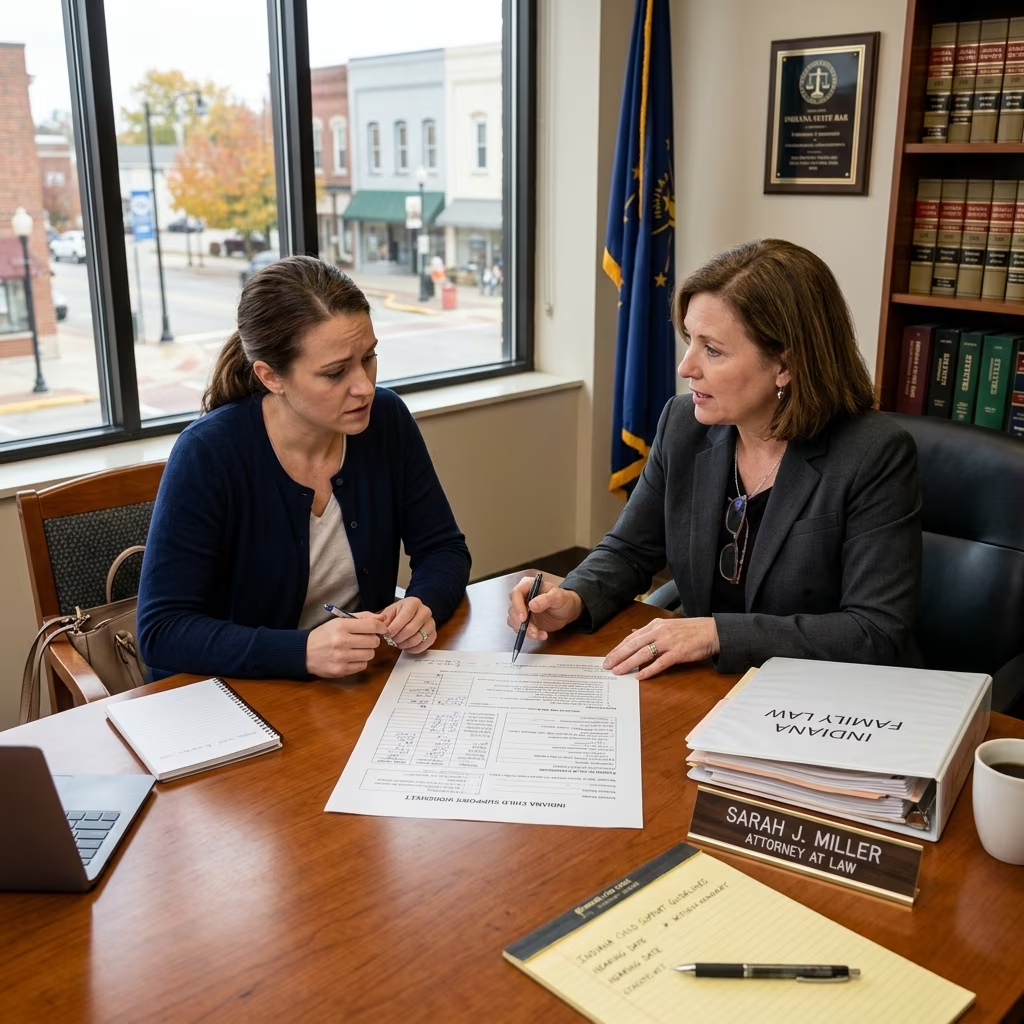
Child support cases in Indiana can look straightforward on paper, but the decisions made in your case will shape your child’s financial stability for years. Choosing whether to work with a private attorney, rely on the state’s IV-D child support program, or handle matters on your own is one of the most important early decisions you will make.
This guide explains how Indiana child support works, what the state will and will not do for you, and when hiring an attorney is likely to make a meaningful difference in your outcome.
Big Picture: Your Options for Handling Child Support in Indiana
In Indiana, child support can be addressed in several ways. You may be:
- Starting support for the first time after separation or divorce
- Trying to enforce an order because payments are not being made
- Seeking to change the amount due to a major change in circumstances
- Dealing with an order that was issued in another state
Depending on your situation, you can:
- Use the Title IV-D Child Support Program administered by Indiana’s Department of Child Services (DCS)
- Hire a private child support attorney to advise and represent you
- Attempt to navigate the process yourself (self-representation)
Each option has benefits and limitations. Understanding what each can realistically do for you helps you decide whether a lawyer is worth the investment in your particular case.
How Indiana Child Support Works in General
Indiana courts use the Indiana Child Support Guidelines to calculate support. These guidelines consider multiple financial and parenting factors.
| Factor | How It Affects Support |
|---|---|
| Income of both parents | Forms the basis of the total support obligation. |
| Number of children | More children generally increases the combined support amount. |
| Health insurance premiums | Premiums paid for the child can be factored into the guideline calculation. |
| Childcare and work-related costs | Necessary daycare or childcare costs are often included. |
| Parenting time / custody arrangements | Time each parent spends with the child may affect the final amount. |
| Existing support or maintenance obligations | Support for other children or spousal maintenance can change the calculation. |
In general, the non-custodial parent (the parent the child lives with less of the time) will be ordered to pay child support, unless that parent’s only income is Supplemental Security Income (SSI) or the parent is incarcerated.
The Role of Indiana’s IV-D Child Support Program
Under federal law, every state is required to provide basic child support services in a program commonly referred to as the Title IV-D Child Support Program. In Indiana:
- The program is managed by the Department of Child Services, Child Support Bureau.
- Services are carried out locally through each county prosecutor’s child support division, the county clerk, and the courts.
- Custodial parents, non-custodial parents, and legal guardians can apply for services regardless of income, and services are generally provided at no cost.
Typical services that the IV-D program can provide include:
- Locating the other parent
- Establishing legal paternity (if needed)
- Requesting the court to set a child support order
- Collecting and distributing payments
- Taking enforcement actions when payments are late or missing (for example, wage withholding or tax refund intercepts)
However, it is crucial to understand that the IV-D office represents the interests of the state and the child, not either parent individually. The staff cannot give you the kind of confidential, strategic legal advice that a private attorney can provide one-on-one.
What a Private Child Support Attorney Can Do Differently
A private Indiana child support lawyer focuses exclusively on your interests and circumstances. Some of the ways an attorney may help include:
- Explaining how the Indiana Child Support Guidelines apply in your specific situation
- Gathering and presenting income and expense evidence in a way that supports your position
- Identifying deductions, credits, or adjustments you may not know to request
- Negotiating with the other parent’s attorney to reach a workable agreement
- Representing you in hearings if you and the other parent cannot agree
- Helping with more complex issues like out-of-state orders or self-employed income
- Preparing and filing motions to enforce or modify child support orders
Because child support rules are technical and fact-specific, having a knowledgeable lawyer can prevent costly mistakes—especially when large income differences, complicated expenses, or serious enforcement issues are involved.
When You May Be Able to Proceed Without a Lawyer
Not every child support matter needs private counsel. The IV-D program and court self-help resources can be enough in more straightforward cases.
You may be able to manage without a private attorney if:
- Your case is relatively simple (for example, one child, regular W-2 income for both parents, no major disputes)
- You are primarily seeking to establish a first-time order and both sides are basically in agreement
- You are comfortable completing forms, gathering documents, and appearing in court if needed
- You are able to work cooperatively with the other parent
Indiana also offers legal information and limited-scope assistance through organizations such as Indiana Legal Services and Indiana Legal Help, which provide guidance on child support orders, modifications, and related forms.
Situations Where Hiring an Attorney Is Strongly Recommended
There are certain circumstances in which the potential consequences of a mistake, or the complexity of the issues, makes consulting a private lawyer much more important.
1. High Conflict or Domestic Violence
If there is a history of domestic violence, intimidation, or high conflict, navigating the system on your own can be risky and emotionally overwhelming. A lawyer can:
- Act as a buffer between you and the other parent
- Ensure court filings and requests are framed to prioritize safety
- Coordinate with any existing protective orders or custody restrictions
2. Complex Income or Self-Employment
Child support calculations become more complicated when one or both parents:
- Own a business or are self-employed
- Receive bonuses, commissions, or irregular income
- Have multiple jobs or income streams
- Are underemployed or working for cash
In these situations, proving income may require detailed financial records, tax returns, or even expert testimony. An attorney can help interpret and present this information so that the support amount better reflects the true financial situation.
3. Cross-State or International Issues
If your existing support order was issued in another state, or one parent has moved, you may need to register the out-of-state order in Indiana before you can ask an Indiana court to modify it. Cases involving multiple states or countries are governed by specific laws and procedures, and a misstep can delay enforcement or modification.
4. Major Change in Circumstances (Modification)
Indiana law allows child support to be modified when there has been a substantial and continuing change in circumstances that makes the current order unreasonable, or when the amount deviates by at least 20% from what the guidelines would require and at least one year has passed since the last order.
Examples include:
- Loss of a job or major change in income (up or down)
- Change in custody or parenting time arrangement
- A child developing a disability or major medical need
- Significant increase in work-related childcare or health care costs
An attorney can help you determine whether you meet modification requirements and gather the evidence needed to support your request.
5. Serious Non-Payment or Enforcement Problems
When child support falls behind, courts can order wage garnishment, intercept tax refunds, suspend driver’s or professional licenses, and even hold a parent in contempt of court, which can result in jail time in serious cases.
If you are the parent owed support, a lawyer can help you:
- Push for effective enforcement measures
- Respond if the other parent claims they cannot pay
- Address complex arrears or interest questions
If you are the parent who owes support, an attorney can help you:
- Seek a modification if your financial circumstances have changed
- Negotiate realistic payment plans
- Defend against contempt allegations when appropriate
How to Decide: A Practical Comparison of Your Options
The table below compares typical features of the IV-D program, private counsel, and self-representation in Indiana.
| Option | Advantages | Limitations | Best For |
|---|---|---|---|
| IV-D Child Support Program |
|
| Routine establishment and enforcement cases where conflict and complexity are low |
| Private Child Support Attorney |
|
| Cases with disputes, complex finances, cross-state issues, or major enforcement problems |
| Self-Representation |
|
| Very simple, low-conflict matters where both parents understand and follow court rules |
Key Steps If You Think You Might Need a Lawyer
If you suspect that your child support situation is too complex or contentious to handle alone, consider taking the following steps:
- Gather basic information – Collect pay stubs, tax returns, childcare invoices, health insurance statements, and any existing court orders.
- Contact your county’s child support office – Ask what services they can provide in your case and how long processes typically take.
- Schedule a consultation with a family law attorney – Many child support lawyers offer initial consultations where you can discuss your situation and potential strategies.
- Explore legal aid options – If you cannot afford a private lawyer, organizations like Indiana Legal Services may provide free or low-cost help if you qualify.
Frequently Asked Questions About Indiana Child Support and Attorneys
Is the IV-D child support office my lawyer?
No. The IV-D child support office represents the interests of the State of Indiana and is charged with enforcing child support laws for the benefit of children, not serving as legal counsel for either parent. Staff can explain procedures and help move your case forward, but they cannot give you individualized legal advice about what is best for you personally.
Can I get child support services even if I am not on public assistance?
Yes. Indiana’s IV-D program is available to custodial parents, non-custodial parents, and legal guardians regardless of income, whether or not they receive programs like Temporary Assistance for Needy Families (TANF) or Medicaid. Many parents who do not receive public assistance still use IV-D services to establish or enforce child support.
How long does child support usually last in Indiana?
Under Indiana law, child support orders generally last until the child turns 19. In some circumstances, support can end earlier (for example, if the child becomes self-supporting and the court terminates the obligation) or extend longer if educational support is requested and ordered by the court. You may need to file specific requests with the court to address support around and beyond age 19.
Can I change my child support order without going to court?
If you and the other parent agree on a new support amount that complies with the guidelines, you still must obtain court approval before the change becomes legally binding. You can submit an agreed order to the court; in some cases a hearing may not be required, but the judge must sign off on any modification.
What if the other parent has moved to a different state?
You can usually still enforce or seek to modify a child support order even if parents live in different states. Indiana courts may require you to register an out-of-state order before they can modify it. Multi-state cases are governed by specific uniform laws, and an attorney can help you understand which court has authority and what steps to take.
Do I need a lawyer just to start a basic child support case?
Not necessarily. For many parents, the IV-D program and court forms are enough to establish a standard child support order. But if you anticipate significant disagreement over income, parenting time, or special expenses—or if safety is a concern—it is wise to at least consult a child support attorney about your options.
Final Thoughts: Balancing Cost, Complexity, and Risk
Hiring a child support attorney in Indiana is rarely required, but often helpful. In low-conflict cases with relatively simple finances, the IV-D program and self-help resources may be enough. The more your case involves disputes, complex income, cross-state orders, or serious enforcement issues, the more value an experienced lawyer is likely to provide.
Before making your decision, take time to understand the services offered by the IV-D office, explore legal aid if needed, and consider speaking with at least one private attorney. The support order you obtain—or fail to change—will influence your child’s financial security and both parents’ budgets for years, so an informed choice at the outset can pay off over the long term.
References
- Child Support Services — Indiana Department of Child Services, Child Support Bureau. 2024-01-10. https://www.in.gov/dcs/child-support/
- IPAC: Child Support Services — Indiana Prosecuting Attorneys Council. 2023-08-15. https://www.in.gov/ipac/child-support-services/
- Child Support — Indiana Legal Services, Inc. 2022-11-30. https://www.indianalegalservices.org/child-support/
- Child Support — Indiana Legal Help (Indiana Bar Foundation). 2023-06-05. https://indianalegalhelp.org/legal-topic-category/child-support-2/
- Indiana Child Support Attorneys — McNeelyLaw LLP. 2023-10-01. https://www.mcneelylaw.com/family-law-attorneys/child-support/
- Child Support Lawyers in Anderson, Indiana — Beeman Heifner Benge P.A. 2023-03-15. https://www.bhblawgroup.com/family-law/child-support/
- Title IV-D Child Support Program Overview — U.S. Department of Health and Human Services, Office of Child Support Services. 2022-09-20. https://www.acf.hhs.gov/css