Game wardens are often thought of as officers who only handle hunting and fishing violations, but their authority can be much broader. In many states, they can issue citations, make arrests, and enforce laws beyond wildlife regulations, sometimes with powers that look very similar to those of police officers.
At the same time, their authority is not identical everywhere. The exact scope of a game warden’s power depends on state law, the type of location involved, and the constitutional rules that apply to searches and seizures.
What a Game Warden Actually Does
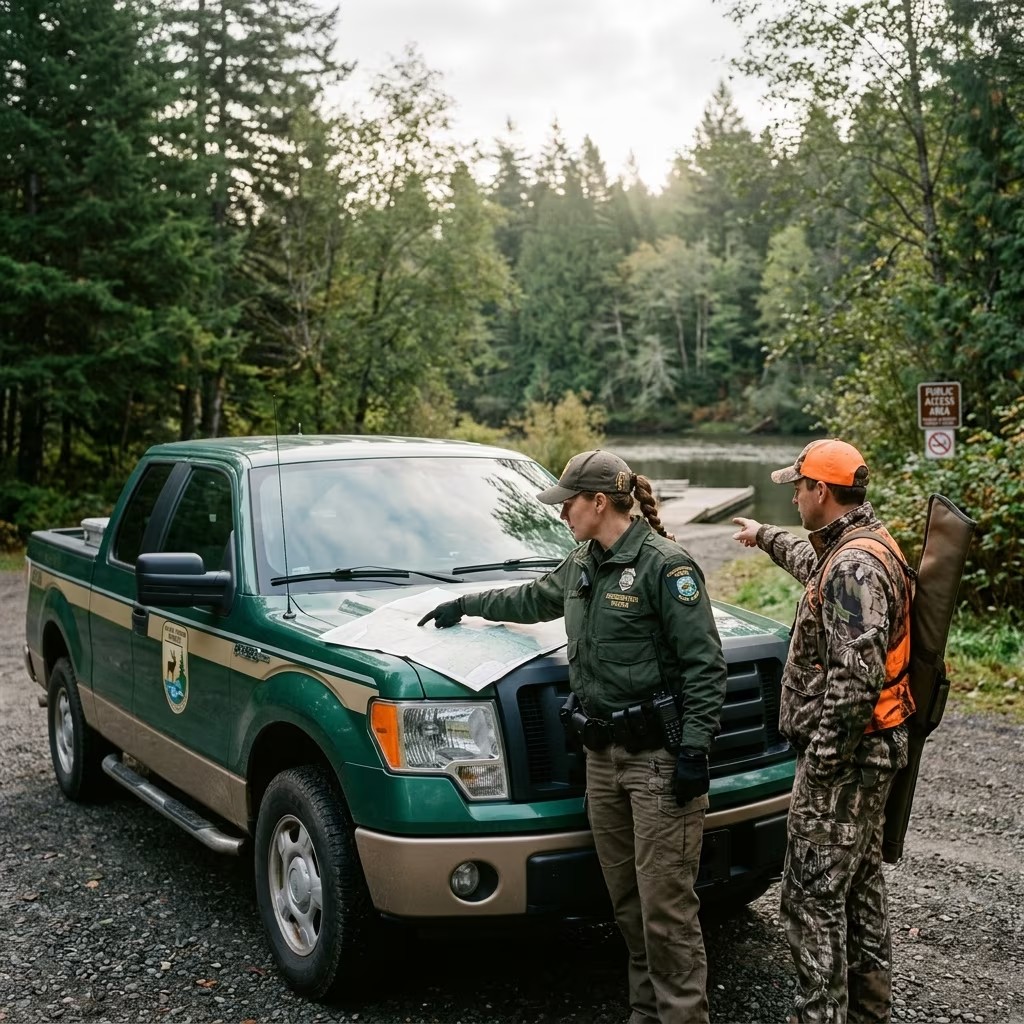
A game warden is a law enforcement officer focused primarily on conservation, hunting, fishing, boating, and related public safety rules. Their work often includes checking licenses, inspecting game, responding to illegal harvesting, and investigating conduct that threatens natural resources.
In practice, that role often overlaps with ordinary policing. A warden may encounter intoxicated drivers on rural roads, firearms violations during hunting season, trespassing issues on public land, or other offenses that are not limited to wildlife law.
- Enforcing hunting and fishing regulations
- Checking licenses and tags
- Investigating illegal possession of wildlife
- Handling boating safety and related offenses
- Addressing other criminal or traffic violations observed during patrol
How Game Wardens Compare With Police Officers
In many states, game wardens are peace officers or full law-enforcement officers with statewide authority. That means they can often stop vehicles, issue citations, and arrest people for more than just fish-and-game offenses. The difference is usually not whether they are real police; the difference is the agency they serve and the subject matter they focus on.
Some states give game wardens authority nearly identical to that of sheriff’s deputies or state troopers. Other states limit them more closely to conservation enforcement. Because of this variation, the answer to whether a game warden has the “same powers” as a police officer is often, “sometimes, but not always.”
| Issue | Typical Police Officer | Game Warden |
|---|---|---|
| Primary mission | General public safety and criminal enforcement | Wildlife, conservation, and outdoor safety enforcement |
| Arrests and citations | Usually broad authority | Often broad authority, but state-specific |
| Traffic enforcement | Routine authority | Often permitted, especially if a violation is observed |
| Search powers | Controlled by the Fourth Amendment and state law | Also controlled by the Fourth Amendment, but some search rules can be broader in the wildlife context |
| Jurisdiction | Usually city, county, or statewide depending on agency | Often statewide or broad rural jurisdiction |
Authority That Goes Beyond Wildlife Violations
Game wardens do not always limit themselves to hunting and fishing cases. If they lawfully observe another crime, such as impaired driving, reckless handling of a firearm, or drug possession, they may take action just as another officer would. In many jurisdictions, they may also stop a person for conduct that threatens safety even if the original reason for the patrol was conservation-related.
This broader authority matters because a person encountering a warden may assume the officer can only ask about fish, game, or permits. In reality, the encounter can expand quickly if the warden sees evidence of another offense.
- Driving under the influence
- Reckless driving or unsafe vehicle operation
- Illegal weapons conduct
- Drug-related offenses
- Trespassing or interference with official duties
Search and Seizure: Where the Rules Can Be Different
One of the biggest differences between game wardens and ordinary police work appears in the search context. Police officers usually need probable cause, a warrant, or valid consent before searching a person, vehicle, or home. Game wardens are also bound by the Constitution, but some courts and state laws recognize special exceptions in wildlife enforcement.
That does not mean wardens can ignore the Fourth Amendment. It does mean that certain outdoor settings, regulated activities, and conservation inspections may allow more limited searches than a typical street encounter. Courts have long recognized that people have a reduced expectation of privacy in some open or heavily regulated areas.
For example, a warden may have more room to inspect wildlife-related items in a vehicle or to check areas tied to hunting and fishing activity than police would in an ordinary unrelated investigation. Even so, the officer’s conduct still must fit within applicable state and federal law.
The Open Fields Idea and Outdoor Property
One important legal concept in this area is the open fields doctrine. Under this rule, the Fourth Amendment generally does not protect open land in the same way it protects a home and its immediate surroundings. As a result, officers may sometimes enter open land without a warrant, even if signs say “No Trespassing.”
This doctrine is especially relevant to game wardens because much of their work occurs outdoors, away from homes and commercial centers. Their inspections may involve fields, wooded property, shorelines, streams, and other areas where wildlife activity occurs.
However, the doctrine does not give unlimited access to everything on private property. The area around a home, known as curtilage, receives stronger constitutional protection. Buildings and spaces tied closely to the home may require a different analysis.
- Open land may receive less Fourth Amendment protection
- Curtilage around a home usually receives stronger protection
- Commercial handling or storage of wildlife may be subject to inspection rules in some states
- State constitutions can provide greater protection than the federal baseline
Why State Law Matters So Much
Game warden authority is highly state-specific. Some states grant them the same powers as peace officers, while others define a narrower role. In a few places, statutes expressly authorize wardens to act like general law enforcement officers. In others, the officer may have broad enforcement powers only within conservation-related contexts.
That means two people can have very different experiences depending on where the encounter happens. A warden in one state may be able to make a traffic stop and arrest a suspect for any offense within jurisdiction, while a warden elsewhere may have a more limited mandate.
If a case involves a search, an arrest, or a citation by a game warden, the exact wording of the state statute often becomes as important as the constitutional issue. Local law can determine whether the officer acted within authority.
Common Misunderstandings About Game Wardens
Public discussion often exaggerates or distorts what game wardens can do. Some people assume wardens can search anywhere at any time, while others assume they only handle fishing tickets and nothing else. Both views are too simplistic.
The truth is more balanced. Game wardens are genuine law enforcement officers, but their powers are shaped by a combination of conservation statutes, criminal procedure rules, and constitutional limits. Their authority is real, but it is not magic.
- They are not limited only to handing out fishing tickets
- They are not universally allowed to search any property without limits
- They often can enforce general criminal and traffic laws
- They remain subject to constitutional protections
When a Warden’s Actions May Be Challenged
A person may be able to challenge a warden’s conduct if the officer exceeded statutory authority or violated constitutional rules. For example, an illegal search of a home, an arrest made without legal basis, or an inspection that went beyond what state law allows may lead to suppression of evidence or another remedy.
Whether a challenge succeeds depends on the facts. Courts often look closely at where the encounter happened, what the officer was investigating, whether the person consented, and whether the officer had a lawful basis to proceed.
Potential issues include:
- Searches without a valid legal exception
- Stops made without reasonable suspicion or probable cause
- Arrests outside the officer’s statutory authority
- Evidence gathered from protected areas of a home
Practical Takeaways for Outdoor Encounters
If you are stopped by a game warden, it is wise to treat the encounter seriously. The officer may have authority to investigate more than the immediate wildlife issue, and your responses can affect how the situation develops. At the same time, you still retain constitutional rights, including the right to avoid unreasonable searches and seizures.
People who hunt, fish, boat, or spend time on public land should assume that wardens can check licenses, ask questions, and respond to signs of broader unlawful conduct. The safest approach is to remain calm, comply with lawful orders, and avoid making assumptions about what the officer can or cannot do.
- Keep required licenses and permits accessible.
- Do not physically interfere with an inspection or stop.
- Ask questions politely if the reason for the stop is unclear.
- Do not assume a warden lacks authority simply because the matter is not purely wildlife-related.
- If a search or arrest seems unlawful, raise the issue later through legal channels rather than in the field.
Frequently Asked Questions
Are game wardens real police officers?
In many states, yes. Game wardens are often sworn law enforcement officers with powers that can include arrests, citations, and traffic enforcement, though the scope varies by state.
Can a game warden stop my car?
Yes, if the stop is legally justified. Wardens may stop a vehicle for observed violations, wildlife-related enforcement, or other lawful reasons within their authority.
Can a game warden search my vehicle without a warrant?
Sometimes. Searches depend on the facts, the location, the nature of the suspected violation, consent, probable cause, and any special wildlife-enforcement exceptions recognized by law.
Can a game warden come onto private land?
In some circumstances, yes. Open land may be treated differently from the home and its immediate surroundings, but the exact rule depends on state law and constitutional doctrine.
Can game wardens arrest someone for non-wildlife crimes?
Often yes, especially in states that grant them broad peace-officer authority. They may also act on crimes they observe while performing their duties.
Why This Question Matters
Whether game wardens have the same powers as police officers is not just a technical legal question. It affects how searches are evaluated, how evidence may be used in court, and what rights a person has during an encounter in the field. Because state law varies, the correct answer always depends on where the incident occurred and what the officer did.
Understanding these rules helps outdoor users, landowners, hunters, and drivers recognize both the reach and the limits of conservation law enforcement. Wardens can be powerful officers, but they are still governed by law.
References
- Do Game Wardens Have the Same Powers as Police Officers? — FindLaw. 2026-07-10. https://www.findlaw.com/legalblogs/criminal-defense/do-game-wardens-have-the-same-powers-as-police-officers/
- Enforcing the Laws of Wildlife and Recreation (Part One) — FBI Law Enforcement Bulletin. 2002-01-01. https://leb.fbi.gov/articles/featured-articles/enforcing-the-laws-of-wildlife-and-recreation-part-one
- Open Fields Doctrine — Congressional Sportsmen’s Foundation. 2026-07-10. https://congressionalsportsmen.org/policy/open-fields-doctrine/
- About NACELC — National Association of Conservation Law Enforcement Chiefs. 2026-07-10. https://naclec.org/about
- Hester v. United States — U.S. Supreme Court. 1924-03-03. https://supreme.justia.com/cases/federal/us/265/57/
- Oliver v. United States — U.S. Supreme Court. 1984-06-25. https://supreme.justia.com/cases/federal/us/466/170/