
Understanding Divorce Types: Fault vs. No-Fault Approaches
Navigate divorce options: Learn how fault and no-fault divorces differ in process, cost, and outcomes.
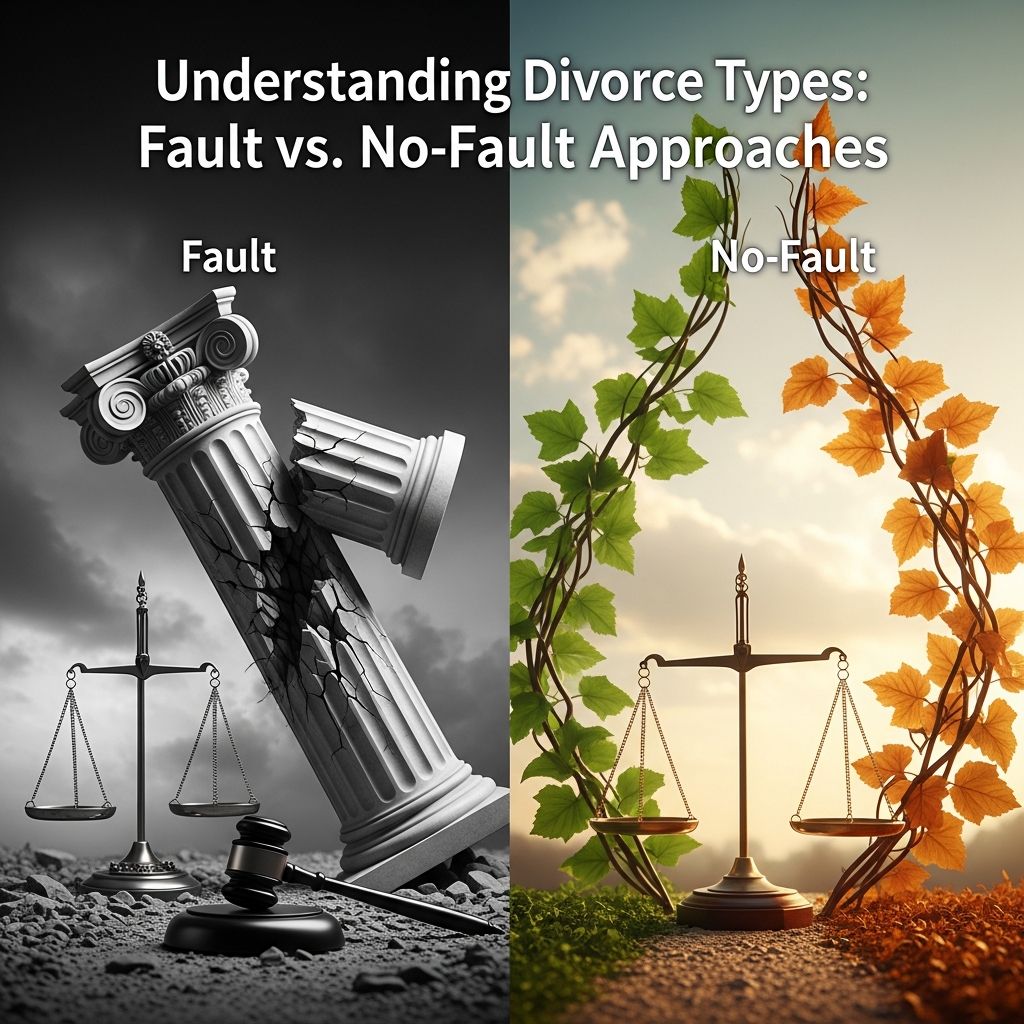
When a marriage reaches its end, couples must navigate the legal dissolution process. One of the most significant decisions involves choosing between a fault-based divorce and a no-fault divorce. These two pathways represent fundamentally different approaches to ending a marriage, each with distinct legal requirements, financial implications, and emotional considerations. Understanding the distinction between these options is essential for anyone contemplating divorce.
The Foundational Concept: How Divorce Types Differ
The primary distinction between these two divorce categories centers on the legal framework and what must be established to obtain the dissolution. In a fault-based divorce, one spouse must demonstrate that the other spouse’s misconduct or wrongdoing caused the marriage to fail. This requires presenting evidence to the court and proving specific grounds for the divorce. Conversely, in a no-fault divorce, neither spouse needs to establish that the other did something wrong. Instead, the dissolving parties simply need to indicate that the relationship cannot be repaired and that continuing the marriage is no longer viable.
All 50 states now permit some form of no-fault divorce, making it widely accessible regardless of location. However, many jurisdictions retain fault-based grounds as an alternative option. This dual-pathway system gives couples flexibility in determining which approach best aligns with their circumstances and preferences.
Exploring No-Fault Divorce: The Modern Standard
A no-fault divorce operates on a straightforward principle: the marriage cannot be salvaged due to fundamental incompatibilities or irreversible breakdown. When filing for a no-fault divorce, the petitioner typically cites reasons such as “irreconcilable differences,” “irretrievable breakdown of the marriage,” or similar language that signals the relationship is beyond repair. The specific terminology varies by jurisdiction, but the concept remains consistent across states.
Advantages of the No-Fault Approach
- Reduced Emotional Burden: Because the process does not require one spouse to publicly establish wrongdoing by the other, the proceedings remain more private and less psychologically taxing on all family members.
- Lower Financial Cost: Without the necessity to gather evidence and present misconduct claims, legal expenses typically decrease significantly compared to contested fault-based proceedings.
- Faster Resolution: The streamlined process typically moves through the court system more quickly, allowing couples to finalize their separation sooner.
- Focus on Real Issues: The court can concentrate on substantive matters like property division, spousal support, and child custody without the distraction of establishing blame.
- Reduced Conflict: The absence of blame-focused arguments creates a less adversarial environment, which can be particularly beneficial when children are involved.
Separation Requirements in No-Fault Divorces
Many states implementing no-fault divorce procedures mandate a period of physical separation before the court will finalize the dissolution. This waiting period demonstrates that the marital breakdown is genuine and irreversible. The duration varies considerably by state, ranging from several months to more than one year of continuous separation. During this interval, spouses typically live apart and do not cohabitate, which provides time for both parties to contemplate the decision and potentially attempt reconciliation.
Fault-Based Divorce: The Traditional Route
Fault-based divorces represent the historical approach to marriage dissolution and remain available in many jurisdictions, though they have become less commonly used as no-fault options have expanded. In this framework, the spouse initiating the divorce must substantiate specific grounds demonstrating that their partner’s misconduct precipitated the marriage’s collapse.
Common Grounds for Fault-Based Divorce
The acceptable grounds for a fault divorce vary by state, but generally include:
- Adultery: Evidence that the other spouse engaged in sexual relations outside the marriage.
- Abandonment: The other spouse departed the home and refused to return without legal justification.
- Cruel and Abusive Treatment: Documentation of physical or emotional abuse, cruelty, or inhumane behavior.
- Substance Abuse: Proof of habitual drug or alcohol dependency that negatively affected the marriage.
- Criminal Conviction or Imprisonment: The spouse was convicted of a felony or sentenced to incarceration.
- Mental or Physical Incapacity: The spouse suffered from conditions rendering them unable to fulfill marital obligations.
- Desertion or Continued Separation: Intentional abandonment lasting a specified duration without reasonable cause.
Requirements for Proving Fault
Pursuing a fault-based divorce demands rigorous evidence gathering and legal demonstration. The spouse asserting fault must present credible documentation—such as photographs, communications, financial records, testimony from witnesses, or professional reports—to convince the court that the alleged misconduct occurred. This evidentiary requirement transforms the divorce proceeding into something resembling a trial, complete with examination and cross-examination of witnesses.
Comparative Analysis: Cost and Time Considerations
| Factor | No-Fault Divorce | Fault-Based Divorce |
|---|---|---|
| Average Cost | Lower, often uncontested | Higher due to evidence gathering and litigation |
| Timeline | Faster, minus separation period requirement | Longer, often involving contested proceedings |
| Attorney Involvement | Often minimal or self-representation possible | Usually requires full legal representation |
| Burden of Proof | None; no misconduct must be proven | Requires clear and convincing evidence |
| Emotional Impact | Less adversarial and combative | Often contentious and emotionally draining |
| Spouse Opposition | Cannot be contested; other spouse cannot prevent | Can be contested if accused denies fault |
Impact on Property Division and Support Obligations
A common misconception holds that establishing fault in a divorce will directly influence property distribution or alimony awards. However, most modern courts apply similar analytical frameworks regardless of whether the divorce is fault-based or no-fault. When determining how to divide marital assets, courts typically apply equitable distribution principles (in some states) or community property rules (in others), considering factors such as the duration of the marriage, each spouse’s financial contributions, earning capacity, and future needs.
In certain jurisdictions, a spouse’s misconduct might influence these decisions to some extent—particularly in cases involving financial waste or severe abuse—but the connection is indirect rather than determinative. The decision to pursue a fault-based divorce for the purpose of improving one’s position regarding property or support is often inefficient, as the same outcomes may be achievable through no-fault proceedings without the added expense and conflict.
Strategic Considerations: Why Couples Choose Each Option
While no-fault divorce offers efficiency and reduced conflict, some couples intentionally select the fault-based approach for specific reasons. Those who cannot or will not wait out the mandatory separation period required by their state’s no-fault statute may opt for fault grounds to accelerate the timeline. Additionally, individuals who harbor significant hurt, betrayal, or desire for validation might pursue fault-based proceedings to have their spouse’s misconduct formally acknowledged and documented by the court.
In limited circumstances, a spouse’s ability to demonstrate the other’s fault might result in enhanced financial awards, though this outcome depends heavily on state law and the specific circumstances. Nevertheless, these potential advantages must be weighed against the substantially greater costs and extended timelines characteristic of contested fault divorces.
The Question of Contested vs. Uncontested Proceedings
Both fault-based and no-fault divorces can technically be uncontested, though this scenario is considerably more common with no-fault approaches. An uncontested divorce means both spouses have reached agreement on all major issues—property division, custody arrangements, support obligations, and other relevant matters. When a divorce is fully settled, the court’s role becomes primarily administrative, and the cost savings are substantial.
An uncontested fault-based divorce can occur when one spouse willingly admits to the alleged misconduct and accepts the consequences without contesting the divorce. However, such situations are relatively uncommon because an accused spouse might challenge the fault allegations or present mitigating explanations for their behavior.
Defenses and Special Circumstances in Fault Divorces
An accused spouse can potentially prevent a fault divorce from being granted by successfully challenging the allegations. If the spouse can demonstrate that the charges are false or lacks sufficient evidence, the court may deny the fault-based divorce petition. Additionally, defenses exist based on the principle of “comparative rectitude”—when both spouses have engaged in behavior qualifying as fault grounds, the court may grant the divorce to whichever spouse is deemed less culpable. In years past, when both parties were at fault, neither could obtain a divorce under the rigid rules of fault-based systems. The comparative rectitude doctrine developed to address this impractical outcome.
The Inability to Stop a No-Fault Divorce
A significant practical difference exists regarding a spouse’s power to prevent the dissolution. In a no-fault divorce, the responding spouse cannot block the proceeding simply by refusing to cooperate or by objecting to the divorce itself. A court will recognize the objection as evidence of irreconcilable differences, thereby reinforcing the grounds for the divorce. This feature of no-fault divorces fundamentally shifts the legal landscape, as either spouse can unilaterally initiate the dissolution process if they believe the marriage is irretrievable.
Jurisdictional Variations and State-Specific Rules
While the broad distinctions between fault and no-fault divorces apply nationwide, each state maintains its own specific statutes, terminology, and procedures. Some jurisdictions have fully transitioned to no-fault systems, while others maintain robust fault-based options. Residency requirements, separation period lengths, and the admissibility of fault evidence in financial decisions vary considerably. Individuals contemplating divorce should research their specific state’s laws or consult with a family law attorney familiar with local regulations.
Frequently Asked Questions
Q: Can I file for divorce without my spouse’s consent?
A: Yes. In all 50 states, you can file for a no-fault divorce without your spouse’s agreement. Your spouse cannot prevent a no-fault divorce by refusing to cooperate, though they may still be involved in determining property division and custody.
Q: Will proving my spouse’s fault result in me receiving more assets or support?
A: Not necessarily. While some states may consider marital misconduct in determining property distribution or alimony, most courts apply similar analysis regardless of fault status. The connection between proving fault and financial advantage is indirect and unpredictable.
Q: How long does a no-fault divorce typically take?
A: Timeline varies by state and whether the separation period requirement applies. Uncontested no-fault divorces may be finalized in several months, while others involving mandatory waiting periods might extend to a year or more.
Q: Is a fault-based divorce ever advisable?
A: Fault-based divorces may be considered if you cannot wait for a state’s separation period requirement or if your spouse’s misconduct substantially affected marital finances. However, the increased costs and emotional toll should be carefully weighed against potential benefits.
Q: What happens if both spouses want a no-fault divorce?
A: If both parties agree, the process is typically faster and less expensive. An agreed no-fault divorce can often be uncontested, allowing couples to resolve property and custody issues through negotiation or mediation rather than litigation.
References
- No-Fault vs. Fault Divorce Under State Laws — Justia. https://www.justia.com/family/divorce/the-divorce-process/no-fault-vs-fault-divorce/
- No-Fault Divorce vs. Fault Divorce FAQ — Nolo. https://www.nolo.com/legal-encyclopedia/no-fault-divorce-vs-fault-divorce-faq.html
- No-Fault vs. Fault Divorce — DivorceNet. https://www.divorcenet.com/resources/divorce/divorce-basics/no-fault-versus-fault-divorce.htm
- What Is the Difference Between a “Fault” and a “No-Fault” Divorce? — LawInfo. https://www.lawinfo.com/resources/divorce/what-is-the-difference-between-a-fault-and-a.html
- Fault vs. No-Fault Divorce — National Paralegal College. https://www.nationalparalegal.edu/public_documents/courseware_asp_files/DomRelImmig/Divorce/FaultVsNoFaultDivorce.asp
Similar Articles








Read full bio of Sneha Tete


