
Divorce Decree or Certificate: Key Distinctions
Understand the vital differences between a divorce decree and certificate to navigate post-divorce needs effectively and avoid common pitfalls.
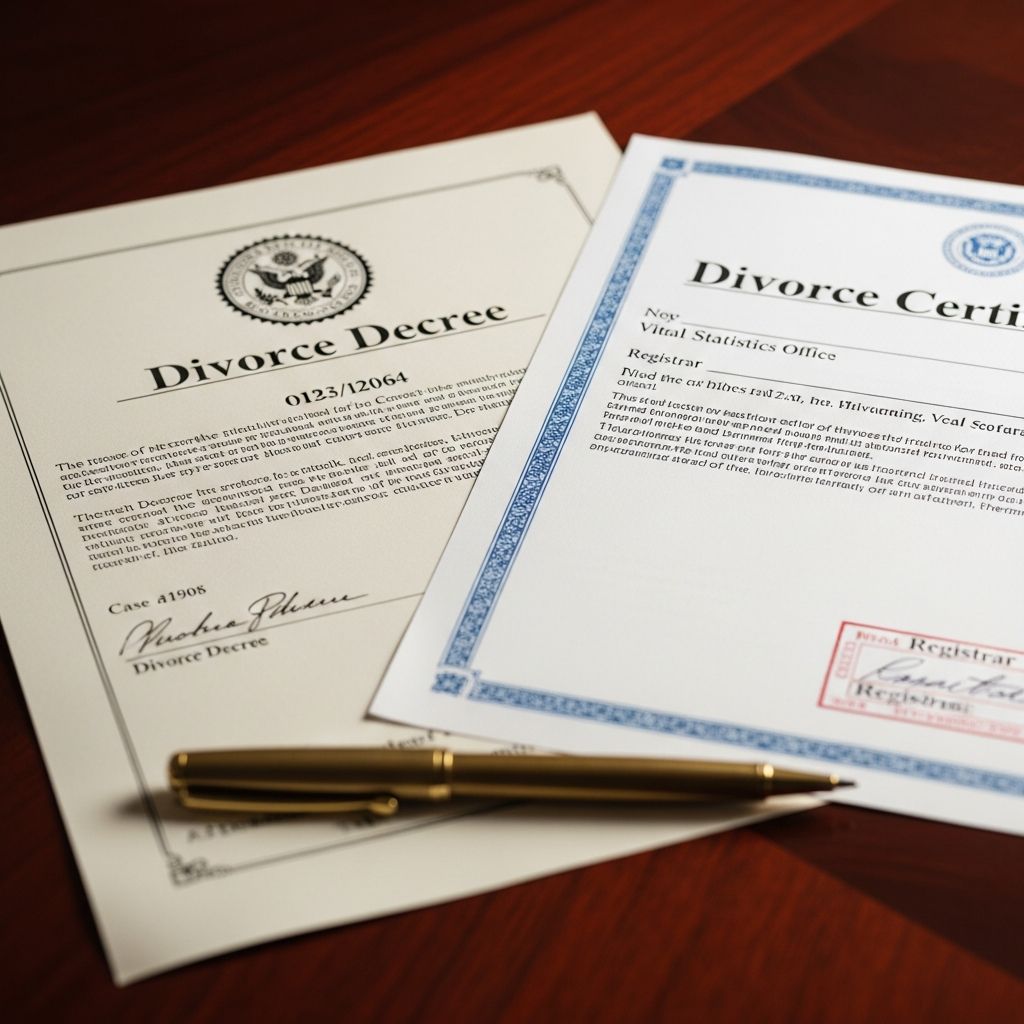
Navigating the aftermath of a divorce requires understanding key legal documents that formalize the end of a marriage. Two primary documents often come into play: the
divorce decree
and thedivorce certificate
. While both confirm the dissolution of a marriage, they serve distinct roles, originate from different authorities, and contain varying levels of detail. Grasping these differences ensures you select the right document for tasks like remarriage, name changes, or financial updates.Understanding the Divorce Decree
The divorce decree represents the court’s official ruling that concludes the divorce proceedings. Issued directly by the family court judge, this comprehensive document not only declares the marriage dissolved but also establishes enforceable terms governing the parties’ future obligations. It acts as a binding contract that both ex-spouses must follow, with potential court enforcement for non-compliance.
Typical elements outlined in a divorce decree include:
- Division of marital property and debts
- Child custody and parenting time schedules
- Child support payment amounts and durations
- Spousal maintenance or alimony provisions
- Any court-ordered name restorations
Courts may incorporate a marital settlement agreement into the decree if the parties reached an amicable resolution through mediation or negotiation. In contested cases, the judge decides these matters after hearings. The document bears the judge’s signature, attorney endorsements where applicable, and an official court seal, rendering it legally authoritative from the signing date.
Purposes and Practical Applications of the Divorce Decree
Beyond finalizing the divorce, the decree serves multiple enforcement and modification functions. Financial institutions reference it to update account ownerships or close joint accounts. Government agencies use it to adjust benefits or tax statuses. For parents, it provides the basis for enforcing child-related orders through mechanisms like wage garnishment or contempt proceedings.
If circumstances change—such as a job loss affecting support payments—either party can petition the issuing court for modifications, presenting the original decree as the starting point. This document’s depth makes it indispensable for complex post-divorce matters, though its sensitive details necessitate careful handling to protect privacy.https://www.experian.com/blogs/ask-experian/what-is-a-divorce-decree/
Obtaining Copies of Your Divorce Decree
Securing a certified copy of the decree requires contacting the clerk’s office in the county or jurisdiction where the divorce was granted. Availability typically extends to the ex-spouses, their legal representatives, or authorized third parties with proper identification and justification. Requests may involve written applications, fees ranging from $10 to $50 depending on the state, and sometimes in-person visits.
Processing times vary: some courts offer same-day service, while others mail copies within weeks. Always verify requirements via the court’s website or phone, as procedures differ by location. Retain multiple certified copies upfront, as original court files may not always be immediately accessible for duplicates.https://www.usa.gov/divorce-decree
Exploring the Divorce Certificate
In contrast to the detailed court decree, the divorce certificate offers a streamlined record of the event. Issued by state vital records offices—such as health departments or bureaus of vital statistics—this document functions as a vital record, akin to birth or death certificates. Not every state produces these; availability depends on local regulations.
A standard divorce certificate lists minimal facts:
- Full names of both ex-spouses
- Date the divorce became final
- County or city where the court issued the decree
- Occasionally, the court’s name or case number
Lacking settlement specifics, it prioritizes privacy while verifying the marital status change. This makes it suitable for scenarios where only confirmation of single status suffices.https://www.cdph.ca.gov/Programs/CHSI/Pages/Vital-Records-Obtaining-Certified-Copies-of-Divorce-Records.aspx
Common Uses for the Divorce Certificate
The certificate’s simplicity suits administrative tasks requiring proof of divorce without exposing private terms. Examples include:
- Applying for a marriage license in a new relationship
- Processing passport applications or international travel visas
- Updating Social Security records or driver’s licenses
- Handling inheritance claims as a single individual
- Executing name changes via vital records forms
For international moves or remarriages abroad, embassies often accept it as sufficient evidence. However, if the certificate omits a name change documented in the decree, additional affidavits may be required.https://www.vitalchek.com/v/divorce-records
Step-by-Step Guide to Requesting a Divorce Certificate
Start by identifying your state’s vital records agency through official government portals. Submit applications online, by mail, or in person, providing identification, the divorce details, and fees typically between $10 and $30 per copy. Expedited services via authorized vendors like VitalChek accelerate delivery for an extra charge.
Public access varies: some states restrict certificates to the principals, while others allow broader inquiries with fees. Expect 2-8 weeks for standard processing. Always confirm if your state issues certificates, as alternatives like dissolution records may substitute in non-issuing jurisdictions.https://www.usa.gov/divorce-decree
Comparative Analysis: Decree vs. Certificate
To highlight disparities, consider this breakdown:
| Aspect | Divorce Decree | Divorce Certificate |
|---|---|---|
| Issuing Authority | Family Court | Vital Records Office |
| Content Depth | Comprehensive (support, custody, assets) | Basic (names, date, location) |
| Legal Effect | Binding orders, enforceable | Proof of event only |
| Availability | All states via courts | Not all states |
| Primary Uses | Enforcement, modifications | Administrative proofs |
| Cost per Copy | $10-$50 | $10-$30 |
This table underscores when to deploy each document strategically.https://www.usa.gov/divorce-decree
State Variations and Special Considerations
Divorce documentation practices differ across the U.S. California, for instance, mandates court sourcing for decrees while vital records handle certificates. Other states like Texas or Florida may use terms like ‘dissolution judgment.’ Internationally, equivalents vary; U.S. documents often require apostilles for foreign recognition.
Post-divorce, update records promptly: notify the IRS for tax filing status, credit bureaus for individual accounts, and employers for benefits. Digital storage via secure clouds preserves copies, but certified originals remain essential for official submissions.
Frequently Asked Questions
Can I remarry immediately after receiving my divorce decree?
Yes, the decree’s signing date marks the marriage’s end, allowing remarriage absent state waiting periods. Verify local laws, as some impose brief delays.
Does every state provide divorce certificates?
No, only select states issue them; others rely on decrees or indexes for proof.
What if I lost my original documents?
Replacements follow standard request procedures from the issuing court or vital office, with fees and ID verification.
Is a divorce certificate sufficient for a passport name change?
Often yes for status proof, but if the name change occurred via decree, include both documents.
How long does it take to get certified copies?
Courts: days to weeks; vital records: 2-8 weeks standard, faster with rush options.
Navigating Post-Divorce Documentation Challenges
Common hurdles include mismatched names from prior records or uncooperative ex-spouses delaying access. Legal aid or family law attorneys can assist with stubborn courts. For out-of-state divorces, interstate compacts streamline verifications. Proactive organization—maintaining a ‘divorce file’ with multiples—mitigates future stresses.
In summary, select the divorce decree for substance and authority, the certificate for simplicity and discretion. Both empower smooth transitions into single life.
References
- How to get a copy of a divorce decree or certificate — USAGov. 2023-10-01. https://www.usa.gov/divorce-decree
- Vital Records Obtaining Certified Copies of Divorce Records — California Department of Public Health. 2024-01-15. https://www.cdph.ca.gov/Programs/CHSI/Pages/Vital-Records-Obtaining-Certified-Copies-of-Divorce-Records.aspx
- Order Divorce Records Online — VitalChek. 2025-12-01. https://www.vitalchek.com/v/divorce-records
- What Is a Divorce Decree? — Experian. 2024-05-20. https://www.experian.com/blogs/ask-experian/what-is-a-divorce-decree/
Similar Articles








Read full bio of Sneha Tete


