
District of Columbia Traffic Laws Explained
A clear guide to D.C. traffic rules, penalties, and driving risks.
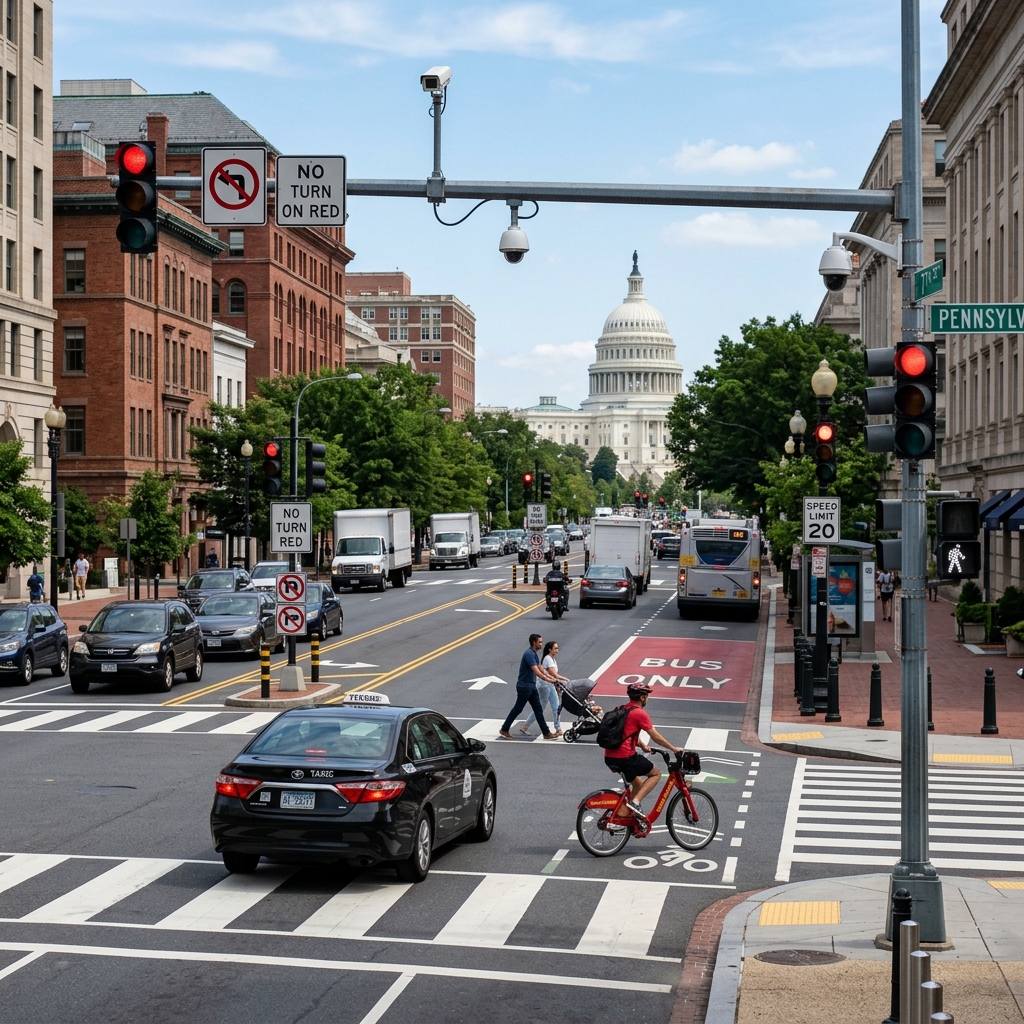
Driving in Washington, D.C. comes with a specific set of traffic rules designed to improve safety, manage congestion, and reduce serious crashes. The District’s traffic system is built around Title 50 of the D.C. Code and related municipal regulations, which cover everything from speeding and right-of-way violations to license suspension and criminal offenses tied to dangerous driving.
For most drivers, the practical question is not whether a violation exists, but what happens after one occurs. In D.C., many traffic offenses carry civil fines, point assessments, and in some cases jail exposure or license loss. Understanding the structure of these penalties can help drivers avoid escalating a routine ticket into a longer-term licensing problem.
How D.C. Traffic Law Is Organized
The traffic rules in the District are not limited to a single statute. They are primarily located in Chapter 22 of Title 50 of the D.C. Code, which includes general traffic rules and separate subchapters for more serious offenses such as negligent homicide, aggressive driving, collision recovery, and impaired driving.
This structure matters because the legal consequences depend on the type of conduct involved. A simple speeding ticket is treated differently from aggressive driving or a crash that leads to injury. D.C. law also combines traffic enforcement with administrative licensing consequences, so one stop by police can affect both your wallet and your driving privileges.
Common Violations and Their Penalties
Many D.C. traffic penalties are based on the severity of the conduct and, in some cases, the amount by which the driver exceeded the legal limit or ignored the rule. The same offense can carry different consequences depending on the facts.
| Violation | Typical Penalty Range | Possible Points |
|---|---|---|
| Speeding | $50 to $500 civil fine | 3 to 5 points |
| Reckless driving | Up to $500 fine and possible jail time | 6 points |
| Driving without a license | Up to $500 fine and possible jail time | Not specifically stated in the source |
| Failure to yield right of way | $65 to $250 fine | Up to 6 points |
These ranges show that D.C. traffic enforcement is not limited to flat-fee citations. Some offenses are civil, while others can become criminal or quasi-criminal matters with substantial consequences.
Speeding Rules in the District
Speeding is one of the most common moving violations in the District, and the penalty can vary based on how far over the limit the driver was traveling. The Findlaw summary reports civil fines from $50 to $500, along with three to five points depending on the speed over the limit.
D.C. traffic materials also indicate that speed limits differ by roadway type. A Washington, D.C. driver manual states that traffic laws are meant to prevent crashes, keep traffic moving, and reduce the risk of citations and fines when violated. Other legal summaries note that the District generally uses lower limits on most roads and special limits in places such as alleys and school zones.
- Speeding penalties can rise as the speed above the limit increases.
- School zones and other sensitive areas may carry lower posted limits.
- Repeated or severe speeding can also contribute to more serious charges, including aggressive or reckless driving.
Because D.C. treats high-risk driving seriously, speed is not just a number on a citation. It can become evidence of broader unsafe conduct if the driver’s behavior creates danger for others.
Right-of-Way Violations and Crosswalk Safety
Failure to yield is another major category of D.C. traffic offense. According to the Findlaw summary, the fine can range from $65 to $250, with up to six points depending on who had the right of way and whether the other road user was a pedestrian, another vehicle, or an emergency vehicle.
This area of law reflects the District’s emphasis on pedestrian protection. In an urban environment with dense foot traffic, crosswalk compliance is especially important, and violations involving people on foot are treated more seriously than routine driver-to-driver conflicts.
Drivers should expect stricter enforcement in settings where pedestrian exposure is high, including intersections, school areas, and busy commercial corridors. The point assignment can be as important as the fine because multiple right-of-way violations may quickly bring a driver close to suspension thresholds.
Reckless Driving and Aggravated Conduct
Reckless driving is much more serious than a basic moving violation. The source summary states that the offense can bring up to a $500 fine, six points, and as much as 90 days in jail. If the reckless driving is aggravated and causes injury, the penalties can increase further.
D.C. law also recognizes aggravated reckless driving as a distinct offense in the broader traffic code structure. The code framework shows a separate subchapter for aggressive driving and other elevated traffic conduct, which confirms that the District distinguishes between ordinary negligence and more dangerous behavior.
- Reckless driving can involve unsafe speed, loss of control, or conduct that endangers others.
- Aggravated forms can apply when the conduct results in injury or substantial harm.
- More severe cases may carry both jail exposure and higher fines.
From a practical standpoint, the key difference is intent and danger. A careless maneuver may be handled as a traffic violation, but conduct that creates a substantial risk can move into a much harsher legal category.
Driving Without a License
Driving without a valid license is another offense that can lead to both fines and jail time in the District. The cited Findlaw summary places the penalty at up to a $500 fine and 90 days in jail.
This offense is important because it is not the same as forgetting a physical card at home. A person may be unlicensed because they never obtained a license, allowed one to expire, or otherwise lost legal driving privileges. D.C. law treats those situations seriously because licensure is tied to the authority to operate a motor vehicle at all.
For drivers with prior violations, an unlicensed-driving charge can compound already existing problems. It may also affect insurance, future licensing eligibility, and the practical ability to contest other traffic enforcement issues.
Point Accumulation and License Suspension
D.C. uses a points system that can lead to administrative consequences even when a violation does not involve jail. According to the Findlaw summary, if a driver reaches 10 or 11 total points, the District will suspend the license for 90 days.
Once the total reaches 12 points, the District can revoke the license for six months or longer. That threshold makes repeated traffic violations far more serious than a single ticket. Two or three separate incidents can push a driver into suspension territory even if none of them individually resulted in arrest.
| Total Points | Likely Consequence |
|---|---|
| 10–11 points | 90-day suspension |
| 12 or more points | Revocation for six months or longer |
Because point totals can build over time, drivers should think of traffic citations as cumulative risk. The penalty for each violation may look modest on its own, but the licensing consequences can become severe when several tickets are combined.
What D.C. Drivers Should Watch Most Closely
Although many traffic offenses appear routine at first glance, several factors make D.C. enforcement especially significant. The first is the use of points, which can accumulate even when fines are relatively limited. The second is the broad range of penalties attached to a single type of conduct, especially speeding and right-of-way violations.
The third factor is that certain violations can overlap with more serious categories, such as reckless or aggressive driving. That means a citation issued for one event may have consequences beyond the original stop if the facts show unsafe conduct.
- Repeated speeding can create point exposure even when fines seem manageable.
- Failure to yield may become more costly when pedestrians or emergency vehicles are involved.
- Reckless driving can trigger both criminal penalties and licensing consequences.
For drivers who commute in and out of the District, this creates an important compliance issue. A driver may be familiar with neighboring state rules but still face different thresholds and penalties once inside D.C.
Practical Ways to Reduce Risk
Safe driving in the District starts with understanding that traffic law is not only about avoiding tickets. It is also about protecting your license, your insurance profile, and your ability to keep driving without interruption.
Helpful habits include watching posted limits carefully, yielding conservatively in crosswalk-heavy areas, and avoiding any driving behavior that could look aggressive or deliberate. Since D.C. can assess points and pursue suspension based on repeated violations, prevention is more effective than trying to fix the problem after citations start to accumulate.
- Pay attention to changing speed limits in school zones and special road segments.
- Be cautious around crosswalks, emergency vehicles, and intersections.
- Track your point total so small violations do not become a larger licensing issue.
Frequently Asked Questions
What laws control traffic in Washington, D.C.?
Traffic regulation in the District is primarily found in Title 50 of the D.C. Code, especially Chapter 22, along with related municipal regulations.
Can a traffic ticket affect my license even if it is only a fine?
Yes. D.C. uses a point system, and enough points can lead to suspension or revocation even if the original offense was handled as a civil matter.
Is reckless driving treated like an ordinary speeding ticket?
No. Reckless driving can lead to a fine, six points, and possible jail time, which makes it substantially more serious than a basic speeding violation.
What happens if I keep getting tickets?
Multiple tickets can add up to 10, 11, or 12 points, which can trigger suspension or revocation of your license in the District.
Why are pedestrian-related violations taken so seriously in D.C.?
Because the District is a dense urban environment with heavy foot traffic, right-of-way and crosswalk violations can create immediate safety risks and carry higher penalties.
References
- District of Columbia Traffic Laws — FindLaw. 2026-07-09. https://www.findlaw.com/state/dc-law/district-of-columbia-traffic-laws.html
- DC Code, Title 50, Chapter 22 (2025) – Regulation of Traffic — Justia. 2025-01-01. https://law.justia.com/codes/district-of-columbia/title-50/chapter-22/
- Parking and Traffic Violations — Metropolitan Police Department. 2026-07-09. https://mpdc.dc.gov/page/parking-and-traffic-violations
- Lesser Known Traffic Laws of Washington DC, Maryland and Virginia — Koonz. 2026-07-09. https://koonz.com/lesser-known-traffic-laws-of-washington-dc-maryland-and-virginia/
- Types of Traffic Offenses in DC — Scrofano Law, PC. 2026-07-09. https://criminallawdc.com/dc-speeding-ticket-lawyer/laws/
- Washington, D.C. Driver Manual — Washington, D.C. Department of Motor Vehicles / ePermitTest copy. 2022-01-01. https://static.epermittest.com/media/filer_public/6d/9f/6d9f2b84-216d-4343-9ff6-9fb28137caa2/washington-dc-drivers-manual-2022.pdf
- Title 50. Motor and Non-Motor Vehicles and Traffic — D.C. Law Library. 2026-07-09. https://code.dccouncil.gov/us/dc/council/code/titles/50
Similar Articles








Read full bio of medha deb


