
District of Columbia Domestic Violence Laws
Understand how D.C. defines domestic violence, protects survivors, and enforces court orders.
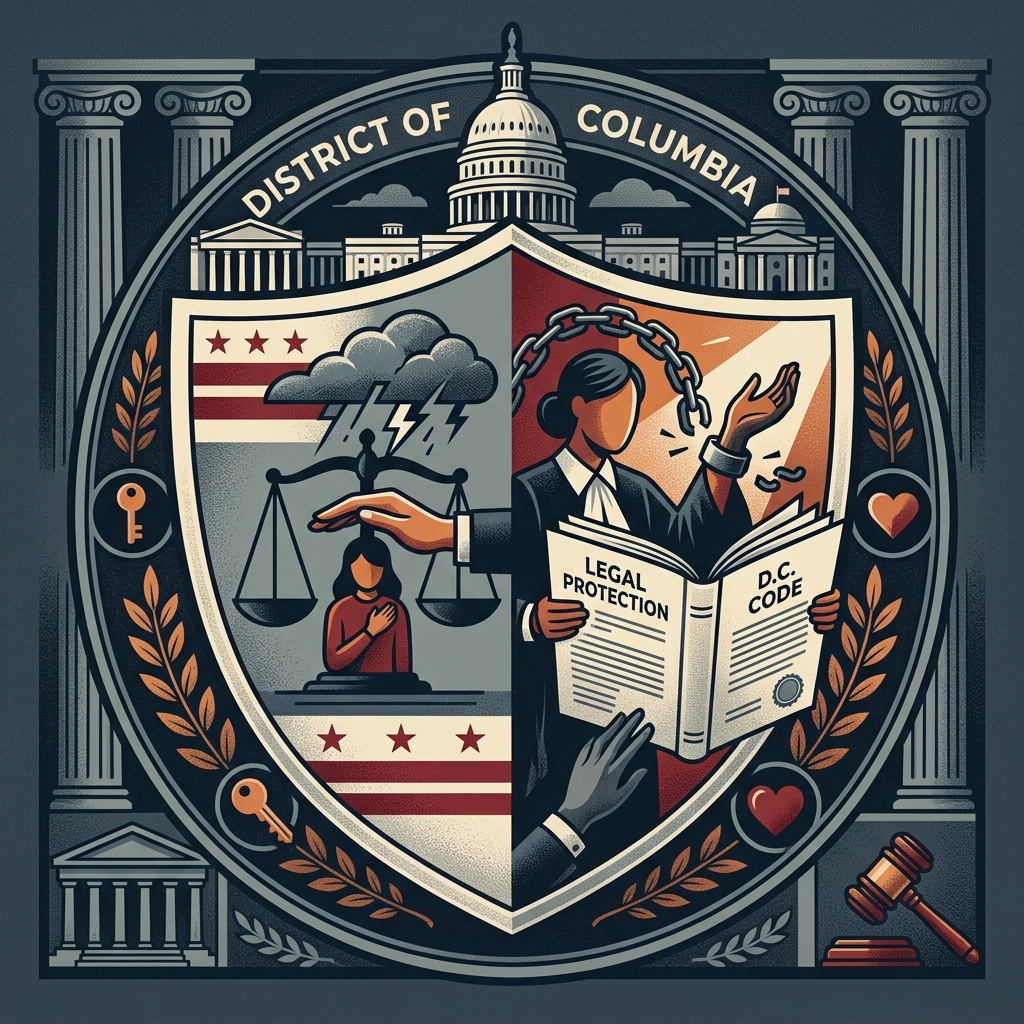
Understanding Domestic Violence Law in Washington, D.C.
Domestic violence law in the District of Columbia is designed to address abuse within family, household, and intimate relationships, while also protecting people who may be harmed by stalking, threats, or other criminal conduct. In practice, D.C. law combines criminal enforcement, civil court remedies, and survivor-focused protections so that a person can seek safety even when a criminal case is not moving forward quickly.
One of the most important features of the District’s approach is that domestic violence is not limited to physical assault. The legal framework also reaches conduct such as threats, harassment, and other offenses committed by a person with a qualifying relationship to the victim. That broader approach matters because abuse often escalates over time and may include intimidation long before severe injury occurs.
- Domestic violence can trigger both criminal and civil consequences.
- Protection orders may be available even when no criminal charge has been filed.
- Relationship status can affect what remedies are available and how the court classifies the case.
How D.C. Defines the Relationship Between the Parties
Before a court or law enforcement officer can apply many domestic violence rules, the relationship between the parties must fit within the statute. D.C. law recognizes several categories of qualifying relationships, including people who are married, divorced, separated, dating, sexually involved, living together, related by blood or marriage, or connected through a child in common. The District also uses related legal terms such as interpersonal violence, intimate partner violence, and intrafamily violence to describe different kinds of offenses tied to those relationships.
This structure is important because it determines whether a case may be treated as an intrafamily matter for purposes of arrest, protection orders, and related court procedures. A relationship does not need to be romantic for the law to apply. Family members, roommates, and co-parents may all fall within the statute depending on the facts.
| Relationship type | Common examples | Why it matters |
|---|---|---|
| Intimate partner | Spouses, dating partners, former partners | May support a civil protection order and domestic violence enforcement |
| Intrafamily | Relatives, people related by marriage, co-parents | Can trigger mandatory arrest rules and family-based remedies |
| Household | People sharing or who shared a residence | May qualify even without a romantic tie |
What Conduct Can Count as Domestic Violence
In D.C., the label “domestic violence” is not a single stand-alone offense. Instead, it describes criminal conduct committed against a protected person within a qualifying relationship. That can include assaults, threats, stalking, unlawful entry, property damage, harassment, and other crimes. For civil protection order purposes, the law can also cover cruelty to animals when the animal belongs to the protected person.
This means that the same act may be treated as a regular criminal offense and, at the same time, as domestic violence because of who the alleged offender is and who the alleged victim is. The relationship element often affects whether the court may order no-contact relief, require the abuser to move out, or impose other safety measures.
- Physical injury is not required for every domestic violence case.
- Threats or conduct creating fear of serious harm may be enough in some situations.
- Animal cruelty may be relevant when pets are used to threaten or control a survivor.
Civil Protection Orders: A Key Safety Tool
D.C. uses civil protection orders, often called CPOs, as a major remedy for survivors. A CPO is a court order that can help stop contact, prevent harassment, and create enforceable boundaries while a case is pending or after a hearing. Unlike a criminal case, a civil protection order begins with a petition filed by the person seeking protection.
Courts can tailor relief to the danger shown in the case. Typical provisions may include no-contact rules, stay-away terms, temporary housing-related orders, and other directions designed to reduce immediate risk. The exact relief depends on the evidence, the relationship, and the stage of the case.
- A CPO is civil, not criminal, though violating it can lead to criminal consequences.
- It may be available whether the abuse is recent or part of an ongoing pattern.
- It can help survivors create a paper record of abusive behavior for later use in court or with law enforcement.
What a Protection Order Can Do
A protection order can be one of the most practical legal tools available to a survivor. Depending on the facts, the court may order the respondent to stop threatening, contacting, following, or interfering with the petitioner. In some cases, the order can also address shared housing, personal property, temporary custody-related issues, or other urgent safety concerns.
Protection orders are especially important because they allow the court to act quickly. A survivor does not have to wait for a criminal prosecution to be completed before asking for help. The civil process is designed to reduce risk while the dispute is being resolved.
Mandatory Arrest and Police Response
Washington, D.C. has mandatory arrest rules for certain intrafamily offenses. When officers have probable cause to believe a qualifying offense caused physical injury or created a reasonable fear of imminent serious injury or death, the law generally requires an arrest. This policy reflects the District’s decision to treat many domestic violence calls as high-risk situations where swift intervention may prevent further harm.
Police response can also include scene control, separating the parties, collecting evidence, identifying witnesses, and determining the primary aggressor. Those steps matter because domestic incidents are often complex, and the most visible injured person is not always the person who initiated the violence. D.C. law and police practice aim to avoid one-sided assumptions and to document the event carefully.
- Officers may arrest based on probable cause, not only after witnessing the act.
- Evidence from the scene can become important in later court proceedings.
- Separating witnesses and parties helps preserve accurate statements.
Criminal Penalties and Court Consequences
Domestic violence-related conduct can lead to jail time, probation, fines, restitution, and a criminal record. The severity of punishment depends on the underlying offense, the person’s prior history, and whether the conduct violated a court order or involved aggravating facts. Repeat violations, threats, and offenses committed in the presence of a child may draw heightened consequences under newer enforcement approaches in the District.
Some cases also lead to collateral consequences beyond the criminal sentence. A conviction may affect employment, housing, custody disputes, immigration status, and firearm eligibility. For that reason, a domestic violence charge in D.C. should be treated as both a public-safety issue and a long-term legal risk.
Firearms Restrictions for Domestic Violence Cases
D.C. law places important restrictions on firearm possession in domestic violence situations. A person may become ineligible to obtain a firearm registration certificate if the person has been convicted of certain intrafamily offenses within the prior five years, or if the person is subject to a qualifying protection order. Those limits reflect the District’s effort to reduce the risk of lethal violence in volatile households or relationships.
Firearm restrictions can be temporary or longer lasting depending on the order or conviction involved. Because these rules are tied to local registration requirements and broader federal prohibitions, a person facing a domestic violence matter should review firearm issues separately from the main criminal case.
What Survivors Can Do Right Away
Immediate safety planning often matters as much as the legal case itself. A survivor may need to gather documents, store copies of important records outside the home, preserve text messages or photographs, and identify a safe place to stay. It can also help to tell a trusted friend, neighbor, school, employer, or counselor what is happening so that more than one person knows where to look for support.
Legal steps can include filing for a civil protection order, contacting police after a new incident, and asking about victim services. If children are involved, additional custody and school-safety concerns may need attention. If the abuser shares a lease or household benefits, the survivor may also need housing or benefits assistance.
- Save evidence such as messages, voicemails, photos, and medical records.
- Keep emergency contacts in an accessible but private place.
- Ask about local domestic violence advocacy organizations for planning and court support.
Housing, Benefits, and Practical Stability
Domestic violence can disrupt housing, finances, and public benefits. Survivors may need to separate from a shared lease, remove an abusive household member from a benefit case, or ask for a change in the family’s living arrangement. These issues can become urgent when the person causing harm controls access to rent money, food assistance, transportation, or identification documents.
The District’s legal system recognizes that safety is not only about staying away from an abuser. It also includes the ability to keep a roof overhead, maintain access to services, and avoid being economically trapped in the abusive situation. For many survivors, practical relief is what makes long-term safety possible.
When the Abuser Violates a Court Order
Violating a protection order is a serious matter in D.C. A breach can lead to arrest, new criminal charges, and additional court restrictions. Survivors can usually respond by calling the police when the violation happens or by documenting the conduct for later reporting. The best choice depends on the urgency and the immediate safety risk.
Because violations often involve repeated contact, stalking, or intimidation, it is important to preserve proof. Screenshots, call logs, witness statements, and security footage can all help show that the order was ignored. Courts tend to treat repeated noncompliance seriously, especially where the violation appears calculated or threatening.
Frequently Asked Questions
Can I file for a protection order if I was not physically injured?
Yes. Physical injury is not always required. In D.C., threats, harassment, or other abusive conduct may still support relief if the relationship and facts fit the statute.
Does domestic violence only apply to spouses?
No. The law can apply to dating partners, household members, relatives, and people who share a child, among others.
Can the police arrest someone even if they did not see the abuse happen?
Yes. If officers have probable cause to believe a qualifying intrafamily offense occurred, the mandatory arrest rules may apply even if the officer did not personally witness the act.
What is the difference between a civil protection order and a criminal case?
A civil protection order is requested by the survivor in family court to improve safety. A criminal case is brought by the government to punish an alleged offense. Both can exist at the same time.
Can a domestic violence case affect firearms rights?
Yes. Certain convictions and active protection orders can make a person ineligible to possess or register firearms in the District.
Why the D.C. Framework Matters
Washington, D.C. uses a layered legal system because domestic violence is rarely just one event. It can involve repeated threats, coercive control, financial dependence, shared children, and fear of escalation. By combining mandatory arrest rules, civil protection orders, firearm restrictions, and criminal penalties, the District tries to intervene before harm becomes more severe.
For survivors, that means there are multiple entry points to seek help. For accused individuals, it means that even one incident can lead to immediate court and law-enforcement consequences. Understanding the system early can make a major difference in safety, evidence preservation, and legal strategy.
References
- Restraining Orders: What is the legal definition of domestic violence … — WomensLaw.org. 2026-07-09. https://www.womenslaw.org/laws/dc/restraining-orders/civil-protection-orders/basic-info/what-legal-definition-domestic
- Definitions of Domestic Violence – District of Columbia — Child Welfare Information Gateway. 2026-07-09. https://www.childwelfare.gov/resources/definitions-domestic-violence-district-columbia/
- 9.1 Domestic Violence Offenses — Metropolitan Police Department, District of Columbia. 2026-07-09. https://mpdc.dc.gov/sites/default/files/dc/sites/mpdc/publication/attachments/9.1%20Domestic%20Violence%20Offenses.pdf
- Domestic Violence FAQs — Legal Aid DC. 2026-07-09. https://www.legalaiddc.org/legal-info/domestic-violence-faqs
- Subchapter III. Domestic Violence — D.C. Law Library. 2026-07-09. https://code.dccouncil.gov/dc/council/code/titles/16/chapters/10/subchapters/III
- Domestic Violence & Firearms in Washington DC — Giffords Law Center. 2026-07-09. https://giffords.org/lawcenter/state-laws/domestic-violence-and-firearms-in-washington-dc/
Similar Articles








Read full bio of Sneha Tete


