
Disputing Credit Report Errors Under the FCRA
Understand your Fair Credit Reporting Act dispute rights and how to correct inaccurate or incomplete information on your credit reports.
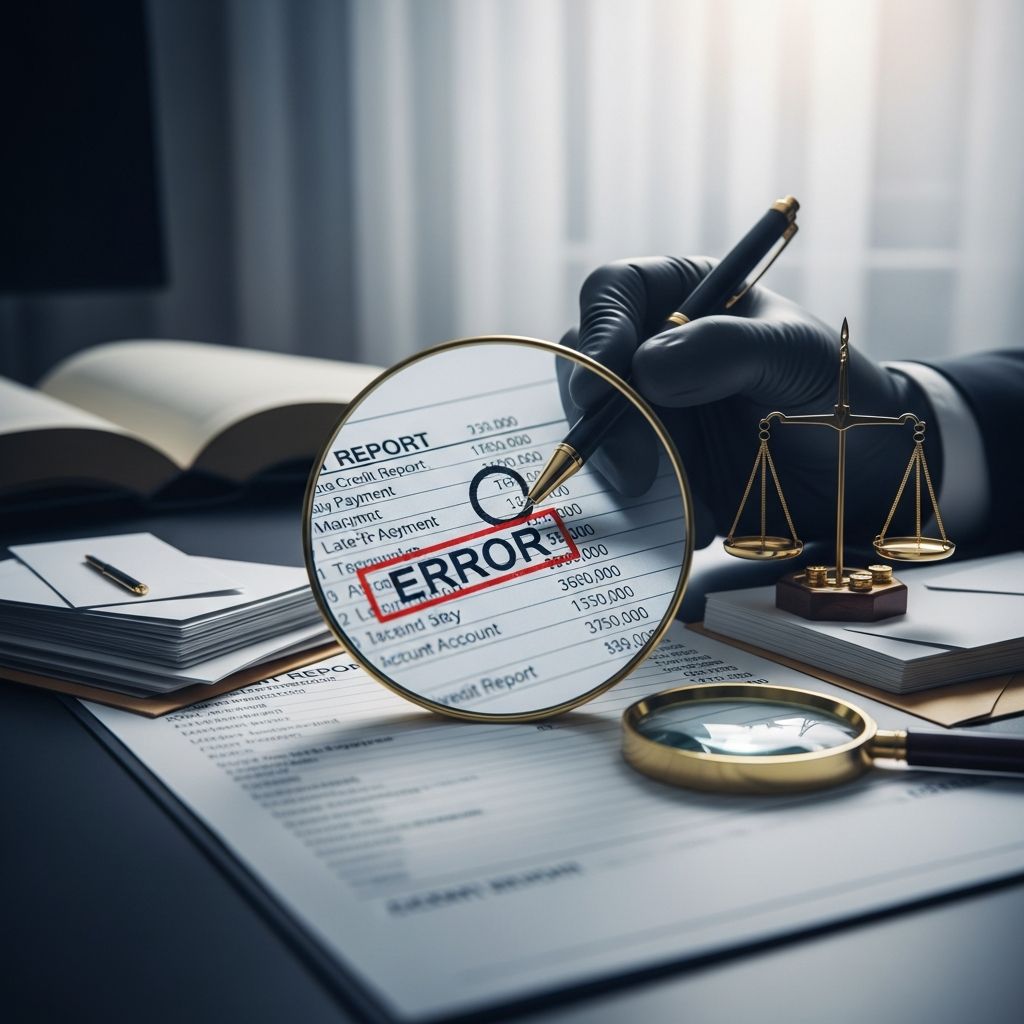
The Fair Credit Reporting Act (FCRA) is a federal law that gives you powerful tools to challenge and correct inaccurate, incomplete, or unverifiable information in your credit reports. It also sets strict duties for credit reporting agencies and companies that supply information to them (often called “furnishers”).
This guide explains, in clear and practical terms, how the dispute process works, what each party is responsible for, and how to protect your rights if something on your credit report is wrong.
1. Why the FCRA Dispute Process Matters
The information in your credit reports affects many important parts of your life, including:
- Whether you are approved for credit cards, auto loans, or mortgages
- The interest rates and other terms you are offered (risk-based pricing)
- Insurance pricing in some states
- Rental housing decisions and some employment background checks
Because of these high stakes, the FCRA requires that information in your credit reports be reasonably accurate, fairly reported, and kept private.
2. Key Players in the Credit Reporting System
To understand how disputes work, it helps to know who is involved and what each party does.
| Participant | Role in Credit Reporting | Examples |
|---|---|---|
| Consumer Reporting Agencies (CRAs) | Compile and sell consumer reports (credit reports and other background reports) to creditors, insurers, landlords, and some employers. | Nationwide credit bureaus and specialty agencies (tenant or employment screening companies) |
| Furnishers | Provide account and payment information to CRAs and must investigate disputes about the data they report. | Banks, credit unions, auto lenders, debt collectors, utilities |
| Users of Reports | Use consumer reports for decisions about credit, insurance, employment, and other permissible purposes and must send notices when they take adverse action. | Credit card issuers, mortgage lenders, employers, landlords, insurers |
3. Your Core FCRA Rights Related to Disputes
The FCRA gives you several important protections tied directly to the dispute process.
- Right to access your reports – You can get copies of your consumer reports to see what is being reported about you. Federal law requires free annual reports from each nationwide credit bureau, and there may be extra free reports after certain events like adverse actions.
- Right to dispute inaccurate or incomplete information – You can challenge information you believe is wrong, incomplete, not yours, outdated under FCRA rules, or not verifiable.
- Right to a reasonable investigation – CRAs and, in many cases, furnishers must conduct a reasonable investigation once they receive your dispute and review all relevant information you provide.
- Right to correction or deletion of inaccurate data – If information is found to be inaccurate, incomplete, or unverified, it must be corrected or removed, usually within specific timelines.
- Right to be told when information is used against you – If a report is used to deny credit, insurance, or employment, or to take another adverse action, you must receive a notice that includes which CRA provided the report.
4. Common Types of Credit Report Problems You Can Dispute
Not every negative item is wrong, but many reports contain errors that can and should be corrected.
- Identity-related mistakes
- Misspelled names or wrong Social Security number
- Accounts that belong to someone else with a similar name
- Mixed files (information from another person’s file appearing in yours)
- Account and payment errors
- Payments marked late when you paid on time
- Incorrect credit limits or balances
- Closed accounts reported as open, or the reverse
- Outdated negative information
- Most negative items still listed after seven years
- Bankruptcies reported longer than the time allowed by law
- Identity theft or fraud
- Accounts you never opened
- Inquiries from lenders you never contacted
- Incomplete or ambiguous information
- Accounts missing important status details (for example, settled, discharged, or paid in full)
- Public records that lack disposition or satisfaction information
5. Step-by-Step: Disputing an Error with a Credit Reporting Agency
You may dispute directly with the CRA that is reporting the questionable information. The FCRA requires CRAs to investigate disputes and update or remove incorrect data when appropriate.
5.1 Prepare Before You File the Dispute
- Order and review your report from each major CRA so you can see how the item appears across different reports.
- Gather supporting documents, which may include:
- Account statements and payment receipts
- Letters or emails from your creditor showing corrections or settlements
- Identity theft reports or police reports, if applicable
- Bankruptcy or court records, when relevant
- Highlight or print the specific line items you believe are wrong, and make notes on why.
5.2 Submit Your Dispute
You can usually dispute online, by mail, or by phone. Many consumer advocates recommend written disputes (sent by mail with proof of delivery) to create a clear paper trail.
- Clearly identify each item you are disputing (account name, number, date, and how it is reported).
- Explain briefly why each entry is inaccurate, incomplete, or not verifiable.
- Attach copies (not originals) of documents that support your position.
- Include your identifying information (full name, current address, date of birth, and last four digits of your Social Security number or other identifiers) as requested by the CRA to locate your file.
5.3 What the CRA Must Do After Receiving Your Dispute
Once a CRA receives your dispute and has enough information to investigate, FCRA rules require that it:
6. Disputing Directly with the Furnisher
In many situations, you can also dispute inaccurate information directly with the company that furnished it to the CRA. Furnishers have separate duties under the FCRA and related regulations to handle these “direct disputes.”
6.1 When a Direct Dispute Makes Sense
- The error appears to stem from how the creditor or servicer has recorded your account (for example, a misapplied payment).
- You have already communicated with the creditor informally, but the CRA dispute did not resolve the issue.
- The information is still being reported incorrectly after a dispute and you want to hold the furnisher accountable under its own FCRA obligations.
6.2 What Furnishers Must Do with Disputes
When a furnisher receives a qualifying dispute and has enough detail to investigate, it generally must:
- Review all relevant information you provide.
- Conduct a reasonable investigation of the disputed information.
- Report the results of the investigation to you within defined time frames.
- Notify each CRA to which it provided the inaccurate information if a correction is necessary, and provide updated data.
- Modify, delete, or block reporting of information that cannot be verified or is found to be inaccurate.
7. Investigation Outcomes and Your Next Steps
After a CRA or furnisher finishes its investigation, there are several possible outcomes.
7.1 If the Information Is Corrected or Deleted
- You will receive a notice summarizing the changes.
- The CRA must update your file and, if you request, send corrected reports to certain recent recipients such as lenders who took adverse action based on the old report.
- Negative information that is removed because it could not be verified may not be reinserted without following strict procedures, including notifying you if it is reinserted.
7.2 If the Information Is Verified and Left Unchanged
If the CRA or furnisher concludes that the information is accurate and refuses to change it, you still have options.
- You can ask the CRA to include a brief statement of dispute in your file so future users see your side of the story.
- You may choose to dispute again if you obtain new, stronger documentation.
- If you believe the investigation was not reasonable or your rights were violated, you can submit complaints to federal or state regulators or consider legal advice.
7.3 Frivolous or Irrelevant Disputes
Credit reporting laws allow CRAs and furnishers to treat certain disputes as frivolous or irrelevant if, for example, they lack enough information to investigate or simply repeat previous disputes without new evidence.
- If a dispute is deemed frivolous or irrelevant, the company generally must notify you within a short period and explain why.
- The notice should also tell you what additional information is needed for a proper investigation.
8. Time Limits on Reporting Negative Information
The FCRA sets limits on how long most negative information can appear in consumer reports, which can be closely tied to dispute rights.
- Most negative information (such as many late payments and collection accounts) is generally limited to about seven years from the relevant date.
- Bankruptcies and certain other events may remain longer under specific legal rules.
- Accurate positive information (for example, timely payments) can often be reported for longer than negative information.
If an item remains on your report beyond the permitted period, you may dispute it as outdated and request its removal.
9. Practical Tips to Strengthen Your Disputes
The more organized and specific your dispute, the more likely it is to be resolved quickly and correctly.
- Be specific and focused – Dispute particular entries rather than your entire report.
- Keep copies of everything – Save letters, emails, delivery receipts, and supporting documents.
- Use clear, factual language – Avoid emotional language and focus on what is wrong and what proves it.
- Update your contact information – Make sure CRAs and furnishers can reach you with investigation results.
- Check all three major credit bureaus – An error may appear in one report but not another, so review and dispute across all that contain the error.
10. Frequently Asked Questions (FAQs)
Q1: Do I have to pay to dispute a credit report error?
No. Filing a dispute about information in your consumer report with a CRA or, in many cases, directly with the furnisher is generally free under the FCRA.
Q2: How long does a credit reporting investigation usually take?
In many standard situations, CRAs must complete their investigation within a defined period that is often about 30 days, with limited extensions if you provide additional information during the investigation.
Q3: Can accurate negative information be removed if I just don’t like it?
No. The FCRA does not require CRAs to remove accurate, properly reported negative information just because it is unfavorable. Disputes are for correcting items that are inaccurate, incomplete, not verifiable, or reported beyond the time limits set by law.
Q4: What should I do if I think I am a victim of identity theft?
You should promptly review your credit reports, dispute any fraudulent accounts, and consider placing fraud alerts or security freezes with CRAs. Federal agencies provide additional guidance and forms for identity theft victims to help block fraudulent information from being reported.
Q5: Who enforces the FCRA?
The FCRA is enforced by federal agencies such as the Federal Trade Commission and the Consumer Financial Protection Bureau, as well as state officials and, in many cases, private lawsuits brought by consumers.
References
- Fair Credit Reporting Act — Federal Trade Commission. 2023-05-01. https://www.ftc.gov/legal-library/browse/statutes/fair-credit-reporting-act
- Fair Credit Reporting Act (FCRA) Fact Sheet — Department of Defense Office of Financial Readiness. 2021-09-01. https://finred.usalearning.gov/assets/downloads/FINRED-FCRA-FS.pdf
- Fair Credit Reporting Act (Regulation V) – Federal Consumer Financial Protection Guide — National Credit Union Administration. 2022-04-01. https://ncua.gov/regulation-supervision/manuals-guides/federal-consumer-financial-protection-guide/compliance-management/lending-regulations/fair-credit-reporting-act-regulation-v
- A Summary of Your Rights Under the Fair Credit Reporting Act — Consumer Financial Protection Bureau. 2018-09-01. https://files.consumerfinance.gov/f/201504_cfpb_summary_your-rights-under-fcra.pdf
- How the Fair Credit Reporting Act Empowers Your Financial Journey — National Credit Union Administration / MyCreditUnion.gov. 2023-02-24. https://mycreditunion.gov/about/news-blog/credit-clarity-how-fair-credit-reporting-act-empowers-your-financial-journey
- What Is the Fair Credit Reporting Act (FCRA)? — Experian. 2023-06-15. https://www.experian.com/blogs/ask-experian/credit-education/report-basics/fair-credit-reporting-act-fcra/
- Fair Credit Reporting Act — U.S. Code, 15 U.S.C. §§ 1681–1681x, via Cornell Law School Legal Information Institute. Accessed 2024-10-01. https://www.law.cornell.edu/uscode/text/15/chapter-41/subchapter-III
Similar Articles








Read full bio of medha deb




