
Digital Privacy at the US Border: Rights and Risks
Navigating the complex intersection of border security and digital privacy.
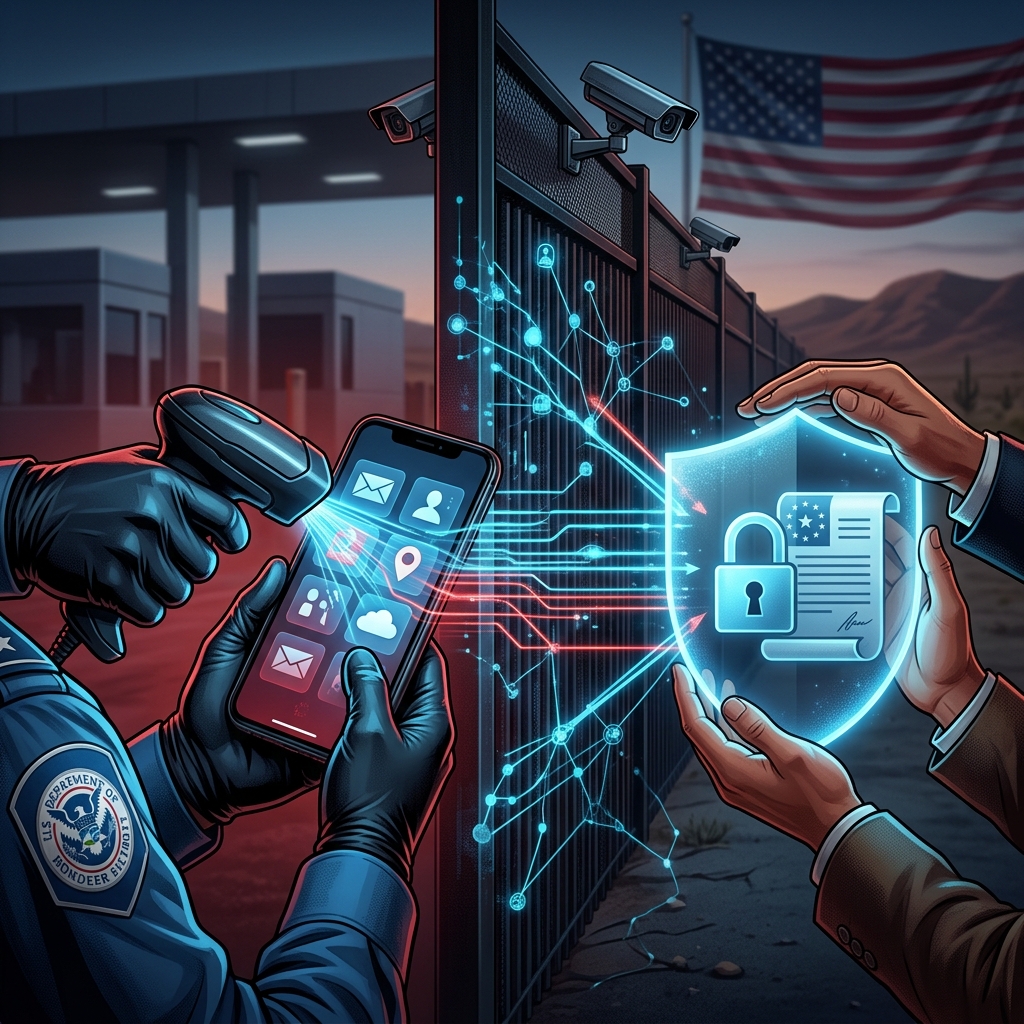
The Digital Checkpoint: When Borders Meet Personal Data
The modern traveler carries a device that is much more than a simple communication tool; it is a repository of their entire existence. A smartphone or laptop holds decades of photographs, sensitive medical records, financial histories, and deeply private communications. When you approach a United States port of entry, you enter a unique legal gray area. While the Fourth Amendment strongly protects citizens against unreasonable searches and seizures within the country, the rules dramatically shift at the border. U.S. Customs and Border Protection (CBP) asserts the authority to search electronic devices without a warrant, without probable cause, and often without any individualized suspicion.
This practice has sparked fierce debates among civil liberties advocates, legal scholars, and government officials. The controversy stems from an antiquated legal doctrine known as the “border search exception,” which was originally designed to prevent the smuggling of physical contraband like agricultural pests, illegal drugs, or untaxed goods. Applying this physical search doctrine to modern digital devices—which hold terabytes of personal information—creates a profound tension between national security imperatives and individual privacy rights. The debate is no longer confined to the fringes; it directly impacts millions of international travelers globally.
The Legal Foundation: Understanding the Border Search Exception
To comprehend why federal agents can demand access to your unlocked smartphone, one must look back to the very foundation of U.S. law. The border search exception is rooted in the idea of national sovereignty. The First Congress of the United States passed legislation in 1789 allowing customs officials to search ships and luggage entering the country to ensure taxes were paid and illegal items were kept out. The courts have historically upheld this exception, ruling that the government’s interest in protecting the nation’s borders outweighs the individual’s expectation of privacy when entering the country. Therefore, “routine” searches of suitcases, purses, and vehicles at the border are legally permissible without any warrant or suspicion.
However, the digital revolution has violently disrupted this legal equilibrium. A suitcase might hold a few books, some clothing, and personal hygiene items. A modern laptop, on the other hand, can contain the digital equivalent of a massive library, complete with comprehensive logs of a person’s location history, internet searches, and private associations. Legal scholars argue that treating a smartphone like a piece of physical luggage is a fundamental misapplication of the law. While the Supreme Court recognized in Riley v. California (2014) that police generally need a warrant to search a cell phone seized during an arrest—noting that phones are “such a pervasive and insistent part of daily life that the proverbial visitor from Mars might conclude they were an important feature of human anatomy”—the Court has yet to definitively rule on how this exact logic applies at the international border.
Basic vs. Advanced Digital Searches
CBP does not treat all electronic searches equally. According to official agency directives, digital border searches are categorized into two distinct types: basic searches and advanced searches. Understanding the difference between these two classifications is vital for any international traveler seeking to protect their digital footprint.
In a “basic” search, a border agent manually navigates through your device. They may scroll through your text messages, browse your photo gallery, or read your emails. According to CBP policy, agents can conduct a basic search without any reasonable suspicion. They simply need the device to be powered on and unlocked. If you refuse to unlock the device, agents have the authority to confiscate it for further analysis, although they cannot legally compel a U.S. citizen to provide a password without a court order.
An “advanced” search, by contrast, is much more intrusive. It involves connecting the electronic device to external forensic equipment. This specialized technology allows the government to copy, clone, and analyze the entire hard drive or memory chip of the device. Through forensic extraction, agents can uncover deleted files, hidden metadata, encrypted communications, and hidden folders. Due to the highly invasive nature of advanced searches, CBP directives require that agents have “reasonable suspicion” of activity in violation of the laws enforced by CBP, or a national security concern, before proceeding with the extraction.
| Feature | Basic Search | Advanced (Forensic) Search |
|---|---|---|
| Methodology | Manual scrolling and tapping through visible files and applications. | Connection to external forensic equipment to copy and analyze data. |
| Legal Standard Required | None (Suspicionless). | Reasonable suspicion of a customs/law violation or national security threat. |
| Data Scope | Only visible, easily accessible data stored locally on the device. | Deleted files, hidden folders, full memory dumps, and hidden metadata. |
| Device Seizure | Usually returned immediately unless the traveler refuses to unlock it. | Device is seized and detained, often for days or weeks, for technical processing. |
A Universal Vulnerability: Bipartisan Privacy Concerns
A common misconception is that civil liberties violations only affect marginalized groups, political dissidents, or suspected criminals. However, the unchecked authority of border agents to search electronic devices represents a universal vulnerability that transcends political affiliations and professional boundaries. The indiscriminate nature of these searches means anyone can face profound privacy invasions.
A business executive returning from a conference in Europe might carry proprietary trade secrets, unreleased financial reports, and confidential merger strategies. An investigative journalist returning from an assignment abroad relies on their smartphone to communicate with highly sensitive, anonymous sources whose lives could be endangered. A corporate attorney holds privileged communications with clients that are legally protected in almost every other context. Yet, at the border checkpoint, all of this data is potentially exposed to government scrutiny.
Even those who historically champion robust law enforcement and national security initiatives are not immune. Prominent conservative scholars, defense policy analysts, and think-tank executives frequently travel internationally to consult on global security matters. If a high-ranking national security expert’s laptop is subjected to a warrantless search, the government suddenly gains access to unclassified but highly sensitive political strategies, private correspondence with lawmakers, and proprietary defense research. When individuals from across the entire political spectrum face the exact same risk of having their entire digital footprint forcibly analyzed, it becomes clear that this is not a partisan issue. It is a fundamental question of how constitutional rights survive in the digital age, uniting civil libertarians and constitutional originalists in shared concern over unchecked executive power.
The Government’s Justifications for Digital Inspections
Despite mounting criticism from privacy advocates, the Department of Homeland Security and its sub-agencies staunchly defend the necessity of electronic device searches at the border. From a law enforcement perspective, the border is the primary chokepoint for identifying and neutralizing transnational threats before they enter the interior of the United States.
CBP argues that the ability to inspect electronic devices is absolutely critical to its mission of combating terrorism, stopping human trafficking, and preventing the distribution of illicit material, including child sexual abuse material (CSAM). In many modern cases, physical contraband is no longer the primary threat; digital evidence often holds the key to uncovering widespread criminal networks. For instance, a quick review of a suspect’s text messages might reveal coordinates for a drug drop-off, while financial records hidden on a laptop could expose sanctions evasion and complex money laundering operations. The government maintains that requiring a warrant for every device search would severely cripple their ability to act swiftly in high-stakes environments where time is of the essence.
Furthermore, federal agencies assert that they operate within strict internal guidelines designed to prevent abuse. CBP directives explicitly state that agents are only permitted to search information that is physically resident on the device itself. They are instructed not to access data stored remotely on cloud servers. If an agent opens an app that connects to the internet to download new emails, that theoretically violates policy, as the border search exception does not extend to data located on external servers hundreds of miles away.
The Shifting Landscape of the Federal Courts
The legal battles over digital border searches are currently snaking their way through the federal court system, resulting in a highly fragmented legal landscape where your rights might depend entirely on which airport you fly into. Several federal appellate courts have issued conflicting rulings on exactly what level of suspicion is required to conduct these intrusive searches.
In major cases spearheaded by digital rights organizations, plaintiffs have argued that the sheer volume and deeply personal nature of digital data require a warrant based on probable cause, fully abandoning the physical luggage analogy. However, the courts have not fully embraced this view. In 2021, the First Circuit Court of Appeals ruled in Alasaad v. Mayorkas that basic, manual searches of electronic devices at the border do not require any suspicion whatsoever, and advanced forensic searches only require reasonable suspicion, effectively upholding the government’s current internal policies.
Conversely, other courts have demonstrated a greater willingness to adapt the Fourth Amendment to modern realities. The Fourth and Ninth Circuit Courts of Appeals have previously indicated that forensic searches of electronic devices at the border are so uniquely intrusive that they must be supported by reasonable suspicion of digital contraband, not just a generalized suspicion of criminal activity. Until the Supreme Court intervenes to establish a unified national standard, travelers are left navigating a confusing mosaic of regional legal precedents.
Actionable Privacy Strategies for International Travelers
Given the uncertain legal environment, international travelers must take proactive measures to protect their digital privacy before arriving at a U.S. port of entry. The most effective strategy is the principle of data minimization.
- Travel with Burner Devices: Consider traveling with laptops or smartphones that are wiped clean and contain only the data absolutely necessary for the trip. By leaving your primary devices at home, you eliminate the risk of exposing your personal or corporate history to a border agent.
- Utilize Cloud Storage: Because current CBP policy restricts agents from searching data stored remotely, travelers can remove sensitive apps, log out of accounts, and delete local files before crossing the border. Once safely inside the country, the data can be securely re-downloaded from the cloud.
- Implement Strong Encryption: Rely on full-device encryption to secure your data. However, travelers must be aware that while encryption protects the data from unauthorized access, refusing to provide a password to CBP can result in the device being seized and detained.
- Power Down Before Customs: Powering off your device before entering the customs area is highly recommended. Many modern smartphones use biometric unlocking (Face ID or fingerprint scans), which some courts have treated with less legal protection than alphanumeric passcodes. A powered-off device typically requires a typed passcode upon reboot, adding a layer of legal friction to the search process.
Frequently Asked Questions (FAQs)
Can border agents force U.S. citizens to unlock their phones?
Border agents cannot legally compel a U.S. citizen to provide their password without a court order, nor can they deny a U.S. citizen entry into the United States for refusing. However, refusal can lead to prolonged detention, intense questioning, and the confiscation of the device for forensic analysis.
Can non-citizens be denied entry for refusing a search?
Yes. Unlike U.S. citizens, foreign nationals (including tourists, business travelers, and students on visas) can be legally denied entry into the United States and deported back to their home country if they refuse to comply with a border agent’s request to unlock their electronic devices.
How long can CBP keep my seized device?
If your device is confiscated for further inspection because you refused to unlock it or because it requires advanced forensic analysis, it can be held for varying lengths of time. CBP guidelines suggest that detentions should generally not exceed five days, but extensions are frequently granted, and it is not uncommon for devices to be held for weeks or even months.
Conclusion
The intersection of national security and digital privacy remains one of the most pressing civil liberties issues of our time. As technology continues to evolve at a breakneck pace, the antiquated legal doctrines governing border searches are becoming increasingly strained. Whether you are a prominent business leader, a political strategist, or an average tourist on vacation, the data you carry across borders represents your digital soul. Until comprehensive legislative reform or a definitive Supreme Court ruling provides clear boundaries, international travelers must remain vigilant, educated, and thoroughly prepared to navigate the complexities of the modern digital checkpoint.
References
- CBP Directive No. 3340-049A: Border Search of Electronic Devices — U.S. Customs and Border Protection. 2018-01-04. https://www.cbp.gov/document/directives/cbp-directive-no-3340-049a-border-search-electronic-devices
- Border Searches of Electronic Devices: Legal Issues — Congressional Research Service. 2023-05-18. https://crsreports.congress.gov/product/pdf/LSB/LSB10963
- Riley v. California, 573 U.S. 373 — Supreme Court of the United States. 2014-06-25. https://www.supremecourt.gov/opinions/13pdf/13-132_8l9c.pdf
- U.S. appeals court upholds warrantless border searches of phones, laptops — Reuters. 2021-02-09. https://www.reuters.com/article/us-usa-court-border-devices-idUSKBN2A92UF/
Similar Articles








Read full bio of Sneha Tete


