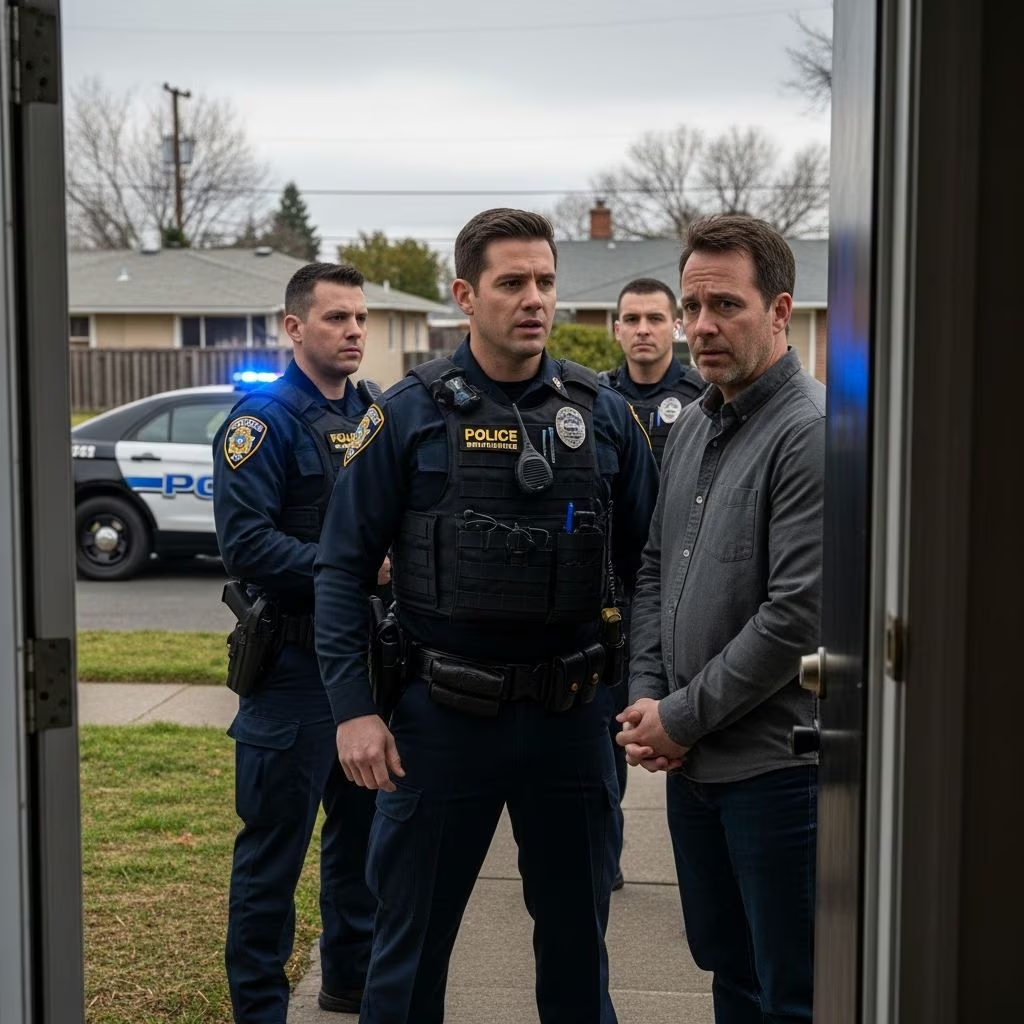
Police Authority to Detain During Search Warrant Execution: A Comprehensive Legal Overview
When law enforcement executes a search warrant at a residence or other premises, questions frequently arise regarding an officer’s authority to detain individuals present at or near the location. The Fourth Amendment to the U.S. Constitution protects citizens against unreasonable searches and seizures, creating important limitations on when and how police can hold people during investigative activities. Understanding these legal boundaries is essential for both law enforcement professionals and citizens who want to know their constitutional rights during police encounters involving search warrant execution.
The Supreme Court has established a nuanced framework governing detention during search warrant execution that balances law enforcement needs with individual constitutional protections. This framework recognizes legitimate governmental interests while maintaining strict limitations on police power. The doctrine remains one of the most actively litigated areas of Fourth Amendment jurisprudence, with courts continuously refining what constitutes reasonable detention in various circumstances.
The Foundation: Michigan v. Summers and Its Three-Part Justification
The cornerstone of modern detention law incident to search warrant execution stems from the landmark 1981 Supreme Court decision in Michigan v. Summers. In this case, the Court upheld officers’ authority to detain individuals at a residence where a search warrant was being executed, even without traditional requirements like reasonable suspicion or probable cause that would normally be necessary to justify a seizure under the Fourth Amendment.
The Supreme Court identified three compelling governmental interests that together justify detention authority in this specific context:
- Officer Safety: Law enforcement officers face potential risks when executing search warrants, particularly when occupants inside the premises might pose threats. Detaining individuals in the immediate area reduces unpredictable variables and allows officers to account for all persons present, minimizing danger to themselves and others.
- Search Facilitation: Preventing occupants from interfering with the search process represents a legitimate interest. If individuals remain mobile and unsecured, they might attempt to obstruct officers, destroy evidence, or alert confederates to the search’s execution, undermining the warrant’s purpose.
- Flight Prevention: If incriminating evidence is discovered during the search, detained individuals cannot flee the premises, ensuring their availability for arrest or further questioning if warranted.
These three interests, considered together and not independently, create the legal predicate for detention authority during search warrant execution. The Supreme Court recognized that this authority represents a departure from ordinary Fourth Amendment requirements, which is why it must operate within carefully defined boundaries.
The Immediate Vicinity Requirement: Geographic Boundaries Matter
While Summers established detention authority, the Supreme Court did not create unlimited detention power. A critical limitation emerged through subsequent case law, particularly the 2013 decision in Bailey v. United States. This case addressed whether the Summers detention authority extends beyond the immediate vicinity of the premises being searched.
In Bailey, officers executed a search warrant at a residence for suspected narcotics trafficking. Bailey, an occupant, had left the premises approximately one mile away before the search began. Officers observed him returning toward the residence and stopped him. The Supreme Court held that this detention violated the Fourth Amendment because Bailey was no longer in the immediate vicinity of the premises.
The Court emphasized that because the Summers rule grants substantial detention authority outside traditional Fourth Amendment protections, it must be carefully circumscribed. A geographic boundary is therefore essential. The Summers authority applies only to persons in the immediate vicinity of the premises, creating a spatial constraint that prevents arbitrary or overly broad detention practices.
This geographic limitation reflects important constitutional principles. The Court reasoned that officer safety concerns do not automatically justify detaining individuals at distance from the search location, since officers can strategically position themselves to intercept anyone attempting to enter. Similarly, when someone is a mile away from the premises, their presence poses no realistic threat to search facilitation. And the flight-prevention rationale simply does not apply to individuals already distant from the location.
What Constitutes the “Immediate Vicinity”?
The Supreme Court has not provided a precise mathematical definition of “immediate vicinity,” recognizing that context matters considerably. Instead, courts analyze the circumstances to determine whether a person was sufficiently proximate to the premises. Factors courts examine include:
- Physical distance from the building or location being searched
- Whether the person was on the property itself, on adjacent grounds, or on a nearby street
- Natural boundaries like fences, barriers, or structural divisions
- Whether the person could readily access or see the premises
- The layout and character of the surrounding area
Courts generally recognize that a person on the property itself or on the immediate walkway or driveway falls within the immediate vicinity. Someone a mile away clearly does not. The challenging cases involve intermediate distances—situations where someone is on the same street, nearby but not immediately adjacent, or approaching the premises. Courts look at all circumstances to make fact-specific determinations rather than applying bright-line distance rules.
Detention Standards Beyond the Immediate Vicinity
The Bailey decision clarified that officers are not prohibited from detaining people who leave the immediate vicinity before or during a search. However, when detention occurs outside the Summers geographic boundary, officers must satisfy different Fourth Amendment standards.
If officers choose to defer detention until an occupant leaves the immediate vicinity, that detention must comply with ordinary Fourth Amendment requirements. Officers must either:
- Have reasonable suspicion that the person committed a crime (justifying an investigative stop)
- Possess probable cause to believe the person committed a crime (justifying an arrest and custodial detention)
When evaluating whether these standards are met for detention outside the immediate vicinity, courts consider several factors:
- Information officers possessed before obtaining the search warrant
- Incriminating conduct the person displayed, such as appearing armed or possessing items matching the evidence sought
- Information communicated from officers conducting the search at the premises
This framework ensures that detention decisions receive individualized scrutiny rather than automatic authorization simply because a search warrant is being executed. Officers must connect the detained person to the investigation through specific evidence or observations, not merely the fact that they were near a location where a warrant was executed.
Evaluating the Reasonableness of Detention Duration and Manner
Even when detention occurs within the immediate vicinity and thus qualifies for Summers protection, the detention itself must remain reasonable in both duration and manner. Courts evaluate whether detention was unnecessarily prolonged or conducted in an excessively intrusive way.
Factors courts consider when assessing detention reasonableness include:
| Factor | Consideration |
|---|---|
| Crime Severity | More serious crimes may justify longer detention periods and more intensive security measures |
| Investigative Focus | Whether the detained person was the actual subject of the investigation or merely present at the location |
| Immediate Threat Assessment | Whether the person posed a direct safety risk to officers or others, or threatened to interfere with the search |
| Active Resistance | Whether the person actively resisted, attempted escape, or remained cooperative |
| Detention Conditions | Whether detention was unnecessarily painful, degrading, prolonged, or involved unjustified privacy invasions |
| Search Necessity | Whether detaining the person actually facilitated orderly search completion |
Courts recognize that detention incident to search warrant execution need not be brief. Reasonable detention may extend through the entire search process and even into the period when officers are concluding their activities. However, detention should not persist significantly beyond the point when the search concludes or when circumstances no longer support the detention rationales established in Summers.
Special Circumstances: Occupants, Visitors, and Others Present
Different considerations apply depending on a person’s relationship to the premises being searched. The Summers rule explicitly encompasses occupants of the premises—people who actually reside there. The authority extends to regular visitors or persons lawfully present inside the premises when officers arrive.
However, the detention authority also applies to persons in the immediate vicinity who are not occupants. Someone standing on the walkway leading from the front steps, for instance, falls within detention authority even if they do not live at the residence. The geographic proximity becomes determinative rather than residency status.
Courts have upheld detention of individuals like elderly family members present at a searched residence, even when no evidence suggested their involvement in the criminal activity prompting the warrant. The Summers rationale applies based on their presence during search execution, not their suspected culpability. However, detention conditions should reflect individual circumstances, such as medical conditions or mobility limitations.
The Search Incident to Arrest Doctrine: Related but Distinct
Students of Fourth Amendment law sometimes confuse detention incident to search warrant execution with the separate doctrine of search incident to lawful arrest. While both involve searches following detention, these represent distinct legal frameworks.
When an officer arrests someone based on probable cause, the officer may search the person arrested to remove weapons and discover evidence without obtaining a separate warrant. This search incident to arrest authority extends to the arrestee’s immediate control—typically the area within reaching distance—and may include containers like pockets, bags, or purses.
The search incident to arrest doctrine does not require the specific justifications identified in Summers. It applies in any arrest scenario, not merely during search warrant execution. Conversely, the detention authority in Summers applies even without probable cause to arrest, which is why it represents an exceptional grant of detention power.
Practical Application: When Can Officers Detain and When Must They Release?
Understanding these principles in practical scenarios helps clarify Fourth Amendment protections. Consider several examples:
- Occupant Inside Premises: Officers executing a search warrant may detain an occupant found inside the residence without reasonable suspicion or probable cause. The detention must occur while the search is ongoing or reasonably related to search completion.
- Person on Front Steps: An individual standing on the property’s immediate entrance can be detained under Summers authority. This reflects the immediate vicinity requirement since the person remains proximate to where officers are searching.
- Neighbor Nearby: A neighbor standing on an adjacent property or on the street nearby might or might not fall within immediate vicinity, depending on exact distance and circumstances. If not in immediate vicinity, detention requires reasonable suspicion or probable cause.
- Person Departing Before Search Begins: Someone who leaves before the search starts cannot be detained merely because they were occupants of the searched premises. If detained later, normal Fourth Amendment standards apply.
- Person Approaching During Search: Someone approaching the premises during search execution can be detained if in the immediate vicinity. Officers can prevent entry to someone attempting to approach the location.
Frequently Asked Questions
Q: Can police detain someone in their yard while searching a neighbor’s house?
A: Not under the Summers doctrine. The detention authority applies to people in the immediate vicinity of the searched premises, not everyone in the general neighborhood. Detention of the neighbor would require reasonable suspicion or probable cause related to their conduct or connection to the investigation.
Q: How long can officers detain someone during a search warrant execution?
A: Detention may continue through the search and beyond, but must remain reasonable. Prolonged detention beyond the search’s completion or significantly longer than typical for the circumstances may violate the Fourth Amendment if not justified by specific circumstances.
Q: What if someone refuses to comply with detention during a search warrant?
A: Within the immediate vicinity, officers can use reasonable force to effectuate lawful detention. Resisting lawful detention can result in additional criminal charges. If detention occurs outside the immediate vicinity without proper justification, the underlying detention may violate the Fourth Amendment.
Q: Can officers search someone being detained during a search warrant?
A: Officers can conduct a pat-down search of a detained person’s outer clothing to check for weapons, regardless of whether they intend to arrest. A more thorough search requires either consent, a search warrant, or probable cause to believe the person committed a crime.
Q: What happens if officers violate detention rules during search warrant execution?
A: Evidence obtained following an illegal detention may be suppressed, meaning it cannot be used in criminal prosecution. Additionally, individuals may bring civil rights lawsuits against officers for damages resulting from Fourth Amendment violations.
References
- Bailey v. United States — U.S. Supreme Court. 2013-04-22. https://supreme.justia.com/cases/federal/us/568/186/
- Muehler v. Mena — U.S. Supreme Court. 2005-05-23. https://supreme.justia.com/cases/federal/us/544/93/
- Michigan v. Summers — U.S. Supreme Court. 1981-07-06. https://supreme.justia.com/cases/federal/us/452/692/
- Arizona v. Gant — U.S. Supreme Court. 2009-04-21. https://supreme.justia.com/cases/federal/us/556/332/
- Search Incident to Arrest Doctrine — Cornell Law School Legal Information Institute. 2024. https://www.law.cornell.edu/constitution-conan/amendment-4/search-incident-to-arrest-doctrine