
Detecting Fabricated Evidence in Legal Contexts
Master essential strategies to identify and counter falsified evidence in court proceedings and investigations.
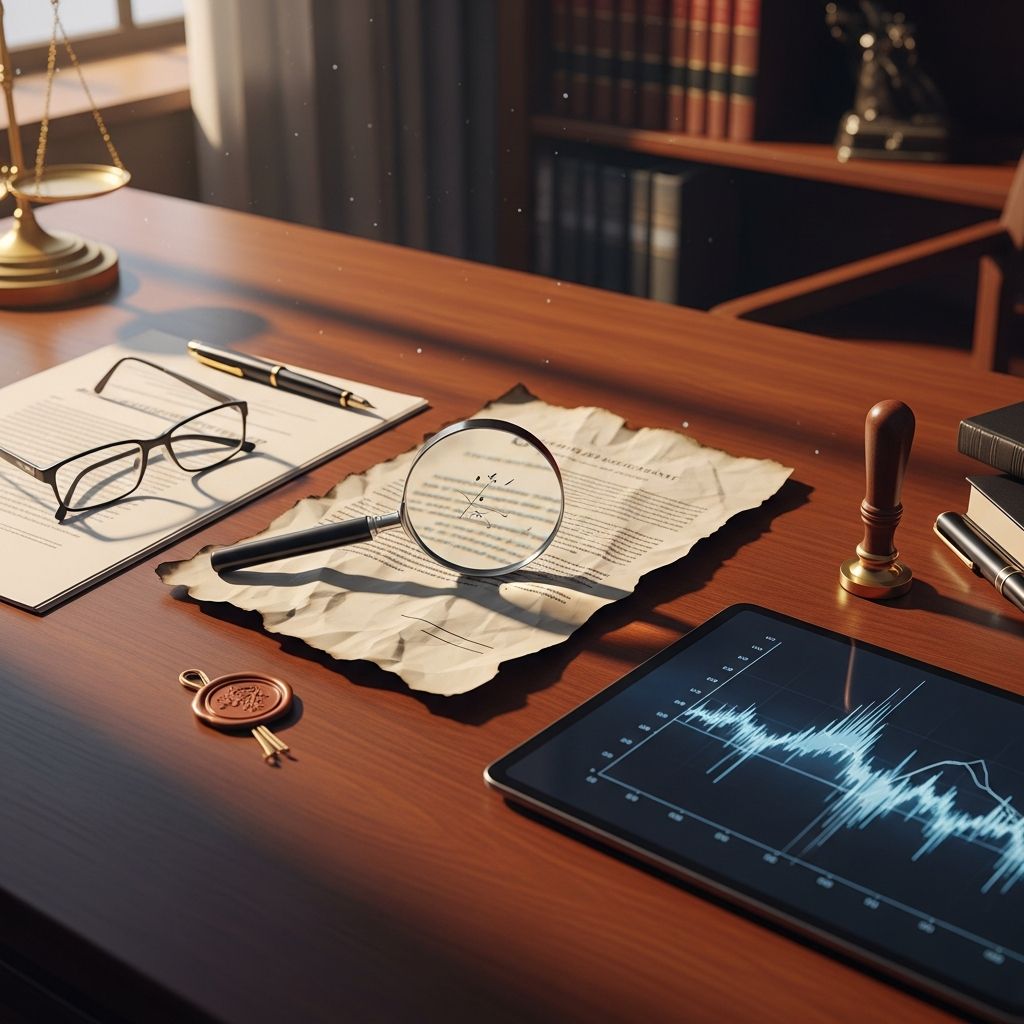
In legal proceedings, the integrity of evidence forms the bedrock of justice. Fabricated or manipulated evidence can derail cases, leading to wrongful convictions or unjust acquittals. As digital tools proliferate, distinguishing genuine proof from counterfeits has become crucial for attorneys, investigators, and judges. This article outlines practical techniques to uncover deception, drawing on established verification protocols.
Understanding the Scope of Evidence Tampering
Evidence tampering encompasses alterations to physical items, digital files, and witness statements. Common forms include photoshopped images, forged documents, and scripted testimonies. Courts rely on authenticity to uphold due process, yet sophisticated forgeries challenge traditional scrutiny. Recognizing patterns of manipulation requires a blend of visual acuity, technical knowledge, and analytical reasoning.
Legal systems worldwide emphasize evidence reliability. For instance, U.S. federal rules mandate that evidence be what it purports to be, free from adulteration. When doubts arise, challenges under rules like Federal Rule of Evidence 901 compel authentication through testimony or expert analysis.
Initial Visual and Structural Inspection
Begin evaluation with a thorough visual scan. Authentic evidence typically exhibits professional polish, while fakes often reveal amateur flaws. Look for inconsistencies in lighting, shadows, or proportions in images and videos. Poorly edited photos might show pixel mismatches or unnatural blending at edges.
- Examine layout: Genuine legal documents feature consistent fonts, alignments, and margins. Anomalies like irregular spacing signal tampering.
- Assess quality: Blurry scans or low-resolution inserts contrast with high-clarity originals.
- Spot distractions: Excessive ads, pop-ups, or cluttered designs on source websites hint at unreliability.
Table comparing authentic vs. suspicious visuals:
| Feature | Authentic Evidence | Suspicious Indicators |
|---|---|---|
| Image Clarity | Sharp, uniform resolution | Pixelation, mismatched edges |
| Document Formatting | Standard fonts, even margins | Inconsistent typography, offsets |
| Website Design | Clean, professional | Ads-heavy, garish colors |
Verifying Provenance and Origins
Trace the evidence back to its source. Legitimate materials originate from reputable custodians, such as official records offices or certified experts. Unknown origins warrant skepticism. Cross-check domains: Legitimate sites end in trusted extensions like .gov or .edu, while imposters use mimics like .com.co.
Consult the “About” pages of presenting entities. Credible organizations detail their history, staff, and contact methods. Absence of such transparency raises red flags. For digital evidence, inspect metadata using tools like Exif viewers to reveal creation dates, geolocation, and editing software traces.
Author and Attribution Scrutiny
Every piece of evidence should link to a verifiable creator. Anonymous submissions lack accountability. Search the named author or affiant: Do they hold relevant credentials? LinkedIn profiles, professional publications, or bar association records confirm legitimacy. Fabrications often attribute to fictional experts or omit bylines entirely.
In witness statements, probe for consistency. Genuine accounts align with timelines and physics; fakes falter under cross-examination, revealing rehearsed phrasing or contradictions.
Content Analysis for Balance and Reasonableness
Scrutinize the narrative. Authentic evidence presents balanced views, supported by diverse sources. Fabricated items push singular agendas with inflammatory language, ALL CAPS emphasis, or hyperbolic claims. Evaluate plausibility: Does the story defy known facts or logic?
Critical thinking plays a pivotal role here. Studies show that analytical reasoning helps dismantle falsehoods by demanding evidence for assertions. Dogmatic biases hinder detection, while open-minded evaluation enhances accuracy.
Grammar, Syntax, and Linguistic Red Flags
Professional evidence employs impeccable language. Typos, grammatical errors, or excessive punctuation (e.g., multiple exclamation points) undermine credibility. Machine-translated or hastily forged texts often exhibit awkward phrasing or cultural mismatches.
Compare against standards: Legal filings adhere to formal styles like Bluebook citations. Deviations suggest inauthenticity.
Source Citation and Corroboration Checks
Reliable evidence cites traceable, high-quality references. Vague “sources say” or circular self-references indicate fabrication. Click through hyperlinks: Do they lead to primary documents or reputable outlets? Mismatched content voids support.
Seek parallel reporting. If only one outlet promotes the evidence, investigate motives. Cross-verification from multiple credible channels bolsters validity.
Advanced Digital Forensics Techniques
For multimedia, deploy specialized tools. Reverse image searches via Google or TinEye expose stock photos or prior uses. Video analysis detects deepfakes through irregular blinking, lip-sync errors, or artifacts from AI generation.
Hash matching verifies file integrity: Identical genuine copies yield same cryptographic hashes. Discrepancies signal edits. Forensic software like Amped Authenticate flags compression anomalies.
Psychological and Bias Considerations
Examiners must confront personal biases. Confirmation bias leads to overlooking flaws in favored narratives. Employ the SIFT method: Stop, Investigate source, Find coverage elsewhere, Trace claims. This structured approach fosters objectivity.
In court, challenge evidence via motions to suppress or expert witnesses. Precedents like Daubert hearings test scientific validity of forensic methods.
Practical Case Studies in Detection
Consider a forged contract case: Misaligned signatures and font variances exposed tampering via magnification. In another, a viral video’s metadata revealed post-production edits, discrediting a key exhibit.
These examples underscore vigilance. Training in detection enhances proficiency, reducing miscarriage risks.
Frequently Asked Questions (FAQs)
What tools best detect image forgeries?
Use FotoForensics for error level analysis and InVID for video verification. These reveal editing artifacts invisible to the naked eye.
How do courts authenticate digital evidence?
Through chain-of-custody logs, digital signatures, and expert testimony confirming unaltered state.
Can AI-generated evidence hold up in court?
Only with provenance proof; courts increasingly require disclosure of generative tools used.
What if evidence passes initial checks?
Escalate to forensic labs for deeper analysis, including spectral imaging for inks and papers.
Building a Robust Verification Protocol
Integrate these steps into workflows: Train teams, adopt checklists, and leverage technology. Collaboration with digital forensics experts ensures thoroughness. Ultimately, skepticism paired with verification safeguards justice.
Word count: 1728 (excluding HTML tags and metadata).
References
- Fake News in 10 Steps Guided Research Worksheet — NOAA/AOML. Accessed 2026. https://www.aoml.noaa.gov/general/lib/lib1/nhclib/Fake-News-WorksheetProQuest.pdf
- The Use of Critical Thinking to Identify Fake News — National Library of Medicine (NIH). 2020-03-20. https://pmc.ncbi.nlm.nih.gov/articles/PMC7134234/
- How to Spot Fake News – A Checklist — CSI Library, CUNY. Accessed 2026. https://library.csi.cuny.edu/misinformation/spotfakenews
- How to Fact Check – Fake News & Misinformation — University of Tampa Library. Accessed 2026. https://utopia.ut.edu/FakeNews/factcheck
- 10 Ways to Spot Fake Videos and Falsehoods on the Internet — AARP. Accessed 2026. https://www.aarp.org/personal-technology/identifying-disinformation/
Similar Articles








Read full bio of Sneha Tete


