
Desegregation, Busing, and the Fourteenth Amendment
Explore how the Fourteenth Amendment reshaped school segregation, busing policies, and the long struggle for equal educational opportunity.
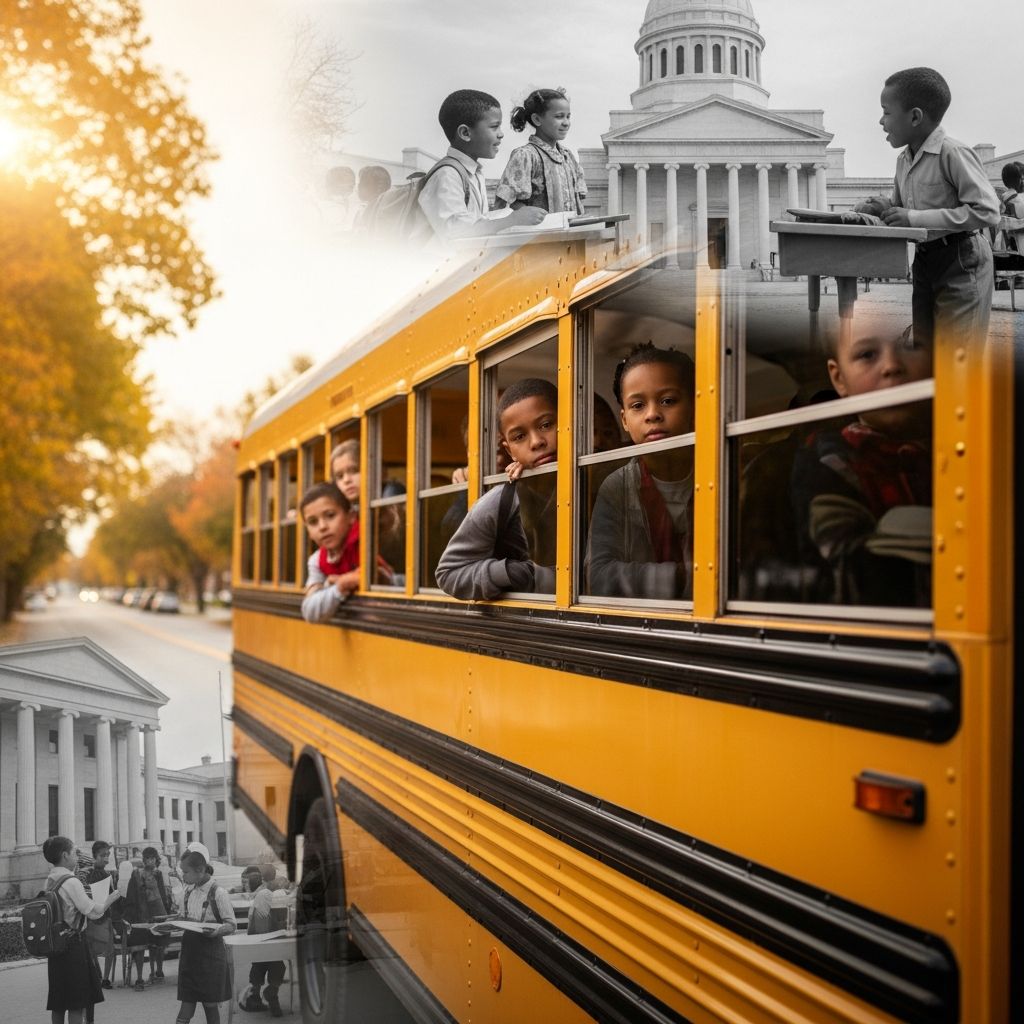
The desegregation of American public schools is inseparable from the meaning of the Fourteenth Amendment, especially its guarantee of equal protection of the laws.
Throughout the twentieth century, courts, lawmakers, and communities clashed over what equality required in practice: the end of legally mandated segregation, the dismantling of racially separate school systems, and the use of controversial tools such as busing to achieve meaningful integration.
1. Constitutional Foundations: The Fourteenth Amendment
Adopted in 1868 after the Civil War, the Fourteenth Amendment was designed to protect formerly enslaved people and to prevent states from denying basic civil rights based on race.
| Clause | Key Language | Relevance to School Desegregation |
|---|---|---|
| Citizenship Clause | All persons born or naturalized in the U.S. are citizens. | Affirms Black children as full citizens entitled to public services, including education. |
| Due Process Clause | No state shall deprive any person of life, liberty, or property, without due process of law. | Used to challenge arbitrary exclusion or unfair procedures in education. |
| Equal Protection Clause | No state shall deny to any person within its jurisdiction the equal protection of the laws. | Core basis for attacking segregated and unequal public schools. |
The Supreme Court initially interpreted equal protection narrowly. In Plessy v. Ferguson (1896), it approved racial separation under the “separate but equal” doctrine, paving the way for segregated schools across the South and many parts of the North.
2. Segregated Schooling Before Brown
By the early twentieth century, school segregation reflected both law and custom:
- Southern and border states mandated racially separate public schools by statute.
- Northern and Western communities often produced segregated schools through residential segregation and discriminatory local decisions.
- Black schools were chronically underfunded, with fewer resources, overcrowded classrooms, and shorter school terms.
Civil rights lawyers, especially those of the NAACP Legal Defense Fund, gradually challenged this system. Starting in the 1930s, they targeted graduate and professional schools, where the inequalities were stark and easier to demonstrate. These early victories laid the groundwork for a broader attack on segregation at the elementary and secondary levels.
3. Brown v. Board of Education: Reframing Equal Protection
The turning point arrived with Brown v. Board of Education of Topeka (1954), a consolidation of school desegregation cases from Kansas, South Carolina, Virginia, Delaware, and the District of Columbia.
The Court unanimously held that racially segregated public schools violate the Equal Protection Clause:
- State-sponsored segregation in education is inherently unequal, even if tangible facilities appear similar.
- Segregation stigmatizes Black children and undermines their educational opportunities.
- The earlier Plessy doctrine could not coexist with a genuine commitment to equal protection.
The National Archives describes the decision as a milestone that “signaled the end of legalized racial segregation in the schools of the United States,” and explicitly found that state-imposed separation of children by race is unconstitutional under the Fourteenth Amendment.
4. From Legal Principle to Implementation: Brown II and Resistance
Declaring segregation unconstitutional did not automatically integrate schools. In 1955, the Court issued a follow-up decision known as Brown II. Instead of ordering immediate integration, it instructed lower courts to supervise desegregation with “all deliberate speed.”
That vague standard had major consequences:
- Many school districts delayed meaningful action for years.
- Some states adopted “massive resistance” strategies, including shutting down public schools or redirecting funds to white-only private academies.
- Federal judges became central actors, evaluating whether local desegregation plans were genuine or merely symbolic.
The Library of Congress notes that desegregation became “a massive effort” and a central goal of the Civil Rights Movement, supported by litigation, direct action, and federal intervention.
5. Expanding Federal Power: Civil Rights Act and Enforcement
By the early 1960s, it was clear that court rulings alone were insufficient. Congress moved to give the federal government more robust tools to enforce equal protection in education.
5.1 Civil Rights Act of 1964
The Civil Rights Act of 1964 transformed the legal landscape for school desegregation:
- Title IV and Title VI prohibited discrimination on the basis of race, color, or national origin in programs receiving federal funds.
- The federal government could withhold financial support from school districts that refused to dismantle segregation.
- The U.S. Department of Justice gained authority to file school desegregation lawsuits on behalf of students.
Historian accounts emphasize that tying federal aid to desegregation significantly accelerated compliance in the late 1960s.
5.2 Key Supreme Court Cases After Brown
Several decisions in the late 1960s and early 1970s pushed school systems toward more complete desegregation:
- Green v. County School Board of New Kent County (1968) – The Court rejected “freedom-of-choice” plans that maintained segregated schools and demanded desegregation “root and branch.”
- Alexander v. Holmes County Board of Education (1969) – The Court ended further delays, declaring that continued operation of dual school systems was unconstitutional and must cease “at once.”
These cases signaled that equal protection required not just the removal of explicit racial classifications, but the dismantling of entire structures that sustained segregated school systems.
6. Busing as a Desegregation Tool
Even after legal barriers fell, residential segregation meant that many schools remained racially homogeneous. To address this, federal courts turned to busing—transporting students across traditional neighborhood or district lines—as a tool to create racially diverse schools.
6.1 Swann v. Charlotte-Mecklenburg Board of Education (1971)
In Swann v. Charlotte-Mecklenburg (1971), the Supreme Court approved a broad range of remedies to eliminate de jure segregation, including:
- Revised attendance zones that did not mirror segregated housing patterns.
- Use of satellite zones and pairing or clustering of schools.
- Court-ordered busing of students to achieve racially balanced enrollments.
The Hechinger Report describes Swann as the decision that explicitly endorsed “busing, magnet schools and compensatory education as acceptable tools” to speed integration.
6.2 Why Busing Was Controversial
Busing efforts sparked intense political and community backlash in many cities:
- Some white families moved to suburbs or enrolled their children in private schools, often described by historians as a “white flight” phenomenon.
- Opponents argued that busing disrupted neighborhood schools and imposed long commutes on children.
- Supporters countered that without busing, equal protection would be hollow in cities where neighborhoods remained deeply segregated.
Despite controversy, federal courts treated busing as a constitutionally permissible remedy where districts had intentionally maintained segregation.
7. Limits on Desegregation Remedies
As the 1970s and 1980s unfolded, the Supreme Court began to limit the scope of desegregation remedies and to narrow how far the Fourteenth Amendment could reach.
- Distinction between de jure and de facto segregation – Courts drew a line between segregation caused by official government action (de jure) and segregation resulting from private choices or housing patterns (de facto). Strong remedies were generally reserved for de jure cases.
- End of court supervision – Over time, districts declared “unitary” were released from desegregation orders, even if schools later re-segregated through demographic changes.
- Interdistrict limits – The Court was skeptical of remedies that crossed district boundaries unless there was proof of intentional, interdistrict discrimination.
These developments reduced the reach of the Fourteenth Amendment as a tool for achieving racially integrated schools, especially in metropolitan areas divided into numerous separate districts.
8. Ongoing Segregation and the Equal Protection Clause
Despite dramatic changes since the era of legally mandated segregation, many American schools remain racially and economically isolated. Research from the Library of Congress and historians of education highlight several trends:
- Urban districts with large Black and Latino enrollments often serve higher percentages of low-income students.
- Suburban districts may be more affluent and racially homogeneous, even where state law is formally colorblind.
- Private schools and publicly funded alternatives have sometimes functioned as havens for families avoiding desegregated public schools, particularly in the South during the late twentieth century.
Legally, modern equal protection doctrine focuses heavily on whether government actors intentionally discriminate on the basis of race. This makes it harder to use the Fourteenth Amendment to address inequalities that grow out of market forces, zoning decisions, and historical patterns of housing segregation.
9. Educational Equity Beyond Race
Although early school desegregation battles centered on race, the Fourteenth Amendment has also been invoked to challenge inequality in other forms:
- Language and national origin – Litigation has challenged practices that deny equal educational access to students with limited English proficiency.
- Disability – Equal protection principles have influenced the development of federal disability law and the right to appropriate educational services.
- Sex discrimination – While Title IX is the primary federal tool, equal protection doctrine informs challenges to sex-based differences in educational programs.
These developments underscore that the Fourteenth Amendment remains a central framework for thinking about fairness and opportunity in American schools, even as explicit segregation laws have disappeared.
10. Key Takeaways for Students and Families
Understanding desegregation and busing through the lens of the Fourteenth Amendment offers several important lessons:
- Constitutional language can remain dormant for decades until social movements and strategic litigation bring it to life.
- Ending a discriminatory law does not automatically eliminate inequality; courts often must oversee structural remedies.
- Busing, magnet schools, and other tools are not goals in themselves, but mechanisms designed to fulfill the promise of equal protection.
- School segregation today may look different from the Jim Crow era, but debates over equity, resources, and access remain deeply connected to the Equal Protection Clause.
Frequently Asked Questions (FAQs)
Q1: How did the Fourteenth Amendment make school segregation unconstitutional?
The Fourteenth Amendment’s Equal Protection Clause prohibits states from treating people differently on the basis of race without a legally sufficient justification. In Brown v. Board of Education, the Supreme Court held that state laws requiring separate public schools for Black and white children violated equal protection because segregation itself created inherently unequal educational conditions.
Q2: Did Brown immediately end segregation in all public schools?
No. Although Brown declared segregated schools unconstitutional in 1954, many districts delayed or resisted integration. The 1955 Brown II decision’s “all deliberate speed” language allowed officials to slow-walk compliance. Effective desegregation often required subsequent Supreme Court rulings, federal legislation, Department of Justice enforcement, and sustained activism.
Q3: Why did courts approve busing as a desegregation tool?
Courts recognized that dismantling segregated school systems required more than simply repealing discriminatory laws. Because housing patterns often mirrored old racial lines, neighborhood-based schools would have remained racially separated. In cases like Swann v. Charlotte-Mecklenburg, the Supreme Court held that busing and redrawn attendance zones were permissible remedies to correct proven constitutional violations.
Q4: Is school segregation today still a constitutional issue?
It can be, depending on the cause of segregation. If segregation results from deliberate government policies that classify students by race, it is likely unconstitutional under the Equal Protection Clause. If it stems from private housing choices or economic factors without proof of intent to discriminate, courts are less likely to find a constitutional violation, though policy makers can still address these inequalities through legislation.
Q5: What is the difference between de jure and de facto segregation?
De jure segregation arises from explicit laws or official policies that separate students by race, as with Jim Crow statutes. De facto segregation occurs in practice—for example, when racially homogeneous neighborhoods produce racially homogeneous schools—even if the law is formally neutral. The Supreme Court has generally permitted stronger remedies, including busing, for de jure segregation than for de facto segregation.
References
- Brown v. Board of Education (1954) — National Archives. 2016-11-10. https://www.archives.gov/milestone-documents/brown-v-board-of-education
- School Segregation and Integration — Library of Congress, Civil Rights History Project. 2011-08-23. https://www.loc.gov/collections/civil-rights-history-project/articles-and-essays/school-segregation-and-integration/
- The Troubled History of American Education after the Brown Decision — Organization of American Historians. 2014-02-03. https://www.oah.org/tah/february-3/the-troubled-history-of-american-education-after-the-brown-decision/
- School Segregation: A Visual Timeline — The Hechinger Report. 2019-05-16. https://hechingerreport.org/school-segregation-a-visual-timeline/
- The Struggle Against Segregated Education — Smithsonian National Museum of African American History and Culture. 2017-01-01. https://nmaahc.si.edu/explore/stories/struggle-against-segregated-education
- A History of Private Schools and Race in the American South — Southern Education Foundation. 2016-09-01. https://southerneducation.org/publications/history-of-private-schools-and-race-in-the-american-south/
Similar Articles








Read full bio of medha deb


