
Denver’s Magic Mushroom Vote and the Rise of Psychedelic Decriminalization
How Denver’s landmark psilocybin vote reshaped local drug policy and helped launch a broader psychedelic reform movement.
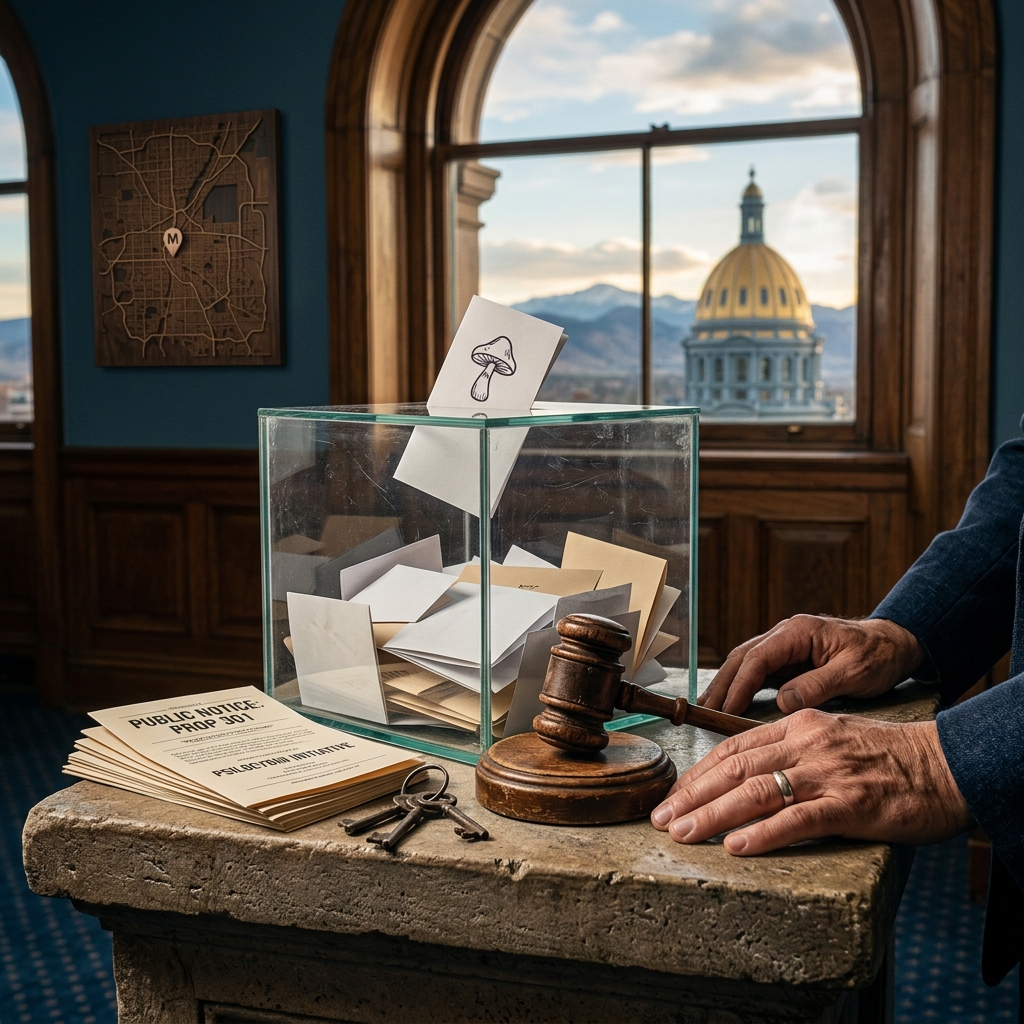
In 2019, Denver became the first city in the United States to decriminalize psilocybin mushrooms, often called magic mushrooms, after a narrow ballot initiative victory. This decision helped launch a broader conversation about psychedelic policy, harm reduction, and the difference between decriminalization and full legalization.
This article explains what Denver’s ordinance did, how it fits into Colorado’s evolving psychedelic laws, and why the details matter for residents, visitors, and policymakers.
From Grassroots Campaign to Landmark Vote
Denver’s change in mushroom policy did not come from the state legislature or Congress. It started as a grassroots campaign, organized by local advocates who collected enough signatures to place an initiative, often referred to as Initiated Ordinance 301, on the city ballot.
On election night, early returns suggested the measure might fail. But when final votes were counted, supporters prevailed by a razor-thin margin of just over 50%. Denver’s elections office confirmed that the initiative passed, making the city a national testing ground for a new approach to psilocybin enforcement.
- Vote Margin: Approximately 50.5–50.6% in favor versus about 49.4% opposed.
- Mechanism: Local ballot initiative, not statewide law.
- Scope: Adults 21 and older in the City and County of Denver.
What Decriminalization Means (and What It Does Not)
One of the most common misunderstandings about Denver’s decision is the belief that psilocybin magically became legal. It did not. The city enacted decriminalization, which is very different from legalization.
Key Elements of Denver’s Psilocybin Decriminalization
The ordinance focused on how local law enforcement should treat personal possession and use of psilocybin mushrooms by adults.
- Personal possession and use for adults 21 and older became the lowest law enforcement priority for city agencies.
- The city was barred from spending resources to pursue criminal penalties against adults solely for possessing or using psilocybin mushrooms.
- Adults could grow mushrooms for personal use, with enforcement against such cultivation deprioritized in the same way as possession.
- A policy review panel was created to monitor the effects of the ordinance and recommend future changes.
Limits: Still Illegal under State and Federal Law
While Denver deprioritized enforcement at the city level, psilocybin remained a controlled substance under both Colorado state law and federal law at the time.
| Aspect | Decriminalization in Denver | Legal Status Outside Denver (2019) |
|---|---|---|
| Personal possession (21+) | Lowest police priority; city resources not used to prosecute. | Still illegal under Colorado and federal law. |
| Personal cultivation for own use | Deprioritized enforcement. | Illegal in most jurisdictions. |
| Sale, distribution, trafficking | Not decriminalized; can still be fully prosecuted. | Generally illegal, subject to criminal penalties. |
| Use on federal property | Still illegal; federal law applies. | Illegal nationwide. |
In practical terms, Denver’s ordinance signaled that local police should focus their efforts on more serious offenses, while personal adult mushroom use would rarely be a priority. However, the ordinance did not guarantee immunity from state or federal enforcement.
Why Psilocybin? A Look at Risks and Emerging Benefits
Psilocybin is a naturally occurring psychedelic compound found in certain species of mushrooms. It can cause altered perception, intense emotions, and, at higher doses, profound changes in consciousness. These effects are why the substance has been widely used both recreationally and in traditional spiritual practices.
At the same time, modern research has begun to explore potential therapeutic uses of psilocybin for conditions such as depression, anxiety, and substance use disorders, under carefully controlled settings. This emerging science is one reason some voters and advocates felt comfortable reducing criminal penalties for adult use, even as many medical experts still emphasize significant risks.
Potential Risks of Psilocybin Use
- Psilocybin can cause acute psychological distress, including panic, paranoia, or disorientation, particularly at high doses or in unsafe settings.
- Individuals with a history of serious mental illness—such as schizophrenia or bipolar disorder—may be at higher risk of adverse effects and should be especially cautious.
- There is a potential for accidents or injuries due to impaired judgment or perception during intense experiences.
Researchers and clinicians in Colorado have noted that even under new statewide laws, psilocybin is unlikely to become an over-the-counter product because of these risks and the need for professional supervision in therapeutic settings.
From Denver’s Ordinance to Colorado’s Statewide Psychedelic Law
Denver’s local initiative was an early step in a broader movement. In 2022, Colorado voters approved Proposition 122, known as the Natural Medicine Health Act, which expanded psychedelic decriminalization statewide and created a framework for supervised therapeutic use.
What Proposition 122 Changed
Under Proposition 122, adults 21 and older across Colorado gained new protections and options related to psilocybin and several other natural psychedelics.
- Statewide decriminalization: Many criminal penalties were removed for personal possession, cultivation, and use of psilocybin and psilocin, as well as certain other natural psychedelics like mescaline (not from peyote), ibogaine, and DMT.
- Personal use and sharing: Adults can possess, consume, grow, and share these substances for personal use, with limits such as restrictions on sharing ibogaine.
- No retail sales: The law does not allow commercial retail sales or recreational dispensaries for psilocybin.
- Healing centers: Colorado is developing licensed facilities where individuals can pay for supervised psilocybin experiences guided by trained facilitators.
Colorado’s statewide framework significantly reshaped the legal landscape, eventually leading Denver’s City Council to repeal its earlier, narrower mushroom ordinance in favor of alignment with state law.
Healing Centers: Supervised Psychedelic Experiences
One of the most notable features of Colorado’s new psychedelic law is the creation of state-regulated healing centers. Rather than retail sales, these centers offer structured, supervised psilocybin sessions for adults.
How Healing Centers Work
Details are still evolving, but Colorado’s law and policy discussions outline a general model for these services.
- Clients attend a preparation session to discuss history, goals, and potential risks.
- The core psilocybin experience often lasts six to eight hours, with clients consuming the substance on site and remaining under professional supervision.
- Afterward, clients participate in integration sessions to help make sense of the experience and apply insights to everyday life.
- Healing centers, cultivators, and testing facilities must navigate both state licensing and, in Denver’s case, local licensing requirements for certain operations.
Colorado’s approach reflects a compromise: allowing access to psilocybin while emphasizing structured, carefully managed use rather than casual retail availability.
Practical Takeaways for Denver Residents and Visitors
For people living in or visiting Denver, the legal environment around psilocybin can be confusing. The city’s 2019 ordinance, statewide reforms, and ongoing rulemaking all interact in complex ways.
Key Points to Understand
- Decriminalization is not legalization: Personal use may carry fewer criminal risks, but psilocybin remains controlled and subject to various restrictions.
- Age matters: Most reforms apply only to adults 21 and older.
- Sales are still constrained: Unlicensed sale or trafficking of psilocybin can result in serious criminal penalties, especially when minors or large quantities are involved.
- Location matters: Federal property and certain public spaces remain off-limits for psilocybin use, regardless of city or state decriminalization.
- Therapeutic access is structured: Legal paid access will generally occur at healing centers under supervision, not via over-the-counter products.
FAQs about Denver’s Magic Mushroom Policy
Is it legal to possess magic mushrooms in Denver?
Personal possession by adults 21 and older has been decriminalized and treated as a low law enforcement priority, first under Denver’s ordinance and now under Colorado’s wider framework. However, psilocybin is not fully legalized and remains a controlled substance under broader law.
Can I buy psilocybin at a store or dispensary?
No. Colorado’s laws do not permit retail sales of psilocybin in the way cannabis dispensaries operate. Access through healing centers is based on supervised sessions, not take-home products.
Are magic mushrooms safe?
Psilocybin carries both potential benefits and significant risks. It may offer therapeutic value in structured clinical settings, but can cause serious psychological distress or harm, especially for people with certain mental health conditions or in unsafe environments. Medical experts caution against casual use.
What happens if someone sells mushrooms illegally in Denver?
Decriminalization in Denver focuses on personal possession and use. Sale or distribution remains illegal and can trigger severe penalties under state and possibly federal law, particularly for large quantities or sales involving minors.
Does Colorado’s law cover all psychedelics?
No. Colorado’s reforms focus on natural substances such as psilocybin, psilocin, mescaline (with limits), ibogaine, and DMT for personal use. Synthetic substances like LSD remain fully criminalized.
Looking Ahead: Policy, Research, and Public Health
Denver’s 2019 vote marked a symbolic turning point in U.S. drug policy, showing that local voters were willing to experiment with alternatives to strict prohibition for certain psychedelics. Colorado’s later statewide reforms built on that momentum, shifting the focus toward supervised, therapeutic use and harm reduction.
As healing centers open and research progresses, policymakers will continue to balance public health concerns, potential medical benefits, and community values. For now, understanding the distinction between decriminalization and legalization—and the specific rules in place—is essential for anyone interested in this rapidly evolving area of law.
References
- Denver becomes the first city to decriminalize hallucinogenic mushrooms — CNN. 2019-05-08. https://www.cnn.com/2019/05/08/us/denver-magic-mushrooms-approved-trnd
- Denver First In Nation To Decriminalize Psilocybin Mushrooms — Addiction Center. 2019-05-09. https://www.addictioncenter.com/community/denver-decriminalize-psilocybin-mushrooms/
- In Close Vote, Denver Becomes 1st U.S. City To Decriminalize Psychedelic Mushrooms — NPR. 2019-05-09. https://www.npr.org/sections/health-shots/2019/05/09/721660053/in-close-vote-denver-becomes-first-u-s-city-to-decriminalize-psychedelic-mushroo
- Colorado Voted to Decriminalize ‘Magic Mushrooms’ — University of Colorado Anschutz Medical Campus. 2022-11-22. https://news.cuanschutz.edu/medicine/colorado-magic-mushrooms-psilocybin
- What to know about Colorado’s psychedelic law — Colorado Public Radio. 2023-06-21. https://www.cpr.org/2023/06/21/colorado-psychedelic-law-for-psilocybin-mushrooms/
- A Guide To Recreational Use of Psychedelic Mushrooms in Colorado — Colorado Springs Criminal Defense. 2023. https://coloradospringscriminaldefense.net/guide-recreational-use-psychedelic-mushrooms-in-colorado-new-magic-mushroom-laws/
- It’s the end of an era for mushrooms in Denver as council adopts new licensing law — Denverite. 2025-03-03. https://denverite.com/2025/03/03/its-the-end-of-an-era-for-mushrooms-in-denver-as-council-adopts-new-licensing-law/
Similar Articles








Read full bio of medha deb




