
Dentures, Justice, and Ohio’s Crime Victim Compensation
How an Ohio court battle over lost dentures reshaped the understanding of what crime victim compensation should cover.
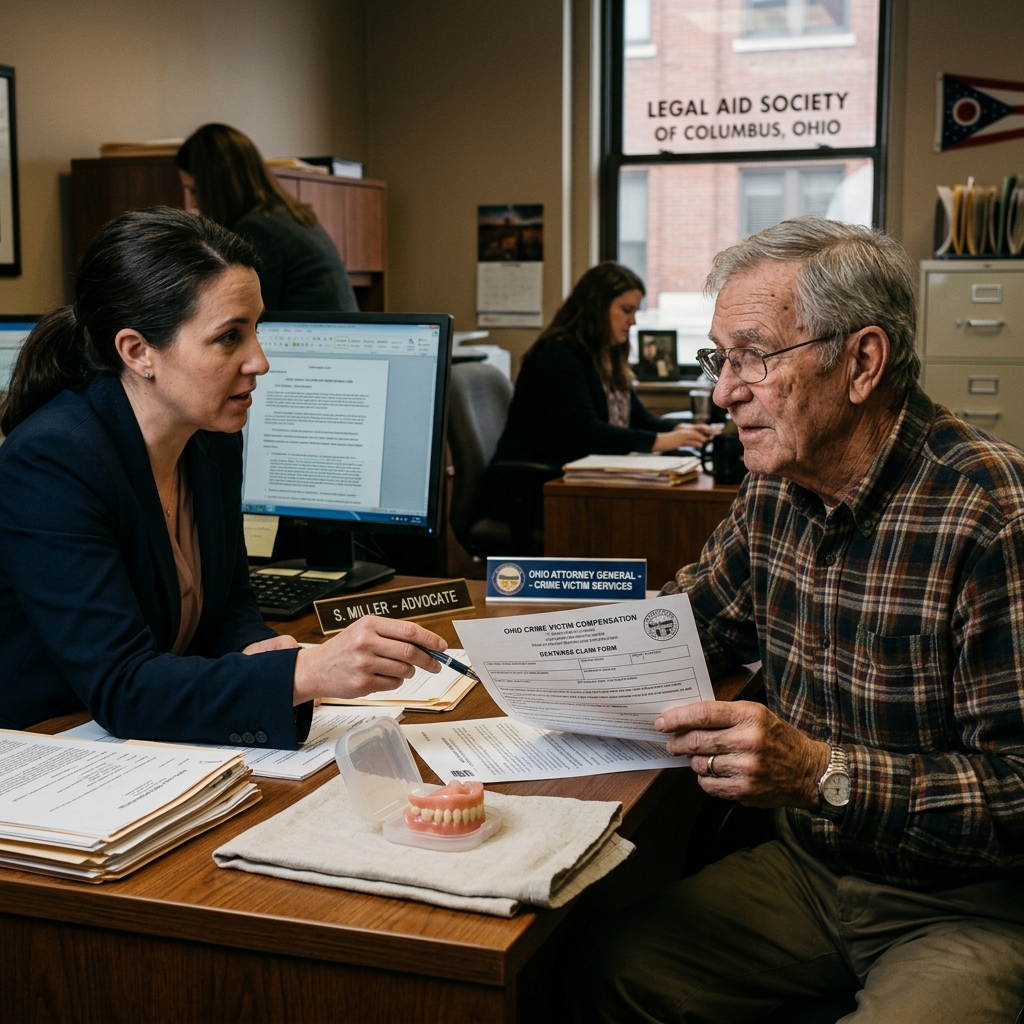
Crime victim compensation programs are often thought of as tools to reimburse hospital bills or funeral expenses. Yet one Ohio case involving a man whose dentures were lost during a violent assault shows how complex, and deeply human, these programs can be. His fight to have the state pay for replacement dentures raised an uncomfortable question: what exactly counts as a compensable loss when someone is attacked?
This article examines the Ohio Crime Victims Compensation Program, the legal reasoning that allowed dentures to be covered, and the broader implications for victim rights. Drawing from official Ohio sources and legal commentary, we explore how compensation law balances strict rules with real-world needs.
Understanding Crime Victim Compensation in Ohio
Ohio operates a statewide crime victim compensation program that provides financial assistance to innocent victims of violent crime and certain family members. The program is administered by the Ohio Attorney General, with judicial review available through the Ohio Court of Claims. It is designed as a payer of last resort, stepping in only when other sources such as insurance or government benefits do not cover necessary expenses.
Core Purpose of the Program
At its core, the program exists to reduce the financial burden caused by violent crime-related injuries. Official materials emphasize that compensation is reserved for out-of-pocket expenses rather than generalized losses like pain and suffering or property damage. Payments are capped at a maximum total award of $50,000 per claim.
- Provide financial assistance for victims of violent crime.
- Support dependents of homicide victims and certain family members.
- Cover necessary expenses that are not otherwise reimbursed.
- Operate under clear eligibility rules and statutory limits.
Standard Eligibility Rules
Victims, or in some cases their dependents, must satisfy several conditions to qualify.
- The underlying incident must be a violent crime, and the victim must be innocent of significant wrongdoing contributing to the injury.
- A police report must be filed, although earlier strict deadlines have been relaxed.
- Claims generally must be filed within three years of the crime, with extended time for minors.
- The expenses claimed must not be fully covered by insurance or other benefits.
Historically, certain criminal histories or conduct could disqualify applicants, but recent legislative changes have removed some of these barriers, particularly around past convictions and drug possession at the time of the offense. These reforms reflect a growing recognition that prior criminal records should not automatically prevent legitimate victims from receiving assistance.
What Expenses Can Victims Recover?
Ohio’s program distinguishes between
Typical Covered Costs
Common reimbursable categories include medical care, mental health services, and lost income directly attributable to crime-related injuries.
- Medical and related expenses (including hospitalization, medication, and rehabilitation).
- Counseling and psychological services for victims and, in some cases, immediate family members.
- Lost wages and certain replacement service costs when the victim cannot perform essential tasks.
- Funeral and burial expenses for homicide victims.
- Crime scene cleanup and security repairs like damaged doors or windows.
The state bar association and judicial materials note that reimbursement may also be available for specific assistive devices and appliances, reflecting the importance of restoring basic daily functioning to victims.
Dental Appliances and Similar Items
Ohio’s victim compensation framework expressly references items such as hearing aids, eyeglasses, and dental appliances. These are treated differently from ordinary property because they are necessary to restore physical function and health.
- Hearing aids and vision aids (glasses and other devices).
- Dental appliances, including dentures and other dental aids.
- Mobility devices like canes, walkers, and wheelchairs.
Importantly, these items are typically compensable only when broken or lost as a direct result of the crime, not simply because they existed prior to the incident. This distinction became central in the Ohio dentures dispute.
Expenses Generally Not Covered
The law draws firm lines around certain categories of loss.
- Pain and suffering (non-economic damages) are not compensable through the program.
- Stolen, damaged, or lost property in the ordinary sense is excluded.
- Expenses that can reasonably be covered by insurance or other sources will not be paid by the program.
On paper, this may seem straightforward. In practice, however, the line between “property” and “necessary medical or functional equipment” often requires careful legal interpretation – as the dentures case illustrates.
The Dentures Dispute: When a Medical Need Looks Like Property
In the Ohio case that sparked broader discussion, a man was violently assaulted in 2011 and lost his dentures in the process. His dentures, essential to his ability to eat and speak, were never recovered. He sought reimbursement through the Crime Victims Compensation Program but initially faced denial.
Initial Denial and Attorney General Decision
The Ohio Attorney General’s Office is responsible for investigating claims and making initial determinations. In this case, the office concluded that reimbursement for the lost dentures was not appropriate under the existing interpretation of the statute.
Although specific reasoning in that decision turned on program rules, it likely involved classifying the dentures as a form of property loss rather than a compensable medical-related expense. Such an approach aligns with the general rule that typical property damage is excluded from compensation.
Court of Claims Review and Reversal
The claimant appealed to the Ohio Court of Claims, which has authority to review decisions from the Attorney General and apply the law to contested facts. Commissioners for the Court of Claims examined whether dentures lost during a violent attack should be treated like ordinary property or like a necessary medical appliance directly tied to the victim’s physical condition.
Ultimately, the Court of Claims reversed the Attorney General’s decision, holding that the victim was entitled to compensation for replacement dentures. The commissioners found that the request was not unreasonable and fit within the statutory framework that allows reimbursement for dental appliances when they are broken or lost as a result of the crime.
Why Dentures Matter So Much
This outcome was more than symbolic. Dentures are not merely personal belongings; they are essential health aids. Without them, many people struggle with basic nutrition, speech, and social interaction. Recognizing dentures as compensable when lost in a violent crime acknowledges that the harm extends beyond the immediate physical injuries.
The case highlighted how rigid interpretations of “property” can fail to capture the reality of victim needs, and why judicial review is a crucial safeguard in compensation systems.
Property vs. Functional Loss: A Legal and Practical Tension
Ohio’s statutory scheme clearly excludes ordinary property damage from compensation. Yet the dentures case exposed the tension between protecting public funds from broad property claims and ensuring victims can restore basic functioning after an attack.
| Category | Typical Treatment in Ohio Program | Example |
|---|---|---|
| Ordinary Property | Generally not covered; victims must seek other remedies or insurance. | Stolen television, damaged car, broken smartphone |
| Medical & Assistive Devices | Covered when damaged or lost as a direct result of a violent crime. | Broken eyeglasses, destroyed hearing aid, lost dentures |
| Pain & Suffering | Never covered; must be pursued through civil lawsuits if appropriate. | Emotional distress, generalized discomfort |
The essential legal question in the dentures case was whether the dentures fell into the second row – medical and assistive devices – rather than the first. By treating them as dental appliances that restore core bodily function, the Court of Claims brought them squarely within the program’s compensable categories.
How Victims Can Navigate Ohio’s System
For victims considering a claim, the dentures case underscores the importance of understanding both the program’s rules and the appeals process.
Key Steps in Filing a Claim
- Report the crime to law enforcement and obtain documentation (police reports, incident numbers).
- Gather evidence of expenses, including medical bills, invoices for devices, and proof of payment or estimates.
- File an application with the Ohio Attorney General’s Office, either online or by mail.
- Track deadlines, especially the three-year limit for adults and extended period for minors.
- Seek help from victim advocates or legal assistance if the process is confusing.
Official guidance encourages victims to use advocates and legal resources; attorney fees related to compensation claims can be paid by the state in certain circumstances, reducing financial barriers to pursuing justice.
What To Do If a Claim Is Denied
The dentures case demonstrates that an initial denial is not the end of the story. Victims can appeal to the Ohio Court of Claims, which independently reviews the Attorney General’s determinations.
- Request written explanation of the denial from the Attorney General’s Office.
- Consult a lawyer or victim advocacy group to evaluate grounds for appeal.
- File a complaint with the Court of Claims, paying the required filing fee.
- Present legal arguments and evidence showing that the expense fits within compensable categories.
The availability of judicial review, as seen in the dentures case, helps ensure that program rules are interpreted consistently and fairly, and that borderline issues receive thorough scrutiny.
Broader Implications for Victim Rights
The Ohio dentures decision may seem narrow, but it has broader implications for how we think about victim rights and compensation.
Recognizing the Full Impact of Violence
Violent crime often causes ripple effects beyond immediate physical injuries. Losing dentures, glasses, or mobility devices can dramatically affect a victim’s ability to function, work, and live with dignity. By treating such losses as compensable, Ohio’s program moves closer to acknowledging the full scope of harm.
Balancing Fiscal Responsibility and Human Need
Compensation programs must protect public funds and prevent abuse. The exclusion of general property damage serves this goal. Yet cases like the dentures dispute show that strict rules require thoughtful interpretation when they intersect with health-related necessities.
Judicial oversight by the Court of Claims provides a mechanism to balance these competing interests. It ensures that genuinely essential losses – even when they resemble property – are not arbitrarily excluded from support.
Evolving Standards and Policy Changes
Recent changes to Ohio’s compensation rules, including the removal of certain criminal-history disqualifiers and updated filing deadlines, signal an ongoing evolution in how the state views victim eligibility. As policymakers and courts confront new fact patterns, further refinements are likely, particularly around emerging categories of loss and modern assistive technologies.
Frequently Asked Questions (FAQs)
1. Are dentures always covered by Ohio’s Crime Victims Compensation Program?
No. Dentures may be compensable when they qualify as dental appliances lost or damaged as a direct result of a violent crime. Victims must show the connection between the crime and the loss and meet all eligibility requirements.
2. What is the maximum compensation I can receive as an Ohio crime victim?
The total award is generally capped at $50,000 per claim. This limit covers all eligible expenses combined, such as medical care, counseling, funeral costs, and approved devices.
3. Does Ohio pay for pain and suffering through the compensation program?
No. Pain and suffering, emotional distress, and similar non-economic damages are excluded from compensation. Victims who seek such damages must consider civil litigation or other legal avenues.
4. How long do I have to file a compensation claim in Ohio?
Adults generally must file within three years of the date of the crime. Minors typically have until their 24th birthday to submit an application. Some reforms now allow previously disqualified applicants to refile under specific conditions.
5. If my claim is denied, can I challenge the decision?
Yes. You can appeal to the Ohio Court of Claims, which provides judicial review of decisions issued by the Attorney General’s Office. This process played a critical role in the dentures case, resulting in a reversal of the initial denial.
6. Are ordinary property losses ever reimbursed?
Generally no. The program does not cover stolen, damaged, or lost property. However, certain items like medical aids, dental appliances, and mobility devices are treated differently because they are integral to a victim’s physical functioning.
References
- Court of Claims: Decision Reversed in Dentures Refund Case — Court News Ohio. 2014-09-10. https://www.courtnewsohio.gov/cases/2014/COC/0910/2014-00409VI.asp
- Compensation — Ohio Crime Victim Justice Center — Ohio Crime Victim Justice Center. 2022-03-02 (updates noted). https://www.ocvjc.org/comp
- Victim Compensation — Montgomery County, OH (Official County Website). 2023-01-01 (approx. last updated; date not explicitly stated). https://www.mcohio.org/1162/Victim-Compensation
- Crime Victims Compensation — Ohio Court of Claims (Official State Website). 2023-01-01 (approx. last updated; date not explicitly stated). https://ohiocourtofclaims.gov/crime-victims-compensation/
- Apply for Victims Compensation — Ohio Attorney General. 2023-01-01 (approx. last updated; date not explicitly stated). https://www.ohioattorneygeneral.gov/Individuals-and-Families/Victims/Apply-for-Victims-Compensation
- Ohio’s Victim of Crime Compensation Program: Questions and Answers — Ohio State Bar Association. 2017-01-01 (older but authoritative overview of program). https://www.ohiobar.org/public-resources/commonly-asked-law-questions-results/criminal-justice/ohios-victim-of-crime-compensation-program-questions-and-answers/
- In Brief: Victim Compensation Programs and Restitution — Council of State Governments Justice Center. 2017-01-13. https://csgjusticecenter.org/2017/01/13/in-brief-victim-compensation-programs-and-restitution/
Similar Articles








Read full bio of Sneha Tete




