
Demystifying Free Speech and Criminal Conspiracy
Where does free speech end and criminal conspiracy begin under federal law?
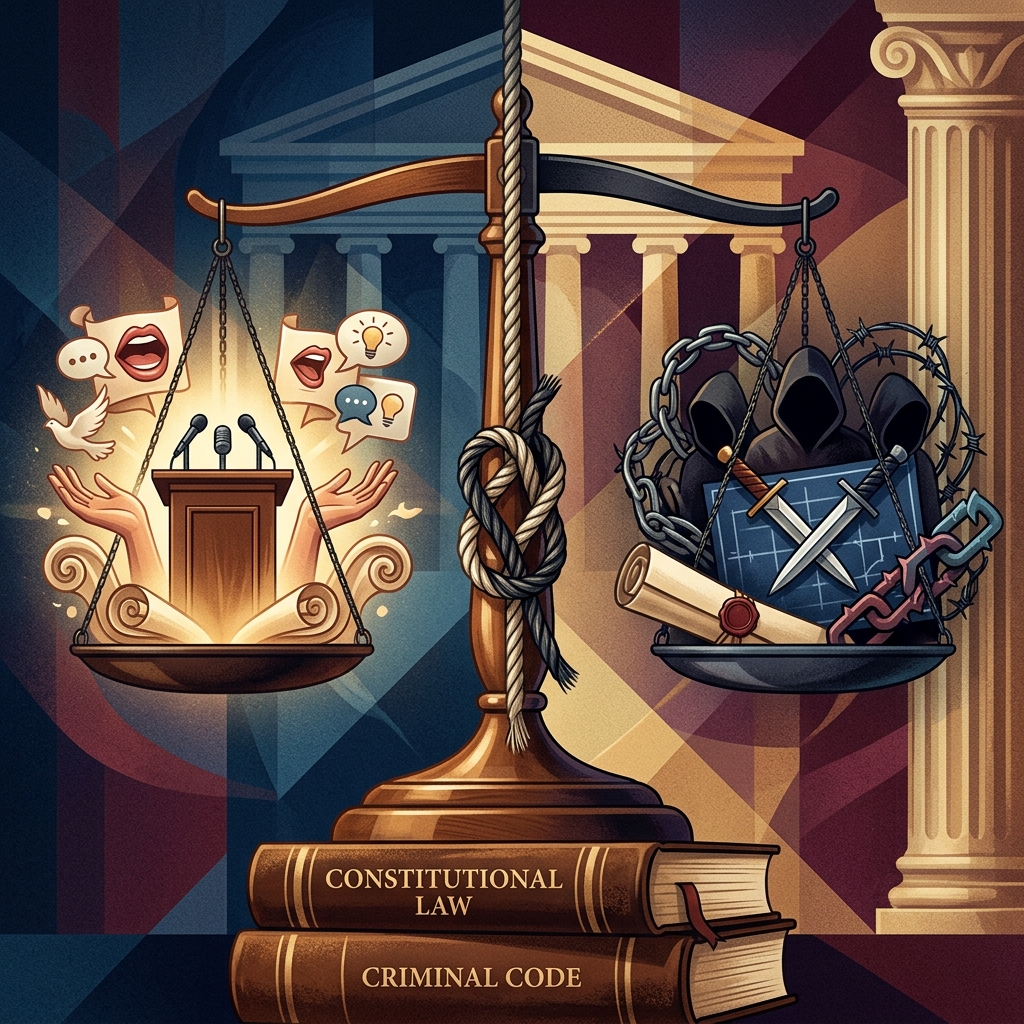
In contemporary American political discourse, the tension between free expression and unlawful conduct has never been more scrutinized. At the center of this complex legal web lies the First Amendment, a constitutional bedrock designed to protect the marketplace of ideas from government overreach. However, the intersection of constitutional protections and criminal law creates a nuanced landscape where the legal interpretation of words can mean the difference between a protected political rally and a federal indictment.
While the United States offers some of the most robust free speech protections in the world, these rights are not absolute . The judicial system is frequently tasked with deciphering where rhetorical hyperbole ends and actionable criminal conspiracy begins. This article demystifies the delicate boundary separating legally protected political speech from illicit conduct, exploring historical Supreme Court precedents, the intricacies of federal conspiracy statutes, and the enduring debate over the weaponization of the legal system.
Understanding the Core Protections of Political Speech
The First Amendment of the U.S. Constitution stands as a formidable bulwark against government censorship. It guarantees that individuals can express dissenting, unpopular, and even deeply offensive viewpoints without fear of state-sponsored retribution. In the political sphere, courts have historically granted the widest possible latitude for expression. Political speech is considered the lifeblood of a functioning democracy, allowing citizens to challenge their leaders, critique government policies, and advocate for systemic change.
The Supreme Court has consistently applied a standard known as “strict scrutiny” to any law attempting to regulate political speech based on its content. For the government to successfully restrict such speech, it must prove that the regulation serves a compelling state interest and is narrowly tailored to achieve that goal. This high bar ensures that politicians, activists, and everyday citizens can engage in vigorous, uninhibited debate. However, while the Constitution protects the expression of ideas and beliefs, it does not offer blanket immunity when those words are utilized as the operational mechanism to violate established laws.
When Speech Becomes an Act: The Doctrine of Criminal Conduct
The distinction between uttering a belief and committing a crime is legally encapsulated in the “speech integral to criminal conduct” doctrine. This legal framework dictates that the government can criminalize speech if it is an essential component of an illegal act. The landmark Supreme Court case Giboney v. Empire Storage & Ice Co. (1949) solidified this principle . In Giboney, a labor union picketed a wholesale ice distributor in an attempt to force the company into an agreement that would violate state antitrust laws. The union argued their picketing was protected under the First Amendment as a peaceful demonstration.
The Supreme Court rejected the union’s defense, ruling that the First Amendment does not shield speech that is used as an essential, inseparable part of a criminal violation . In other words, if an individual utilizes words to coordinate a bank robbery, solicit a bribe, or extort a business, the verbalization of the plan is not a protected expression of ideas; it is the act of a crime itself. This doctrine is paramount when evaluating the actions of political figures. Solicitation, extortion, and conspiracy all rely heavily on verbal or written communication. The Supreme Court has repeatedly emphasized that making illegal conduct actionable does not become unconstitutional simply because the conduct was initiated, evidenced, or carried out via spoken or written language.
Navigating Falsehoods: Are Lies Protected by the Constitution?
A common public misconception is that all false statements are inherently illegal or completely stripped of constitutional protection. In reality, the Supreme Court has ruled that falsity alone does not remove speech from the protective umbrella of the First Amendment. This principle was famously tested in United States v. Alvarez (2012) . The case centered around the Stolen Valor Act, a federal law that criminalized the act of falsely claiming to have received military honors. Xavier Alvarez, a local water board member in California, falsely stated during a public meeting that he had been awarded the Congressional Medal of Honor.
The Supreme Court struck down the Stolen Valor Act, ruling that Alvarez’s lie, while morally reprehensible, was protected speech because it did not facilitate a secondary crime like fraud or defamation . A plurality of the Court expressed concern that allowing the government to criminalize lies simply for being false would open the door to an Orwellian “Ministry of Truth,” granting the state unprecedented censorship powers. Consequently, politicians and public figures are generally protected when making false statements in the public square, provided those statements do not cross into legally recognized exceptions.
However, the protection of falsehoods evaporates when a lie is deployed to secure financial gain (fraud), maliciously destroy a private citizen’s reputation (defamation), or intentionally subvert a lawful government function. In these instances, the lie transitions from protected political theater to a tangible legal injury.
Obstruction and Conspiracy: The Legal Definitions
Federal law takes a rigid stance on agreements intended to disrupt the functioning of the United States government. When examining the boundaries of political speech, 18 U.S.C. § 371 often takes center stage. This statute makes it a federal crime for two or more persons to conspire either to commit any offense against the United States or to defraud the United States in any manner or for any purpose .
Crucially, “defrauding” the government in this context does not strictly require a financial loss or the theft of federal property. The Department of Justice interprets this broadly to include any conspiracy designed to impair, obstruct, or defeat the lawful functions of any government department by deceit, craft, trickery, or dishonest means . For a conspiracy charge to stick, the prosecution must prove three elements: an agreement between two or more people to achieve an illegal goal, the defendant’s knowing participation in the conspiracy, and an “overt act” committed by at least one conspirator in furtherance of the scheme.
Furthermore, federal obstruction charges often hinge on actions intended to impede official congressional or judicial proceedings. The overlap between protected speech and criminal obstruction becomes highly contentious when public figures use sweeping rhetoric to challenge government processes. The prosecution carries the heavy burden of proving that the speech was not merely rhetorical dissent but an operational directive within a concerted, actionable plan to break the law.
High-Profile Legal Cases and First Amendment Defenses
Throughout American history, political activists, dissenters, and high-ranking officials have frequently invoked the First Amendment when facing federal charges. The defense typically centers on the argument that indictments criminalize political dissent and penalize the act of challenging established governmental narratives or electoral results. Civil liberties organizations are renowned for fiercely defending the free speech rights of controversial figures, even those whose politics they vehemently oppose. They operate on the principle that allowing the government to suppress unpopular speech sets a dangerous precedent that could eventually be used against marginalized groups or legitimate protestors.
Despite this fierce defense of civil liberties, legal experts maintain a clear delineation between speech and criminal acts. Advocating for a change in government, claiming an electoral process was fundamentally flawed, or urging supporters to peacefully protest are all legally protected activities. However, directing individuals to submit forged documents to a government agency, attempting to manipulate government officials through extortionate threats, or organizing a physical disruption of a legislative process falls squarely into the realm of criminal conduct.
The Role of Intent in Prosecuting Speech-Related Crimes
The cornerstone of American criminal law is the concept of mens rea, which translates to a “guilty mind.” When dealing with speech-adjacent crimes such as fraud or conspiracy, prosecutors face an incredibly rigorous evidentiary standard regarding intent. To convict someone of a conspiracy to defraud the United States, the government must demonstrate beyond a reasonable doubt that the individual knew their claims were false and that they willfully engaged in deceptive practices to obstruct government functions.
If a speaker genuinely believes the falsehoods they are propagating, their speech is substantially more likely to be protected. In such scenarios, the requisite corrupt intent required for a fraud or conspiracy conviction is absent. Prosecutors cannot simply point to the objective falsity of the statements made by a defendant; they must uncover internal communications, testimonies, or documented actions proving a coordinated, knowing plan to utilize those false statements unlawfully. This stringent requirement is designed to protect citizens from being imprisoned for mere ignorance, delusion, or political exaggeration.
Differentiating Speech and Conduct
To better understand the nuances between protected expressions and actionable crimes, it is helpful to examine how the law categorizes different scenarios:
| Scenario | Legal Status | Reasoning |
|---|---|---|
| Claiming an election was stolen during a televised interview. | Protected Speech | Political expression and false statements (without secondary material harm) are protected under the First Amendment. |
| Drafting and submitting forged certificates to Congress. | Criminal Conduct | This involves the overt act of creating fraudulent documents to deceive a government body, violating federal conspiracy/fraud statutes. |
| Encouraging supporters to “fight like hell” at a rally. | Likely Protected Speech | Rhetorical hyperbole is protected unless it meets the strict “Brandenburg test” for inciting imminent, likely lawless action. |
| Coordinating with officials to illegally breach voting machines. | Criminal Conduct | The communication is integral to the commission of a cybercrime and election tampering, falling under the Giboney exception. |
Frequently Asked Questions (FAQs)
Does the First Amendment protect hate speech?
Yes, generally speaking, the First Amendment protects hate speech. The Supreme Court has repeatedly ruled that speech cannot be banned simply because it is offensive, hateful, or repugnant. However, there are exceptions. If hate speech crosses the line into a “true threat” (a statement meant to frighten or intimidate one or more specified persons into believing that they will be seriously harmed) or “incitement to imminent lawless action,” it loses its constitutional protection.
Can you be prosecuted for spreading misinformation?
As established in United States v. Alvarez, the government cannot prosecute individuals simply for spreading misinformation or lying. Falsity is not an exception to the First Amendment. However, if the misinformation is part of a scheme to defraud individuals of money, constitutes perjury under oath, or defames a private individual with actual malice, the speaker can face criminal or civil liability.
What is the difference between political advocacy and incitement?
The legal line between advocacy and incitement was established in the 1969 Supreme Court case Brandenburg v. Ohio. To qualify as unprotected incitement, the speech must be directed to inciting or producing imminent lawless action and must be likely to incite or produce such action. Vaguely advocating for a revolution at some point in the future is protected advocacy. Instructing an angry crowd to immediately burn down a specific building across the street is unprotected incitement.
What constitutes an “overt act” in a conspiracy?
Under 18 U.S.C. § 371, an overt act is any step taken by any one of the conspirators that goes beyond mere planning and moves toward executing the illegal agreement. The act itself does not need to be illegal; it simply must be an action taken to further the conspiracy. For example, buying ski masks could be the overt act in a conspiracy to commit a robbery.
References
- Justice Manual | 923. 18 U.S.C. § 371—Conspiracy to Defraud the United States — U.S. Department of Justice. 2023-01-01. https://www.justice.gov/archives/jm/criminal-resource-manual-923-18-usc-371-conspiracy-defraud-us
- Giboney v. Empire Storage & Ice Co., 336 U.S. 490 (1949) — Justia Supreme Court Center. 1949-04-04. https://supreme.justia.com/cases/federal/us/336/490/
- United States v. Alvarez, 567 U.S. 709 (2012) — Justia Supreme Court Center. 2012-06-28. https://supreme.justia.com/cases/federal/us/567/709/
- Freedom of Speech and Press: Exceptions to the First Amendment — Congressional Research Service. 2014-09-08. https://sgp.fas.org/crs/misc/95-815.pdf
Similar Articles








Read full bio of medha deb


