
Delta-8 THC: What Employers Need To Know In 2025, US Vs UK Laws
Understand how delta‑8 THC is regulated in the US and UK, what it means for employees, and how employers can manage legal and workplace risks.
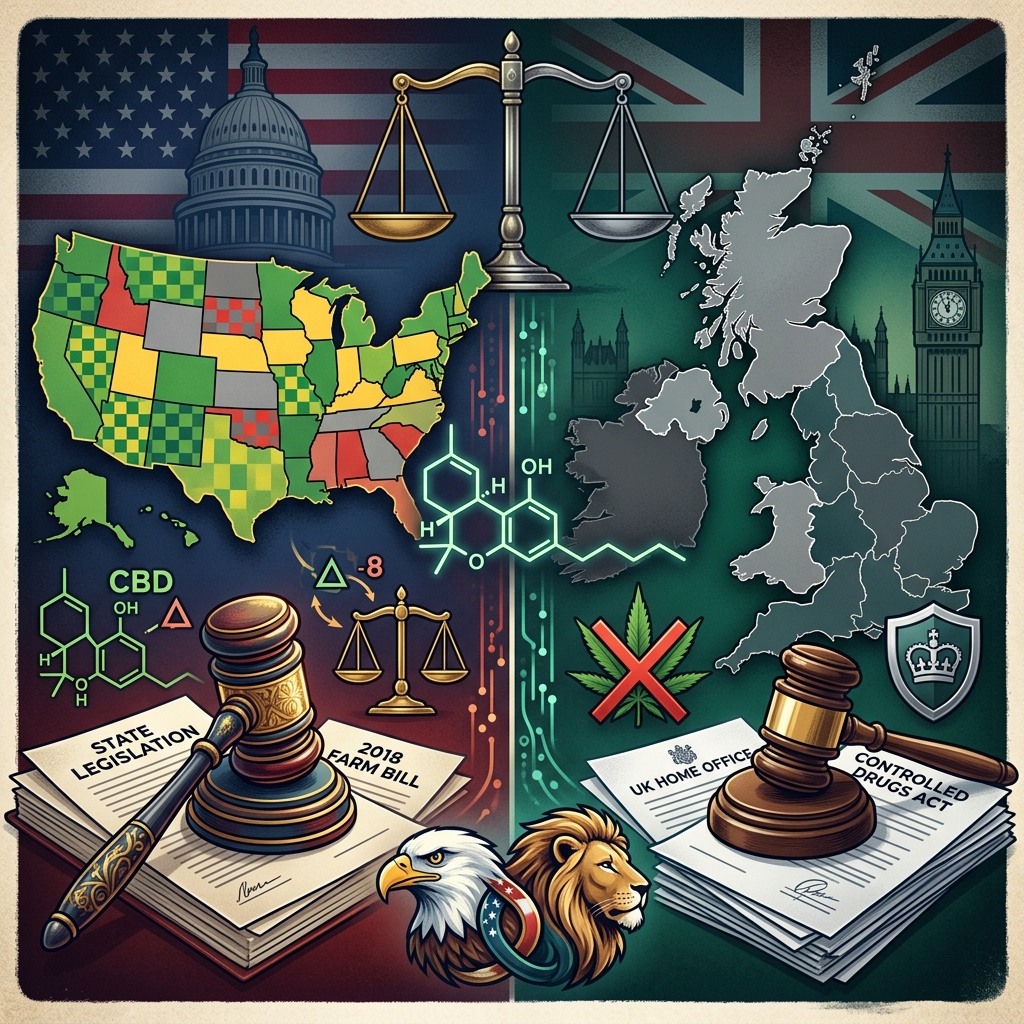
Delta‑8 tetrahydrocannabinol (delta‑8 THC) has moved from an obscure cannabinoid to a major legal and workplace issue in a few short years. It is often marketed as a “legal high” or a hemp‑derived alternative to traditional cannabis, but its legal status is far from simple in both the United States and the United Kingdom. This guide explains how delta‑8 is regulated, the differences between US and UK approaches, and what employees and employers need to know about use, testing, and workplace policies.
1. What Is Delta‑8 THC and Why Does the Law Care?
Delta‑8 THC is a psychoactive cannabinoid that occurs in cannabis plants at very low concentrations. Most commercial delta‑8 is produced by chemically converting cannabidiol (CBD) extracted from hemp, rather than being directly extracted in its natural form.
1.1 Key features of delta‑8 THC
- Structural similarity: Delta‑8 is closely related to delta‑9 THC, the main psychoactive component in cannabis, differing only by the position of a double bond in its molecular structure.
- Psychoactive effects: Research and user reports suggest it can cause intoxication, impairment, and side effects such as anxiety or dizziness, even if some describe the effects as milder than delta‑9 THC.
- Synthetic conversion: Commercial products typically rely on laboratory conversion of CBD to delta‑8, raising legal questions about whether the result is a synthetic tetrahydrocannabinol.
- Detection in tests: Standard workplace drug tests usually detect THC metabolites without distinguishing between delta‑8 and delta‑9, making a positive test likely if enough is consumed.
Because delta‑8 can intoxicate users and is often produced through chemical conversion, regulators treat it as more than a benign hemp by‑product.
2. US Federal Law: From Hemp Loophole to Tightening Rules
The legal journey of delta‑8 in the US starts with the 2018 Agriculture Improvement Act (the 2018 Farm Bill), which removed hemp—defined as cannabis with no more than 0.3% delta‑9 THC on a dry‑weight basis—from the federal list of controlled substances.
2.1 The Farm Bill and the “hemp loophole”
- The Farm Bill legalized cultivation and sale of hemp and hemp‑derived products with up to 0.3% delta‑9 THC, but it did not explicitly address delta‑8 THC.
- Manufacturers began producing delta‑8 from legal hemp‑derived CBD and argued that, because the starting material is lawful hemp and the final product stays within the 0.3% delta‑9 THC limit, delta‑8 products are federally legal hemp goods.
- This interpretation led to widespread, largely unregulated sale of delta‑8 gummies, vapes, and edibles across many states, often outside licensed cannabis systems.
2.2 DEA and controlled substance concerns
The US Drug Enforcement Administration (DEA) has taken the position that synthetically derived tetrahydrocannabinols remain Schedule I controlled substances, regardless of their delta‑9 content. In an interim rule implementing the 2018 Farm Bill, the DEA emphasized that the change in law did not remove synthetic THC analogues from control.
Because commercial delta‑8 is generally produced through chemical conversion rather than directly harvested from the plant, some federal interpretations consider it a Schedule I substance despite hemp origins.
2.3 New federal hemp law closing the gap
More recently, Congress has moved to explicitly restrict intoxicating hemp derivatives such as delta‑8 and related compounds. New federal legislation revising the definition of hemp does several key things:
- Redefines hemp using a total THC threshold that counts precursors and related intoxicating cannabinoids, not just delta‑9 THC.
- Bans laboratory‑synthesized cannabinoids like delta‑8 THC when they are manufactured outside the plant, effectively treating them as controlled substances at the federal level.
- Sets an extremely low cap on allowable THC content per product container, including THCA and other cannabinoids with similar intoxicating effects.
Once fully implemented, this federal change will significantly reduce the room for delta‑8 products to claim hemp legality, even where state law is more permissive.
3. Patchwork US State Laws on Delta‑8 THC
Even before recent congressional action, states adopted widely different policies toward delta‑8. Some treated it as another hemp product, others folded it into existing marijuana laws, and some banned it outright.
3.1 Common state approaches
US states generally fall into four broad categories with respect to delta‑8:
| State approach | Typical features |
|---|---|
| Explicitly legal / permitted | Delta‑8 is allowed as a hemp product, sometimes with age limits, testing, and packaging rules, but without being treated as marijuana. |
| Regulated within cannabis systems | Delta‑8 is treated like other THC products; it may only be sold through licensed dispensaries or subject to state cannabis regulations. |
| Explicitly banned | State law classifies delta‑8 as a controlled substance or includes it in the definition of THC or marijuana, making its sale and possession illegal. |
| Unclear / not directly addressed | No specific reference to delta‑8; regulators may treat it as illegal, tolerate it, or be in the process of clarifying the law. |
3.2 Example: state‑level summary
Analyses by legislative research bodies and legal commentators show that:
- Dozens of states allow delta‑8 in some form, either explicitly or by not banning it, though rules on packaging, age, and potency vary.
- A growing group of states explicitly prohibit possession or sale of delta‑8 by classifying it as a controlled substance or including it under THC or marijuana definitions.
- Some states permit delta‑8 but impose stringent limits on total THC per serving or per package and require licensing within regulated cannabis markets.
Because state law is changing quickly, employees and employers must always review the most recent statutes and agency guidance in the relevant jurisdiction.
4. UK Law: A Much Stricter Environment
In the United Kingdom, cannabis and most cannabinoids are controlled primarily under the Misuse of Drugs Act 1971 and associated regulations. Delta‑8 is not treated as a harmless hemp derivative; instead, it is typically regarded as a form of THC and thus a controlled drug.
4.1 Cannabis and THC in UK law
- Cannabis (including resin and most products containing THC) is generally classified as a Class B drug, making unauthorised production, supply, and possession criminal offences.
- While low‑THC CBD products can be legally sold in some circumstances, any product containing a controlled cannabinoid such as delta‑9 THC is tightly restricted.
- Because delta‑8 is an isomer of THC and is produced synthetically from CBD, it is typically treated as falling within the scope of controlled THC‑type substances.
4.2 Implications for delta‑8 products in the UK
As a practical matter:
- Retail sale of delta‑8 products as consumer goods is generally not lawful without specific authorisation.
- Importing, distributing, or possessing delta‑8 for recreational purposes exposes individuals or businesses to potential criminal liability.
- Any medicinal use would require strict regulatory approval and would be subject to the UK’s controlled drugs and medicines regimes.
This is in stark contrast to the US, where delta‑8 products have been widely available in shops and online marketplaces, at least prior to newer federal restrictions.
5. Employment and Workplace Issues
Regardless of country, delta‑8 raises difficult questions for both employees and employers, especially in safety‑sensitive industries and workplaces with drug‑free policies.
5.1 Drug testing and detection
- Standard tests: Most workplace drug tests screen for THC metabolites rather than a specific isomer, so delta‑8 use can lead to a positive result that appears identical to cannabis use.
- No easy distinction: Routine immunoassay tests used in employment settings generally cannot determine whether the THC detected comes from delta‑8, delta‑9, or other analogues.
- Policy impact: Where an employer prohibits any use of illegal drugs or THC, a positive test may have consequences even if the employee believed delta‑8 was lawful under local hemp rules.
5.2 US employment considerations
In the US, the legal and employment landscape is layered:
- Federal contractors and safety‑sensitive roles: Employees working in positions covered by federal drug‑testing mandates (such as commercial transportation or defence contracts) are generally prohibited from using delta‑8, regardless of state law, because it is treated like other THC for testing purposes.
- State‑law protection varies: Some states provide employment protections for registered medical cannabis patients or for off‑duty lawful conduct, but these protections may not clearly extend to delta‑8, especially where it is classified as illegal or unregulated.
- Company policies: Many employers maintain zero‑tolerance or impairment‑focused drug policies. Even in states where delta‑8 products have been available, employers often treat THC metabolites as violations if their policy prohibits them outright.
5.3 UK employment considerations
In the UK, the starting point is that non‑prescribed THC‑type substances are illegal:
- Drug‑free policies: Employers frequently rely on the illegality of controlled drugs to justify strict workplace bans and disciplinary action for positive tests.
- Health and safety duties: Employers have statutory obligations to protect employees and the public; allowing intoxication on duty can conflict with those duties.
- Limited medical exceptions: Where cannabis‑based medicines are lawfully prescribed, employers must balance safety with potential disability discrimination and reasonable adjustments; however, delta‑8 products are unlikely to fall in this category.
6. Risk Management for Employers
Because the law is evolving and varies widely by jurisdiction, employers should approach delta‑8 proactively rather than waiting for a contested disciplinary case or legal claim.
6.1 Policy drafting tips
Effective workplace drug and alcohol policies in this area usually:
- Define “intoxicating substances” broadly enough to include all THC isomers and similar cannabinoids, not just delta‑9 THC.
- Clarify whether the policy bans any detectable THC metabolite or focuses on impairment during working time.
- Explain the difference between lawful CBD products and intoxicating hemp‑derived products, and specify that employees are responsible for checking legality.
- Set out clear procedures for testing, confidentiality, and the consequences of positive results.
- Take into account any applicable collective bargaining agreements or state‑specific employment protections.
6.2 Training and communication
- Educate managers and employees about the basics of cannabinoids, including delta‑8 and other hemp‑derived products.
- Highlight that marketing claims such as “legal hemp,” “non‑detectable,” or “compliant delta‑8” may not match legal or testing realities.
- Encourage employees to disclose prescribed medications and seek guidance before using any product that might affect testing.
6.3 Cross‑border organisations
For employers operating in both the US and UK, additional complexity arises:
- US staff may have access to a variety of legal cannabis and hemp products, while UK staff generally do not.
- Remote workers travelling between countries may misunderstand what is permitted where.
- Companies should adopt jurisdiction‑specific appendices to global policies, explaining how rules apply in each country and how conflicts with local law are resolved.
7. Practical Guidance for Employees
Employees contemplating delta‑8 use need to consider not just whether a product appears legal in shops or online, but also how it interacts with workplace expectations and testing.
7.1 Questions to ask before using delta‑8
- Is delta‑8 clearly legal, regulated, or banned in my state or country? If the answer is unclear, assume higher risk.
- Does my employer have a zero‑tolerance policy for THC, or does it focus on impairment and safety?
- Am I in a safety‑sensitive role, working around heavy machinery, driving, or carrying out tasks where impairment could be dangerous?
- Could a positive THC test, even from a product I believed to be legal, affect my professional licence or security clearance?
7.2 Safer approaches from an employment perspective
From a workplace risk standpoint, employees who choose to use cannabinoids might:
- Prefer non‑intoxicating CBD products with third‑party lab reports showing no or minimal THC, where lawful.
- Avoid any product explicitly marketed as psychoactive, euphoric, or a cannabis substitute, especially in safety‑critical jobs.
- Consult healthcare professionals before using cannabinoid products for medical reasons, and discuss any prescribed medicines with their employer under appropriate confidentiality safeguards.
8. Future Trends and Regulatory Direction
Regulation of delta‑8 and other hemp‑derived intoxicants is moving toward tighter control rather than relaxation.
8.1 US trajectory
- New federal reforms explicitly restrict synthetic or lab‑derived cannabinoids like delta‑8 within the hemp framework, narrowing the earlier Farm Bill loopholes.
- States are increasingly updating their statutes to include delta‑8 and similar substances in THC definitions, or to integrate them into existing cannabis markets with age and safety controls.
- Public health concerns—such as reports of unregulated products, mislabelled strengths, and accidental exposure—continue to drive calls for stronger oversight.
8.2 UK outlook
The UK’s more conservative approach to cannabis makes a broad consumer market for delta‑8 unlikely in the short term. Any future change would probably come through:
- Carefully controlled medicinal approvals, rather than general retail sale.
- Evidence‑based reviews of cannabinoid safety and therapeutic value.
- Ongoing enforcement against unauthorised psychoactive products sold as food supplements or wellness items.
9. FAQs About Delta‑8 THC, US and UK Law, and Work
Q1. Is delta‑8 THC legal everywhere in the United States?
No. While hemp‑derived products initially benefited from the 2018 Farm Bill, many states have since restricted or banned delta‑8, and recent federal reforms further limit synthetic THC‑like cannabinoids. The legality now depends heavily on both federal rules and specific state law.
Q2. Can using delta‑8 cause me to fail a workplace drug test?
Yes. Most workplace tests detect THC metabolites without distinguishing between delta‑8 and delta‑9 THC, so sufficient use of delta‑8 can lead to a positive result. From a testing perspective, delta‑8 is generally not treated differently from other forms of THC.
Q3. Is delta‑8 treated as legal hemp in the UK?
Generally, no. In the UK, THC and related compounds are controlled drugs, and delta‑8 is usually treated as a form of THC rather than a benign hemp product. This means that delta‑8 products are typically unlawful unless specifically authorised under controlled drugs and medicines regulations.
Q4. Does a medical cannabis law automatically protect delta‑8 use at work?
Not necessarily. Some US states provide limited employment protections for registered medical cannabis patients, but laws often refer to specific programs and products, not to hemp‑derived delta‑8. Where delta‑8 is considered illegal or unregulated, relying on medical cannabis laws for protection can be risky.
Q5. What should employers do if they operate in multiple US states and in the UK?
Employers should develop a core global policy on drugs and alcohol, then add jurisdiction‑specific supplements that address local law on cannabis, hemp products, and testing. Consulting local counsel is essential, particularly where state laws are changing rapidly or where UK controlled drugs rules may impose stricter obligations.
References
- Δ8-THC: Legal Status, Widespread Availability, and Safety Concerns — Kruger, J.S., & Kruger, D.J., in Journal of Cannabis Research. 2021-11-01. https://pmc.ncbi.nlm.nih.gov/articles/PMC8664123/
- Delta-8-THC — Kansas Legislative Research Department. 2024-02-01. https://klrd.gov/2024/02/01/delta-8-thc-2/
- U.S. State Marijuana and Delta-8-Tetrahydrocannabinol Laws and Policies — Smart et al., in Journal of Adolescent Health. 2025-05-01. https://www.sciencedirect.com/science/article/pii/S0749379725005045
- Congress Bans Delta-8 & THCA Under New Hemp Law — Forbes. 2025-12-05. https://www.forbes.com/sites/alonzomartinez/2025/12/05/congress-bans-delta-8-and-thca-under-new-hemp-law/
- Are Delta 8 THC and Delta 9 THC Legal? What States Don’t Allow? — O’Flaherty Law. 2024-03-01. https://www.oflaherty-law.com/learn-about-law/are-delta-8-thc-and-delta-9-thc-legal-what-states-dont-allow
Similar Articles








Read full bio of medha deb




