
Delaware’s Digital Estate Law: Managing Online Accounts After Death
Understand how Delaware’s digital estate law empowers executors to access and manage online accounts when someone dies, and what it means for your planning.
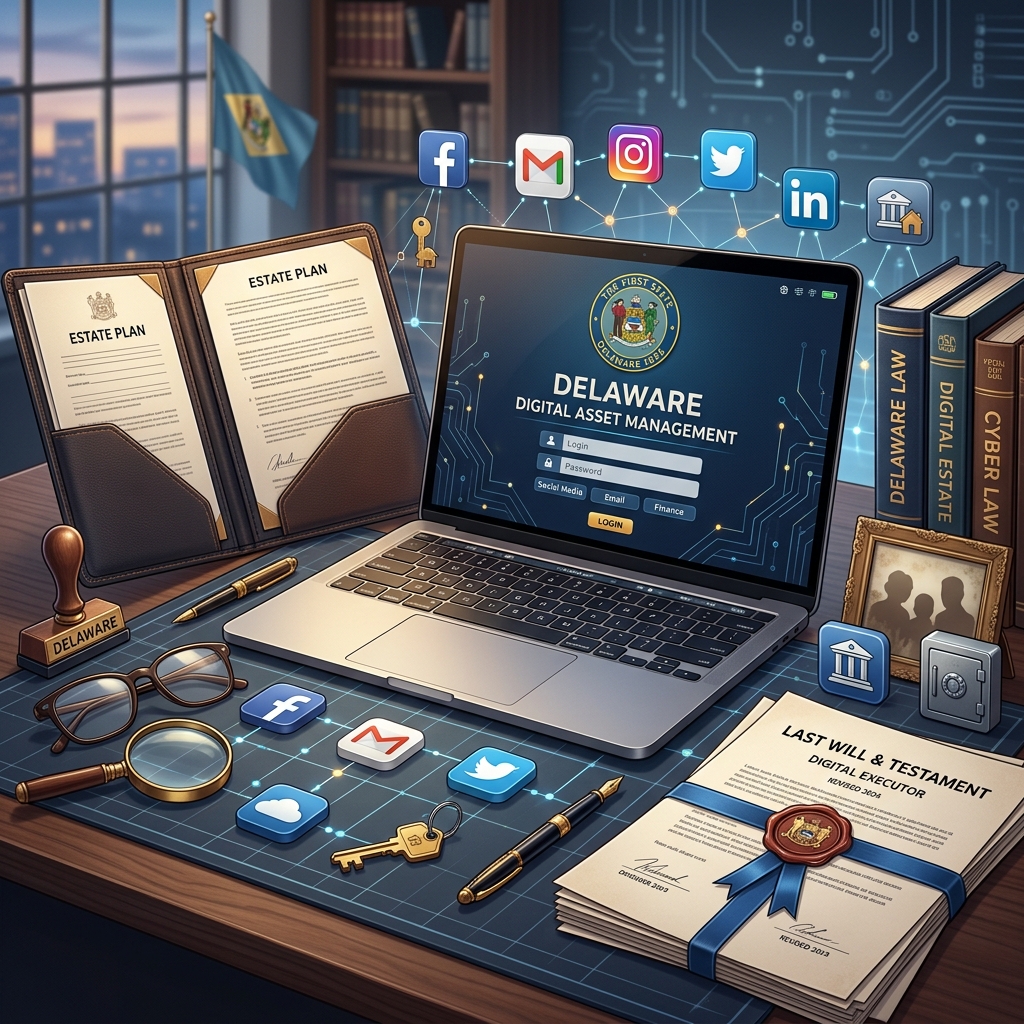
For many people, some of the most valuable and sensitive assets they own never appear in a file cabinet or safety deposit box. Photos, emails, social media profiles, cloud storage, and online financial accounts collectively form a digital estate. Delaware was among the first states in the United States to adopt a comprehensive law confirming that these digital assets can be accessed and managed by fiduciaries, such as executors, after a person’s death.
This article explains the core ideas behind Delaware’s digital estate law, what kinds of accounts it covers, how it interacts with terms of service and modern uniform laws, and the practical steps individuals can take to plan for their own digital legacy.
Why Digital Estates Needed Special Legal Rules
Traditional estate law was built around physical property: houses, vehicles, paper records, and tangible financial instruments like stock certificates. As daily life shifted online, crucial information started living in password-protected accounts owned by large technology companies. Without clear laws, loved ones and executors often found themselves locked out of:
- Personal email archives that contain legal, financial, and sentimental information
- Cloud photo libraries documenting years of family history
- Social media profiles used to communicate with friends and communities
- Online banking, investment, and payment service accounts
In many cases, providers refused access, citing privacy obligations and terms of service that defined access rights strictly as personal and non-transferable. Families struggled to close accounts, settle online subscriptions, or even find out what digital assets existed.
Delaware’s digital estate law responds to these challenges by explicitly treating digital assets and digital accounts as part of the decedent’s estate and specifying rights for executors, administrators, trustees, and guardians.
Key Features of Delaware’s Digital Estate Law
Delaware’s legislation, often referred to as a fiduciary access statute, sets out how fiduciaries can deal with a deceased person’s online accounts during the probate process. Its central policy choice is to put digital property on the same footing as physical property unless the account holder clearly stated otherwise.
Digital Assets Treated as Part of the Estate
Under Delaware’s approach, digital assets such as email accounts, social media profiles, photos stored online, and certain financial accounts are explicitly recognized as part of the decedent’s estate. Executors and other fiduciaries are given control comparable to their control over physical assets, subject to any instructions in the decedent’s will or other estate planning documents.
- Email and messaging accounts: Can be accessed and managed to the extent authorized by law and the decedent’s instructions.
- Social media profiles: Can potentially be closed, preserved, or otherwise handled as part of the estate administration.
- Online photos and documents: Treated as assets that may be preserved or distributed to family members.
- Online financial and investment accounts: Addressed as part of the overall inventory of estate property.
Fiduciary Powers and Roles
The law focuses on traditional fiduciaries—people who already have court-recognized authority to manage another person’s property. In Delaware, the relevant categories include:
- Executors and administrators: Manage digital assets during probate in the same way they manage other estate property.
- Trustees: Handle digital accounts and assets held in or related to a trust, consistent with trust terms.
- Guardians or similar fiduciaries: May gain access to a living person’s digital assets if that person is incapacitated, typically via court order.
These fiduciaries are expected to act in the best interests of the estate or the person they represent, and they may be required to provide documentation, such as letters of appointment and death certificates, to service providers.
Superseding Terms of Service Agreements
One of the most significant aspects of Delaware’s law is its impact on private contracts known as terms of service agreements. Many platforms assert that accounts are non-transferable, that access must remain personal, and that data is subject to company policies even after death.
Delaware’s statute aims to override those general terms in favor of the state’s policy of estate access. In practical terms:
- Executors and other fiduciaries may demand access and control as provided by state law, even if the terms of service otherwise restrict such access.
- Providers may need to comply with legally valid requests, subject to privacy rules and any specific instructions the decedent left through designated tools.
Respecting Online Tools and User Instructions
At the same time, Delaware’s law and related policies acknowledge modern tools that allow users to set preferences directly with service providers. For example, Google’s Inactive Account Manager lets users choose what happens to their data after a period of inactivity. If a person makes such a designation, it typically takes precedence:
- Instructions given through a platform’s official legacy or inactive-account tool override conflicting estate law defaults.
- Examples include directing a provider to delete all data, transfer it to a specific contact, or maintain an account in memorialized form.
In effect, the law gives weight both to state policy and to the account holder’s clearly expressed wishes. If the user leaves no digital instructions and no estate documents addressing the matter, statutory default rules apply.
Delaware’s Law in the Broader Landscape of Digital Estate Legislation
When Delaware acted, only a small group of states had laws dealing directly with digital assets in an estate context. Over time, many states have adopted similar frameworks, often based on model laws developed by the Uniform Law Commission, such as the Revised Uniform Fiduciary Access to Digital Assets Act (RUFADAA).
| Aspect | Delaware’s Digital Estate Law | RUFADAA-Inspired Approach |
|---|---|---|
| Primary goal | Provide executors and other fiduciaries control of digital assets during probate. | Grant fiduciaries legal authority to access digital assets, with strong privacy safeguards. |
| Status of digital assets | Explicitly treated as part of the decedent’s estate, comparable to physical property. | Recognized as a distinct category of property, access governed by hierarchy of user instructions. |
| Effect on terms of service | Law can supersede generic non-transferability clauses to allow estate access. | Terms of service apply when no express user instructions or legal documents exist. |
| User control | Will and other instructions may restrict or guide release of information. | Designated online tools and written estate planning documents rank above default rules. |
While policy details vary from state to state, the trend is clear: digital accounts are no longer legally invisible. Almost all states now provide some rights for executors or family members to manage digital assets after death.
What Delaware’s Law Means for Individuals and Families
For Delaware residents, or for those whose estates may be probated there, the law affects both privacy expectations and practical planning. Recognizing that executors may have access to digital accounts, individuals can take steps to make their wishes clear and to ease the administrative burden on loved ones.
Practical Implications for Executors
Executors operating under Delaware’s framework may find that they have legal tools to deal with accounts that previously would have remained inaccessible. Common tasks include:
- Requesting access to email records to identify outstanding obligations or locate important information
- Managing online banking and investment accounts to settle debts and distribute assets
- Closing or memorializing social media profiles, in line with the decedent’s instructions or family preferences
- Responding to subscription services or recurring charges tied to digital platforms
To exercise these rights, executors typically must provide providers with documentation such as a copy of the death certificate and proof of their appointment. In some instances, specific court orders may be required, especially where privacy or access issues are contested.
Benefits and Risks for Families
For families, Delaware’s law offers several potential benefits:
- Preservation of memories: Increased ability to preserve photographs, messages, and other sentimental digital content.
- Financial clarity: Better access to online statements and records that might otherwise be difficult to locate.
- Administrative efficiency: Clearer route to closing accounts and preventing fraud or ongoing charges.
However, families also face risks and challenges, including:
- Privacy concerns: Access to private emails and messages may reveal sensitive information that the decedent did not wish to share.
- Complexity of provider policies: Different platforms may interpret legal requests differently and require varying documentation.
- Potential conflicts: Disagreements among family members or between fiduciaries and providers about appropriate handling of accounts.
Building a Digital Estate Plan Under Delaware’s Rules
Although Delaware’s law supplies default rules, digital estate planning is more effective when individuals take proactive steps. Educational sources on digital estate planning emphasize the value of a structured digital plan that complements traditional estate documents.
Core Components of a Digital Estate Plan
A robust digital estate plan typically includes:
- Inventory of digital assets: A list of accounts and digital holdings, including email addresses, social media profiles, cloud storage, online financial accounts, and subscription services.
- Access information: Securely stored login details or instructions regarding how a fiduciary can obtain them (for example, through a password manager).
- Handling instructions: Clear directions about which accounts should be deleted, memorialized, transferred, or kept private.
- Designation of a digital fiduciary: Identification of a person who understands digital systems and can work with the executor to carry out the plan.
- Integration with legal documents: References in wills, trusts, or powers of attorney that authorize fiduciaries to act in the digital realm and align with statutory requirements.
Aligning Personal Wishes with Delaware’s Legal Framework
Within Delaware, individuals can use these planning tools to tailor the statutory framework to their preferences. For example:
- Specifying in a will that certain email accounts or messaging platforms should remain confidential or be deleted promptly.
- Directing an executor to preserve and share photo archives and documents with specific family members.
- Using online legacy tools to provide providers with instructions that complement, rather than conflict with, estate documents.
Because user instructions generated through provider tools can override statutory defaults, it is important that estate planning professionals and individuals ensure consistency between these settings and the contents of legal documents.
Frequently Asked Questions (FAQs)
Does Delaware’s digital estate law give executors access to all of a decedent’s online accounts?
Delaware’s law treats many digital assets and accounts as part of the estate and grants executors control comparable to physical property, but access is not absolute. Provider policies, federal privacy laws, and any specific instructions the decedent made through online tools or legal documents can limit or direct that access.
Can service providers refuse to comply with requests from Delaware executors?
Providers must follow applicable state and federal law, but they may still scrutinize requests to ensure they are legally valid and properly documented. Some providers may require court orders or specific forms before providing account content, even when Delaware law recognizes the executor’s authority.
What happens if there is a conflict between an online legacy tool and a will?
Modern frameworks, including those reflected in many state laws, often give priority to instructions provided through designated online tools for specific accounts. If a conflict arises, the account-level designation can control what happens to data within that platform, while the will governs broader estate matters.
Do guardians of incapacitated people have similar rights to digital access in Delaware?
Guardians or conservator-type fiduciaries may obtain court-authorized access to digital assets of people who are incapacitated, but this usually requires more explicit judicial oversight than post-death access. The focus is on protecting the individual while enabling necessary management of their affairs.
How can Delaware residents prepare for their digital estate to reduce family stress?
Residents can create a comprehensive digital inventory, specify handling instructions, designate a knowledgeable digital fiduciary, and ensure their estate documents expressly address digital assets. Aligning these steps with Delaware law and provider tools helps reduce uncertainty and administrative burdens after death.
References
- Digital Estate Planning in Louisiana: Protect Online Assets — Louisiana Succession Attorney Blog. 2023-05-01. https://www.louisianasuccessionattorney.com/blog/death-and-the-digital-estate/
- Preserving Online Accounts After Death — GovTech. 2014-08-08. https://www.govtech.com/gov-experience/Preserving-Online-Accounts-After-Death.html
- State-by-State Digital Estate Planning Laws — Everplans. 2023-01-15. https://www.everplans.com/articles/state-by-state-digital-estate-planning-laws
- Laws vary on accessing digital assets of deceased — Senator Stefano (PDF reprint of news article). 2014-08-15. https://www.senatorstefano.com/wp-content/uploads/sites/73/2022/01/sb07-articles.pdf
- Digital Estate Planning: How to Protect Digital Assets — Purdue Global Law School. 2022-02-10. https://www.purduegloballawschool.edu/blog/news/digital-estate-planning
- Del.’s New Digital Estate Law Allows Account Access After Death — Digital Death Guide (reprint of FindLaw article). 2014-08-19. https://digitaldeathguide.com/del-s-new-digital-estate-law-allows-account-access-after-death/
- House Bill 345 – Fiduciary Access to Digital Assets and Digital Accounts Act — Delaware General Assembly. 2014-07-28. https://legis.delaware.gov/json/BillDetail/GetHtmlDocument?fileAttachmentId=42862
Similar Articles








Read full bio of medha deb


