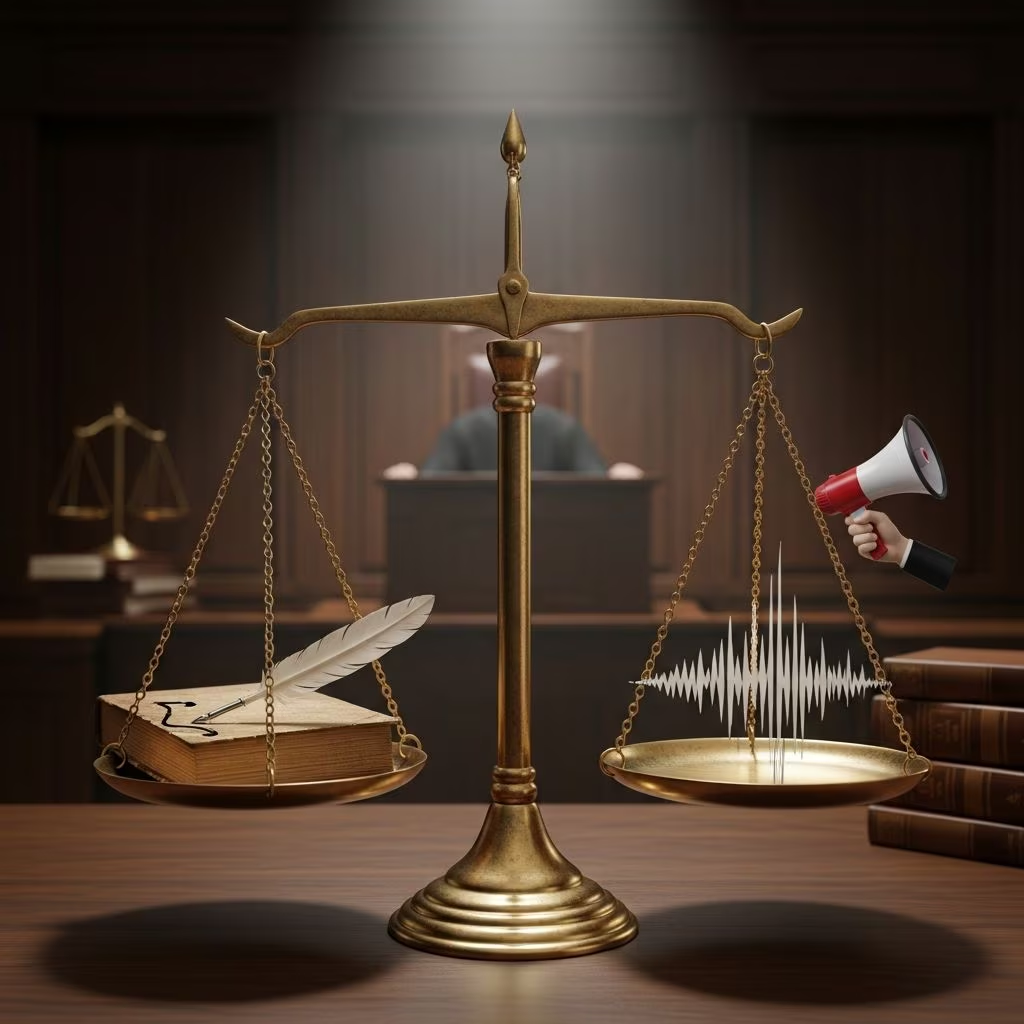
Defamation law protects individuals and businesses from false statements that damage reputations. It encompasses two primary forms: **libel**, involving written or permanent expressions, and **slander**, referring to spoken or transient communications. Grasping these distinctions is crucial in today’s digital age where information spreads rapidly.
Core Concepts of Reputational Harm
At its heart, defamation occurs when a false statement harms someone’s standing in the community. Courts evaluate whether the communication lowers the subject’s esteem, exposes them to contempt, or causes shunning by others. This harm must be serious, often measured by its impact on personal, professional, or social life.
Historically, the divide between libel and slander stemmed from the medium’s permanence. Libel, being fixed in writing or visuals, posed greater long-term threats, while slander’s ephemerality made it harder to substantiate. Modern jurisdictions, including some like Australia, have streamlined these categories under unified defamation statutes.
Defining Slander: The Spoken Assault
**Slander** involves oral defamatory statements or those vanishing quickly, such as live speeches, gestures, or unrecorded broadcasts. Because evidence dissipates, plaintiffs face steeper hurdles, often needing to prove tangible damages like lost income or emotional distress.
Key characteristics include:
- Spoken words at events, meetings, or casual conversations.
- Transient media like phone calls or impromptu videos without lasting records.
- Requirement for ‘special damages’ in many cases—concrete financial losses—unlike libel.
Real-Life Slander Scenarios
Consider a workplace rumor: a coworker whispers to colleagues that a manager ’embezzled company funds.’ This could trigger investigations, demotions, or firings, even if baseless. Or, at a social gathering, accusing someone of infidelity might fracture relationships and isolate them socially.
Another example: publicly labeling a neighbor a ‘convicted felon’ during a homeowners’ association dispute. Such claims invite legal scrutiny if they lead to ostracism or job repercussions.
Understanding Libel: The Permanent Stain
**Libel** targets enduring formats: articles, social media posts, emails, videos, or images. Its persistence amplifies damage, as content lingers online indefinitely, reachable by vast audiences.
Distinct features:
- Written publications in newspapers, blogs, or reviews.
- Digital permanence on platforms like Twitter or Facebook.
- Presumed harm in most jurisdictions—no special damages needed.
Illustrative Libel Cases
A scathing online review claiming a restaurant ‘poisons customers with tainted meat’ could devastate business. Similarly, a tweet alleging a politician ‘takes bribes’ spreads virally, influencing elections and public trust.
In professional contexts, a LinkedIn post accusing an executive of ‘resume fraud’ might halt career progression, as recruiters scour digital footprints.
Legal Elements to Prove a Defamation Claim
To succeed, plaintiffs must establish core elements, consistent across libel and slander with nuances by form.
| Element | Description | Libel Specifics | Slander Specifics |
|---|---|---|---|
| False Statement | Verifiably untrue fact, not opinion. | Easy to document via text. | Relies on witnesses or recordings. |
| Publication | Shared with at least one third party. | Posts, prints qualify. | Oral dissemination to others. |
| Identification | Clearly links to plaintiff. | Names or descriptions. | Same, via context. |
| Fault | Negligence or actual malice (public figures). | Applies equally. | Often higher bar. |
| Damages | Harm to reputation or finances. | Presumed often. | Usually proven specially. |
First Amendment protections in the U.S. raise the bar for public figures, requiring proof of ‘actual malice’—knowledge of falsity or reckless disregard.
Powerful Defenses Against Accusations
Defendants wield several shields:
- Truth: Absolute defense; verify facts rigorously.
- Opinion: Protected if not implying verifiable facts, e.g., ‘I dislike their service’ vs. ‘They steal from customers.’
- Privilege: Absolute (court testimony) or qualified (fair reporting).
- Consent: Plaintiff authorized the statement.
Context matters: hyperbole or satire often evades liability.
Navigating Remedies and Legal Recourse
Successful claimants seek:
- Compensatory damages for losses.
- Punitive damages for malice.
- Injunctions to retract or remove content.
- Retracted apologies.
Steps include consulting attorneys promptly due to statutes of limitations (often 1-3 years). Gather evidence: screenshots, witness statements, impact records.
Defamation in the Digital Era
Social media blurs lines—tweets can be libelous, live streams slanderous. Platforms enjoy Section 230 immunity in the U.S., shifting burden to originators.
Businesses face review site perils; individuals combat cancel culture. Global variances exist: stricter in Europe under GDPR-adjacent rules.
Comparative Analysis: Libel vs Slander
| Aspect | Libel | Slander |
|---|---|---|
| Medium | Written/permanent (posts, articles) | Spoken/transient (talks, calls) |
| Proof Ease | High (tangible evidence) | Low (memory-based) |
| Damage Presumption | Often yes | Usually no |
| Severity View | Higher due to reach | Lower but still actionable |
Frequently Asked Questions (FAQs)
What constitutes defamation?
A false factual statement published to others causing reputational harm.
Is opinion ever defamatory?
No, if clearly subjective and not implying hidden facts.
Can businesses sue for defamation?
Yes, for harm to goodwill or profits.
What’s the statute of limitations?
Typically 1-3 years; check local laws.
Do public figures face higher burdens?
Yes, proving ‘actual malice’ under First Amendment.
Protecting Yourself Proactively
Monitor online presence, respond factually to falsehoods, and foster positive narratives. Legal insurance or reputation management services aid preparedness.
In summary, while libel and slander differ in form, both demand vigilance. Understanding empowers defense or pursuit of justice.
References
- Libel, Slander, and Defamation – Understanding the Difference — Stonegate Legal. 2023-05-15. https://stonegatelegal.com.au/libel-slander-and-defamation-understanding-the-difference/
- Defamation and the First Amendment — Foundation for Individual Rights and Expression (FIRE). 2024-02-10. https://www.thefire.org/research-learn/defamation-and-first-amendment
- Defamation, Slander, and Libel — Nolo. 2025-01-20. https://www.nolo.com/legal-encyclopedia/defamation-slander-libel
- Libel and Slander Attorneys in Virginia Beach, VA — Jeremiah Denton Law. 2024-08-05. https://www.jeremiahdenton.com/practice-areas/libel-slander-defamation/slander/difference-between-libel-and-slander/
- What Is Defamation vs. Libel vs. Slander? — Bloodworth Law. 2024-11-12. https://lawyerfightsforyou.com/blog/what-is-defamation-vs-libel-vs-slander/
- What is defamation? What is slander and libel? — New York Courts Ask a Law Librarian. 2025-03-01. https://askalawlibrarian.nycourts.gov/legalresearch/faq/367713