
Defamation Essentials: Libel, Slander Differences
Unravel the legal distinctions between defamation, libel, and slander to protect your reputation effectively in today's digital age.
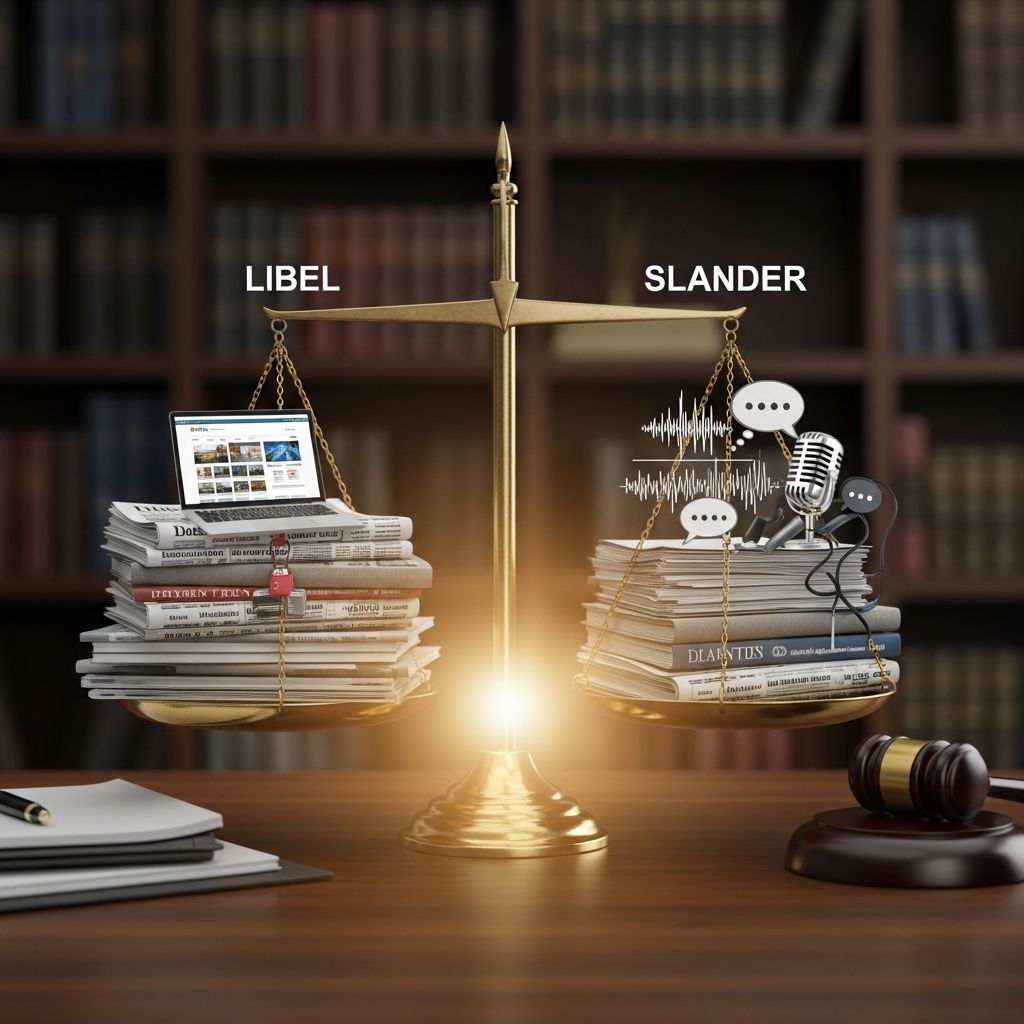
Defamation law protects individuals and businesses from false statements that damage reputations. It encompasses two primary forms: libel, which involves written or permanent expressions, and slander, which covers spoken or temporary communications. Understanding these distinctions is crucial in an era where information spreads rapidly online and offline.
Core Concepts in Reputation Protection Law
At its heart, defamation refers to any false assertion presented as fact that harms another’s standing in the community. This broad category includes both libel and slander, but the medium of transmission defines the subtype. Courts evaluate claims based on whether the statement was published to a third party, its falsity, and the resulting injury.
Historically, common law treated libel as more severe due to its permanence, allowing broader dissemination and lasting impact. Many jurisdictions, including parts of the U.S., have unified standards, applying similar rules regardless of form. However, the distinction persists in terminology and proof requirements.
Defining Slander: The Spoken Assault on Character
Slander occurs when defamatory content is conveyed orally or through ephemeral means, such as live broadcasts or casual conversations overheard by others. Because spoken words vanish quickly, plaintiffs face a higher burden to demonstrate tangible harm, like lost business opportunities or emotional distress.
- Public accusations during speeches or meetings that question professional integrity.
- Verbal claims in social settings implying criminal behavior or moral failings.
- Live radio or TV remarks falsely attributing incompetence to a professional.
Proving slander requires evidence that the words were heard by at least one third party and directly led to reputational damage. Without “special damages”—concrete financial losses—many slander claims fail unless the statement falls into a per se category, like accusing someone of a crime or unchastity.
Understanding Libel: Permanent Written Harm
Libel involves defamatory material in a fixed format, including print, digital posts, videos, or images. Its enduring nature amplifies damage, as content can be shared, archived, and revisited indefinitely, reaching vast audiences.
- Newspaper articles falsely claiming fraud by a business owner.
- Social media posts alleging infidelity or professional misconduct.
- Online reviews fabricating product safety issues to harm a company.
Libel per se statements—those inherently damaging on their face—do not require proof of specific injury. Categories include imputing criminality, business misconduct, or serious sexual impropriety. For other cases (per quod), extrinsic evidence links the statement to harm.
Key Distinctions: A Comparative Overview
The table below summarizes the primary differences, aiding quick reference for legal navigation.
| Aspect | Slander | Libel |
|---|---|---|
| Medium | Oral/transient (speech, live audio) | Written/permanent (print, online, video) |
| Permanence | Fleeting; harder to preserve | Lasting; easily archived/shared |
| Proof Burden | Often needs special damages | Per se often presumed harmful |
| Severity Perception | Less severe historically | Viewed as more damaging |
| Examples | Verbal accusation at party | Defamatory tweet or blog |
Both require falsity, publication to a third party, and identification of the plaintiff. Public figures must additionally prove “actual malice”—knowledge of falsity or reckless disregard—per U.S. Supreme Court rulings like New York Times v. Sullivan.
Legal Elements Required for a Successful Claim
To prevail in court, plaintiffs must establish four core elements across jurisdictions:
- False Statement of Fact: Opinions are protected; facts must be provably untrue.
- Publication: Communicated to at least one person besides plaintiff and defendant.
- Fault: Negligence for private figures; actual malice for public ones.
- Damages: Harm to reputation, emotional distress, or economic loss; presumed in per se cases.
State laws vary; some cap damages or require pre-suit notices. In Australia, serious harm is mandated.
Robust Defenses Against Accusations
Defendants can counter with several affirmative defenses:
- Truth: Absolute shield; burden shifts to plaintiff in some areas.
- Opinion/Protected Speech: First Amendment safeguards rhetorical hyperbole or fair comment.
- Privilege: Absolute (court testimony) or qualified (news reports on public proceedings).
- Consent: Plaintiff authorized the statement.
Retraction demands often precede suits, mitigating damages if promptly issued.
Modern Challenges: Digital Age Defamation
Social media blurs lines, treating posts as libel despite viral transience. Platforms like Twitter (X) or Facebook host libelous content, invoking Section 230 immunity for hosts but liability for original posters.
Deepfakes and AI-generated audio complicate slander proofs. Victims must screenshot, record, or use digital forensics. Cyber-smears spread globally, prompting jurisdiction battles.
Real-World Scenarios and Case Studies
Consider a restaurateur slandered at a community event as serving contaminated food—hard to prove without witnesses. Contrast with a Yelp review claiming the same: libel, actionable with archives.
In Bloodworth Law explanations, verbal workplace gossip (slander) differs from emailed accusations (libel). High-profile cases, like Dominion Voting Systems v. Fox News (libel settlement over election claims), highlight massive stakes in media libel.
Steps to Take if Victimized
Immediate action preserves claims:
- Document everything: Screenshots, recordings, witness contacts.
- Send cease-and-desist letters demanding retraction.
- Consult attorneys specializing in defamation.
- Report to platforms for removal.
- Avoid retaliation to prevent counterclaims.
Statutes of limitations (1-3 years typically) urge promptness.
Potential Remedies and Compensation
Courts award:
- Compensatory damages for proven losses.
- Punitive damages for malice.
- Injunctions halting further publication.
- Retracted public apologies.
Average settlements range from thousands to millions, depending on reach and harm.
Frequently Asked Questions (FAQs)
Is every false statement defamation?
No. It must harm reputation, be factual, and published. Pure opinions are safe.
Can social media posts be slander?
Rarely; text/videos qualify as libel. Live audio might be slander.
What makes a statement defamatory per se?
Accusations of crime, immorality, professional incompetence, or business harm—damage presumed.
Do public figures sue for defamation easily?
No; they prove actual malice, a high bar.
Is truth always a defense?
Yes, universally.
Navigating Claims as the Accused
If accused, gather evidence of truth or opinion. Respond swiftly to demands. Many cases settle pre-trial via mediation, avoiding costly litigation.
Businesses implement social media policies to train employees on risks. Insurance (media liability) covers some exposures.
Global Perspectives on These Torts
U.S. emphasizes free speech; Europe prioritizes privacy (e.g., GDPR influences). Australia requires “serious harm” proof. Uniformity grows, but local counsel is essential.
Defamation law evolves with technology, balancing expression and protection. Stay informed to safeguard rights.
References
- Libel, Slander, and Defamation – Understanding the Difference — Stonegate Legal. 2023. https://stonegatelegal.com.au/libel-slander-and-defamation-understanding-the-difference/
- Libel vs. Slander vs. Defamation – What are the Differences? — The Business Litigators. 2024. https://www.thebusinesslitigators.com/business-commercial-litigation/defamation-libel-slander-and-cyber-smear/libel-vs-slander-vs-defamation-what-are-the-differences/
- What is defamation? What is slander and libel? — Ask a Law Librarian, NY Courts. 2025. https://askalawlibrarian.nycourts.gov/legalresearch/faq/367713
- Libel and Slander — First Amendment Encyclopedia, MTSU. 2024. https://firstamendment.mtsu.edu/article/libel-and-slander/
- Defamation (Slander and Libel) — Lax & Neville. 2023. https://www.laxneville.com/practice-areas/commercial-litigation/defamation-slander-and-libel/
- Defamation, Slander, and Libel — Nolo. 2025. https://www.nolo.com/legal-encyclopedia/defamation-slander-libel
Similar Articles








Read full bio of Sneha Tete




