
Decoding the Structural Roots of the Racial Wealth Gap
Uncovering the history and systemic drivers fueling America's wealth divide.
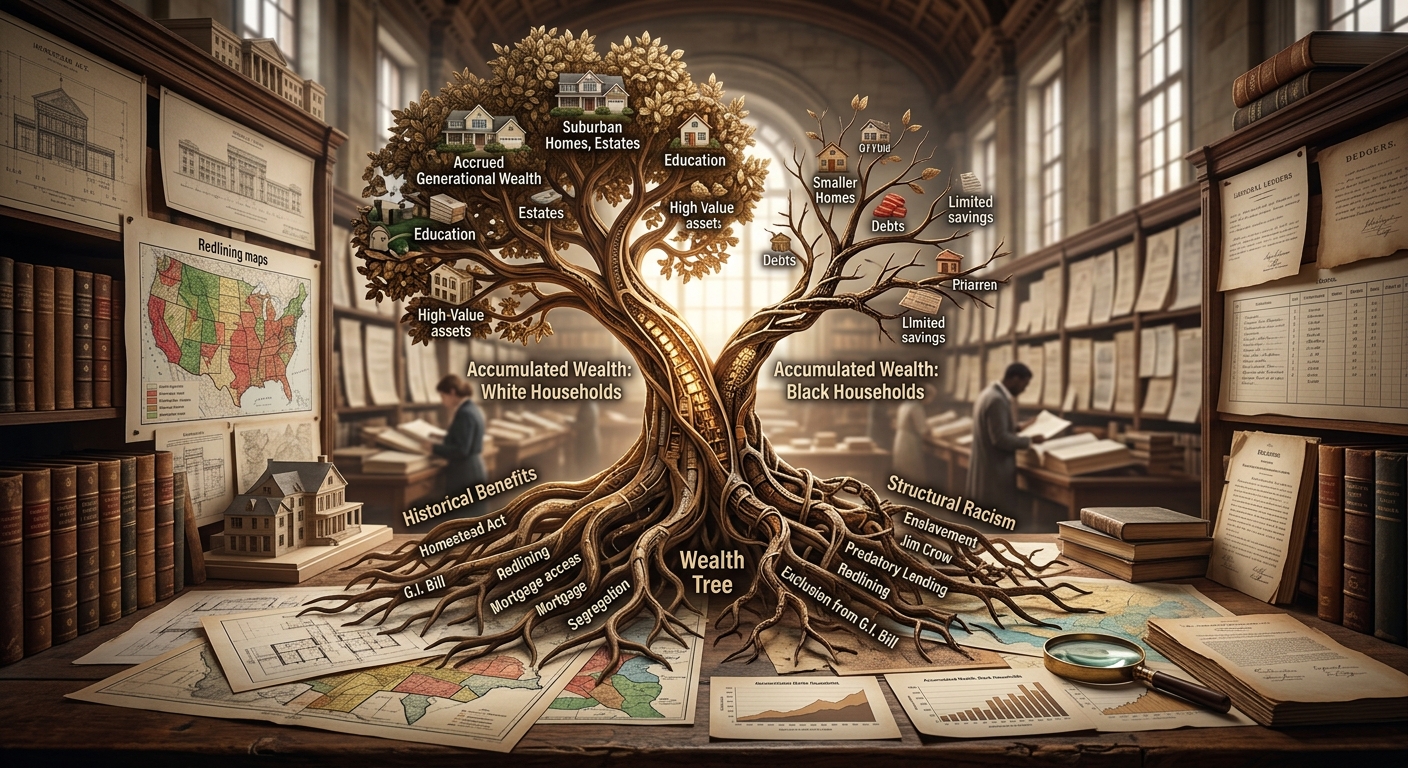
The Illusion of Equal Footing
The prevailing narrative of the American Dream suggests that hard work, perseverance, and dedication inevitably lead to prosperity and financial stability. However, underneath this optimistic, meritocratic veneer lies a stark economic reality defined by deeply entrenched disparities. One of the most glaring manifestations of economic inequality in the United States is the persistent racial wealth gap. This divide is not a natural economic occurrence, nor is it merely a reflection of individual financial choices; rather, it is the direct result of decades of systemic policies, exclusionary financial practices, and institutional barriers that have disproportionately hindered minority communities—particularly Black and Hispanic households—from accumulating and transferring assets.
Understanding this phenomenon requires a comprehensive shift in perspective. We must look beyond mere paycheck-to-paycheck earnings to examine the historical context of property ownership, modern financial blockades in the credit system, and the structural debt burdens that continuously reinforce this divide. To dismantle the architecture of economic disparity, one must first understand how its foundation was poured.
Deconstructing the Divide: Income Versus Wealth
To fully grasp the magnitude of economic disparity in modern America, one must first recognize the fundamental difference between income and wealth—two concepts that are frequently, yet incorrectly, used interchangeably in public discourse. Income represents a flow of capital. It encompasses the wages, salaries, dividends, and localized profits a household brings in over a specific period. Wealth, conversely, is a cumulative stock. It is the comprehensive sum of what a household owns (such as residential and commercial real estate, savings accounts, retirement funds, and business equity) minus what it owes (such as mortgages, credit card debt, auto loans, and student loans). This final calculation results in a household’s net worth.
While income inequality is a significant issue that deserves sustained legislative attention, it pales in comparison to the sheer scale of wealth inequality. A family might earn a high income but possess zero—or even negative—net wealth if their systemic debt obligations exceed their asset valuations. Wealth acts as an essential economic shock absorber. It provides a robust buffer against life’s unpredictable crises, such as medical emergencies, sudden unemployment, or unexpected critical expenses. When a family holds wealth, a temporary job loss is a hurdle; without wealth, that same job loss can trigger a cascade of financial ruin, including eviction and bankruptcy.
More importantly, wealth is inherently generational. It is the invisible scaffolding that allows parents to pay for a child’s higher education without subjecting them to decades of predatory loans. It provides the crucial down payment for a first home, or serves as the financial safety net required to launch an entrepreneurial venture. When minority households are systemically blocked from building this foundational net worth, the consequences ripple across generations, making upward economic mobility an extraordinarily steep climb.
Historical Blueprints of Disparity
The modern racial wealth gap cannot be untangled from the deliberate historical policies that established it. Asset accumulation in the United States has heavily relied on federal assistance and subsidized loan programs, which were historically distributed along racial lines. Understanding this historical blueprint is essential for recognizing why the gap persists today .
Redlining and Federal Housing Policies
During the 1930s, the federal government revolutionized homeownership through the creation of New Deal programs, notably the Home Owners’ Loan Corporation (HOLC) and the Federal Housing Administration (FHA). These institutions established nationwide underwriting standards that heavily favored white, suburban neighborhoods while systematically denying investment in urban, minority-heavy areas. This localized practice, widely known as “redlining,” actively starved minority communities of vital capital. Neighborhoods were color-coded on maps, with predominantly Black and immigrant neighborhoods frequently outlined in red and deemed “hazardous” for lending.
According to extensive economic research, the FHA from its inception deliberately avoided insuring mortgages in low-income urban neighborhoods where the vast majority of Black Americans resided . By legally locking minority families out of the most significant wealth-building vehicle of the 20th century—subsidized, fixed-rate homeownership—the government effectively engineered a segregated wealth trajectory that mathematically compounds to this day.
The Exclusions of the G.I. Bill
Furthermore, the post-World War II era witnessed the implementation of the Servicemen’s Readjustment Act of 1944, commonly known as the G.I. Bill. This sweeping legislation is often celebrated for democratizing prosperity, as it subsidized higher education and low-cost mortgages for millions of returning veterans. However, its local administration allowed for rampant, unchecked racial discrimination.
Because the benefits were dispersed by local banks and universities rather than a centralized federal authority, Black veterans in many parts of the country were frequently denied bank loans. They were also explicitly excluded from purchasing homes in sprawling new suburban developments due to racially restrictive covenants written directly into property deeds. Consequently, while white veterans successfully leveraged the G.I. Bill to build the modern American middle class, Black veterans were largely left behind, cementing an economic divergence that time has only magnified.
The Expanding Gap: Current Statistical Realities
The legacy of these historical exclusions is unambiguously visible in contemporary economic data. Despite incremental gains in civil rights, higher education access, and workplace equality over the last half-century, the wealth divide remains staggering and, in many critical aspects, is continuing to widen. It is a sobering reality that equality of opportunity in the present cannot mathematically erase the compound interest of historical denial.
Recent data from the Federal Reserve’s Survey of Consumer Finances, comprehensively analyzed by economic researchers, reveals that the economic upheaval of the COVID-19 pandemic era further exacerbated this divide. Between 2019 and 2022, median wealth across the country increased across most demographics, but the absolute racial wealth gap expanded by nearly $50,000 . The total difference in net worth between the median white household and the median Black household has reached astonishing levels, heavily driven by disparities in housing and business equity.
| Economic Indicator (2022 Data Estimates) | White Households | Black Households |
|---|---|---|
| Relative Wealth Distribution | $100 | $15 |
| Homeownership Rate | ~73% | ~44% |
| Primary Wealth Driver | Corporate & Business Equity | Net Housing Equity |
Note: The metrics above illustrate general proportional disparities as analyzed from recent Survey of Consumer Finances reports, highlighting that for every $100 in wealth held by a median white household, a median Black household holds approximately $15.
Debt as a Barrier to Entry
While historically discriminatory housing policies laid the groundwork for the wealth gap, modern mechanisms of structurally disproportionate debt act as the primary preservers of this divide. The most glaring example of this phenomenon is the ongoing student loan crisis.
The Burden of Student Loans
Higher education is frequently championed as the ultimate societal equalizer. Students are told that securing a college degree is the most reliable path to achieving middle-class stability. Yet, for minority students who lack generational wealth, accessing this education requires taking on substantial, sometimes insurmountable, financial liabilities.
Research indicates that the United States student loan system functions in a deeply regressive manner . Minority borrowers, particularly Black students, are forced to borrow significantly higher amounts to finance their undergraduate and graduate degrees compared to their white peers, who often receive substantial tuition assistance from family wealth. Furthermore, because of persistent, documented wage gaps and discrimination in the labor market, these borrowers receive lower financial returns on their educational investments.
As a result, Black college graduates often hold higher debt balances years after graduation than when they initially borrowed, turning what should be an engine for economic mobility into a wealth-draining anchor. According to the Federal Reserve Board’s evaluations of household economic well-being, lower-income and minority borrowers consistently report higher rates of falling behind on student loan payments or entering collections, highlighting a systemic vulnerability that traps them in a cycle of debt repayment rather than asset accumulation .
Systemic Blockades in Modern Asset Building
Even when minority families manage to successfully navigate the hurdles of educational debt and secure tangible assets, they frequently encounter modern systemic blockades that limit the growth of their wealth. In the realm of real estate, appraisal bias remains a pervasive, insidious issue. Homes located in predominantly minority neighborhoods are frequently undervalued compared to identical properties in white neighborhoods. This devaluation actively robs minority homeowners of crucial home equity, severely limiting their ability to refinance at favorable rates, fund necessary home improvements, or pass down significant, untaxed value to their heirs.
Moreover, traditional credit scoring models and algorithms tend to severely penalize populations that rely on non-traditional banking or have a history of thin credit files. Without access to prime borrowing rates, minority consumers are often steered toward subprime lending products—whether for auto loans, residential mortgages, or unsecured personal credit—resulting in tens of thousands of dollars in excess interest payments over a standard lifetime.
Pathways Toward Economic Equity
Addressing an issue as deeply rooted and complex as the racial wealth gap requires comprehensive, structural policy interventions. The gap cannot be closed through individual financial literacy campaigns or budgeting seminars alone; the math of systemic disadvantage requires systemic solutions. Promising avenues for bridging the divide include:
- Targeted Debt Relief: Restructuring or canceling a significant portion of federal student loan debt would immediately improve the balance sheets of millions of minority households. This would free up stagnant capital, allowing a generation to pivot toward homeownership, retirement savings, and small business development.
- Baby Bonds: Establishing federally funded, compounding trust accounts for children at birth, scaled inversely to family wealth, would guarantee that every young adult enters the economy with a baseline of capital to invest in high-yield assets like education, housing, or entrepreneurship.
- First-Generation Homebuyer Assistance: Providing direct down payment grants—rather than high-interest loans—to first-generation homebuyers can help circumvent the historical lack of familial wealth transfers, effectively equalizing the entry point into the restrictive real estate market.
- Algorithmic and Appraisal Reform: Implementing stricter federal regulations on real estate appraisals and encouraging the adoption of alternative credit data (such as sustained rent and utility payment histories) can help dismantle the systemic biases silently embedded in modern financial services.
Frequently Asked Questions (FAQs)
What exactly is the racial wealth gap?
The racial wealth gap refers to the absolute difference in median net worth (the total value of assets minus all liabilities) between white households and minority households, particularly Black and Hispanic families. It is a macro-economic indicator that highlights deeply ingrained systemic inequalities across generations.
Isn’t the wealth gap just a direct result of the income gap?
No. While income disparities certainly contribute to financial inequality, the wealth gap is far more profound and complex. Research demonstrates that even at identical income and education levels, white households typically possess significantly more wealth due to historical intergenerational transfers, untaxed inheritances, earlier access to home equity, and substantially lower debt burdens.
Can attaining higher education close the gap?
While achieving a college degree generally increases an individual’s lifetime earning potential, it does not autonomously close the wealth gap. Because minority students frequently finance their higher education with substantial, compounding debt, the net financial gain of their degree is substantially reduced compared to peers who graduate debt-free with the assistance of family capital.
How did the practice of redlining contribute to this issue?
Redlining was an explicit, government-backed practice originating in the 1930s that denied equitable mortgages and financial services to residents of minority neighborhoods. By systematically preventing these families from purchasing homes—the primary driver of middle-class wealth in America—the policy prevented generations from acquiring property equity and passing that accumulated wealth down to their descendants.
References
- Black wealth is increasing, but so is the racial wealth gap — Brookings Institution / Perry et al. 2024-01-09. https://www.brookings.edu/articles/black-wealth-is-increasing-but-so-is-the-racial-wealth-gap/
- New Evidence on Redlining by Federal Housing Programs in the 1930s — National Bureau of Economic Research (NBER) / Fishback, Rose, Snowden, Storrs. 2021-09-01. https://www.nber.org/papers/w29244
- A regressive student loan system results in costly racial disparities — Brookings Institution / Seamster, Charron-Chénier. 2022-01-24. https://www.brookings.edu/articles/a-regressive-student-loan-system-results-in-costly-racial-disparities/
- Economic Well-Being of U.S. Households in 2023 — Federal Reserve Board. 2024-05-01. https://www.federalreserve.gov/publications/files/2023-report-economic-well-being-us-households-202405.pdf
Similar Articles








Read full bio of medha deb


