
Debts That Survive a Chapter 7 Bankruptcy Discharge
Understand which obligations remain after Chapter 7 so you can plan realistically, protect key assets, and avoid costly surprises.
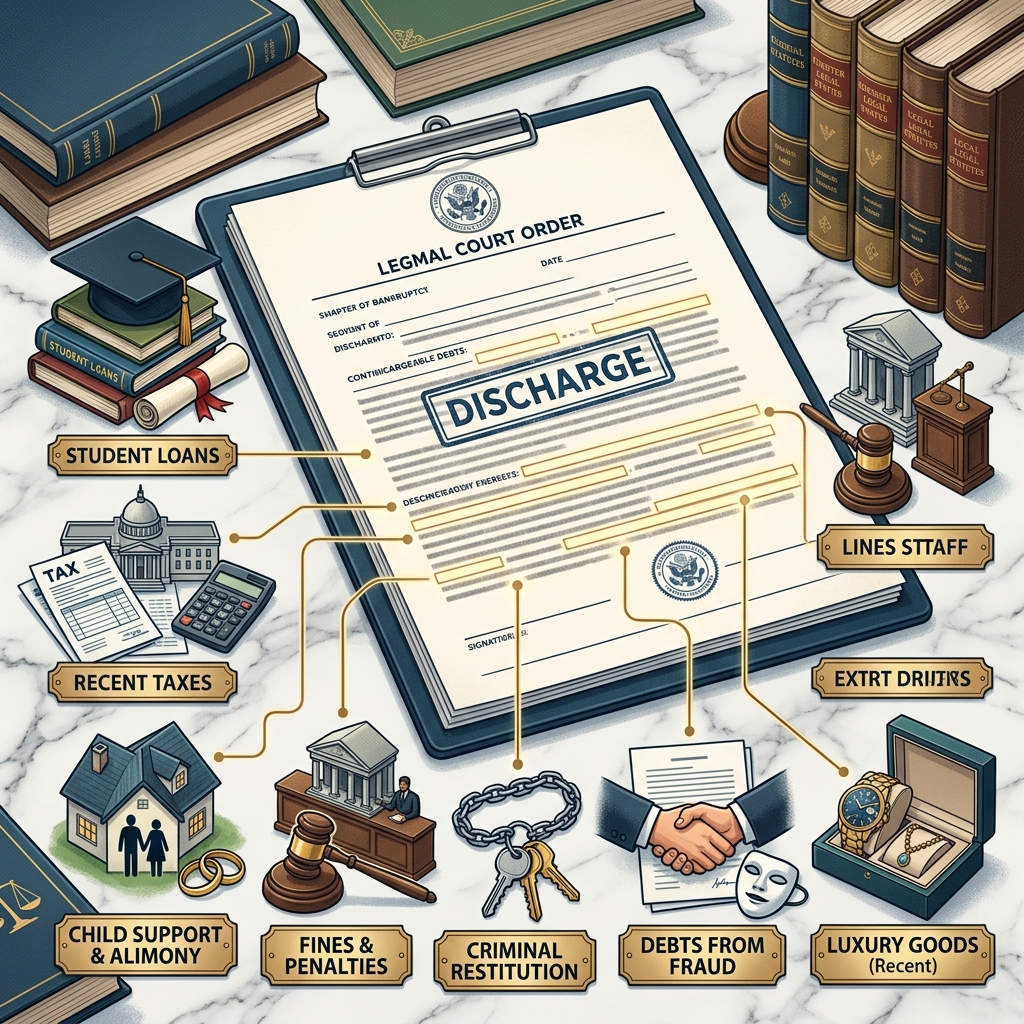
Chapter 7 bankruptcy can provide powerful relief from overwhelming bills, but it does not erase every financial obligation you owe. Understanding which debts remain after a discharge helps you create a realistic plan for life after bankruptcy and avoid unpleasant surprises.
This guide explains in plain language which debts usually survive Chapter 7, how secured loans and liens work, and what you can do if you still face nondischargeable obligations once your case is over.
How Chapter 7 Discharge Works
A Chapter 7 case ends, in most successful filings, with a discharge order from the bankruptcy court. This order permanently eliminates your legal responsibility to repay most types of qualifying debts, such as credit cards, medical bills and unsecured personal loans.
However, the Bankruptcy Code includes a list of specific categories of debt that are excepted from discharge. Those obligations remain legally enforceable even after you receive your discharge.
- The discharge ends your personal liability for dischargeable debts.
- It does not automatically remove valid liens from property you pledged as collateral.
- It does not cancel debts that fall into an exception under federal law (mainly Section 523 of the Bankruptcy Code).
Big Picture: Dischargeable vs. Nondischargeable Debts
Most consumer Chapter 7 cases revolve around unsecured debt, which usually can be discharged. Typical examples include:
- Credit card balances and store cards
- Medical and dental bills
- Unsecured personal loans and payday loans
- Past-due utility bills and back rent
By contrast, nondischargeable debts reflect categories that Congress decided deserve special protection, such as obligations related to family support, certain taxes and debts involving wrongdoing or abuse of the credit system.
Key Categories of Debts That Typically Survive Chapter 7
Below are the major types of obligations that commonly remain after a Chapter 7 discharge. The details can be highly fact‑specific, but these categories offer a reliable starting point for understanding what you will still owe.
1. Domestic Support Obligations (Child Support and Alimony)
Domestic support obligations are among the most strongly protected debts in bankruptcy. You cannot discharge court‑ordered child support, alimony or similar family support obligations in Chapter 7.
- Past‑due support (arrears) remains fully collectible.
- Future monthly payments continue according to your existing order.
- Support claims are treated as priority debts when the trustee distributes any funds to creditors.
Even if your discharge wipes out credit cards and medical bills, falling behind on support can still lead to wage garnishments, license suspensions or other enforcement actions under state law.
2. Certain Tax Debts
Tax obligations are treated in a nuanced way. Some income tax debts can be discharged if they meet strict timing and filing requirements, but many taxes remain collectible after Chapter 7.
Common examples of taxes that typically cannot be discharged include:
- Recent income taxes (generally less than three years old)
- Taxes tied to unfiled or late‑filed returns
- Taxes stemming from fraud or willful evasion
- Trust fund taxes, such as the employee portion of payroll taxes
The Internal Revenue Service notes that whether a particular tax is dischargeable depends on the type of tax, how old the debt is, and whether you filed required returns on time. Because these rules are complex, professional advice is often essential in cases involving significant tax liabilities.
3. Student Loans
Most student loans are not discharged in Chapter 7 unless you successfully prove that repayment would be an undue hardship under applicable legal standards.
- Federal student loans are strongly protected and rarely discharged.
- Many private student loans receive similar treatment.
- You must generally file a separate lawsuit in the bankruptcy court (called an adversary proceeding) and meet a demanding hardship test to seek discharge.
Because courts often interpret hardship requirements strictly, it is common for borrowers to emerge from Chapter 7 still responsible for their student debt.
4. Debts Involving Fraud, Misrepresentation or Willful Misconduct
The Bankruptcy Code denies a discharge for debts that arise from certain kinds of wrongdoing. These rules aim to prevent people from using bankruptcy to escape liability for dishonest or harmful conduct.
Examples include:
- Debts based on fraud or intentional misrepresentation, such as lying on a loan application
- Debts arising from theft, embezzlement or similar misconduct
- Obligations for willful and malicious injury to another person or their property
Creditors typically must bring a specific challenge in the bankruptcy case to have these debts declared nondischargeable, but if they do so successfully, the obligation survives the discharge.
5. Personal Injury Debts from Drunk Driving or Comparable Conduct
If you caused personal injury or death while operating a vehicle, boat or aircraft under the influence of alcohol or drugs, any resulting civil debt (such as a judgment or settlement) is usually nondischargeable in Chapter 7.
- Victims can continue collection efforts after your case is closed.
- These obligations are treated as a serious category of debt under federal law.
Other personal injury claims may also be nondischargeable when they involve willful and malicious conduct, even if substance use is not involved.
6. Fines, Penalties and Restitution
Court‑ordered fines, criminal penalties and restitution obligations survive Chapter 7 in most circumstances.
- Criminal restitution to victims remains fully collectible.
- Government fines and penalties, including many administrative sanctions, are not wiped out.
These debts reflect society’s interest in enforcing criminal and regulatory law, so bankruptcy relief is intentionally limited.
7. Certain Debts Owed to Homeowner or Condo Associations
Debts connected to condominium, cooperative or homeowner association fees can be difficult to discharge. In many situations, ongoing obligations tied to property ownership survive bankruptcy, even if some past‑due amounts might be treated differently.
Because these debts are often secured by a lien on your home, separate property and lien rules also play an important role in what happens after discharge.
8. Debts Not Properly Listed in Your Bankruptcy Case
Bankruptcy depends on full and accurate disclosure. If you fail to list a creditor or debt in your petition, that obligation may be excluded from the discharge and remain enforceable afterward, especially if the creditor did not learn of the case in time.
Liens and Secured Debts: What Happens to Collateral?
Chapter 7 treats your personal liability for a loan separately from a creditor’s rights in the collateral securing that loan. A discharge eliminates your responsibility to pay the debt, but a valid lien attached to property generally survives unless it is specifically removed in the case.
| Aspect | What Discharge Does | What Still Happens After Discharge |
|---|---|---|
| Personal liability on mortgage or car loan | Can be eliminated; you are no longer personally obligated to pay the note. | Lender can still foreclose or repossess if you stop paying, because the lien on the property remains. |
| Judicial lien resulting from a lawsuit | Underlying unsecured debt may be discharged. | The lien itself may continue to burden property unless avoided through specific legal procedures. |
This distinction is critical: you may walk away from a house or car you no longer want, but if you wish to keep the collateral, you will typically need to stay current on the secured debt or negotiate with the creditor.
Debts You Choose to Keep: Reaffirmed Obligations
During a Chapter 7 case, you may decide to reaffirm certain debts. Reaffirmation means entering into a formal agreement to remain personally liable for a particular obligation even though it would otherwise be dischargeable.
- Reaffirmation is common with car loans when debtors want to keep their vehicle.
- The agreement must meet procedural requirements and, in some cases, be approved by the court.
- Once reaffirmed, the debt survives the discharge and you remain responsible for payment.
Because reaffirmation reinstates liability for a debt you could have discharged, it is important to review these decisions carefully with counsel.
Debts That Are Eliminated: Common Dischargeable Obligations
To put nondischargeable debts in perspective, it helps to remember that Chapter 7 does, in fact, clear away many burdens for eligible filers. Typical dischargeable debts include:
- Most credit card and charge card balances
- Medical and hospital bills
- Unsecured personal loans and many lines of credit
- Deficiency balances remaining after repossession or foreclosure
- Past‑due utility bills and many landlord claims for back rent
By eliminating these debts, Chapter 7 can free up money to address obligations that do remain, such as support payments and nondischargeable taxes.
Planning for Life After Discharge When Debts Remain
If you know that certain obligations will survive your Chapter 7 case, the discharge process becomes only one part of a broader financial strategy. Here are practical steps to consider once your discharge is entered:
- Update your budget: Remove discharged debts and rebuild your monthly plan around nondischargeable obligations such as support or taxes.
- Communicate with surviving creditors: Contact agencies handling child support, tax authorities or association boards to confirm balances and payment schedules.
- Explore repayment programs: Tax agencies and student loan servicers may offer installment plans or income‑based options even if your underlying debt is nondischargeable.
- Protect key assets: Make timely payments on secured debts you choose to keep to reduce the risk of foreclosure or repossession.
A clear understanding of what survives the discharge makes it easier to rebuild your financial life and avoid future collection problems.
Frequently Asked Questions About Debts After Chapter 7
Does Chapter 7 erase all of my debts?
No. Chapter 7 eliminates many unsecured obligations, but domestic support, most recent tax debts, student loans and several other categories typically remain after your case is over.
Will I still owe child support or alimony?
Yes. Court‑ordered child support, alimony and related family support obligations are not dischargeable in Chapter 7. You remain fully responsible for both past‑due and future payments.
Can I keep my house or car after Chapter 7?
You may be able to keep secured property if you stay current on payments and comply with any reaffirmation or other requirements. The discharge can remove your personal liability for the loan, but the creditor’s lien on the property generally survives, allowing repossession or foreclosure if payments stop.
Are my tax debts wiped out?
Some older income tax debts can be discharged if they meet strict rules, but many tax obligations—especially recent or non‑compliant ones—remain after Chapter 7. The IRS emphasizes that dischargeability depends on timing, filing history and the type of tax involved.
What happens to my student loans?
Student loans are usually not discharged. They can be eliminated only if you file a separate action in the bankruptcy court and prove undue hardship under applicable standards, which many courts interpret narrowly.
If a debt is discharged, can I still choose to pay it?
Yes. You may voluntarily repay any discharged debt even though the creditor can no longer legally force you to pay. Some people do this for moral reasons or to maintain relationships, such as with family members who loaned them money.
When Professional Advice Is Essential
The line between dischargeable and nondischargeable debts is grounded in federal statute but applied through case‑specific analysis. Complex issues frequently arise when debts involve potential fraud, mixed types of taxes, or complicated secured transactions.
Because mistakes in listing debts or misunderstanding discharge rules can have long‑lasting consequences, many debtors benefit from consulting a qualified bankruptcy attorney or legal aid organization before and during the Chapter 7 process.
References
- Discharge in Bankruptcy – Bankruptcy Basics — United States Courts. 2023-05-15. https://www.uscourts.gov/court-programs/bankruptcy/bankruptcy-basics/discharge-bankruptcy-bankruptcy-basics
- Chapter 7 Bankruptcy – Liquidation Under the Bankruptcy Code — Internal Revenue Service. 2023-02-09. https://www.irs.gov/businesses/small-businesses-self-employed/chapter-7-bankruptcy-liquidation-under-the-bankruptcy-code
- What Is Chapter 7 Bankruptcy? — Experian. 2023-11-10. https://www.experian.com/blogs/ask-experian/what-is-chapter-7-bankruptcy/
- Debts that Cannot be Eliminated by Bankruptcy — Peoples Law Library of Maryland. 2022-08-01. https://www.peoples-law.org/debts-cannot-be-eliminated-bankruptcy
- What Debts are not Discharged in My Chapter 7? — Orfelia Mayor, P.A. 2022-04-15. https://www.mayorbankruptcy.com/bankruptcy/chapter-7/what-debts-are-not-discharged-in-my-chapter-7/
- What Can Be Discharged in a Chapter 7 Bankruptcy? — Miller & Miller Law, LLC. 2023-03-20. https://millermillerlaw.com/what-can-be-discharged-in-a-chapter-7-bankruptcy/
- Chapter 7 Bankruptcy Frequently Asked Questions — Higgs Law Group. 2022-09-12. https://higgslaw.com/chapter-7-bankruptcy-frequently-asked-questions/
Similar Articles








Read full bio of medha deb




