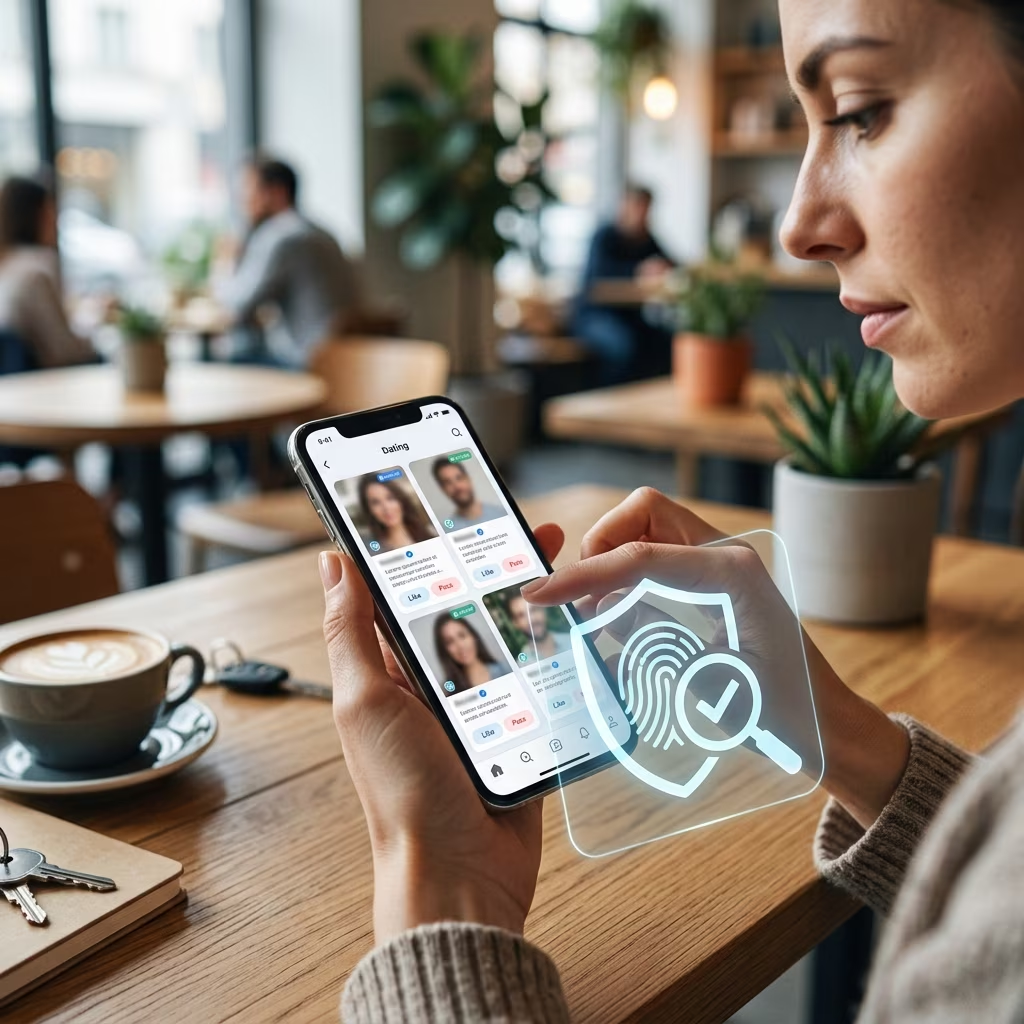
Online dating has become a standard way to meet new people, but it also raises difficult questions about safety and platform responsibility. Some services screen users against sex offender registries, while others rely more heavily on user reports, terms of service, and fraud detection tools. That uneven approach has made dating-app safety a major legal and consumer issue.
This article explains how screening works, why some platforms do more than others, and what the law says about liability when harm occurs through an app-based connection. It also outlines practical safety steps users can take when meeting strangers online.
Why screening matters in online dating
Dating platforms do more than match profiles. They create an environment where strangers can communicate, share personal information, and arrange in-person meetings. That makes trust and verification especially important. When apps do not verify identities or check criminal histories, users often assume the platform has done more safety work than it actually has.
Some services screen for sex offender registration, but others state that they do not conduct criminal background checks or identity verification. In those systems, the burden of caution shifts heavily to users themselves. That approach may reduce costs for the company, but it can leave people vulnerable if they believe an app offers stronger protections than it really does.
How dating platforms screen users
There is no single industry standard for background checks in online dating. A platform may use one or more of the following methods:
- Checking user names or other identifying information against public sex offender registries
- Reviewing reports from other members about suspicious or harmful behavior
- Using automated fraud and abuse detection tools
- Verifying phone numbers, email addresses, or photos
- Requiring paid subscriptions before unlocking certain account features
These steps are not the same as a full criminal background check. Registry screening may catch some serious offenders, but it can miss people whose names are incomplete, who use aliases, or whose offenses are not reflected in the registry record a company reviews. In addition, not all harmful conduct involves a registered sex offender. Harassment, coercion, stalking, and assault can come from people with no registry history at all.
Why some companies screen and others do not
Companies have different reasons for adopting different policies. Some say they want to protect users and reduce the risk of abuse. Others emphasize the practical limits of verifying millions of accounts and the difficulty of accurately matching a profile to a real-world identity. Some also point to privacy concerns and the possibility of false positives when users share common names or limited information.
Business structure also matters. Large dating platforms may operate multiple apps under one parent company, and safety tools are sometimes rolled out on one service but not another. That creates a patchwork system in which one app may have a stronger screening process while another owned by the same company may not.
For users, that inconsistency can be confusing. A platform that markets itself as safer than competitors may still rely on minimal verification unless its policies are clearly explained and actually enforced.
The legal backdrop: platform responsibility and liability
Legal disputes involving online dating often focus on whether a company should be responsible when a user harms another user after meeting through the platform. One major issue is the extent to which federal law shields websites from liability for content or conduct connected to user-generated material.
In the United States, Section 230 of the Communications Decency Act has been a central defense for many internet companies. It was designed to protect platforms from being treated as the publisher or speaker of content created by users. In practice, companies have often invoked that protection when plaintiffs try to hold them responsible for harms caused by another user.
That does not mean a dating app has no legal duties at all. Companies still face claims involving negligence, misleading statements, or failure to honor safety commitments. But Section 230 has made many lawsuits harder to pursue, especially when the claim depends on how the platform handled user-generated profiles, messages, or reports.
What public concern has changed
Public pressure has pushed some dating companies to adopt better screening and reporting tools. High-profile incidents and investigative reporting have made users more aware of the gap between marketing language and actual safety practices. In response, some platforms have added clearer community rules, user blocking tools, and reporting systems.
Safety expectations have also increased because dating apps are now part of everyday life. What once looked like a niche internet service is now a mainstream way to meet partners. That change has made consumers more likely to ask basic questions: Does the app verify identities? Does it screen for dangerous users? What happens after someone is reported?
These questions matter because a service can be popular and still have weak safety procedures. User scale does not guarantee user protection.
What users should look for before signing up
Before creating a profile, users should review a platform’s terms, safety tools, and privacy practices. The most important issue is not whether an app claims to be “safe,” but whether it explains how safety actually works.
- Look for whether the company checks against sex offender registries
- See whether photo, phone, or identity verification is available
- Review whether the app allows blocking and reporting in-app
- Check whether safety tips are easy to find and updated
- Read the company’s language about user conduct and account suspension
Users should also be cautious about assuming that a paid subscription means better vetting. In some services, payment may create the impression of legitimacy, but it does not necessarily mean the company has done a meaningful background check.
Practical steps users can take to stay safer
Even when an app offers safety features, personal caution remains important. No platform can eliminate risk entirely, especially when people meet face to face after chatting online. A few careful habits can reduce exposure to danger:
- Keep early conversations inside the app until trust is built
- Search for inconsistencies in photos, names, and profile details
- Meet in a public place for the first date
- Tell a friend where you are going and who you are meeting
- Use your own transportation so you can leave easily
- Trust pressure, secrecy, or rushed intimacy as warning signs
These steps do not replace platform accountability, but they give users more control over their own safety.
How reporting systems can make a difference
Reporting tools are one of the most important parts of a dating app’s safety system. When a user behaves abusively, other members need a way to document the conduct quickly. A useful reporting process should allow users to flag messages, profiles, and in-person threats without navigating a confusing support maze.
Good reporting systems do two things. First, they help the company remove dangerous accounts. Second, they create records that may be important if law enforcement or civil lawyers later need to investigate a pattern of abuse. The faster an app responds to reports, the more likely it is to prevent repeated harm.
However, reporting is only effective when the company takes complaints seriously. If reports disappear into automated responses or are never reviewed, the safety promise is largely meaningless.
Table: common dating-app safety approaches
| Safety measure | What it does | Limitations |
|---|---|---|
| Registry screening | Compares account information with public sex offender records | May miss aliases, incomplete identities, or non-registered risks |
| Identity verification | Confirms that a profile belongs to a real person | Does not reveal a criminal history by itself |
| User reporting | Lets members flag abusive behavior | Depends on fast company review and enforcement |
| Blocking tools | Prevents further contact from a specific account | Does not stop new accounts unless the platform detects them |
| Safety tips | Educates users on safer dating habits | Helpful, but not a substitute for screening |
FAQ: Dating app safety and screening
Do all dating apps check sex offender registries?
No. Some platforms do, while others state that they do not conduct background checks or identity verification.
Does registry screening guarantee safety?
No. It can reduce risk, but it cannot identify every dangerous person or prevent all misconduct.
Can a dating app be sued if a user is harmed?
Possibly, but claims often face strong legal defenses, including federal protections related to user-generated content.
What is the best way to protect myself on a dating app?
Use in-app reporting, meet in public, verify details independently, and avoid rushing into private meetings or sharing sensitive information.
Are paid dating apps safer than free ones?
Not necessarily. Pricing does not automatically mean stronger screening or better moderation.
What the future may require
The next stage of online dating safety will likely involve clearer standards. Users want to know whether a company checks registry data, how often it updates that information, and what happens when a complaint is filed. Regulators and courts may continue to shape those expectations as more disputes arise.
More transparency would help. If platforms explained their safety systems in plain language, users could make better decisions about where to create a profile and how much trust to place in the service. Until then, online daters should assume that app policies vary widely and that personal caution is still necessary.
References
- Tinder Lets Known Sex Offenders Use the App. It’s Not the Only One. — ProPublica. 2019-12-03. https://www.propublica.org/article/tinder-lets-known-sex-offenders-use-the-app-its-not-the-only-one
- Home | Dru Sjodin National Sex Offender Public Website — United States Department of Justice, Office of Justice Programs. 2026. https://www.nsopw.gov/
- Section 230 of the Communications Decency Act — Congressional Research Service. 2024-01-10. https://crsreports.congress.gov/product/details?prodcode=R46751
- How to Stay Safe While Using Online Dating Apps — Federal Trade Commission. 2025-02-14. https://consumer.ftc.gov/articles/online-dating-scams
- Internet Safety for Dating Apps — National Center for Missing & Exploited Children. 2025-06-18. https://www.missingkids.org/theissues/onlineenticement