
Cybersquatting: Meaning, Risks and Legal Remedies
Understand how cybersquatting threatens your brand online and the practical legal and technical steps you can take to stop it.
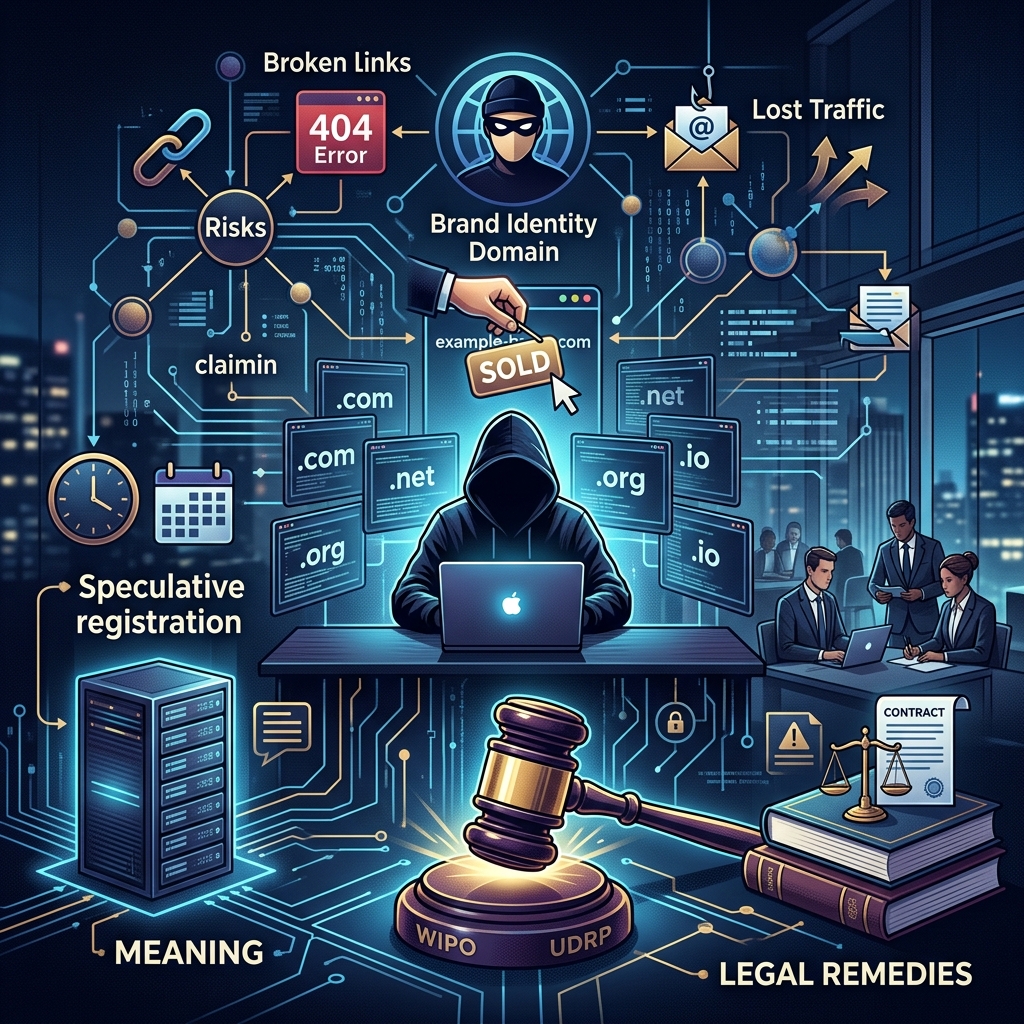
Cybersquatting has evolved into a serious business risk in the domain name era. It occurs when someone registers or uses a domain name that is identical or confusingly similar to an existing trademark, brand, or personal name, typically in bad faith and with the intent to profit from another party’s reputation. As more commerce and communication move online, understanding what cybersquatting is and how to respond to it has become vital for business owners, brand managers, and professionals.
Understanding Cybersquatting in the Modern Internet
At its core, cybersquatting is the abusive use of the domain name system. The cybersquatter is not simply choosing a similar name by coincidence; they deliberately target a brand or mark to benefit from user confusion or to pressure the legitimate owner into paying for the domain.
Core Legal Definition
Under U.S. law, cybersquatting generally refers to registering, trafficking in, or using a domain name that is identical or confusingly similar to a distinctive or famous trademark, with a bad-faith intent to profit from that mark. This concept is codified in the Anticybersquatting Consumer Protection Act (ACPA), which is part of the federal trademark statute at 15 U.S.C. § 1125(d).
- Identical or confusingly similar: The domain name closely matches the trademark, service mark, or personal name.
- Distinctive or famous mark: The underlying mark is protectable under trademark law.
- Bad-faith intent to profit: The registrant intends to exploit the goodwill associated with the mark for financial gain or other unfair advantage.
Internationally, cybersquatting is also recognized in policies administered by the Internet Corporation for Assigned Names and Numbers (ICANN), which describes cybersquatting as bad-faith registration of another’s trademark in a domain name.
Common Motives Behind Cybersquatting
Cybersquatters typically exploit domain names for one or more of the following reasons:
- Resale at a premium: Buying a domain matching a brand and then demanding a high price from the legitimate owner.
- Traffic diversion: Redirecting web visitors to competing websites or advertising pages.
- Phishing and fraud: Using look‑alike domains to trick users into disclosing passwords, financial data, or other sensitive information.
- Brand dilution: Associating a trademark with low‑quality, offensive, or irrelevant content that damages its reputation.
- Blocking competitors: Preventing a rival from securing a domain that clearly corresponds to their brand or product name.
Types of Cybersquatting Attacks
Cybersquatting appears in several patterns. Recognizing these variants helps businesses detect threats more quickly and choose appropriate responses.
Classic Domain Squatting
Classic domain squatting occurs when someone registers a domain name that directly incorporates an existing trademark or service mark, often with no intention of legitimate use.
Typical features include:
- Domain name is the exact trademark or a very close variation.
- Registrant offers to sell the domain to the mark owner at a profit.
- Site may be parked, show minimal content, or display pay‑per‑click ads.
Typosquatting and Look‑Alike Domains
Typosquatting focuses on misspellings or close variants of popular domains, expecting users to mistype or misread URLs.
- Extra or missing letters, swapped characters, or common spelling errors.
- Use of numbers or hyphens to mimic the original domain.
- Look‑alike domains used to host ads, malware, or phishing pages.
Brand Extension and Generic Top-Level Domain Abuse
With a growing number of generic top-level domains (gTLDs), cybersquatters may register brand names across multiple extensions (.com, .net, .biz, and newer gTLDs) to exploit user expectations.
- Registering a brand under several gTLDs before the legitimate owner can act.
- Using alternative extensions to impersonate corporate sites or regional branches.
- Creating confusion about which site is the official online presence.
Social Media and Platform-Based Squatting
Cybersquatting concepts also apply to usernames and handles on social platforms. While the legal frameworks differ from domain name law, the underlying behavior—capturing brand identifiers in bad faith—may still infringe trademarks or violate platform policies.
Why Cybersquatting Is a Legal Problem
Cybersquatting is more than an annoyance. It intersects directly with trademark law, consumer protection, and sometimes criminal fraud.
Trademark Infringement and Consumer Confusion
Trademark law aims to prevent consumer confusion about the source of goods and services. When a cybersquatter uses a domain incorporating another party’s mark, visitors may incorrectly assume the site is operated by the trademark owner.
- Misleading content can damage the brand’s reputation.
- Users may be diverted from the genuine business, resulting in lost sales.
- Phishing or malware on the squatted site can lead to additional harms.
Because cybersquatting uses domain registration as a vehicle for trademark misuse, courts and regulators often treat it as a specialized form of trademark infringement.
Bad-Faith Intent and Legal Thresholds
Not every similar domain registration is illegal. The key differentiator is bad faith. Under the ACPA, courts consider various factors to determine whether a registrant acted with bad-faith intent to profit, including whether they intended to trade on the goodwill of another’s mark, offered to sell the domain, or provided misleading contact information.
| Indicator | How it Supports a Cybersquatting Claim |
|---|---|
| Offer to sell domain to mark owner | Shows intent to profit from trademark rather than operate a legitimate site. |
| No legitimate business associated with domain | Suggests registration is primarily strategic or speculative. |
| Use of false WHOIS information | Can imply awareness of wrongdoing and attempt to avoid accountability. |
| Pattern of registering multiple famous marks | Demonstrates systematic exploitation of brand names. |
Key Legal Tools Against Cybersquatting
Trademark owners and businesses have two primary legal avenues to contest cybersquatting: U.S. litigation under the Anticybersquatting Consumer Protection Act and international arbitration under ICANN’s Uniform Domain Name Dispute Resolution Policy (UDRP).
Anticybersquatting Consumer Protection Act (ACPA)
The ACPA is a U.S. federal law enacted in 1999 to address cybersquatting specifically. It allows trademark owners to bring civil actions in federal court against those who register, traffic in, or use domain names in bad faith that are identical or confusingly similar to distinctive or famous marks.
- Scope: Applies to trademarks and personal names protected under federal law.
- Relief: Courts may order transfer or cancellation of the domain name, and statutory damages typically ranging from $1,000 to $100,000 per domain.
- Requirements: Plaintiff must show ownership of a distinctive mark, similarity of the domain, and bad-faith intent to profit.
Litigation under the ACPA can be effective but is often costly and time‑consuming. It may nevertheless be appropriate for severe cases, particularly when the cybersquatter’s conduct is part of broader fraud or when substantial monetary damages are sought.
Uniform Domain Name Dispute Resolution Policy (UDRP)
UDRP is an administrative dispute resolution process created by ICANN to provide a faster, more streamlined procedure for domain name disputes involving trademarks.
To succeed under UDRP, a complainant generally must demonstrate three elements:
- The domain name is identical or confusingly similar to a trademark or service mark in which the complainant has rights.
- The registrant has no rights or legitimate interests in the domain name.
- The domain name was registered and is being used in bad faith.
UDRP proceedings are decided by approved arbitration providers and usually result in either transfer or cancellation of the domain if the complaint is successful. They are considered quicker and often less expensive than filing a lawsuit, but they do not offer monetary damages.
| Feature | ACPA (U.S. Court) | UDRP (ICANN Arbitration) |
|---|---|---|
| Forum | Federal court in the United States | Administrative panel selected through ICANN providers |
| Relief Available | Domain transfer/cancellation, monetary damages, injunctions | Domain transfer or cancellation only |
| Speed | Slower; follows court litigation timelines | Faster; often concluded in a few months |
| Costs | Higher litigation and attorney fees | Generally lower arbitration and filing fees |
| Geographic Reach | U.S. law; enforcement depends on jurisdiction | Applies to domains under ICANN‑regulated gTLDs worldwide |
Practical Steps When You Discover Cybersquatting
Legal remedies are powerful, but many disputes are resolved through practical negotiation and careful documentation. When you identify a suspicious domain, treat the situation methodically.
Initial Assessment and Evidence Gathering
- Verify the content: Visit the domain from a secure device and capture screenshots of any pages.
- Record DNS and WHOIS data: Document registration details, name servers, and any hosting information.
- Compare with your marks: Note how closely the domain approximates your registered trademarks or trade names.
- Monitor activity over time: Determine whether the site is static, frequently updated, or used for phishing campaigns.
Non-Litigation Options
In some cases, a direct commercial solution may be preferable, especially where the domain has limited harmful use:
- Negotiated purchase: Contact the registrant to negotiate transfer of the domain at a reasonable price, though care must be taken not to incentivize widespread squatting.
- Registrar or host complaints: Many registrars and hosting providers have policies against trademark violations, phishing, or malware, and may suspend or disable infringing sites following a complaint.
- Platform enforcement: For social media usernames or marketplace storefronts, use the platform’s internal trademark complaint mechanisms.
Choosing Between ACPA and UDRP
When informal resolution fails, you may need to choose between litigation and arbitration. Factors to consider include:
- Desired outcome: If monetary damages are important, ACPA is more suitable; if your main goal is quick control of the domain, UDRP may be preferable.
- Budget and timeline: Arbitration is typically faster and less expensive than pursuing a court case.
- Geographic considerations: For internationally registered domains, UDRP may provide a more practical path to relief.
Preventive Strategies for Businesses and Brands
Prevention is often more efficient than remediation. By combining legal protection with proactive domain management, you can significantly reduce the risk of cybersquatting.
Protecting Trademarks and Domain Names
- Register your marks: Secure trademark registration in relevant jurisdictions. Registered marks are typically stronger in cybersquatting claims.
- Align domains and marks: Register domain names that closely match your principal trademarks and brand names, including common variants.
- Trademark your core domain: Some businesses choose to treat their primary domain name as a trademark, strengthening their legal position against infringing registrants.
Defensive Domain Registration
Defensive registration involves acquiring domain names that could otherwise be exploited by cybersquatters.
- Secure your brand under multiple popular gTLDs (e.g., .com, .net, .org).
- Register likely typo variants and common misspellings.
- Consider region-specific ccTLDs if you operate internationally.
Monitoring and Digital Risk Protection
Continuous monitoring plays an important role in detecting domain abuse before it escalates.
- Domain watch services: Use commercial or registrar-based tools that alert you when domains similar to your marks are registered.
- Threat intelligence platforms: Cybersecurity products may track phishing domains, typosquats, and other malicious sites targeting your organization.
- Regular manual checks: Periodically search for variations of your brand in domain registries and search engines.
Frequently Asked Questions About Cybersquatting
Is cybersquatting always illegal?
Cybersquatting is generally considered illegal when a registrant acts in bad faith by registering or using a domain identical or confusingly similar to a distinctive mark, with intent to profit from the mark’s goodwill. However, some similar domain registrations may be lawful—for example, when the domain is used legitimately for commentary, unrelated business, or other non‑infringing purposes. The presence or absence of bad‑faith intent is central to the legal analysis.
Can I claim cybersquatting if my mark is not registered?
Registered trademarks are stronger, but some legal mechanisms also recognize rights in unregistered marks that have acquired distinctiveness through use. Under UDRP, a complainant must show rights in a trademark, which can sometimes be established through common law usage; under ACPA, federal trademark protection is typically important. Consulting an attorney is advisable to evaluate the strength of your claim.
How long does a UDRP case usually take?
UDRP procedures are designed to be relatively fast compared with court litigation. While timelines vary by provider and case complexity, many UDRP decisions are issued within a few months from filing. This speed makes UDRP a common choice for urgent domain transfers.
What evidence should I collect before filing a cybersquatting complaint?
Useful evidence includes proof of your trademark rights, documentation of the domain’s registration data, screenshots of the website’s content, and any communications from the registrant (such as offers to sell the domain). Consistent records of user confusion, phishing attempts, or reputational harm can also strengthen the case.
Do cybersecurity tools help against cybersquatting?
Yes. Digital risk protection and threat intelligence tools can help identify suspicious domain registrations, phishing campaigns, and typosquatting attempts targeting your brand. While they do not replace legal remedies, they enable early detection and coordinated responses across technical and legal teams.
References
- Cybersquatting — Legal Information Institute, Cornell Law School. 2023-03-15. https://www.law.cornell.edu/wex/cybersquatting
- Cybersquatting Involving Trademarks and Service Marks — Justia. 2022-06-10. https://www.justia.com/intellectual-property/trademarks/cybersquatting/
- About Cybersquatting — ICANN. 2013-05-03. https://www.icann.org/resources/pages/cybersquatting-2013-05-03-en
- What is Cybersquatting? — Kaspersky. 2023-05-01. https://www.kaspersky.com/resource-center/preemptive-safety/cybersquatting
- What Is Cybersquatting? Definition & Real Examples — CrowdStrike. 2023-11-06. https://www.crowdstrike.com/en-us/cybersecurity-101/threat-intelligence/cybersquatting-domain-squatting/
- What is cybersquatting (domain squatting) — OVHcloud. 2022-09-20. https://www.ovhcloud.com/en/learn/what-is-cybersquatting/
Similar Articles








Read full bio of Sneha Tete


