
Culture Fit Hiring: Hidden Bias and Legal Risk
How culture fit hiring can quietly enable discrimination and what HR leaders must do to build fair, defensible practices.
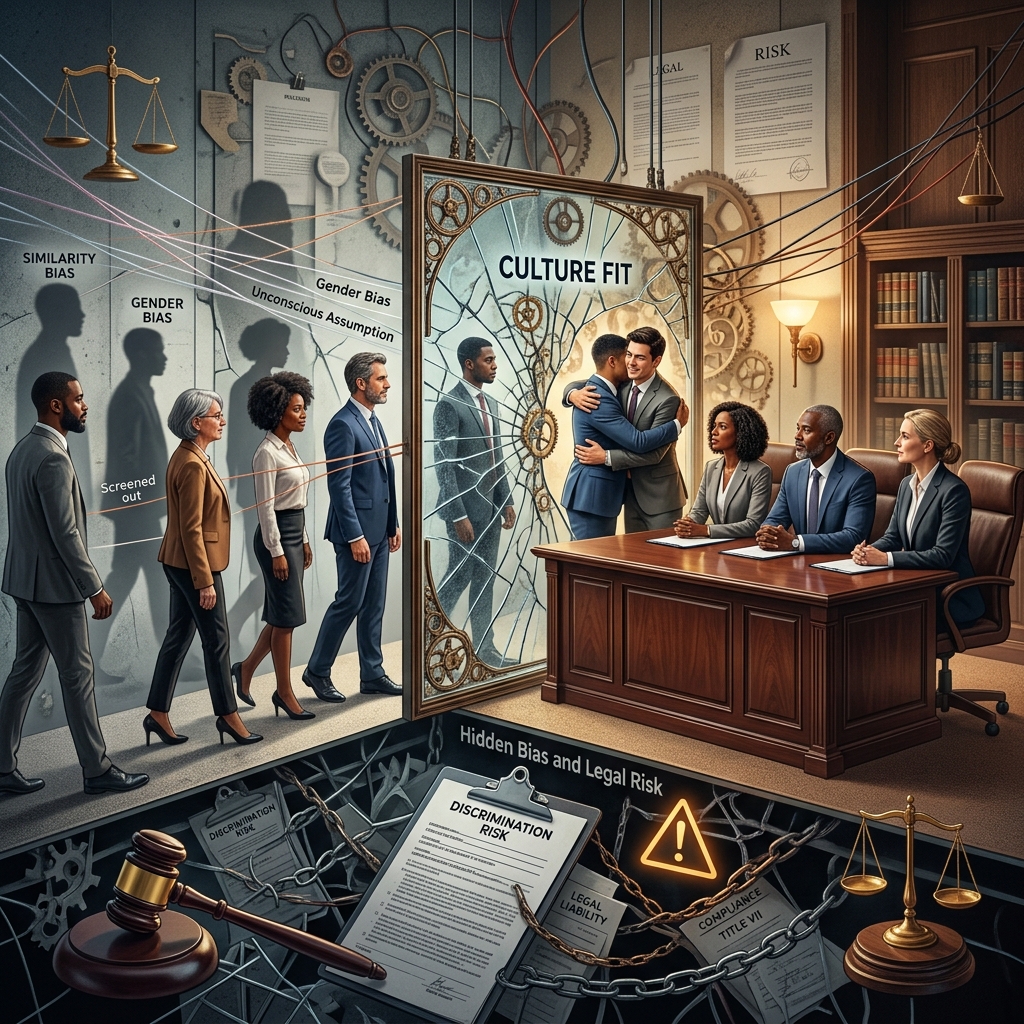
Hiring for culture fit sounds positive: organizations want people who share their values, collaborate well, and contribute to a healthy workplace. Yet in recent years, employers have faced lawsuits alleging that culture fit was used as a justification to exclude candidates based on race, age, or other protected characteristics, turning a seemingly neutral concept into a vehicle for illegal discrimination. This article explains why culture fit can be risky, how it intersects with employment law, and what HR and legal teams can do to design fair, defensible hiring practices.
What Do Employers Mean by Culture Fit?
Culture fit is typically described as the degree to which a candidate’s behavior, values, and interpersonal style align with an organization’s way of working. Many hiring managers use the term informally, referring to whether they “click” with a candidate or whether the person seems like someone they would enjoy working with day to day.
At its best, culture fit is about alignment with clearly defined organizational values, such as integrity, collaboration, or customer focus. At its worst, it becomes a vague, subjective impression rooted in personal comfort, shared background, or similarity in interests—factors that often track closely with demographics like age, race, or socioeconomic status.
- Positive intent: building cohesive teams, preserving mission-driven values, and avoiding toxic behavior.
- Practical concern: reducing conflict, improving communication, and increasing engagement.
- Hidden risk: elevating personal preference over objective job-related criteria.
When Culture Fit Crosses into Discrimination
In the United States, federal law prohibits discrimination in hiring based on race, color, religion, sex (including sexual orientation and gender identity), national origin, age (40 or older), disability, and genetic information. If an employer rejects someone as “not a culture fit” and that decision is influenced—consciously or unconsciously—by one of these protected traits, the organization may face legal exposure under laws such as Title VII of the Civil Rights Act and the Age Discrimination in Employment Act.
Disparate Treatment and Disparate Impact
Two core legal concepts help explain how culture fit can create risk:
- Disparate treatment: an employer intentionally treats someone differently because of a protected characteristic (for example, rejecting older candidates while favoring younger ones for “energy” or “startup culture”).
- Disparate impact: a neutral policy or criterion that disproportionately screens out members of a protected group and is not sufficiently job-related or necessary to the business.
Culture fit evaluations can lead to disparate impact when subjective judgments result in systematically rejecting candidates from certain demographic groups—for instance, dismissing people who do not share the majority’s hobbies, communication style, or informal social norms.
Why Vague Culture Fit Criteria Are So Dangerous
From a compliance perspective, the biggest problem is not culture itself but how it is assessed. Many organizations rely on informal interviews where decision-makers are encouraged to “trust their gut” about whether a candidate fits the team. Research on unconscious bias shows that when criteria are ambiguous, people tend to favor those who resemble themselves or the existing group.
Common Red Flags
- Undefined culture: the organization cannot clearly describe its values or how they relate to job performance.
- No behavioral indicators: criteria like “collaborative” or “innovative” are not translated into observable, job-related behaviors.
- Uneven application: different interviewers use their own standards, with no shared rubric or scoring system.
- Poor documentation: hiring decisions are not supported by structured notes or records explaining why some candidates were chosen and others rejected.
- Lack of outcome audits: nobody reviews hiring data to check whether “culture fit” rejections cluster around specific demographic groups.
Each of these factors increases the likelihood that culture fit serves as a proxy for protected characteristics, even when the organization sincerely believes it is acting fairly.
Legal Framework: What the Law Actually Prohibits
Under U.S. federal law, it is illegal to make any employment decision—including hiring, promotion, termination, and training—because of a person’s protected characteristics. The Equal Employment Opportunity Commission (EEOC) identifies prohibited practices such as:
- Refusing to hire someone because of race, age, religion, sex, national origin, disability, or genetic information.
- Using hiring criteria that disproportionately screen out a protected group without being demonstrably job-related and consistent with business necessity.
- Retaliating against people who complain about discrimination or participate in investigations.
These rules apply even when the employer uses softer language like “not a fit” or “won’t mesh with our culture” instead of explicitly referring to a protected trait. Courts and enforcement agencies look beyond the labels to examine patterns, documentation, and the actual impact of the practices.
| Problematic Culture Fit Practice | Legally Safer Alternative |
|---|---|
| Rejecting candidates for being “too corporate” or “not startup enough” without explanation. | Evaluating candidates on specific behaviors like comfort with ambiguity, pace of work, and decision-making style using a structured rubric. |
| Preferring people who “feel like one of us” based on informal social interactions. | Assessing teamwork and communication using standardized interview questions and scoring guidelines. |
| Relying on unstructured interviews where the final decision turns on personal chemistry. | Combining skills-based screening with structured interviews and limiting the weight of culture fit in final decisions. |
How Culture Fit Can Undermine Diversity and Inclusion
Diversity and inclusion initiatives aim to expand representation and ensure equitable opportunities. Overemphasizing culture fit can unintentionally work against these goals by favoring candidates who resemble the existing workforce.
Typical consequences include:
- Homogeneous teams: hiring people from similar educational, social, or regional backgrounds, reducing diversity of perspectives.
- Gatekeeping: using culture fit as a polite way to exclude candidates who challenge norms or come from underrepresented groups.
- Missed talent: overlooking highly qualified candidates whose style or experiences differ from the majority.
- Damaged employer brand: candidates share stories of vague, subjective rejections, harming the organization’s reputation among diverse applicants.
From a business standpoint, research and practice show that diverse teams tend to make better decisions, innovate more, and perform strongly in complex environments. Prioritizing culture fit over diversity can therefore harm both legal compliance and competitive advantage.
Shifting from Culture Fit to Culture Contribution
Many organizations are now reconsidering the language of “culture fit” and focusing instead on culture contribution—what new hires can add to the culture rather than how closely they match what already exists. This perspective encourages teams to value complementary strengths, different viewpoints, and constructive challenge.
Key Principles of Culture Contribution
- Alignment with core values, not personal preferences: candidates are assessed on clearly defined values linked to mission and performance.
- Emphasis on job-related behaviors: interview questions focus on how candidates would handle real situations, not on hobbies or social traits.
- Recognition of diversity as a positive: differences in background and perspective are treated as potential assets for innovation and problem-solving.
Building Legally Defensible Culture Assessments
Organizations that want to retain some form of culture or values assessment can do so, but must design processes that are objective, documented, and regularly reviewed. The following elements are critical.
1. Define Culture in Job-Related Terms
Start by articulating the organization’s culture in concrete, behaviorally grounded language. Avoid vague buzzwords like “dynamic” or “passionate.” Instead, identify the skills and behaviors that truly drive success.
- Describe how decisions are made (data-driven, consensus-based, rapid iteration).
- Clarify expectations around collaboration, autonomy, and communication.
- Connect values directly to outcomes such as customer satisfaction, quality, or innovation.
2. Translate Values into Observable Behaviors
For each cultural value, specify what it looks like in practice. For example, instead of “team player,” define behavior such as “regularly solicits input from colleagues before major decisions” and “helps resolve conflicts constructively.”
Use these behaviors to design:
- Structured interview questions.
- Scenario-based exercises or role plays.
- Evaluation rubrics with clear rating scales.
3. Use Skills-Based Screening Before Culture Interviews
To reduce the influence of bias, many experts recommend screening candidates for job-related skills before evaluating culture-related attributes. For example:
- Require relevant work samples or writing assignments.
- Administer validated skills tests or technical assessments.
- Ensure only candidates who meet the skills bar move on to culture-focused interviews.
This approach helps ensure that culture judgments are applied to candidates who are already objectively qualified, reducing the chance that culture fit becomes the primary gatekeeper.
4. Apply Criteria Uniformly and Document Decisions
Consistency and documentation are essential for legal defensibility.
- Use the same core questions for all candidates applying to the same role.
- Train interviewers to use shared scoring rubrics.
- Record scores, notes, and rationales for each decision.
Well-kept documentation can be critical evidence if hiring decisions are later challenged, demonstrating that the organization used objective, job-related criteria and applied them fairly.
5. Audit Outcomes for Bias and Disparate Impact
Regularly review hiring data to identify patterns. Analyze whether “culture” or “fit” is cited disproportionately as the reason for rejecting candidates from particular demographic groups.
- Monitor selection rates by race, gender, age, and other protected characteristics where legally permissible.
- Investigate significant disparities and adjust criteria or processes when necessary.
- Use diversity analytics to track progress toward inclusion goals.
Practical Tools to Reduce Bias in Culture Evaluations
Several practical tools and methods can help organizations evaluate culture-related attributes while minimizing bias and legal risk.
- Structured interviews: standardized questions and rating scales focusing on behaviors rather than personal impressions.
- Blind resume review: removing identifying information (such as names or schools) from resumes to reduce implicit bias.
- Validated assessments: personality or situational judgment tests designed and validated for fairness, used as supplements rather than replacements for interviews.
- Diverse hiring panels: including interviewers from different backgrounds to dilute individual biases and encourage more balanced decisions.
Frequently Asked Questions About Culture Fit and Discrimination
Is hiring for culture fit always illegal?
No. Using culture-related criteria is not illegal by itself. It becomes a legal problem when culture fit is used as a proxy for protected characteristics or when it creates a disparate impact on protected groups without being clearly job-related and necessary.
Can we still talk about culture in interviews?
Yes, but focus on job-relevant behaviors and values tied to performance. Ask candidates how they have handled specific situations that reflect your culture, and evaluate their responses using structured rubrics rather than general impressions.
What should we avoid saying in rejection communications?
Avoid vague phrases like “not a culture fit” with no further explanation. When possible, tie feedback to specific job-related criteria, such as required experience level or demonstrated skills, rather than subjective fit language. This helps reduce confusion and potential misunderstandings about discrimination.
How often should we audit our hiring outcomes?
There is no single rule, but many organizations conduct at least annual reviews, with more frequent audits when introducing new hiring practices or after rapid growth. The key is to examine whether certain criteria—like culture fit—correlate with disproportionate rejection of particular demographic groups.
What role should HR and legal play?
HR should design and implement structured, inclusive hiring processes, while legal and compliance teams review policies for alignment with anti-discrimination laws and advise on documentation and audits. Both functions should collaborate to ensure culture assessments are fair, transparent, and defensible.
Key Takeaways for HR Leaders and Counsel
Culture matters, but the way organizations use culture in hiring can create serious legal and ethical challenges. To manage risk and support diversity, HR leaders and in-house counsel should keep several key points in mind:
- Culture fit should never substitute for objective, job-related criteria.
- Vague or subjective fit language can mask discriminatory practices, even unintentionally.
- Clear definitions, structured interviews, and robust documentation are essential for compliance.
- Shifting from “fit” to “contribution” encourages diversity and better business outcomes.
- Regular audits of hiring data help identify and correct potential disparate impacts.
By treating culture as a set of explicit, job-related behaviors rather than a feeling, organizations can hire people who support their mission while respecting legal obligations and fostering genuinely inclusive workplaces.
References
- Hiring for Cultural Fit: Pros, Cons, Bias and Legal Risks — InOp AI. 2026-01-15. https://inop.ai/the-problem-with-hiring-for-cultural-fit/
- Prohibited Employment Policies/Practices — U.S. Equal Employment Opportunity Commission (EEOC). 2023-06-15. https://www.eeoc.gov/prohibited-employment-policiespractices
- Hiring for Culture Fit: Discrimination by Another Name? — FindLaw Legal Blogs, In-House Counsel. 2024-02-01. https://www.findlaw.com/legalblogs/in-house/hiring-for-culture-fit-discrimination-by-another-name/
- The thin line between discrimination and culture fit — Interact Software Blog. 2022-09-08. https://www.interactsoftware.com/blog/the-thin-line-between-discrimination-and-culture-fit/
- Stop Hiring for “Cultural Fit” — Kellogg Insight, Northwestern University. 2019-08-20. https://insight.kellogg.northwestern.edu/article/cultural-fit-discrimination
Similar Articles








Read full bio of medha deb




