Criminal Records in Housing: Legal Guidelines for Landlords
Navigate fair housing rules on using arrest and conviction records to screen tenants effectively and avoid discrimination claims.
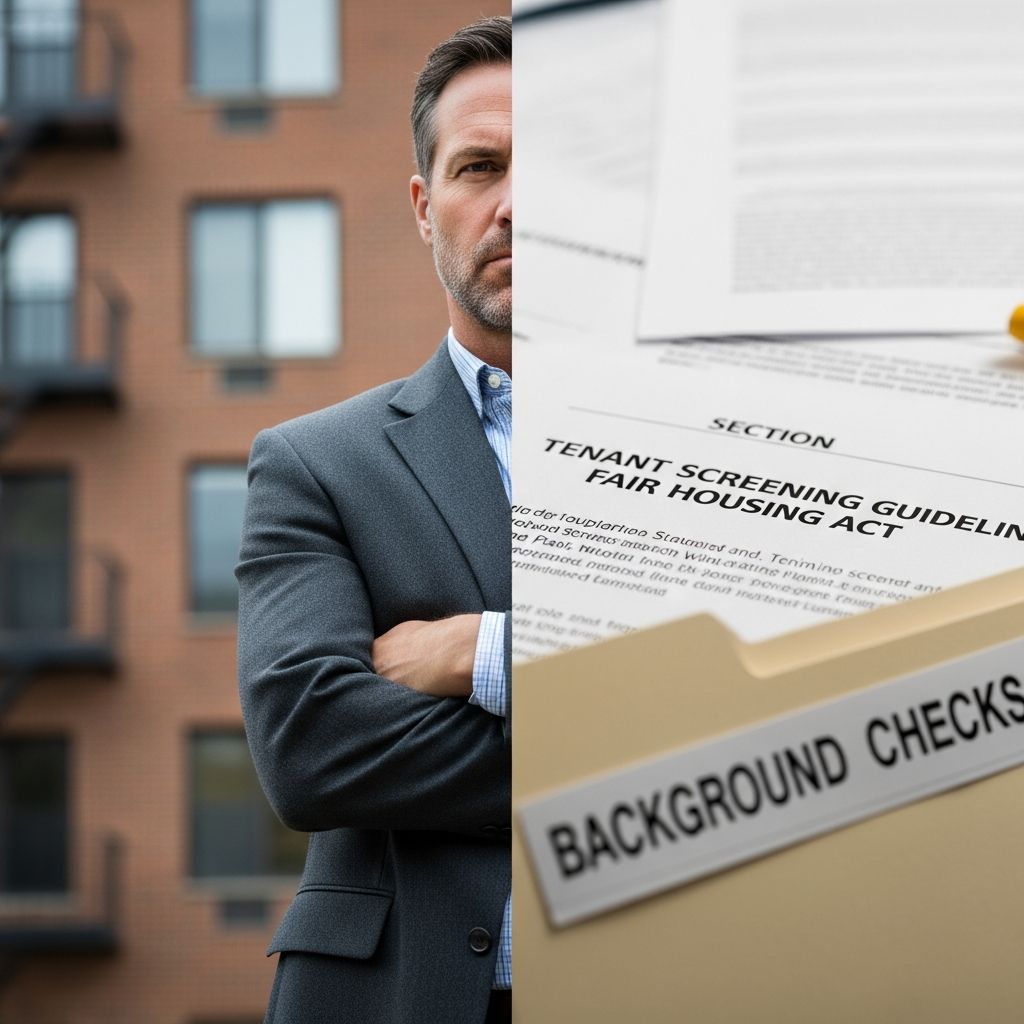
Landlords frequently conduct background checks to assess tenant suitability, but federal fair housing laws impose strict limits on using criminal records. These regulations aim to prevent discriminatory practices that disproportionately affect protected groups, such as racial minorities who face higher arrest and incarceration rates.
Understanding Federal Fair Housing Protections
The Fair Housing Act (FHA) prohibits discrimination in housing based on race, color, national origin, and other protected characteristics. Policies relying on criminal histories can trigger liability if they have a disparate impact—meaning they exclude disproportionate numbers from protected classes without sufficient justification.
Historically, the U.S. Department of Housing and Urban Development (HUD) issued guidance emphasizing individualized assessments over blanket exclusions. This included warnings against using arrest records alone, as arrests do not prove guilt, and convictions must be evaluated based on offense type, severity, and time elapsed.
Evolution of HUD Policies on Criminal Screening
In 2016, HUD’s Office of General Counsel released a memo outlining how FHA standards apply to criminal record use. It highlighted disparate impact concerns, noting African American males face imprisonment rates nearly six times higher than white males, and Hispanics over twice as high.
Subsequent documents, like the 2022 Office of Fair Housing and Equal Opportunity (FHEO) memo, reinforced these principles with investigative procedures and best practices for screening policies.
However, recent developments have shifted the landscape. In late 2025, HUD rescinded key guidances—including Notice PIH 2015-19, the 2016 OGC memo, and the 2022 FHEO memo—removing them as “safe-harbor” references. This revocation, announced around November 2025, introduces less federal clarity, particularly on arrest records, though core FHA risks persist.
| Document | Date | Main Focus |
|---|---|---|
| Notice PIH 2015-19 | 2015 | Excluding arrest records in housing decisions |
| OGC Guidance Memo | 2016 | FHA application to criminal histories |
| FHEO Implementation Memo | 2022 | Best practices and investigations |
Despite rescission, using arrests without convictions to deny housing can still invite fair housing complaints, as it may lack evidentiary support.
Permissible vs. Prohibited Screening Practices
Landlords may screen based on convictions but must tailor policies narrowly to protect safety and property. Prohibited practices include:
- Blanket bans on all individuals with any criminal history.
- Denials solely on arrests or charges without convictions.
- Inconsistent application, such as selective checks based on perceived traits.
- Policies without evidence linking the exclusion to reduced risks.
Acceptable approaches involve:
- Reviewing only convictions, confirmed via reliable sources like court records.
- Considering factors like crime nature (e.g., violent vs. non-violent), rehabilitation evidence, and passage of time (e.g., 3-7 years lookback).
- Conducting individualized reviews, documenting decisions.
Developing a Compliant Criminal Screening Policy
A robust policy should be written, uniformly applied, and justifiable. Steps include:
- Define scope: Limit to convictions; exclude arrests unless corroborated by strong evidence.
- Set criteria: Categorize offenses (e.g., sex crimes, drug trafficking) with time limits (e.g., no denials for misdemeanors over 5 years old).
- Require documentation: Provide applicants copies of records used and adverse action notices.
- Allow appeals: Offer chances for applicants to explain records or provide mitigating evidence like completion of probation.
- Monitor impact: Track denial rates by demographics to detect disparities.
HUD previously required proof that such policies enhance safety, with challengers able to propose less discriminatory alternatives. Post-rescission, landlords bear greater responsibility to defend policies in complaints.
Tenant Rights and Challenging Denials
Applicants denied due to criminal history have rights under the Fair Credit Reporting Act (FCRA) if third-party reports are used: pre-adverse action notice, report copy, and summary of rights.
To contest:
- Request the landlord’s written screening policy in writing.
- Argue non-compliance with FHA by citing disparate impact or arrest-only use.
- Provide evidence like dismissed charges, verifiable via public court databases.
- File complaints with HUD or local fair housing agencies if discrimination is suspected.
For evictions based on criminal activity, state laws (e.g., Wisconsin’s 5-day notice) require specifics on the incident, but must align with FHA individualized review.
Implications for Public and Subsidized Housing
Public Housing Authorities (PHAs) and subsidized properties face additional scrutiny. Admissions denials must use preponderance-of-evidence standards, favoring convictions over arrests.
Recommendations include providing denied applicants with exact records used and categorization details. Evictions or subsidy terminations similarly demand evidence beyond arrests.
Best Practices to Minimize Legal Risks
To stay compliant:
- Use reliable sources: Court records over unverified reports.
- Train staff: On FHA risks and consistent application.
- Document everything: Policies, reviews, and rationales.
- Consider alternatives: References, employment history, or shorter lookbacks.
- Consult legal experts: Especially post-2025 changes.
Recent guidance stresses narrow tailoring and individualized assessments for convictions.
Frequently Asked Questions
Can landlords deny housing based solely on an arrest?
No, arrests without convictions lack proof of guilt and risk FHA violations. Prior HUD guidance explicitly discouraged this; current rules maintain similar risks.
What factors should be considered for convictions?
Offense nature, severity, time since conviction, and rehabilitation evidence. Blanket lifetime bans are problematic.
Has HUD banned all criminal screening?
No, screening is allowed if policies are non-discriminatory, evidence-based, and narrowly tailored.
What changed with the 2025 HUD rescission?
It revoked prior guidances, reducing federal “safe harbor” but not altering FHA liability for disparate impact.
How can tenants dispute a denial?
Request the policy, provide mitigating evidence, and file a HUD complaint if discriminatory.
State Variations and Local Ordinances
Federal rules set a baseline, but states and cities add layers. For example, some ban conviction use entirely (e.g., Newark, NJ), while others limit lookback periods. Landlords must check local laws alongside FHA.
In subsidized housing, regulations like 24 CFR parts 960 and 982 impose conviction-based “lookback” periods up to 7 years for certain crimes.
Future Outlook and Compliance Strategies
With rescinded guidances, expect increased litigation testing FHA boundaries. Landlords should proactively audit policies for disparate impact using demographic data.
Adopting holistic screening—balancing criminal history with income stability, rental references, and credit—reduces risks while promoting diverse tenancy.
Ultimately, the goal is safe housing without unlawful exclusion. By prioritizing evidence-based, uniform policies, landlords protect properties and comply with law.
References
- Renting With a Criminal Conviction or Arrest Record — Tenant Resource Center. Accessed 2026. https://www.tenantresourcecenter.org/renting_with_a_criminal_conviction_or_arrest_record
- Missed the Recent HUD Announcement? Here Are the Details — Loebsack & Brownlee. 2025. https://loebsackbrownlee.com/missed-the-recent-hud-announcement-here-are-the-details/
- HUD Just Reset the Rules: Here’s What Developers and Owners Need to Know — Nelson Mullins. 2025. https://www.nelsonmullins.com/insights/alerts/nelson-mullins-affordable-housing-news/all/hud-just-reset-the-rules-here-s-what-developers-and-owners-need-to-know
- Fair Housing for People with a Criminal Record: A Digital Toolkit — Fair Housing Center for Rights & Research. 2022-09. https://www.thehousingcenter.org/wp-content/uploads/2022/09/FAIR-HOUSING-FOR-PEOPLE-WITH-A-CRIMINAL-RECORD-A-DIGITAL-TOOLKIT.pdf
- Recommendations on the Use of Criminal Records in HUD — National Housing Law Project. Accessed 2026. https://www.nhlp.org/wp-content/uploads/NHLP-Criminal-History-Recommendations-to-HUD.pdf
Similar Articles








Read full bio of medha deb