Criminal Defenses: Excuses and Justifications Explained
Understand key criminal defenses like insanity, self-defense, duress, and more that can challenge liability in court proceedings.
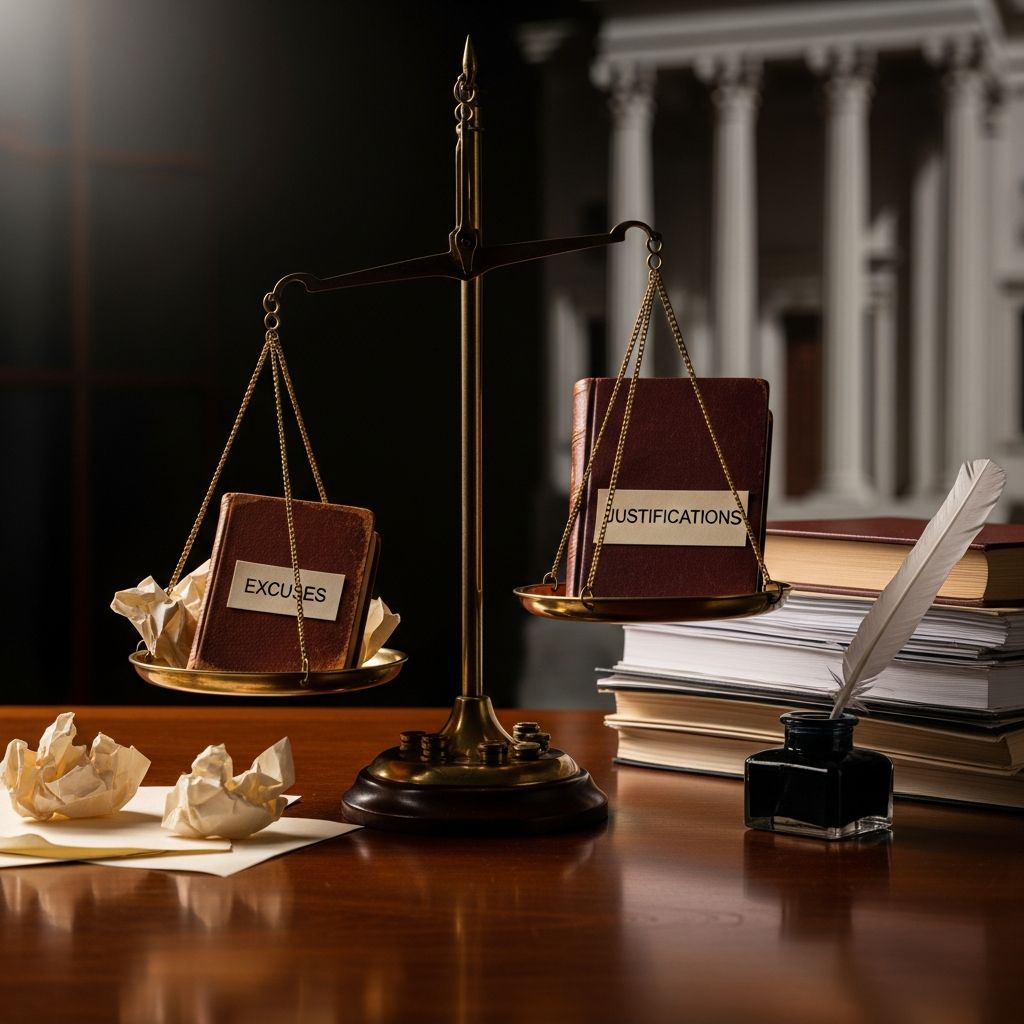
Criminal defenses form the backbone of a fair trial, allowing defendants to challenge accusations by asserting legal excuses or justifications for their actions. These strategies can lead to acquittal, reduced charges, or dismissal, depending on the evidence and jurisdiction. Understanding these defenses is crucial for anyone navigating the criminal justice system.
Understanding the Framework of Criminal Defenses
Criminal defenses are broadly classified into categories like denial of facts, failure of proof, affirmative defenses, justifications, and excuses. Denial defenses question whether the crime occurred or if the defendant was involved, while affirmative defenses admit the act but provide a legal reason to avoid liability. Justifications argue the conduct was permissible, whereas excuses concede wrongdoing but claim lack of full responsibility due to circumstances.
Prosecutors bear the burden of proving guilt beyond a reasonable doubt. Defenses shift this dynamic by introducing doubt or requiring the state to counter specific claims. State laws vary, with some defenses statutory and others rooted in common law precedents.
Denial-Based Defenses: Proving Non-Involvement
Denial defenses directly refute the prosecution’s case. The most straightforward is
innocence
, where the defendant claims they did not commit the alleged act. Evidence like video footage, witness statements, or DNA exclusions supports this.- Alibi: Establishes the defendant was elsewhere during the crime. Reliable witnesses or timestamps are key.
- Mistaken Identity: Argues the wrong person was identified, often bolstered by forensic mismatches or unreliable eyewitness accounts.
- Lack of Intent: For specific intent crimes, proves absence of mens rea (guilty mind).
These defenses succeed by creating reasonable doubt without admitting fault.
Justification Defenses: When Actions Are Legally Permissible
Justification defenses posit that the defendant’s conduct, though appearing criminal, was reasonable and necessary under the circumstances. Courts evaluate proportionality and immediacy.
Self-Defense and Defense of Others
**Self-defense** permits reasonable force against imminent unlawful harm. Key elements include a genuine belief in danger, no duty to retreat in many jurisdictions (stand-your-ground laws), and proportional response. Deadly force requires fear of death or serious injury.
| Element | Requirements | Example |
|---|---|---|
| Imminent Threat | Immediate danger, not past or future | Attacker advancing with weapon |
| Proportionality | Force matches threat level | Fists against fists; gun against gun |
| Reasonable Belief | Objective standard: what a reasonable person would do | Not excessive retaliation |
Defense of others extends this to protecting third parties under similar conditions.
Defense of Property
Lesser force is allowed to protect property, but deadly force is rarely justified unless it escalates to personal threat. Non-deadly measures like alarms or barriers are preferred.
Excuse Defenses: Relieving Responsibility
Excuse defenses acknowledge the act but argue the defendant lacked capacity or choice, thus not fully culpable.
Insanity Defense
The
insanity defense
claims mental illness prevented understanding the act’s wrongfulness or controlling impulses. The M’Naghten Rule (could not know nature/consequences or wrongfulness) or Model Penal Code test (lacked substantial capacity due to mental disease) are common standards. Only about 1% of cases use it successfully, requiring psychiatric evidence.- Pre-trial evaluation by experts.
- Not guilty by reason of insanity (NGRI) leads to commitment, not freedom.
Duress and Necessity
**Duress** applies when imminent threat of harm compels the crime, with no reasonable escape. The threat must be immediate, and the crime not disproportionately serious (e.g., no murder under duress).
**Necessity** (choice of evils) justifies harm to prevent greater harm, like breaking into a cabin during a blizzard. Elements: imminent peril, no legal alternative, net benefit.
Intoxication and Infancy
Voluntary intoxication rarely excuses but may negate specific intent. Involuntary intoxication mirrors insanity. Juveniles under age of reason (typically 7-14) benefit from
infancy defense
, presuming incapacity.Procedural and Constitutional Defenses
These attack the case’s validity rather than the act.
Constitutional Violations
Violations of rights under the Fourth (illegal search/seizure), Fifth (self-incrimination, due process), or Sixth (speedy trial, counsel) Amendments can suppress evidence or dismiss charges. Miranda violations exemplify this.
Entrapment
**Entrapment** occurs when government induces crime an ordinary person wouldn’t commit. Focuses on police conduct, not predisposition.
Statute of Limitations
Expired time bars prosecution for non-capital crimes, ensuring timely justice.
Strategic Considerations in Raising Defenses
Choosing a defense involves risks: affirmative defenses admit the act, potentially aiding prosecutors. Jury instructions vary by state, and success rates differ (self-defense ~20-30% in homicides). Expert testimony is pivotal for insanity or diminished capacity.
Diminished capacity reduces degree of crime (e.g., murder to manslaughter) via mental impairment short of insanity.
Case Studies Illustrating Key Defenses
In a 2023 Texas case, self-defense acquitted a homeowner who shot an armed intruder, upheld under stand-your-ground. A federal entrapment ruling dismissed charges against a defendant coerced by an undercover agent into a minor offense.
High-profile insanity pleas, like in the Hinckley-Reagan attempt, spotlight psychiatric battles, resulting in NGRI commitment.
Frequently Asked Questions
What is the burden of proof for self-defense?
In most jurisdictions, defendants must produce evidence; prosecutors disprove beyond reasonable doubt.
Can intoxication excuse a crime?
Voluntary no; involuntary may negate intent or mimic insanity.
How rare is the insanity defense?
Used in <1% of felonies, successful ~25% of attempts, leading to treatment not prison.
Does duress excuse murder?
Generally no; courts refuse to allow killing innocents even under threat.
What happens after NGRI verdict?
Civil commitment for evaluation; potential indefinite treatment until safe.
References
- The four major criminal law defenses — Legal glossary — Thomson Reuters. 2023-2024. https://legal.thomsonreuters.com/blog/the-four-major-criminal-law-defenses/
- 5.1 Criminal Defenses – Criminal Law — SLCC Pressbooks. 2023-05-15. https://slcc.pressbooks.pub/criminallaw/chapter/5-1-criminal-defenses/
- The 10 Most Common Types of Criminal Defenses: Explained — Terry Shoemaker Law. 2024-01-10. https://terryshoemakerlaw.com/blog/the-10-most-common-types-of-criminal-defenses-explained/
- What Is a Defense in Criminal Law? — LawFirm.com. 2024-06-20. https://www.lawfirm.com/criminal-defense/
- 8 Different Types of Criminal Defenses in Law — Best Lawyers. 2023-11-08. https://www.bestlawyers.com/article/8-different-types-of-criminal-defenses-in-law/5168
- Common Defenses In Criminal Cases — Cowboy Law Group. 2024-02-14. https://cowboylawgroup.com/common-defenses-in-criminal-cases/
Similar Articles








Read full bio of medha deb