Courts have long struggled with a basic but important question: when does hands-on training in a school setting cross the line into paid work? In a significant decision involving cosmetology students, the Ninth Circuit explained that not every student who performs services for the public is an employee. The central issue is whether the educational program or the school is the main beneficiary of the relationship.
This distinction matters for schools, students, and employers in training-heavy industries. It also matters for wage-and-hour law, because employee status can trigger minimum wage, overtime, and recordkeeping obligations under federal and state law. The Ninth Circuit’s reasoning offers a useful framework for educational programs that rely on supervised practical experience.
Why the case mattered
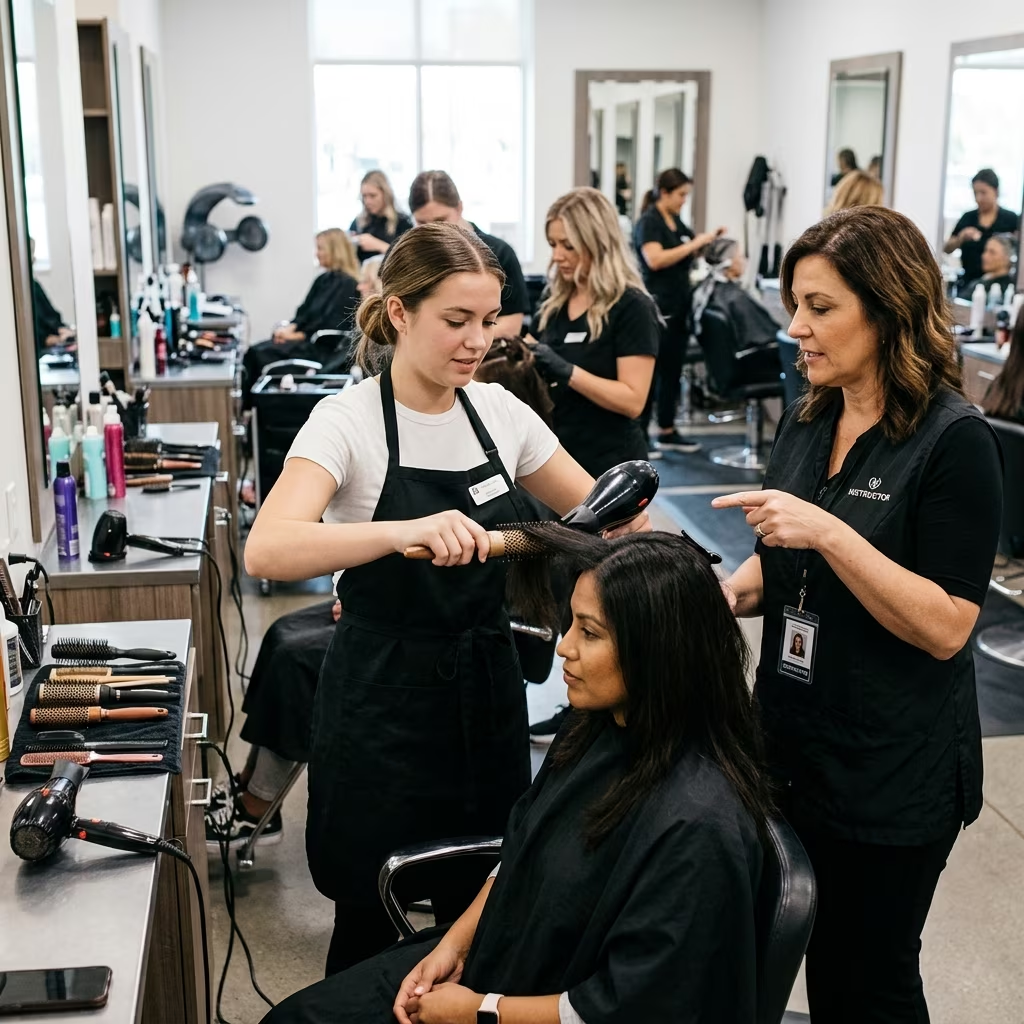
The case arose from a familiar type of professional training model. Cosmetology students spent part of their program working in a clinic-style setting where they practiced on real customers. The students argued that because they performed services that resembled work, they should have been paid as employees. The school responded that the clinic work was part of the curriculum and designed to prepare students for licensure and future employment.
The court’s task was not simply to decide whether the students did useful tasks. Instead, it had to examine the economic reality of the relationship. That approach asks who primarily benefits from the arrangement, what the parties expected, and whether the activities are tied to education rather than ordinary labor.
The legal question behind the dispute
The Fair Labor Standards Act protects employees, but it does not automatically cover students engaged in bona fide educational programs. The challenge is that many training programs include productive activity. Nursing students, interns, apprentices, and vocational students often gain experience by doing work that also provides value to others. That overlap makes classification difficult.
In this setting, the Ninth Circuit adopted a primary beneficiary approach. Under that framework, the court looks at whether the student or the school receives the main advantage from the relationship. If the student’s training, credentials, and educational progress are the primary gains, the student is less likely to be treated as an employee.
How the court analyzed the program
The court did not rely on a single fact. Instead, it considered the overall structure of the program and several practical indicators. The court noted that the students were not expecting wages, received academic credit, and participated in hands-on work that matched their curriculum. It also considered whether the students stayed in the clinic only as long as required by the educational program and state licensing rules.
Another important point was whether the students replaced paid workers. If students are simply filling regular staff positions, that can suggest employment. But where the tasks are supervised, instructional, and tied to learning outcomes, the educational purpose remains strong. The court found that the students did not routinely displace paid employees and had no realistic expectation of a job with the school after graduation.
| Factor | Why it mattered |
|---|---|
| No expectation of pay | Suggested the relationship was educational rather than wage-based |
| Academic credit for clinic hours | Showed the work was part of the curriculum |
| Hands-on training linked to coursework | Demonstrated a direct educational purpose |
| Limited duration based on state requirements | Indicated the clinic work was confined to training needs |
| No regular displacement of paid staff | Weakened the argument that the school was using students as labor |
| No expectation of post-graduation employment | Supported the conclusion that the students were not hired workers |
What the primary beneficiary test means
The primary beneficiary test is flexible. Rather than treating every unpaid training arrangement the same, it asks a practical question about substance. A student may contribute value to a school or business and still not be an employee if the educational benefits are real and central. That is especially true in regulated professions where practical experience is necessary for licensure.
This approach gives courts room to consider the full context. It also helps distinguish between genuine training and arrangements that look educational on paper but function like unpaid labor. The difference often depends on how structured, supervised, and integrated the work is within the learning program.
Why the ruling was favorable to schools
For schools, the decision provides guidance on how to build defensible training programs. It is not enough to call a person a student. A school must be able to show that the clinic or practicum serves a legitimate instructional purpose. That means classroom instruction, supervised application, and documentation should all point in the same direction.
The ruling suggests that schools are on safer ground when they clearly explain that students are not employees, do not earn wages, and are participating in required educational exercises. It also helps when the program tracks hours, credits, and skill development in a way that is consistent with licensing standards.
When a student program can create wage risks
Not every hands-on program will pass the test. Problems may arise if a school uses students primarily to generate revenue, staff a business, or replace paid labor. Risk also increases if students perform repetitive menial tasks unrelated to their training, are supervised only loosely, or have no meaningful classroom tie-in.
Programs can also become vulnerable when the school’s clinic looks more like a commercial operation than a teaching environment. If the school emphasizes profit over instruction, or if students spend most of their time serving customers without educational feedback, the arrangement may begin to resemble employment.
- Students perform tasks that do not advance a learning objective.
- The school relies on students to cover normal staffing needs.
- Clinic work is disconnected from the curriculum.
- Students are led to believe they are building a paid work role.
- Supervision and instruction are minimal.
State law questions can differ from federal law
Although the dispute involved federal wage law, state law can add another layer of complexity. Some states have their own wage definitions or employment tests. Even so, courts often look closely at whether the educational context changes the analysis. The Ninth Circuit treated the training setting as an important reason not to stretch ordinary employee definitions too far.
That matters because schools operating in more than one state need to design programs that are consistent across jurisdictions. A clinic that works under federal law may still face state-law arguments if the facts suggest students are doing ordinary labor rather than structured training. Legal review should therefore consider both federal and state wage rules.
Practical lessons for schools and training programs
The decision offers a blueprint for institutions that use clinic-based learning. Clear policies and consistent records can make the difference between a defensible academic model and a wage claim. Schools should be able to show, with documents and day-to-day practices, that the student experience is educational first.
Useful safeguards include written program descriptions, training objectives, credit assignments, attendance records, and supervision protocols. Schools should also train faculty and clinic managers to avoid language or practices that suggest students are functioning as unpaid workers.
- State in writing that students are participants in an educational program.
- Connect clinic tasks to specific learning goals.
- Track academic credit, hours, and competency milestones.
- Use supervision that reinforces instruction, not only output.
- Avoid relying on students to meet ordinary staffing demands.
How students should understand the ruling
For students, the case shows that not all valuable labor creates an employment relationship. If the work is required for licensure, supervised, and integrated into coursework, the law may treat it as part of education rather than compensated labor. That does not mean students have no rights; it means the source of those rights depends on the structure of the program.
Students who believe a school is using them mainly as unpaid labor should look for signs that the program is out of balance. Those signs may include a lack of instruction, a focus on sales or revenue, little connection to academic credit, or promises that resemble job placement rather than schooling.
Frequently asked questions
Are cosmetology students always unpaid under federal law?
No. The issue is not the subject of study alone, but the nature of the relationship. If a program is truly educational and the student is the primary beneficiary, pay may not be required. If the facts show ordinary work for the school’s benefit, wage obligations may arise.
What is the primary beneficiary test?
It is a legal framework used to decide whether a trainee or student is really an employee. The test asks who gains the most from the relationship by looking at the overall context, including compensation expectations, educational value, supervision, and the role of the work in the curriculum.
Does hands-on work automatically make a student an employee?
No. Hands-on experience is common in vocational education. The key question is whether the work is tied to learning objectives and licensing requirements, or whether it mainly serves the institution’s operational needs.
Can a school charge clients and still avoid treating students as employees?
Yes, if the clinic is part of a bona fide training model and the revenue is secondary to instruction. Charging the public does not automatically create employment status. The broader structure of the program matters more than the fact that customers are served.
Why is documentation so important?
Documentation shows that the school’s practices match its educational claims. Written curricula, attendance logs, credit records, and supervision notes can help prove that the clinic work is part of a legitimate training program rather than unpaid labor.
What this ruling signals for future disputes
The Ninth Circuit’s analysis fits within a broader trend in wage-and-hour law: courts are increasingly focused on economic reality and educational purpose rather than labels. That means institutions cannot rely on a formal title alone. They must show that the substance of the arrangement supports a student-centered model.
At the same time, the ruling does not give schools a blank check. If a program drifts away from education and toward routine labor, future plaintiffs may still succeed. The balance is fact-specific, and courts will continue to examine whether the student’s training is genuine, supervised, and valuable in its own right.
More questions about cosmetology training and employee status
Does a state license requirement matter? Yes. When practical training is necessary to qualify for licensure, that supports the argument that the student is pursuing education rather than taking a job.
What if students serve paying customers? Serving the public does not automatically make students employees. The court will ask whether serving customers is part of the learning process and whether the student still remains the primary beneficiary.
Should schools tell students they are not employees? Yes. Clear notice can reduce confusion and support the school’s position if a dispute arises later.
Bottom line for vocational programs
The main lesson is that training is not the same as employment just because it involves productive activity. A cosmetology student may cut hair, style clients, and work in a clinic while still remaining a student rather than an employee. The legal question turns on purpose, structure, and benefit.
For schools, the safest approach is to keep the educational mission visible at every stage of the program. For students, the key is to understand whether the program is designed to teach skills or to extract labor. The Ninth Circuit’s decision shows that when education is the true center of the relationship, wage claims may fail.
References
- Benjamin v. B&H Education, Inc. — U.S. Court of Appeals for the Ninth Circuit. 2017-12-18. https://cdn.ca9.uscourts.gov/datastore/opinions/2017/12/19/15-17147.pdf
- Ninth Circuit Concludes Cosmetology Students Are Not Employees — Duane Morris. 2018-01-18. https://www.duanemorris.com/alerts/ninth_circuit_concludes_cosmetology_students_not_employees_school_0118.html
- Ninth Circuit Adopts Primary Beneficiary Test To Determine If Students Were Employees — Proskauer. 2018-01-02. https://calemploymentlawupdate.proskauer.com/2018/01/ninth-circuit-adopts-primary-beneficiary-test-to-determine-if-students-were-employees/
- Velarde v. GW GJ, Inc. — U.S. Court of Appeals for the Second Circuit. 2019-02-05. https://www.bsk.com/news-events-videos/second-circuit-court-of-appeals-holds-that-cosmetology-students-at-a-for-profit-cosmetology-training-school-were-not-employees-under-the-fair-labor-standards-act-or-new-york-labor-law
- Fact Sheet #13: Employment Relationship Under the Fair Labor Standards Act — U.S. Department of Labor. 2025-01-01. https://www.dol.gov/agencies/whd/fact-sheets/13-flsa-employment-relationship