
The Coordinated Legal Campaign Reshaping Civil Rights
How a strategic legal movement is dismantling race-conscious policies.
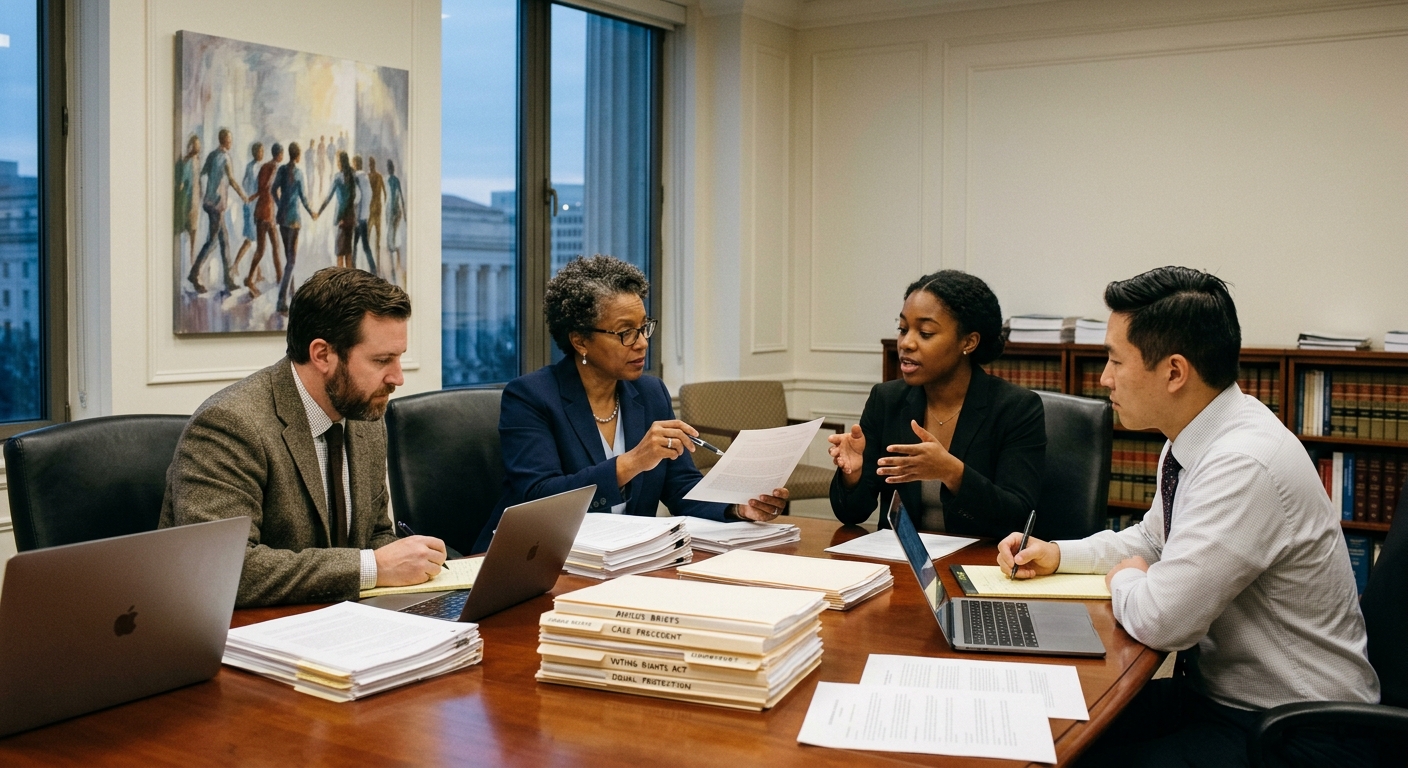
The landscape of American civil rights is undergoing a profound transformation, driven not by sweeping legislative reforms, but by a meticulously calculated series of legal challenges. For decades, policies such as affirmative action in higher education and the protective oversight mechanisms of the Voting Rights Act stood as institutional pillars aimed at addressing systemic inequalities. Today, these foundational structures are being dismantled through a coordinated litigation strategy that seeks to redefine the interpretation of equality under the United States Constitution. By leveraging a doctrine of strict “colorblindness,” specialized legal activists and advocacy organizations are succeeding in overturning decades of precedent, fundamentally altering how race can be considered in public life, education, and democratic participation. This shift highlights the power of the federal judiciary to shape civil rights and holds profound implications for the future of equity in America.
The Architecture of Modern Legal Activism
Rather than waiting for organic disputes to arise, modern legal movements actively construct “test cases” designed to challenge specific laws or policies at the Supreme Court level. This architecture of legal activism relies on the creation of non-profit organizations and legal defense funds that serve as carefully crafted vehicles for litigation. These entities identify vulnerable institutional policies, recruit sympathetic plaintiffs who have allegedly been disadvantaged by these policies, and secure the substantial, long-term funding required to litigate complex cases over many years.
The objective of these organizations is rarely to win a single localized settlement. Instead, the overriding goal is to secure appellate and Supreme Court rulings that set sweeping national precedents. By strategically filing lawsuits in federal districts with judges known to be sympathetic to their legal philosophies, these groups maximize the chances of their cases advancing favorably through the judicial hierarchy. The strategy often involves combing through immense volumes of institutional data to find statistical anomalies that can be portrayed as intentional discrimination, an approach that requires millions of dollars in expert testimony and statistical modeling. This highly effective methodology is now being heavily utilized to reverse race-conscious policies, arguing that any consideration of race—even for remedial or diversity purposes—inherently violates constitutional guarantees of equal protection.
Dismantling Affirmative Action: The Fall of Race-Conscious Admissions
For over forty years, the Supreme Court repeatedly upheld the constitutionality of affirmative action in higher education, consistently ruling that universities had a compelling educational interest in fostering a diverse student body. However, the legal landscape shifted dramatically and irrevocably with the culmination of two parallel, heavily funded lawsuits: Students for Fair Admissions (SFFA) v. Harvard and SFFA v. University of North Carolina.
These lawsuits posited that the admissions practices at both elite private and public universities unlawfully penalized certain groups, particularly Asian American applicants, in order to artificially boost the enrollment of other underrepresented minority groups. The plaintiffs argued that the University of North Carolina, as a state actor, violated the Equal Protection Clause of the Fourteenth Amendment, which mandates that no state shall deny to any person within its jurisdiction the equal protection of the laws. Simultaneously, they argued that Harvard University, as a private institution receiving federal financial assistance, directly violated Title VI of the Civil Rights Act of 1964.
In June 2023, the Supreme Court delivered a historic 6-3 decision in favor of the plaintiffs, effectively ending race-conscious college admissions nationwide. The majority opinion asserted that the admissions programs lacked sufficiently focused and measurable objectives warranting the explicit use of race and unavoidably employed race in a negative manner . This ruling overturned decades of established legal precedent and forced academic institutions across the country to rapidly overhaul their admissions frameworks in time for the next application cycle.
The Immediate Impact on Higher Education Enrollment
The institutional repercussions of the SFFA v. Harvard decision materialized swiftly across the higher education sector. Without the ability to explicitly consider race as one contextual factor among many in comprehensive admissions decisions, highly selective universities have experienced significant demographic shifts. According to early enrollment data from the classes entering in 2024 and beyond, the percentage of Black, Hispanic, and Native American students at many elite institutions has markedly declined.
A 2026 analysis of post-SFFA enrollment trends indicates that the end of race-conscious admissions has triggered a prominent “cascading effect.” High-achieving underrepresented minority students are increasingly enrolling in less selective institutions or state flagship universities, rather than highly selective elite colleges . This demographic shift is deeply concerning for educational equity advocates, as elite institutions often provide robust institutional financial aid, extensive alumni networks, and premier resources that significantly enhance socioeconomic mobility. While some universities have managed to mitigate these sharp declines through aggressive recruitment and holistic review adjustments, the overall trend points toward a more stratified higher education ecosystem where racial and ethnic diversity is increasingly concentrated outside of the nation’s most prestigious and well-resourced academic institutions.
Reinterpreting Title VI of the Civil Rights Act of 1964
At the heart of the legal argument against affirmative action in private institutions is Title VI of the Civil Rights Act of 1964. The original, historical intent of Title VI was to ensure that federal taxpayer dollars were not used to subsidize discriminatory practices. The statute explicitly states that no person in the United States shall, on the ground of race, color, or national origin, be excluded from participation in, be denied the benefits of, or be subjected to discrimination under any program or activity receiving Federal financial assistance .
Historically, this foundational statute was the primary tool used by the federal government to aggressively compel the desegregation of schools and public facilities in the Jim Crow South. Today, however, the statutory interpretation of Title VI has been entirely flipped by conservative legal strategists. They argue that any policy designed to explicitly assist historically marginalized racial groups by definition discriminates against individuals who do not belong to those specific groups. The Supreme Court’s endorsement of this strictly colorblind interpretation has weaponized Title VI against the very race-conscious equity programs it was originally conceived to support, opening the legal door for an avalanche of lawsuits against a wide array of diversity initiatives.
The Eroding Architecture of the Voting Rights Act
The strategic legal campaign against race-conscious policies is not remotely confined to the sphere of education; it extends deeply into the fundamental mechanisms of American democracy, most notably through sustained attacks on the Voting Rights Act (VRA) of 1965. For decades, the VRA served as arguably the most effective piece of civil rights legislation in American history, largely due to its robust “preclearance” requirement located under Section 5. This powerful provision required jurisdictions with a documented history of racial discrimination in voting to obtain federal approval from the Department of Justice before implementing any changes whatsoever to their election laws.
However, the legal movement pushing for constitutional colorblindness successfully challenged this oversight mechanism in the 2013 Supreme Court case Shelby County v. Holder. The plaintiffs argued that the specific coverage formula used to determine which states were subject to preclearance (Section 4(b)) was obsolete. The Supreme Court agreed, ruling in a 5-4 decision that the coverage formula was unconstitutional because it relied on decades-old data that did not accurately reflect current political realities and voter parity .
By striking down the coverage formula, the Court effectively immobilized Section 5. Almost immediately following the Shelby County decision, several states implemented stringent new voting laws, including strict voter identification requirements, aggressive voter roll purges, and the widespread closure of polling places in predominantly minority neighborhoods. This fundamentally shifted the legal burden of proof; rather than states having to prove their new laws were not discriminatory prior to implementation, civil rights organizations now face the arduous, expensive task of proving intentional racial discrimination after the restrictive laws have already taken effect.
Expanding the Battlefield: Corporate Diversity and Beyond
Emboldened by massive victories in higher education and voting rights, the legal apparatus driving these changes has aggressively expanded its focus to the private sector and philanthropic organizations. Corporate Diversity, Equity, and Inclusion (DEI) programs, which proliferated rapidly and gained widespread prominence in the early 2020s following national racial justice movements, are now facing a barrage of well-funded litigation. Using Section 1981 of the Civil Rights Act of 1866—a law originally passed during the Reconstruction era to ensure that formerly enslaved individuals had the same fundamental right to make and enforce contracts as white citizens—activists are challenging a wide array of corporate programs. These targets include corporate leadership fellowships, diverse hiring slates, specialized mentorship pipelines, and grants exclusively designed for minority-owned businesses.
The core legal argument asserts that any corporate program that explicitly reserves spots, financial resources, or professional opportunities for specific racial or ethnic groups constitutes an illegal, discriminatory contract. In response to these high-profile lawsuits and the underlying threat of massive litigation costs, many corporations are quietly dismantling their DEI initiatives, scrubbing race-based criteria from fellowship applications, and rapidly rebranding their efforts to focus on broader, entirely race-neutral definitions of diversity.
Navigating the Future of Institutional Diversity
As the legal avenues for explicitly considering race continue to narrow across all sectors of public and private life, institutions across the United States are desperately searching for legally permissible alternatives to foster and maintain diversity. In higher education, universities are increasingly relying on socioeconomic factors, such as household income, first-generation college student status, and granular geographic location data, to build diverse incoming classes. Some institutions are massively expanding recruitment efforts in historically underserved rural and urban ZIP codes to organically widen their applicant pools.
Additionally, there is a growing, bipartisan movement to eliminate admissions practices that have historically and disproportionately favored wealthy, overwhelmingly white applicants, such as legacy preferences and early decision binding programs. By removing these systemic, generational advantages, universities hope to naturally level the playing field without relying on explicit racial classifications that run afoul of the Supreme Court’s new directives. However, early data suggests that while socioeconomic affirmative action can significantly improve class and geographic diversity, it remains an imperfect proxy for race and often fails to fully replicate the racial diversity achieved under prior policies. The coming years will serve as a crucial testing ground to determine whether these race-neutral strategies can sustain inclusive environments in an increasingly restricted and heavily litigated legal landscape.
Frequently Asked Questions
- What was the core issue in Students for Fair Admissions v. Harvard?
The core issue was whether the consideration of race in college admissions violated the Equal Protection Clause of the 14th Amendment and Title VI of the Civil Rights Act. The Supreme Court ultimately ruled that the race-conscious admissions programs at Harvard and UNC were unconstitutional because they lacked measurable objectives and utilized race in a stereotypical manner. - How did the Shelby County v. Holder decision affect voting rights?
The 2013 Shelby County v. Holder decision struck down Section 4(b) of the Voting Rights Act, which contained the historical formula determining which specific jurisdictions required federal “preclearance” before changing their voting laws. This ruling allowed states with past histories of discrimination to implement new election laws without obtaining prior federal approval. - Are corporate diversity, equity, and inclusion (DEI) programs illegal now?
While the SFFA v. Harvard ruling specifically targeted higher education admissions, its strict underlying legal reasoning is being actively used to challenge corporate DEI programs under other civil rights statutes, such as Section 1981. Consequently, to minimize severe legal risks, many organizations are quickly restructuring their internal programs to be entirely race-neutral.
References
- The complex ramifications of Students for Fair Admissions v. Harvard — Brookings Institution. 2026-04-27. https://www.brookings.edu/articles/the-complex-ramifications-of-students-for-fair-admissions-v-harvard/
- Civil Rights Division | The Shelby County Decision — Department of Justice. 2023-11-17. https://www.justice.gov/crt/about/vot/sec_5/shelby.php
- Title VI of the Civil Rights Act of 1964 — Department of Justice. 2025-03-24. https://www.justice.gov/crt/fcs/TitleVI
- Research Notes: Affirmative Action Ban Reduces Minority Student Enrollment at Top Universities — FutureEd. 2026-03-24. https://www.future-ed.org/research-notes-affirmative-action-ban-reduces-minority-student-enrollment-at-top-universities/
Similar Articles








Read full bio of medha deb


