
Convert Sole Proprietorship To LLC: 7-Step Checklist
Unlock liability protection and growth potential by transforming your sole proprietorship into a robust LLC structure.
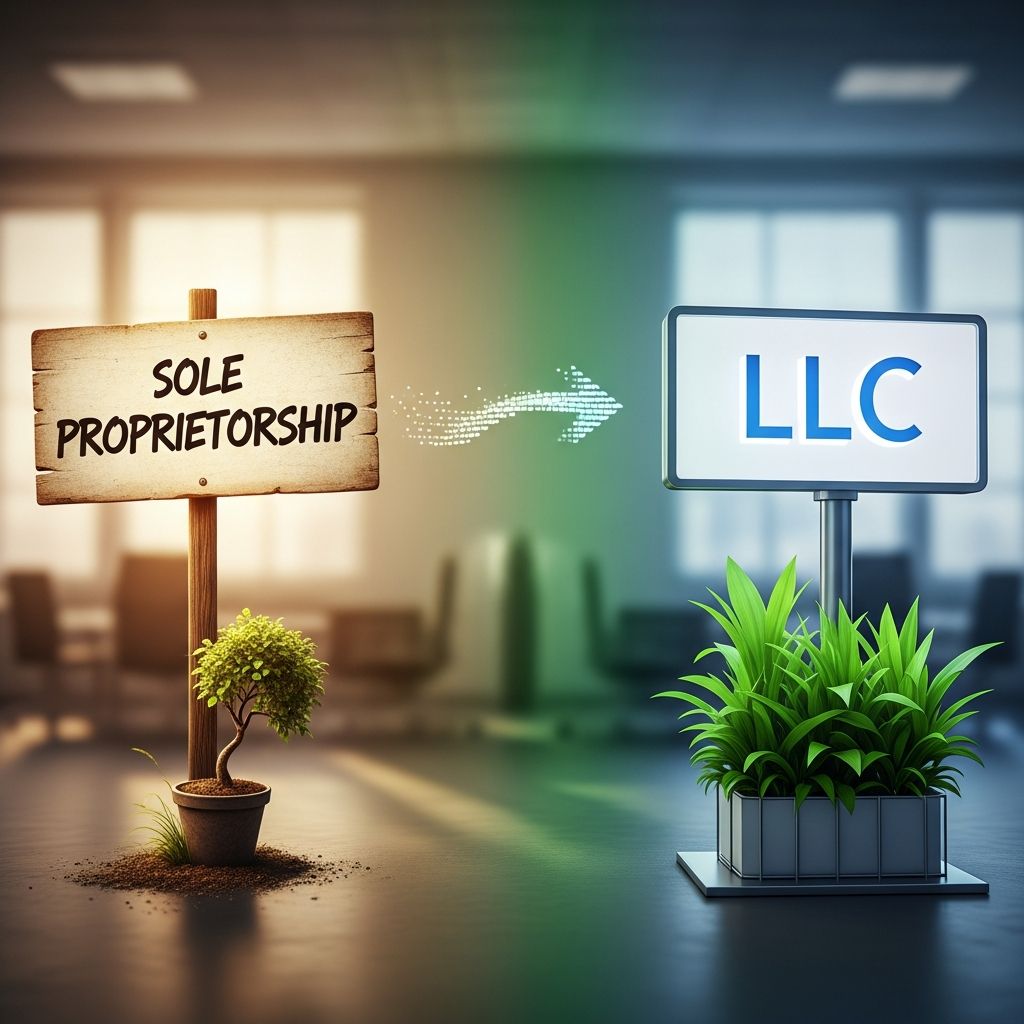
Transforming a sole proprietorship into a limited liability company (LLC) offers entrepreneurs a strategic upgrade in business structure. This shift provides
limited liability protection
, separating personal assets from business debts, while maintaining operational flexibility. Unlike sole proprietorships, where owners bear unlimited personal liability, LLCs shield individuals from lawsuits and creditor claims against the business.Why Make the Switch? Key Advantages of LLC Formation
The decision to convert often stems from the need for greater security and scalability. Sole proprietorships expose owners to full personal liability for business obligations, including debts and legal judgments. An LLC changes this dynamic by creating a legal entity that stands apart from its owner.
- Asset Protection: Creditors can only pursue LLC assets, not personal savings or property.
- Tax Continuity: Single-member LLCs (SMLLCs) are disregarded entities for federal taxes, allowing Schedule C reporting like a sole proprietorship.
- Credibility Boost: LLC status enhances professionalism, aiding in securing loans, contracts, and partnerships.
- Flexibility for Growth: Easily add members to shift to partnership taxation without dissolving the entity.
Statistics from the U.S. Small Business Administration indicate over 30 million small businesses operate as sole proprietorships, many ripe for LLC conversion as they scale. However, weigh costs like filing fees (typically $50-$500 per state) against these benefits.
Legal and Structural Differences Explained
A
sole proprietorship
is the simplest business form: no formal registration beyond local licenses, with the owner and business as one legal entity. Profits pass directly to the owner’s personal tax return via Schedule C.In contrast, an
LLC
is a hybrid entity combining corporate liability limits with partnership-like taxation. Single-member LLCs default to disregarded status under IRS rules, meaning no separate tax return unless electing corporate treatment via Form 8832. Multi-member LLCs are taxed as partnerships by default.| Aspect | Sole Proprietorship | Single-Member LLC |
|---|---|---|
| Liability | Unlimited personal | Limited to business assets |
| Tax Filing | Schedule C (personal return) | Same as sole prop (disregarded) |
| Formation | Minimal/none | Articles of organization + operating agreement |
| Costs | Low | State fees + potential legal help |
Step-by-Step Process to Convert Your Business
Conversion varies by state but follows a core sequence. Always consult state-specific statutes via the Secretary of State’s office.
- Choose and Verify Business Name: Ensure availability and compliance with state rules (e.g., include ‘LLC’). Cancel any DBA if conflicting.
- Appoint a Registered Agent: Designate a person or service for legal notices, often the owner.
- File Articles of Organization: Submit to your state’s business division with details like name, address, and agent. Fees range from $40 in Kentucky to $500 in Massachusetts.
- Draft an Operating Agreement: Outline ownership, management, and profit-sharing. Essential for single-member LLCs to reinforce limited liability.
- Obtain EIN: Apply via IRS Form SS-4, even if previously unnecessary. Required for banking and taxes if electing corporate status.
- Transfer Assets and Update Records: Assets automatically vest in the LLC post-filing for disregarded entities; no tax event occurs. Update bank accounts, contracts, licenses, and insurance.
- Handle Licenses and Permits: Reapply under the LLC name where required.
For states allowing statutory conversion, a single filing may suffice; otherwise, form a new LLC and merge assets.
Tax Ramifications: What Owners Need to Know
Tax treatment is a primary concern. For SMLLCs, the IRS disregards the entity, so income flows to your personal return unchanged. Self-employment taxes apply identically.
Key pitfalls include:
- At-Risk Recapture: If liabilities exceed basis post-conversion, previously deducted losses may be recaptured as income. Example: A proprietor with $25,000 at-risk on a $100,000 loan recognizes $75,000 gain upon LLC assumption relieving personal liability.
- Multi-Member Shift: Adding owners triggers partnership taxation (Form 1065), potentially altering self-employment tax.
- Accounting Methods: SMLLCs inherit the owner’s method (often cash-basis); partnerships may require accrual if large.
Electing C-corp or S-corp status via Form 8832 or 2553 changes this, offering potential deductions but added complexity. Consult a CPA for basis calculations and elections.
Potential Challenges and How to Avoid Them
Conversions aren’t without hurdles. State laws differ: California requires biennial statements; Delaware offers anonymity.
Common issues:
- Liability Transfer Traps: Ensure debts are properly assumed to avoid personal guarantees persisting.
- Partnership Misclassification: Factors like joint control or shared profits could reclassify an SMLLC as a partnership.
- Costs Accrual: Beyond filing ($100 avg.), budget for legal ($500+), EIN (free), and updates ($200+).
Mitigate by using formation services for compliance or attorneys for complex assets.
Real-World Example: Retail Shop Conversion
Consider Jane, owner of a boutique sole proprietorship with $50,000 inventory, $20,000 cash, and $30,000 bank loan (personal guarantee). She files articles in Texas, drafts an operating agreement, gets a new EIN, and transfers assets. Tax-wise, no gain recognized as disregarded; liability shifts to LLC. Jane now enjoys protection if sued over a slip-and-fall, with taxes unchanged.
Frequently Asked Questions
Does converting trigger taxes on assets?
No, for disregarded SMLLCs; assets are deemed continuously owned by the proprietor.
Can I keep my existing EIN?
Generally no; apply for a new one for the LLC.
What if I add a partner later?
The LLC becomes a partnership; file Form 1065 and consider liability impacts.
Is an operating agreement mandatory?
Not always legally required but highly recommended for liability proof.
How long does the process take?
1-4 weeks, depending on state processing.
Next Steps for Success
Post-conversion, maintain separate finances, annual reports, and records. This structure positions your business for investment, expansion, or sale. For tailored advice, engage a business attorney or tax professional familiar with your state.
References
- Converting a sole proprietorship to an LLC — The Tax Adviser (AICPA). 2024-02-01. https://www.thetaxadviser.com/issues/2024/feb/converting-a-sole-proprietorship-to-an-llc/
- Converting a Sole Proprietorship or Partnership to a SMLLC — Nolo. Accessed 2026. https://www.nolo.com/legal-encyclopedia/converting-sole-proprietorship-partnership-single-member-llc.html
- Can You Change a Sole Proprietorship to an LLC? — LegalZoom. Accessed 2026. https://www.legalzoom.com/articles/can-you-change-a-sole-proprietorship-to-an-llc
- Single member limited liability companies — Internal Revenue Service. Accessed 2026. https://www.irs.gov/businesses/small-businesses-self-employed/single-member-limited-liability-companies
Similar Articles








Read full bio of Sneha Tete


