
Contracts for Goods vs. Services: Legal and Practical Differences
Understand how contracts for goods and contracts for services differ in law, structure, risk, and enforcement so you can draft better business agreements.
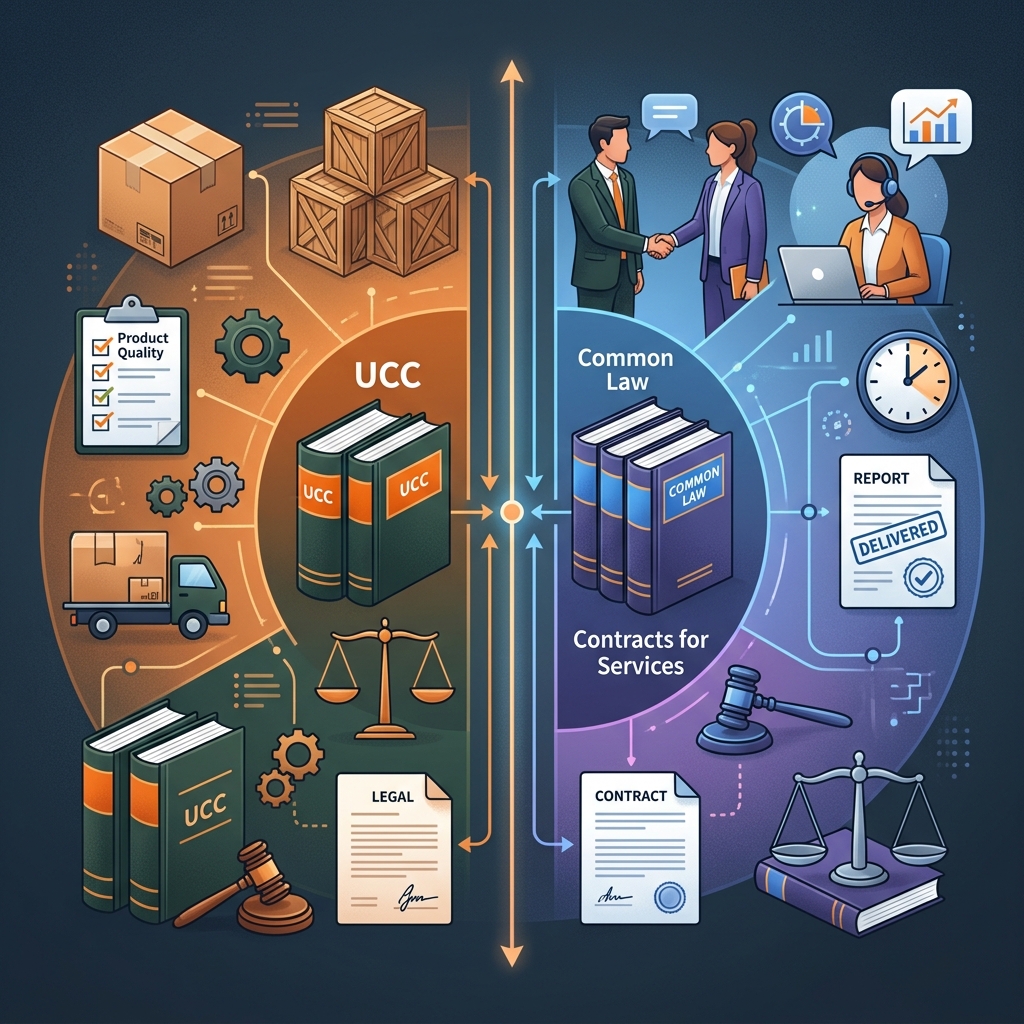
Businesses routinely buy and sell both products and professional services, but the contracts that govern these transactions are not all the same. Understanding when you are dealing with a contract for the sale of goods versus a contract for services is crucial for compliance, risk management, and effective dispute resolution.
This guide explains how goods and services contracts differ under the law, what typical terms they include, how mixed agreements are handled, and how you can structure clear, enforceable agreements for your business relationships.
1. Core Definitions: Goods vs. Services in Contract Law
Before looking at legal rules, it helps to clarify what counts as a good and what counts as a service in commercial contracting.
1.1 What is a Contract for the Sale of Goods?
In most U.S. states, contracts for goods are governed by Article 2 of the Uniform Commercial Code (UCC). Article 2 defines goods as movable items identified to the contract at the time of sale. This includes manufactured products, raw materials, and other tangible items.
- Tangible and movable: Goods are physical items that can be moved, such as inventory, equipment, or materials.
- Transfer of ownership: A goods contract primarily focuses on transferring title (ownership) of those items from seller to buyer.
- Price in money: The buyer agrees to pay a monetary price for the goods.
In many common law jurisdictions, this concept is reflected in statutes like the Sale of Goods Act, which frames a sale as a contract whereby the seller transfers or agrees to transfer property in goods to the buyer for a monetary price.
1.2 What is a Contract for Services?
A contract for services is focused on the performance of tasks or the application of skill and expertise rather than on delivering a physical product.
- Intangible performance: Services are activities, work, and expertise provided to the client rather than goods that can be stored or resold.
- Common law governance: In the U.S., service contracts are typically governed by general contract law (common law and relevant state statutes) rather than the UCC.
- Focus on skill and effort: The client pays for the provider’s labor, knowledge, or professional judgment.
Some jurisdictions explicitly define services broadly. For example, Virginia law defines services as any activity performed for financial gain, including personal services, leasing, and licensing.
2. Legal Frameworks: UCC vs. Common Law
The most significant legal distinction between goods and services contracts is the set of rules that apply to each. These rules affect formation, performance, remedies, and enforceability.
| Aspect | Contract for Goods | Contract for Services |
|---|---|---|
| Primary legal source | UCC Article 2 (sale of goods) | Common law contracts and specific statutes |
| Subject matter | Movable, tangible items identified to the contract | Tasks, labor, skill, professional services |
| Key focus | Transfer of title and conformity of goods | Performance quality, standards of care, completion |
| Default rules | Detailed statutory rules on delivery, risk of loss, warranties, remedies | Case law principles on breach, damages, and interpretation |
| Statute of Frauds | UCC writing requirements for certain goods contracts | General contract Statute of Frauds rules, varies by jurisdiction |
Because goods contracts have extensive statutory guidance, many issues—such as implied warranties, delivery terms, and buyer remedies—are addressed even if the contract is silent. Service agreements rely more heavily on case law and the parties’ explicit terms, making careful drafting particularly important.
3. Typical Structure of a Contract for Goods
While every agreement is unique, contracts for the sale of goods tend to share common elements that reflect the UCC framework and commercial practice.
3.1 Core Elements
- Identification of the parties: Names and legal status of the buyer and seller.
- Description of goods: Detailed specifications, model numbers, quantities, quality standards, and any special manufacturing requirements.
- Price and payment terms: Unit price, total price, payment schedule, invoicing procedures, and acceptable payment methods.
- Delivery obligations: Delivery location, timing, shipping method, and allocation of shipping costs.
- Risk of loss and title transfer: When ownership and risk pass from seller to buyer (e.g., shipment vs. destination contracts).
3.2 Quality, Inspection, and Acceptance
Goods contracts often address how the buyer will confirm that the goods meet the contract standards.
- Conforming goods: Goods must match contract specifications; nonconforming goods may be rejected or require cure under UCC rules.
- Inspection rights: Buyers typically have a right to inspect goods before accepting them, and may condition acceptance on inspection.
- Acceptance and rejection procedure: Contracts can set timelines and processes for acceptance, rejection, or revocation of acceptance.
3.3 Warranties and Remedies
UCC Article 2 provides a framework for warranties and remedies, which contracts can supplement or modify.
- Express warranties: Specific promises about quality, performance, or compliance.
- Implied warranties: Depending on jurisdiction, implied warranties of merchantability and fitness for a particular purpose may apply unless disclaimed.
- Remedies: Replacement, repair, price adjustment, or damages for breach, often aligning with UCC remedies.
4. Typical Structure of a Contract for Services
Service agreements are shaped more by common law and the nature of the work than by a single statute, but certain clauses appear in most well-drafted contracts.
4.1 Defining Scope and Performance
Clarity around what the provider will do is the foundation of any services contract.
- Scope of work: Detailed description of services, deliverables, timelines, milestones, and performance standards.
- Standard of care: Expectations regarding professional skill, industry standards, or specific performance levels.
- Change management: Mechanisms to modify scope, pricing, or deadlines if the client requests additional work.
4.2 Payment and Billing
Unlike many goods contracts that specify a fixed price for physical items, service contracts often use more varied fee structures.
- Fixed-fee arrangements: A lump sum for a defined project or phase.
- Hourly or daily rates: Fees based on time spent, often with estimates or caps.
- Retainer or subscription models: Regular payments for ongoing availability or recurring services.
- Expense reimbursement: Terms for reimbursable travel, materials, or other costs.
4.3 Risk, Liability, and Intellectual Property
Because services often involve professional judgment, data, and creative work, contracts typically address liability and IP ownership explicitly.
- Warranties and disclaimers: Limited warranties on service quality and explicit exclusions for outcomes outside the provider’s control.
- Limitation of liability: Caps on damages and exclusions for indirect or consequential losses, where permitted by law.
- Insurance requirements: Professional liability, general liability, and other coverage obligations for the service provider.
- Intellectual property ownership: Who owns reports, designs, software, or other outputs; whether rights are assigned or licensed to the client.
5. Mixed Contracts: Goods and Services in One Deal
Many commercial relationships involve both goods and services—for example, selling equipment with installation, or software licenses bundled with maintenance and support. Courts must determine which legal framework applies.
5.1 The Predominant Purpose Test
U.S. courts often use the predominant purpose test (or dominant factor test) to classify mixed contracts.
- If the primary objective of the transaction is to obtain goods, with services being incidental (such as basic installation), the contract is treated as a goods contract, applying UCC Article 2.
- If the primary objective is to obtain services, with goods being incidental (such as tools or materials used in the work), common law rules for services apply.
This classification affects rights, remedies, and implied protections. For example, a predominantly goods contract may trigger UCC implied warranties, while a predominantly services contract may not.
5.2 Practical Drafting Approaches for Hybrid Deals
Businesses can reduce uncertainty in mixed contracts by addressing goods and services explicitly.
- Separate sections: Create distinct parts of the contract for goods-related terms and services-related terms.
- Choice of law and framework: State whether the parties intend UCC Article 2 to apply to goods portions and common law to services portions (subject to enforceability).
- Clear pricing allocations: Break out pricing for goods and services to support classification and accounting.
6. Performance, Breach, and Remedies Compared
Goods and services contracts handle performance obligations and remedies for breach in different ways, reflecting their underlying legal frameworks.
6.1 Performance and Partial Completion
- Goods contracts: Performance is usually tied to delivering conforming goods, on time and to the correct location, with proper documentation.
- Service contracts: Performance is assessed based on the completion of agreed tasks, adherence to standards of care, and meeting specified milestones.
Partial performance can be treated differently. UCC rules may allow cure of defective goods or require acceptance of conforming installments, while common law may consider material breach or substantial performance depending on the circumstances.
6.2 Remedies for Breach
When one party fails to meet its obligations, the available remedies depend on the type of contract and governing law.
- Goods contracts (UCC): Buyer and seller remedies include cover (obtaining substitute goods), price adjustments, rejection, revocation of acceptance, and damages measured under UCC formulas.
- Service contracts (common law): Remedies typically include expectation damages (putting the injured party in the position as if the contract were performed), restitution, and specific performance in limited cases.
- Force majeure and impossibility: Both types of contracts may include clauses addressing unforeseen events, with doctrines like impracticability or frustration of purpose sometimes applying.
7. Key Drafting Tips for Businesses
Whether your agreement concerns goods, services, or both, careful drafting can prevent disputes and clarify expectations.
7.1 When Drafting Contracts for Goods
- Use precise descriptions of goods, including quality standards and technical specifications.
- Define delivery terms and risk of loss clearly (e.g., shipment vs. destination, Incoterms where applicable).
- Address inspection, acceptance, and rejection procedures, including timelines.
- Clarify warranties and any limitations or disclaimers in compliance with UCC and consumer protection laws.
- Specify remedies and limitation of liability, ensuring they align with statutory requirements.
7.2 When Drafting Contracts for Services
- Define scope of work in detail, avoiding vague phrases that invite disputes.
- Set measurable performance standards and milestones that can be objectively assessed.
- Describe payment structures, billing cycles, and conditions for payment or non-payment.
- Include appropriate liability limitations and insurance obligations suited to the type of service.
- Clearly address intellectual property ownership, licensing, and confidentiality obligations.
7.3 General Best Practices
- Ensure the contract is in writing when required by the applicable Statute of Frauds.
- Identify governing law and dispute resolution mechanisms (e.g., courts, arbitration).
- Review contracts against relevant statutes and case law or consult legal counsel for complex or high-value transactions.
8. Frequently Asked Questions (FAQs)
8.1 How do I know if my contract is for goods or for services?
Look at what the buyer primarily seeks to obtain. If the main objective is to acquire physical, movable items, the contract is likely for goods and governed by UCC Article 2 in many U.S. jurisdictions. If the main objective is professional work, expertise, or an activity—such as consulting, design, or maintenance—the agreement is typically a services contract governed by common law.
8.2 Can one contract cover both goods and services?
Yes. Many commercial agreements cover both types. Courts often apply the predominant purpose test to determine whether UCC or common law rules govern the contract as a whole. To reduce uncertainty, businesses can explicitly separate goods and services provisions and clarify how each is treated in the contract.
8.3 Why does it matter which legal framework applies?
UCC Article 2 provides specific rules on warranties, risk of loss, remedies, and commercial practices for goods. Service contracts do not have a single equivalent statute, so common law principles and the parties’ negotiated terms play a larger role. Knowing which framework applies helps you predict outcomes in case of breach and draft appropriate protections.
8.4 Are all service contracts outside the UCC?
Generally, yes. UCC Article 2 is limited to contracts for the sale of goods. Pure service contracts—such as legal representation, consulting, or repair services—are governed by general contract law and any applicable professional regulations, not by Article 2.
8.5 Do goods and services contracts both require consideration?
Yes. Under general contract principles, both goods and services agreements require consideration—something of value exchanged between the parties, typically payment in money. Without consideration, the agreement may not be enforceable as a contract.
References
- Contracts for Services vs. Goods: What’s the Difference? — Rocket Lawyer. 2023-06-01. https://www.rocketlawyer.com/business-and-contracts/business-operations/product-or-service-sales/legal-guide/contract-for-goods-vs-contract-for-services
- Contract for Services: Key Terms, Clauses, and Examples — UpCounsel. 2022-09-15. https://www.upcounsel.com/what-is-a-contract-for-services
- Contracts for Services Distinguished from Those to Sell Goods — Fordham Law Review. 1950-01-01. https://ir.lawnet.fordham.edu/cgi/viewcontent.cgi?article=1300&context=flr
- Contracts for Services Vs. for the Sale of Goods — Griffith Davison. 2020-11-10. https://www.griffithdavison.com/contracts-for-services-vs-for-the-sale-of-goods/
- Sales of Goods vs. Services under Virginia Contract Law — McClanahan Powers. 2017-03-30. https://www.mcplegal.com/sales-goods-services-virginia/
- Difference Between Sales and Services — LawTeacher. 2013-05-01. https://www.lawteacher.net/free-law-essays/commercial-law/difference-between-sales-and-services-commercial-law-essay.php
Similar Articles








Read full bio of medha deb


